Invest
Titled riad or melkia in Marrakech: the 7 essential checks before buying
You have just viewed a beautiful riad in Marrakech Medina.
The courtyard is stunning, the location ideal and the price particularly attractive.
But the owner tells you that the property is being sold under melkia deeds.
Is this a property opportunity to seize or a legal risk to avoid?
Conversely, is a riad with a registered land title automatically a secure investment?
The answer is no in both cases.
In Marrakech, a riad's land tenure status is one of the first matters to check before acquisition.
A property may be architecturally outstanding and perfectly located, yet have legal complications that make its purchase, renovation or resale more difficult.
These complications can sometimes cost far more than the works originally planned.
In this guide, explore the differences between a titled riad and a riad held under melkia deeds, the seven essential checks, the risks to anticipate and lessons from our operations in Derb Boumba and the Kasbah.
Our aim: to help you invest in a riad in Marrakech with an understanding of the risks before committing your capital.
Titled riad or melkia: what is the difference?
Before buying a riad in Marrakech Medina, you need to understand the two legal situations frequently encountered.
The titled riad: a property registered with the Land Registry
A titled riad has a land title established through Morocco's land registration system.
This title officially identifies the property and the rights recorded against it.
It provides an essential legal basis for checking ownership and certain entries affecting the property.
Consulting land records can, in particular, help identify:
- The registered owner.
- Any mortgages.
- Attachments or other registered entries.
- Certain encumbrances or restrictions.
Please note: a land title does not guarantee that the buildings have the necessary permissions, that the structure is sound or that tourist accommodation operations are possible.
Legal analysis must therefore be supplemented by administrative and technical checks.
Melkia: unregistered ownership
In everyday Moroccan property transactions, melkia refers to ownership established by traditional deeds, generally drawn up by adouls, without a definitive registered land title.
The ownership may be legally valid.
Verifying it requires a thorough examination of the deeds, the chain of ownership and the position of those holding rights over the property.
Complications may concern, in particular:
- Inheritance.
- Undivided co-ownership.
- Property boundaries.
- Continuity of the deeds.
- Identification of all persons entitled to rights.
A melkia property is therefore not necessarily a poor purchase. It does, however, require particular legal vigilance.
Why do investors often favour titled riads?
For a French, Belgian or Swiss investor, a land title generally provides greater clarity.
Ownership is identified in an official register, making certain checks easier and potentially simplifying financing or resale procedures.
A titled riad may also be easier to present to a bank, although obtaining credit depends on other criteria.
However, legal clarity does not mean an absence of risk.
Imagine a titled six-room riad in Marrakech.
The seller presents an ownership certificate. You might think that the acquisition is immediately secure.
Yet several questions remain unanswered:
- Does the seller hold all the rights they intend to transfer?
- Is there a mortgage, an attachment or another registered entry?
- Does the actual area match the available documents?
- Were the alterations to the building authorised?
- Can the riad legally be operated as a guesthouse?
A land title is therefore an important step towards a secure purchase, but never a substitute for due diligence.
Check no. 1: identify the true owner
This is the absolute priority.
Before paying a deposit or signing any commitment, you must establish who legally holds the rights over the property.
For a titled riad, the notary can carry out the necessary checks with the Agence Nationale de la Conservation Foncière, du Cadastre et de la Cartographie (ANCFCC), Morocco's national land registry, cadastre and mapping agency.
For a melkia property, checks generally require an examination of the ownership deeds and their continuity.
In particular, inheritance transfers must be traced and anyone who may hold rights identified.
Inheritance risks
In the Medina, some riads belong to several members of the same family.
A property may have been passed down through several generations.
The person arranging the viewing is therefore not necessarily the only person entitled to sell.
Undivided co-ownership may require the consent of several rights holders.
Darnel advice: never rely solely on a verbal statement. Have the sellers' legal capacity confirmed by the professional responsible for securing the transaction.
Check no. 2: examine the land documents
The documents to examine vary according to the riad's legal status.
| Titled riad | Melkia riad |
|---|---|
| Land title references | Melkia deeds |
| Recent ownership certificate | Chain of ownership deeds |
| Registered entries and encumbrances | Any inheritance documents |
| Available plans and documents | Identification of rights holders |
| Consistency of areas | Boundary and possession checks |
This table is a starting point, not an exhaustive list.
For a melkia property, the nature of the deeds and the procedures required must be assessed case by case.
Further investigations may be necessary, particularly if land registration is being considered.
This procedure must never be regarded as automatic.
Some cases also require examination of specific land-related rights, notably zina. Ownership of the building and rights over the land must be analysed by the appropriate professionals.
Experience from the Kasbah project: our operation involved several melkia deeds and negotiations with different owners. One seller's refusal to formalise the sale led to court proceedings, which ended in our favour but prolonged the process of securing the documentation. Specific steps relating to zina were also necessary. This experience is a reminder that land tenure risks can delay works and tie up capital.
It depends, in particular, on the legal situation, the property boundaries, any objections and the applicable formalities.
Planning to buy a riad in the Medina?
Before committing, have the location, hospitality potential, works and matters requiring attention assessed for referral to the appropriate professionals.
Book my Darnel Collection advisory appointment →
Check no. 3: does the advertised area reflect reality?
Here is an often underestimated issue.
You view a riad advertised as having a 150 m² footprint.
Does this area match the ownership documents, the actual footprint or simply the seller's estimate?
Buildings in the Medina sometimes have complex layouts.
Party walls, passageways, annexes, terraces and successive alterations can make floor areas difficult to interpret.
For an investor, a difference of a few square metres can have a considerable impact.
It can change the feasible number of rooms, courtyard size, circulation space or the possibility of creating a spa.
Before buying, engage a qualified professional to check the areas and the building's configuration.
For a melkia property, identifying the boundaries may require further investigations.
Our recommendation: never value a riad solely on the area stated in a property advertisement.
Check no. 4: do the existing works have the necessary approvals?
A riad may be titled while still having alterations whose administrative status needs to be checked.
This is particularly important when the building has undergone extensive renovation.
A terrace may have been fitted out, rooms added or a pool built.
But did these alterations receive the necessary permissions?
The heritage, planning and safety constraints applicable to the property must also be checked.
In some cases, remedial works or alterations may be necessary to regularise the situation.
These expenses can completely change the financial balance of your acquisition.
Practical advice: before finalising the budget, ask an architect familiar with the Medina's constraints to compare the plans, the existing building and the available permissions.
Check no. 5: can the riad be operated as a guesthouse?
This is an essential question for an investor seeking to generate tourism income.
Owning a riad does not automatically give you the right to operate it as a guesthouse.
Tourist accommodation operations are subject to a specific administrative framework.
In particular, the proposed establishment category, the permissions required, technical requirements and safety conditions must be examined.
A four-room riad is not necessarily subject to the same constraints as a ten-suite boutique hotel.
A practical example
You are considering acquiring a riad to create six rooms.
After analysis, you discover that the building's layout only allows four rooms meeting regulatory and commercial requirements.
Your accommodation capacity falls by one third.
Your financial forecast may then change substantially.
This is why hospitality feasibility must be checked before the business plan is finally approved.
Check no. 6: can the melkia riad obtain a registered land title?
Registration of an untitled property may be considered in certain situations.
But its feasibility, duration and cost must be assessed by the appropriate professionals.
The procedure may require supporting documents, boundary demarcation, public notice formalities and the handling of any objections.
A distinction must be made between compiling the file, submitting the land registration application, boundary surveying, public notice formalities, dealing with any objections and obtaining the definitive title. An application is not a registered land title.
It would therefore be unwise to assume that a melkia property can invariably obtain a registered land title within a few months.
Experience from Derb Boumba: Darnel Collection is developing a project on a plot of approximately 97 m² acquired under melkia deeds. Planning permission has been obtained and land registration procedures are ongoing. We have factored regularisation costs, professional involvement and potential delays into the project structure. The definitive title is not presented as already obtained. This experience shows that legal analysis and economic feasibility must progress together.
Why does this question matter?
Because the investor may wish to finance the acquisition, secure long-term ownership or prepare for resale.
The absence of a registered land title can complicate some of these objectives.
Before buying a melkia property with the intention of registering it, request a written assessment of feasibility and the main risks.
An attractive purchase price should never compensate for legal uncertainty that you do not understand.
Case study: two six-room riads in Marrakech
Imagine two fictional opportunities with comparable hospitality potential.
Riad A: a titled property offered at 550 000 €.
Riad B: a melkia property offered at 480 000 €.
At first sight, the second would offer a saving of 70 000 €.
But the asking price is only part of the investment.
Financial comparison
| Assumption | Riad A titled | Riad B melkia |
|---|---|---|
| Acquisition price | 550 000 € | 480 000 € |
| Simulated acquisition costs at 8 % | 44 000 € | 38 400 € |
| Forecast works | 120 000 € | 120 000 € |
| Provision for formalities and contingencies | 5 000 € | 35 000 € |
| Indicative total budget | 719 000 € | 673 400 € |
In this simulation, the melkia riad retains a budget advantage of 45 600 €.
The hidden cost of delays: a hypothetical six to twelve-month delay in land formalities can tie up more capital, create additional costs and postpone tourism receipts. The business plan must compare several scenarios without assuming the actual timeframe.
But this saving must be weighed against the potential risks.
The 35 000 € provision is a risk management assumption, not an official land registration fee.
Likewise, the 8 % acquisition costs are an illustrative budgeting convention. Actual costs depend on the transaction.
If an objection, an inheritance complication or an inability to deliver the hospitality project arises, the financial comparison may cease to be relevant.
Which riad should you choose?
There is no universal answer.
The titled riad may offer greater legal clarity.
A melkia property may be attractive if rights are clearly established, the transaction can be secured and the price adequately compensates for the residual risks.
The best investment is not necessarily the cheapest riad. It is the one whose risk matches your strategy and your capital.
Five mistakes to avoid before signing
Certain mistakes recur regularly in property acquisitions in Marrakech.
Mistake 1 Paying a deposit too early. Do not commit financially without appropriate legal checks.
Mistake 2 Overlooking inheritance. Check that everyone whose consent to the sale is required has been identified.
Mistake 3 Assuming that a melkia property will be easy to register. The procedure can be complex and its outcome must be assessed.
Mistake 4 Buying before checking room feasibility. A six-room programme may not be achievable.
To limit these risks, we recommend involving the appropriate professionals before any irreversible commitment.
Have you identified a riad to buy?
Darnel Collection can help you assess its property and hospitality potential, in coordination with legal and technical professionals.
Request a project analysis appointment →
Check no. 7: financing and resale, two questions to anticipate
A property investment should not be assessed only at the time of purchase.
Its financing and future resale must also be considered.
The absence of a registered land title can considerably complicate bank financing, particularly where a mortgage over the property is required as security. Possibilities depend on the bank, other security and the investor's application.
Resale deserves the same attention. A future buyer may want a clear registered land title, consistent permissions and complete technical documentation.
A property with uncertainties may attract fewer buyers or lead to additional negotiations.
This does not mean a melkia property cannot be sold.
It means that its liquidity and marketability may depend more heavily on the quality of the legal file.
A sound investment should be planned from the outset with an exit strategy.
Why is land tenure status alone insufficient to determine profitability?
A riad with a perfectly valid registered title can become a poor investment if its acquisition price is excessive.
Conversely, a legally complex property whose acquisition is properly secured may have attractive economic potential.
Profitability depends, in particular, on the capital committed, the number of rooms, the average rate, occupancy and operating costs.
Profitability example: a six-room riad
Consider a riad marketed at 130 € per night, with 70 % occupancy.
Its theoretical gross accommodation revenue would be:
6 × 365 × 130 € × 70 % = 199 290 € per year.
This figure is not profit.
Commissions, staff, operating costs, management, taxes and other expenses still have to be deducted.
It must also be confirmed that the six rooms can legally be created and operated.
This is why we recommend building the business plan after checking the project's main legal and technical characteristics.
Also explore our profitability study for a four-room riad in Marrakech in 2027.
The Dar Léon & Spa simulator uses its own project assumptions, distinct from the comparative simulation above.
The Darnel Collection approach before investing
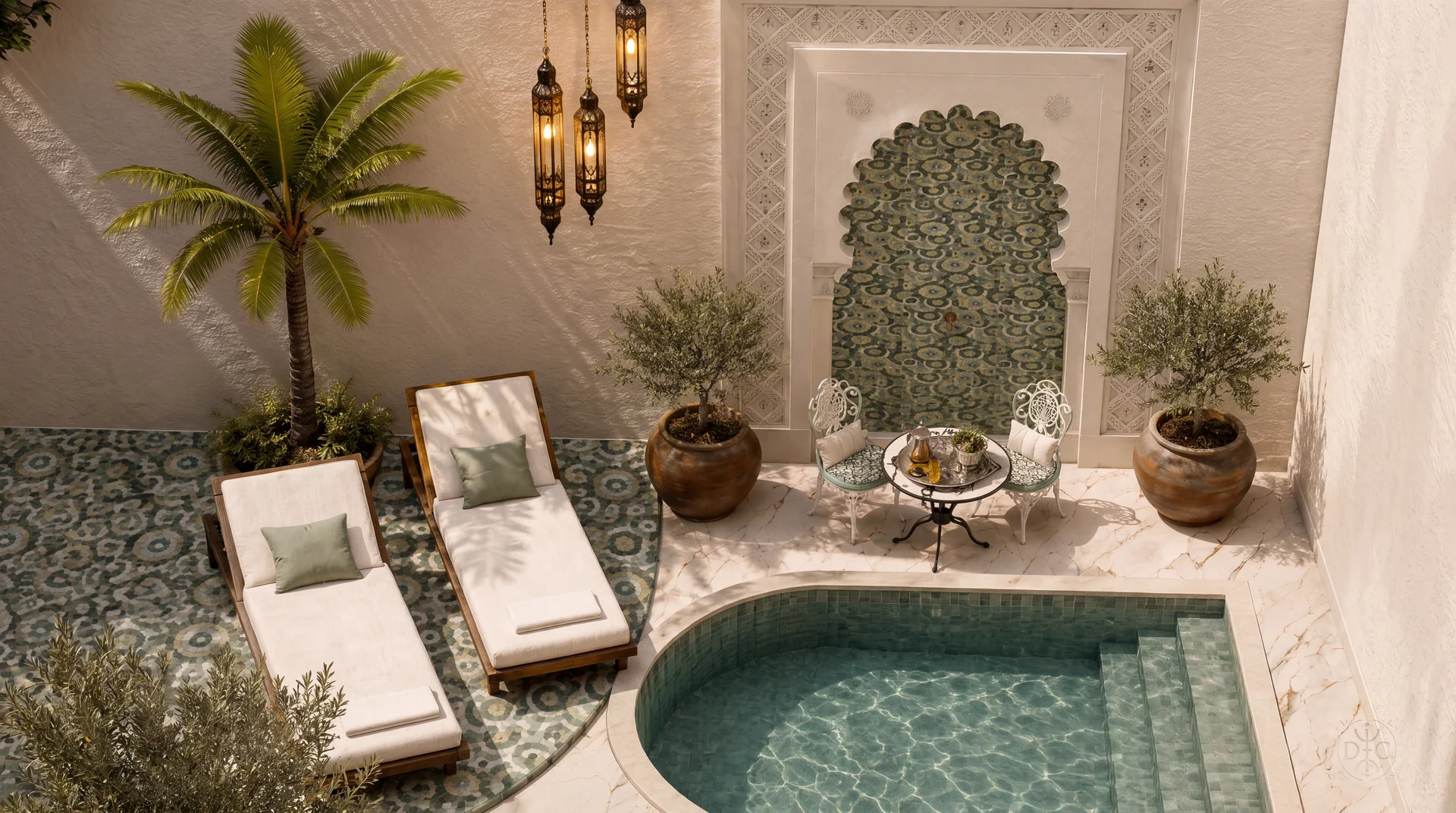
INVESTMENT CASE — DAR LÉON & SPA
4 rooms • Bab Doukkala • Riad & Spa
Dar Léon & Spa illustrates our approach: designing characterful riads by combining architecture, guest experience and hospitality operations.
This project provides for four rooms, a private spa and approximately 200 m² of total floor area.
Discover Darnel Collection projects →
Our approach in three dimensions
At Darnel Collection, we assess the property project in relation to its future hospitality use.
We examine positioning, layout, potential works and economic potential.
For legal matters, checks must be carried out by a notary, a lawyer or authorised professionals, depending on the situation.
For structural matters, compliance and works, the involvement of an architect and, where necessary, an engineering consultancy is essential.
This coordination enables a decision based on several complementary analyses.
Our conviction: the right time to discover a risk is before buying, never afterwards.
FAQ Buying a titled or melkia riad in Marrakech
Can you legally buy a riad under melkia deeds?
An acquisition may be possible, subject to checking the seller's rights, the deeds and the legal conditions of the transaction.
Is a titled riad automatically secure?
No. A registered land title guarantees neither compliance of the works nor permission to operate tourist accommodation.
Can a melkia property obtain a registered land title?
Registration may be possible, but it depends on the property's situation and the applicable procedures.
How long does it take to obtain a land title for a melkia property in Marrakech?
There is no universal timeframe: it depends on the file, boundary surveying, formalities and any objections.
What are the land registration costs?
They depend on the formalities, the professionals involved and the file; official fees must be distinguished from a risk provision.
Can a bank finance a melkia property?
Possibilities depend on the bank, security and the application. Prior checks with lenders are necessary.
What is the first document to request?
For a titled property, a recent ownership certificate is essential. For a melkia property, the deeds and their chain of transfer must be examined by a competent professional.
Prepare your investment in Marrakech
Join the Darnel Collection Private Club →
Conclusion: should you favour a titled riad or a melkia property in Marrakech?
If you are looking for an acquisition whose land tenure situation can be checked more directly, a titled riad may be a simpler option to assess.
But a registered land title does not replace administrative and technical checks.
A melkia property may also offer an opportunity, provided ownership rights, any inheritance matters, property boundaries and the prospects for registration are rigorously examined.
In both cases, check the feasibility of your hospitality project before signing.
The real objective is not simply to buy a riad in Marrakech. It is to acquire an asset whose rights, constraints, costs and economic potential you understand.
At Darnel Collection, we support investors in the analysis, design and development of their riad and boutique hotel projects in Marrakech.
Book my Darnel Collection strategic appointment →
Georges Lelièvre — Darnel Collection
This article provides general information for investors and does not constitute legal advice. The rules, documents and formalities applicable to each case must be confirmed by a professional qualified in Moroccan law.