
Investing
7 mistakes that can turn buying a riad in Marrakech into a bad investment
Before buying a riad, weigh your first impressions against the total project cost, hotel concept and realities of operating the property.
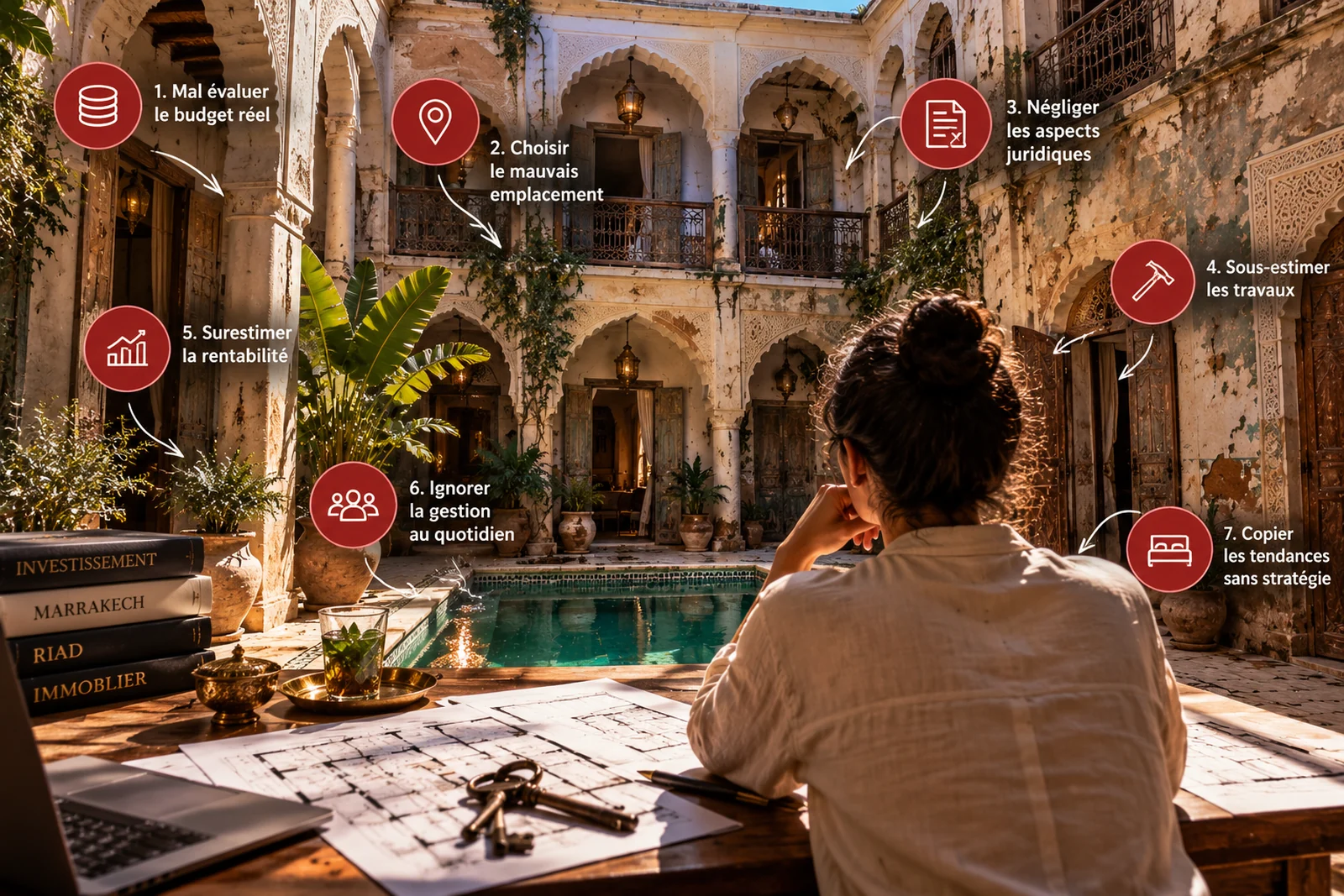
Buying a riad in Marrakech often begins with an emotional response.
You push open a door in the Medina. Behind an almost anonymous wall, you discover a sunlit courtyard, a few orange trees, traditional zellige tiles, a fountain and a rooftop overlooking the city.
It is very easy to start imagining yourself there straight away.
Yet there is a considerable difference between falling in love with a riad and making a successful hospitality investment.
Marrakech’s tourism performance can reinforce that sense of opportunity. By the end of May 2026, the city’s classified tourist accommodation establishments had recorded 6.05 million overnight stays, up 10% year on year. Marrakech accounted for around 33% of Morocco’s classified overnight stays and recorded an average occupancy rate of 72% over the first five months of the year. Source: Maroc.ma.
These figures are encouraging.
But a destination’s performance never guarantees the performance of an individual property.
Two riads a few hundred metres apart can deliver radically different results depending on their acquisition price, layout, renovation work, positioning, room count, average daily rate (ADR), reputation and quality of operations.
A magnificent riad can become a poor investment.
Conversely, a building that seems far less impressive on the first visit can become an outstanding hospitality asset after a carefully planned transformation.
Before searching for the most beautiful riad in Marrakech, you should therefore look for the best possible project for your capital.
Here are the seven mistakes we consider particularly important to avoid before buying a riad in Marrakech.
The crucial mistake is to calculate returns on the purchase price alone. In our illustrative example, the €370,000 acquisition becomes €600,000 in total capital with works, furniture, equipment, fees, launch and working capital. A hypothetical annual result of €60,000 therefore represents 10% of the capital committed, rather than approximately 16% of the purchase price. This is not an observed performance or a guarantee.
Before buying, follow the checks in the guide to buying a riad in Marrakech. To distinguish revenue, earnings and cash flow in your forecast, continue with our analysis of riad operating costs and profit.
Mistake no. 1: Letting emotion lead before looking at the numbers
This is probably the easiest mistake to make in the Medina.
You can fall in love with a property in minutes.
The business plan takes much longer.
Imagine a riad is offered to you for €370,000.
At first glance, you might consider your investment to be €370,000.
But that figure is only the beginning.
You may also need to add acquisition costs, technical surveys, an architect, renovation work, decoration, furniture, equipment, the creation of a spa, professional equipment, photography, a website, the commercial launch and a cash reserve.
Consider this simple example:
- Purchase price: €370,000
- Renovation: €140,000
- Furniture and equipment: €40,000
- Fees, studies and launch: €30,000
- Opening cash reserve: €20,000
Your €370,000 project then becomes €600,000 of committed capital.
That is the amount against which you should start assessing the project’s real profitability.
If the property generates €60,000 in annual profit, the return is not 16% against the €370,000 price quoted during the viewing.
Measured against the €600,000 actually invested, it falls to 10%.
That simple change in the denominator can completely alter your investment decision.
We therefore recommend never asking only:
“How much does this riad cost?”
Instead, ask: “How much will this riad have cost me by the time it is genuinely ready to welcome its first guest?”
To explore this approach, read our guide to the costs to budget for when buying a riad in Marrakech.
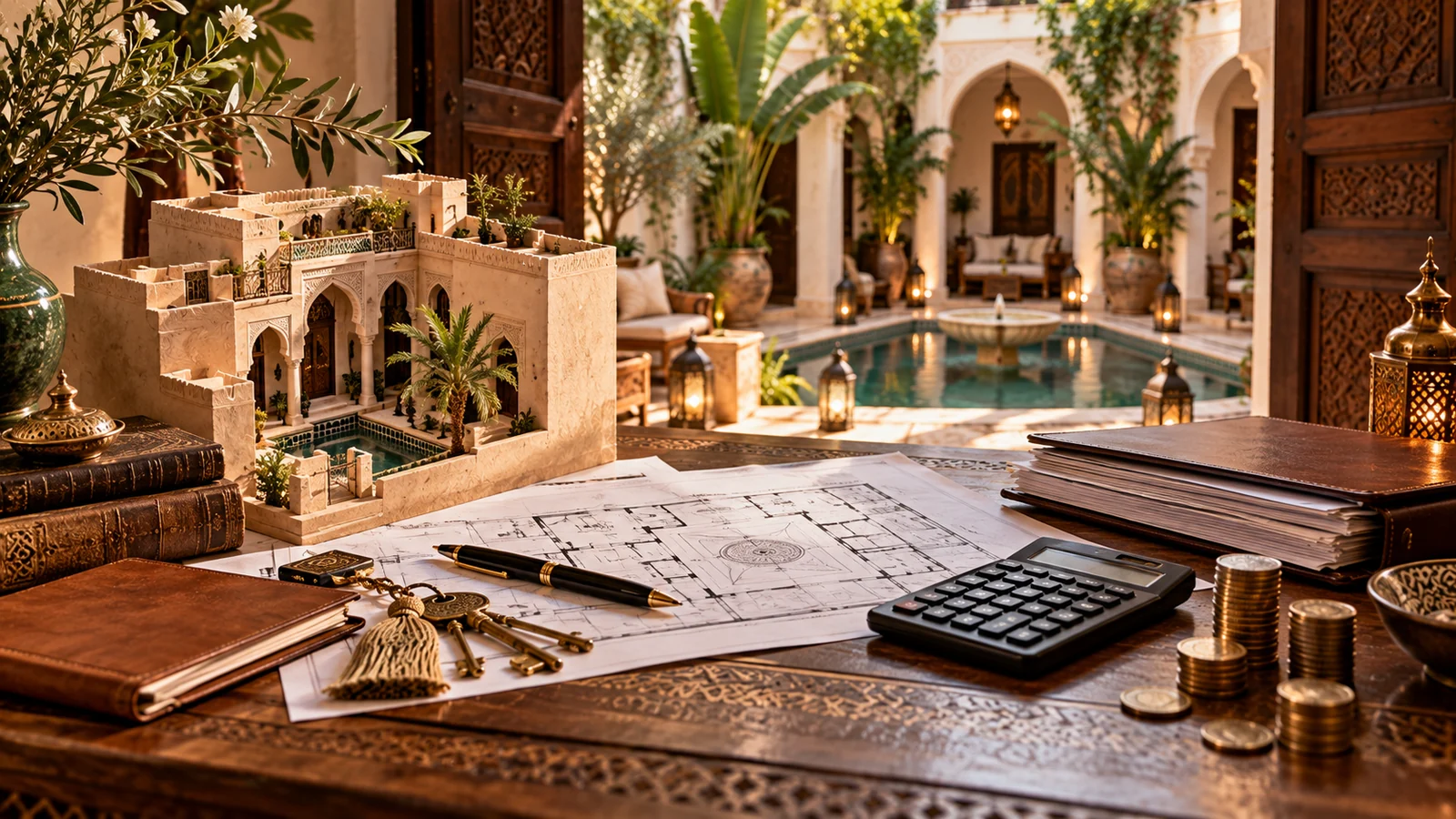
A riad’s potential cannot be judged solely by how it looks on the first visit.
Mistake no. 2: Looking at the purchase price without calculating the completed project cost
This mistake is closely related to the first, but deserves its own discussion because it can severely distort comparisons between properties.
Consider two riads.
Riad A
- Purchase price: €350,000
- Estimated renovation: €185,000
Before furniture and other costs are even included:
€535,000
Riad B
- Purchase price: €440,000
- Estimated renovation: €65,000
Subtotal: €505,000.
In the property listing, Riad A appeared to be €90,000 cheaper.
After renovation, however, it becomes €30,000 more expensive in our simulation.
We have not yet factored in possible differences in timing, lost revenue during renovation or the risk of budget overruns.
That is why the completed project cost is a much more useful concept than the advertised price alone.
The right question is not: Which riad is cheapest?
It is: How much must I invest in each property to create the hospitality product I actually want to bring to market?
A building requiring more work can still be very attractive if the transformation creates more value.
But that value creation must be calculated.
For further reading, see our analysis of the cost of renovating a riad in Marrakech.
Mistake no. 3: Choosing the wrong building for your hotel concept
Not every beautiful riad makes a good hotel.
And not every good property suits your business plan.
Suppose your financial model requires six rooms.
You buy a magnificent building.
After an architectural study, you discover that only four rooms can realistically meet the size, comfort and quality standards required by your concept.
You may have bought a very beautiful property.
But you have not bought the right operating asset.
That distinction is fundamental.
Before acquiring the building, you should already be considering circulation routes, room locations, rooftop access, staff working areas, kitchen organisation, linen storage, arrivals and departures, and which spaces might generate additional revenue.
If your model depends on a spa, that question must be asked before buying.
The same applies to a restaurant, a swimming pool, a large family suite or a rooftop that can be used commercially.
The building should serve the concept.
Not the other way around.
One of the most expensive mistakes is buying a riad and then asking the architect:
“Now, how can we fit my business plan into this building?”
We prefer to reverse the question: “Here is the business plan. Which building will allow us to deliver it under the best conditions?”
This is also why it helps to understand the different neighbourhoods of Marrakech’s Medina before investing: the hospitality product, budget and target clientele should also fit the location.
Have you already identified a riad in Marrakech?
Before negotiating or building your entire project around the property, it can help to assess its price, layout, potential room count and your hotel concept together.
During an advisory appointment with Darnel Collection, we can review your initial project assumptions with you: total budget, acquisition, renovation, room count, positioning, achievable ADR, additional revenue and potential value creation.
REVIEW MY PROJECT WITH DARNEL COLLECTION →
An initial conversation to identify the questions to resolve before committing your capital.
Mistake no. 4: Renovating before defining your future guests
Choosing zellige tiles, lighting or bedroom colours before defining the hotel’s positioning is rather like starting a book with its final chapter.
Before discussing decoration, ask yourself:
Who are we creating this place for?
A romantic four-suite riad aimed mainly at European couples will not be designed in exactly the same way as an eight-room family guesthouse.
A premium boutique hotel targeting an ADR of €300 will also have different requirements from a property aiming to sell its rooms at €100.
The target clientele influences practically everything: room sizes, bedding quality, shared spaces, the spa, dining, acoustics, services, furniture, photography and the way the stay is marketed.
This thinking is particularly important as Morocco strengthens its quality framework for tourist accommodation.
Since May 2026, a mystery-guest inspection programme has covered, among other properties, riads and guesthouses classified at three stars and above. Assessment no longer focuses only on infrastructure: it examines the guest journey, from booking and reception through to dining, cleanliness and the overall experience. According to the ministry, the assessment grids contain between 235 and 387 criteria, depending on the type and category of establishment. Source: Maroc.ma.
In other words, the guest experience is more than a marketing layer added to a beautiful building.
It is part of the hospitality product.
A property designed solely to look beautiful on Instagram can therefore be very different from one designed to earn excellent reviews, retain guests and sustain its average room rate over time.
Mistake no. 5: Overestimating revenue and underestimating costs
This is probably the mistake most likely to turn an attractive business plan into an unpleasant surprise.
Consider a seven-room riad.
Assume:
- ADR: €140
- Occupancy: 65%
The theoretical room revenue would be:
7 × 365 × 65% × €140
That is approximately €232,500 in annual room revenue.
Add dining, transfers, massages and experiences, and it becomes relatively easy to build a forecast exceeding €250,000 in revenue.
On a spreadsheet, the project can look excellent.
But revenue is not profit.
You will need to pay for staff, consumables, energy, upkeep, linen, guest amenities, OTA commissions, payment fees, software, insurance, marketing, advertising campaigns, maintenance and other operating costs.
You also need to consider taxation, any financing and the eventual replacement of equipment.
A business plan should therefore always include several sets of assumptions.
Conservative scenario
What happens with occupancy of only 50%?
Base scenario
What happens if your main assumptions are achieved?
Strong-performance scenario
What is the potential if the property gradually increases its ADR, occupancy and additional revenue?
Above all, also ask the uncomfortable questions:
What happens if ADR is 20% lower?
What happens if renovation costs are 15% higher?
What happens if opening is delayed by three months?
A good business plan is not one that looks extraordinary when everything goes perfectly.
It is one that remains acceptable when several assumptions become less favourable.
To explore these calculations, you can also read our article on riad profitability in Marrakech.
Now test your own project
You have just seen why the purchase price alone is not enough.
The best way to understand this approach is now to replace our examples with your own assumptions.
DARNEL COLLECTION SIMULATOR
Estimate your riad’s profitability in Marrakech.
Estimate your riad’s profitability
Loading exchange rates…
Rates provided by ExchangeRate-API · Updated daily ·
Occupancy: +5 percentage points/year up to 90%, then +2.5 percentage points/year up to 95%.
Estimate based on the purchase price alone. Renovation costs, acquisition fees and financing are excluded from the return calculation.
Your 5-year projection
Version 4 · Exchange rates updated daily · Updated on 6 October 2026
| Year | Occupancy | Nightly rate | Additional sales | Annual revenue | Operating profit | After corporate tax | Return |
|---|
Understanding the assumptions and calculations
Operating profit is set at 45% of total revenue, meaning total operating expenses are estimated at 55%. Corporate tax is simulated at 20% of positive operating profit, without modelling depreciation, deductions or the project’s specific tax regime. Profit after corporate tax is not a calculation of cash flow after financing.
The average room rate per night increases by 7.5% per year, compounded. Occupancy increases by 5 percentage points per year up to 90%, then by 2.5 percentage points per year up to 95%: 60%, 65%, 70%… 90%, 92.5%, 95%. Additional sales increase by 5 percentage points per year up to 30% of room revenue, then by 2.5 percentage points per year, with no projection cap. If an increase crosses a threshold, it stops at that threshold for the year in question (examples: 88% → 90%; 28% → 30%). The operating margin remains constant.
The return equals annual profit after corporate tax divided by the purchase price. No return on equity is calculated. Owners may replace the purchase price with the reference value they wish to analyse.
Indicative conversions are updated automatically from ExchangeRate-API, with a 24-hour local cache. The rates’ publication date is displayed above the inputs. If the service is unavailable, the latest available rates are retained and flagged. Current rates are used to convert all projection years; they do not predict future exchange rates. Displayed amounts are rounded; calculations use unrounded values.
Indicative, non-binding simulation. These assumptions do not guarantee future performance or the applicable tax treatment.
Give your riad the means to achieve these results
Discuss your project and the drivers of its profitability with Darnel Hospitality.
Book an advisory appointmentHow should you use the result?
Never treat the percentage shown as a promise of profitability.
Use it as a stress-testing tool.
Run an initial simulation using your base assumptions.
Then try again with a lower ADR.
Next, reduce occupancy.
Increase your acquisition price.
You will quickly see which variables make your project particularly sensitive.
That is precisely the simulator’s purpose: to understand the conditions required for your investment to break even, rather than to predict the future.
This simulation is indicative and non-binding. A project’s results depend in particular on the total cost actually committed, renovation, financing, taxation, expenses, marketing and operating performance.
INVESTMENT CASE | DAR LÉON & SPA
A Darnel Collection project provides a concrete illustration of this approach.
Dar Léon & Spa, in Bab Doukkala, is conceived as a four-room collection riad with a courtyard and pool, rooftop and wellness area.
The aim is not to create as many rooms as possible within the building.
It is to develop a coherent product in which architecture, experience and operations are considered together.
The project illustrates a central idea in this article: a riad’s economic potential cannot be reduced to its number of keys. An extra room may be worthwhile, but not if creating it damages the proportions, shared spaces or overall positioning of the property.
Three key figures
- 4 rooms
- MAD 6,000,000 stated project price, approximately €550,000 on an indicative basis
- 12-month projected turnkey delivery
These features and timings relate to the project as presented and do not constitute a guarantee of hospitality performance.
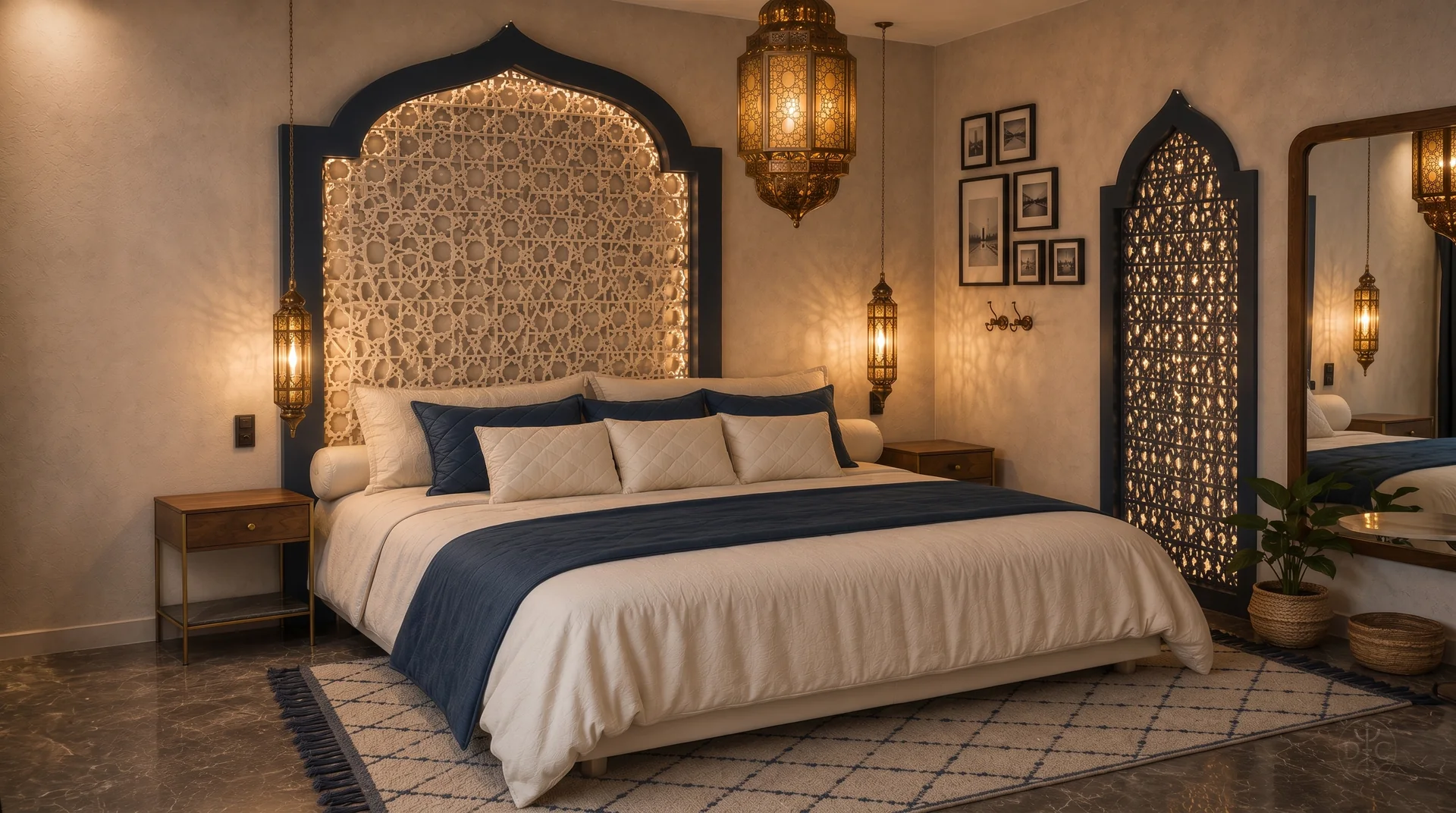
INVESTMENT CASE — DAR LÉON & SPA
4 rooms • Bab Doukkala • Collection Riad & Spa
Mistake no. 6: Assuming Booking will automatically fill the riad
You have found the building.
You have renovated it.
The rooms are magnificent.
A photographer has taken beautiful pictures.
You list the property on Booking and Airbnb.
Now what?
This is precisely where a second profession begins: hospitality management.
A riad needs distribution, pricing, photography, a story and marketing.
You need to manage availability, adjust rates, build reviews, work on Google visibility, create content, run social media, optimise the website and gradually build a customer base.
Excessive dependence on online travel agencies (OTAs) can also weigh heavily on profitability.
Consider a property generating €250,000 in room revenue.
If 80% of that business comes through platforms with an assumed average distribution cost of 18%, that would represent:
€250,000 × 80% × 18%
€36,000 in annual commissions.
Over five years, with activity unchanged: €180,000.
This does not mean you should eliminate OTAs. Booking and other platforms are extremely powerful distribution channels.
The aim is to gradually build a more balanced distribution mix.
Some business through OTAs.
Some through the website.
Some through organic search.
Some through social media, recommendations, returning guests, agencies and partnerships.
Direct bookings are not free either. They require a brand, an effective website, content, a CRM, search optimisation and sometimes advertising.
But they help build something a Booking listing cannot create by itself: your own commercial asset.
Property acquisition and the operating strategy should therefore ideally be considered from the beginning of the project.
For more on this subject, read our guide to operating a tourist riad in Marrakech.
Mistake no. 7: Focusing only on annual returns and forgetting the asset’s future value
There is one final, less obvious mistake.
Focusing solely on annual returns.
A good hospitality investment should ideally produce two forms of value:
income during ownership
and
a more attractive asset when it is sold.
Imagine two properties each generating €300,000 in revenue.
The first depends almost entirely on OTAs, has a weak identity, few direct bookings and no real customer database.
The second has an established brand, thousands of qualified contacts, excellent reviews, repeat guests, an effective website and an increasing share of direct bookings.
On a spreadsheet limited to annual revenue, they may look quite similar.
To a future buyer, however, they tell very different stories.
The second property has something extra: a commercial capability that can outlast its owner.
We therefore believe a riad project should be built around three mutually reinforcing dimensions: the property, which is the physical asset;
operations, which turn square metres into income; and the brand, which gradually helps sustain pricing, reputation and a direct relationship with guests.
When all three progress together, you begin to build a true hospitality asset.
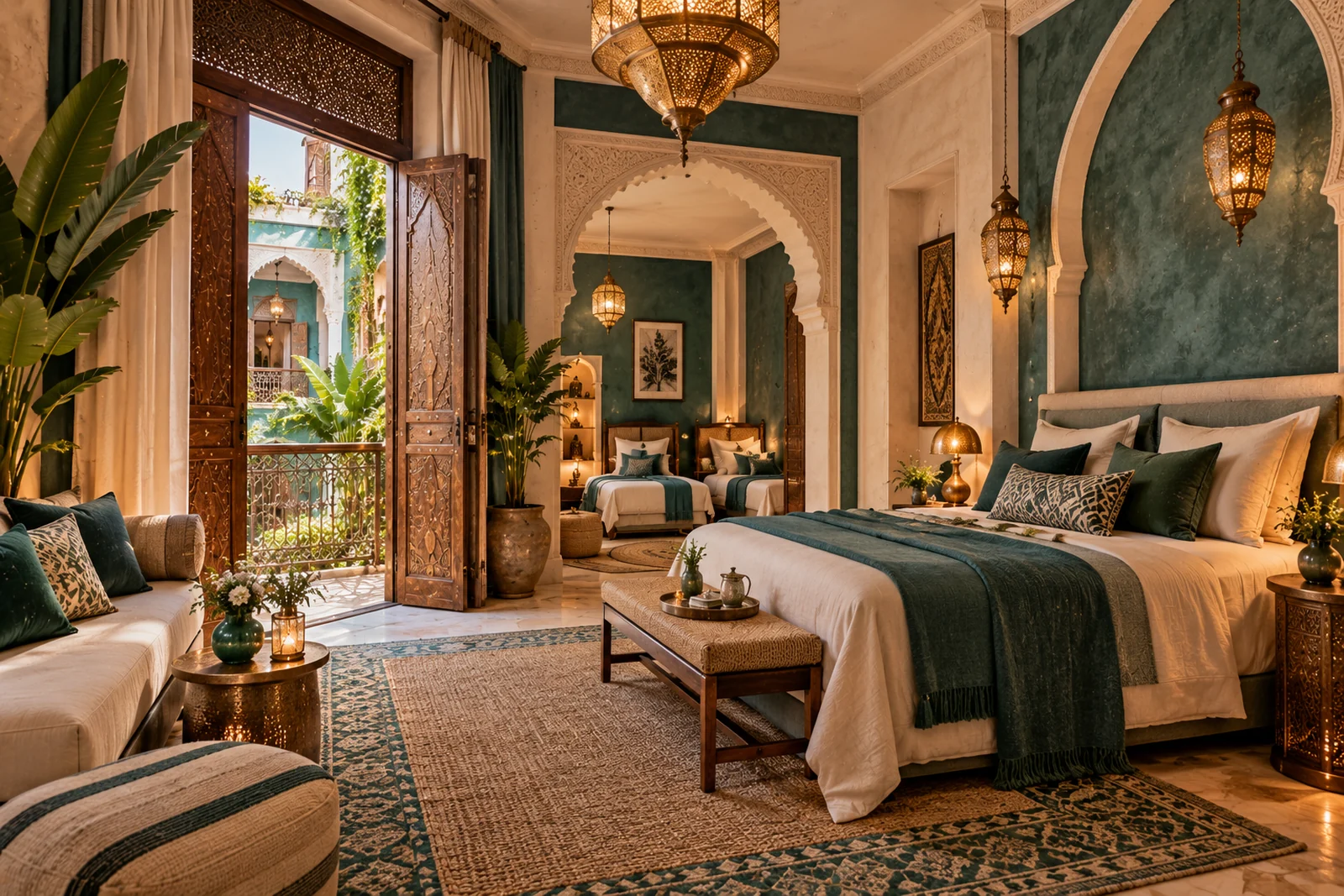
An eighth mistake to avoid: investing in Marrakech without understanding your wider life plans
For some investors, buying a riad remains a purely asset-focused decision.
For many others, it marks the beginning of a broader project.
Moving to Morocco.
Starting a business.
Changing the pace of life.
Developing a tourism activity.
Or dividing their time between Europe and Marrakech.
These decisions have tax, wealth, professional and personal implications that go far beyond choosing a building.
That is precisely why we have devoted a book to this subject.
Réussir sa nouvelle vie au Maroc
A practical guide to settling, investing and prospering in Morocco.
If your riad project is part of a wider plan to relocate to or invest in Morocco, this book will help you explore the subject further.
DISCOVER THE BOOK ON AMAZON →
Darnel’s Private Investors Club
Have you not yet found your riad, but want to keep learning about the market before investing?
Join the Darnel Collection Private Investors Club free of charge.
We share our analysis of the riad and boutique hotel market, case studies, new Darnel Collection projects, opportunities and content on acquisition, renovation and operations.
JOIN THE PRIVATE CLUB FOR FREE →
Free access · Unsubscribe at any time.
FAQ: Buying a riad in Marrakech
Is buying a riad in Marrakech still worthwhile in 2026?
Marrakech benefits from strong tourism momentum. By the end of May 2026, the city’s classified establishments had recorded 6.05 million overnight stays, up 10% year on year. Source: Maroc.ma.
This does not mean every riad is a good investment. The acquisition price, completed project cost, positioning and quality of operations remain decisive.
What budget do you need to buy a riad in Marrakech?
There is no single budget. The neighbourhood, floor area, condition of the building, room count and level of renovation can substantially change the investment required. Above all, you should think in terms of the total completed project budget, rather than the acquisition price alone.
Should you buy a renovated riad or one that needs work?
Both strategies can make sense. A riad to renovate makes it easier to design a concept around your business plan, but increases construction risk, timelines and the period for which capital is tied up. An already renovated property may allow you to start operating sooner, but can cost more to acquire.
How much can a riad earn?
Revenue depends mainly on room count, average nightly rate, occupancy and additional income. A property can also develop dining, spa services, transfers, experiences or exclusive-use bookings.
Revenue must never be confused with the profit actually available to the investor.
What occupancy rate should you use in your business plan?
It is better to build several scenarios than rely on a single assumption. Conservative, base and strong-performance scenarios help measure how sensitive the project is to changes.
How much should you allow for contingencies?
There is no universal percentage that applies to every riad. Structural condition, renovation requirements, finish quality and construction complexity all substantially affect risk. A contingency budget should be planned before buying, rather than after the budget has been exceeded.
Do you need to create a brand for your riad?
It is not a legal requirement for operating accommodation, but commercially a strong identity can help the property stand out, sustain its ADR and attract more direct bookings.
Should you have a riad assessed before buying it?
For a significant investment, it makes sense to combine legal, property-title, technical, architectural, financial and hospitality expertise. The aim is to understand what you are buying, what you can create and what the future property will need to generate to justify the investment.
Before buying a riad, invest in your business plan first
Ultimately, the best way to avoid a poor investment is to reverse the usual approach.
Do not start by finding a riad and then looking for something to do with it.
Start by defining the hospitality product you want to create.
Which guests?
How many rooms?
What quality level?
What target ADR?
Which services?
What additional revenue?
What maximum budget?
What return are you seeking?
And what value do you want to build over five or ten years?
Once your answers are sufficiently developed, look for a building that can accommodate that project.
An emotional connection still matters.
Marrakech and its riads are precisely the kind of investments in which emotion plays a considerable role.
But emotion should make you want to visit.
The numbers should give you a reason to sign.
Have a concrete project? Let’s look at your numbers.
Have you already defined your budget, identified a riad or started assessing several opportunities in Marrakech?
This is exactly the point at which an outside perspective can be useful.
During an advisory appointment with Darnel Collection, we can assess the economic logic of your project: acquisition price, renovation budget, room count, concept, positioning, potential ADR, additional revenue and value creation.
The goal is not to promise you a return.
It is to help you ask the right questions before committing your capital.
Compare my purchase price, total cost and assumptions →
Or speak with us directly on WhatsApp.
Continue your investment journey
Investing in a riad in Marrakech in 2026: the complete guide
Explore the full investment journey, from finding a property to operating it.
How much do you really need to invest in a riad in Marrakech in 2026?
Compare different budget levels and what they mean for your project.
How much does it cost to renovate a riad in Marrakech?
Understand renovation work, budgets and their implications for the project.
About the author
Georges Lelièvre
Founder — Darnel Group
Through Darnel Collection and Darnel Hospitality, Georges Lelièvre develops an approach to investing in riads and boutique hotels in Marrakech that combines property, hotel concept development, marketing and operations.
His approach assesses a project not only through its purchase price, but also through its total cost, hospitality potential, ADR, occupancy, additional revenue and ability to create long-term value.
The financial examples and simulations in this article are educational and do not constitute a guarantee of returns. Currency conversions are indicative. Every investment project requires legal, property-title, technical, tax and financial analysis appropriate to its circumstances.