
Property investment in Marrakech
How Much Do You Really Need to Invest in a Riad in Marrakech in 2026? 4 Costed Scenarios
From a small douria to renovate to a distinctive boutique hotel: four simulations comparing invested capital, revenue and indicative returns.
Do you need 3, 5, 10 or 20 million dirhams to invest in a riad?
This is probably one of the first questions an investor interested in Marrakech asks.
The budget depends on the programme: our four simulations range from MAD 3 million for a small douria to MAD 25 million for a ten-room boutique hotel. These figures illustrate total capital, rather than the purchase price alone; the associated revenues and returns are Darnel assumptions, not observed results.
The market currently includes riads offered for less than MAD 2 million (≈ €182,000) and others priced well above MAD 10 million (≈ €909,000). The euro equivalents in this article are rounded estimates based on an indicative exchange rate of €1 = MAD 11.
On 2 October 2026, an aggregator listed 292 riads for sale in Marrakech’s Medina, with a median asking price of MAD 6.34 million (≈ €576,000) and around MAD 34,806/m² (≈ €3,164/m²). Source
But that median brings together very different properties.
A separate review in August 2026 of nine listings with both price and floor area available found values ranging from MAD 14,091 to 36,571/m² (≈ €1,281 to €3,325/m²), with a median of MAD 24,250/m² (≈ €2,205/m²). Source
These samples concern asking prices in listings, not completed transactions. Source pages change: their current versions cannot by themselves confirm the historical figures quoted. Retain each sample’s date and scope when comparing amounts.
In other words, simply asking “How much does a riad in Marrakech cost?” is not enough. The word riad covers very different properties, standards of accommodation and, above all, business models.
An investor might be looking for a small riad to renovate, a four-bedroom house for holiday rentals, an operating riad, a premium property or a full boutique hotel incorporating a spa, dining and additional services.
The budget required, potential revenue and expected return can therefore vary considerably from one project to another.
To make the question more concrete, we will examine 4 investment scenarios, from an entry-level project of around MAD 3 million (≈ €273,000) to a boutique hotel costing more than MAD 20 million (≈ €1.82 million).
For each scenario, we will estimate the investment budget, potential revenue and an indicative return, to understand what may realistically be possible with different levels of capital and different objectives.
Before the calculations: how will we measure returns?
To avoid presenting artificially attractive figures, let us distinguish three elements.
Invested capital means the budget needed to acquire, transform, equip and launch the project in each scenario.
Accommodation revenue is calculated using this formula:
Number of rooms × 365 × occupancy rate × ADR
In some scenarios, we then add income from the spa, dining and additional sales.
Finally, to make the four scenarios comparable, I will use an illustrative operating profit generally ranging from 40 to 55% of revenue, depending on the project.
This percentage is neither a market statistic nor a Darnel promise. It is a modelling assumption that allows us to compare scenarios before tax, financing and the investor’s personal circumstances.
The indicative return will be:
Hypothetical operating profit ÷ total invested capital × 100.
Scenario 1: MAD 3 million (≈ €273,000): a small douria to renovate
Let us begin with an entry-level strategy.
You find a small riad to renovate for:
Acquisition: MAD 1.7 million (≈ €155,000)
You then budget for:
Renovation: MAD 750,000 (≈ €68,200)
Furniture and equipment: MAD 250,000 (≈ €22,700)
Studies, launch and cash reserves: MAD 300,000 (≈ €27,300)
Total capital: approximately MAD 3 million (≈ €273,000)
Renovation budgets observed in 2026 suggest that a light refurbishment can start at around MAD 2,500/m² (≈ €227/m²), while a complete renovation is more likely to cost around MAD 8,000 to 14,000/m² (≈ €727 to €1,273/m²). A premium structural renovation can reach approximately MAD 22,000/m² (≈ €2,000/m²), depending on the project.
Imagine that this douria allows you to create 3 rooms.
With an ADR of MAD 1,100 (≈ €100) and 55% occupancy: 3 × 365 × 55% × 1,100 = MAD 662,475 (≈ €60,200)
Add 8% in supplementary income: approximately MAD 715,000 (≈ €65,000) in total revenue
With a hypothetical operating margin of 50%: approximately MAD 357,500 (≈ €32,500) in operating profit
Indicative return: 11.9%
This model can offer an entry point, but three rooms leave little room for error: one unavailable room immediately removes a third of the inventory.
Scenario 2: MAD 6 million (≈ €545,000): a four-room riad and spa
Let us move to a slightly larger house.
Acquisition: MAD 3 million (≈ €273,000)
Renovation: MAD 2.25 million (≈ €205,000)
Furniture and equipment: MAD 500,000 (≈ €45,500)
Launch and cash reserves: MAD 250,000 (≈ €22,700)
Total capital: MAD 6 million (≈ €545,000)
After renovation, we have four well-designed rooms, an attractive patio and a rooftop.
Commercial assumptions:
ADR: MAD 1,400 (≈ €127)
Occupancy: 75%
Calculation: 4 × 365 × 75% × 1,400 = MAD 1,533,000 (≈ €139,400)
With 15% in supplementary income: total revenue ≈ MAD 1.763 million (≈ €160,300)
With hypothetical operating profit equal to 50% of revenue:
Profit ≈ MAD 881,000 (≈ €80,100)
Indicative return: 14.7%
We are starting to build a more robust hospitality model.
But the return depends heavily on the acquisition price.
Paying MAD 3.5 million (≈ €318,000) for the same building instead of MAD 3 million (≈ €273,000) would increase total capital to MAD 6.5 million (≈ €591,000) and mechanically reduce the return to around 13.6%, with the same performance.
Negotiating MAD 500,000 (≈ €45,500) off the purchase price can therefore continue to affect your return for years after completion.
Scenario 3: MAD 7.7 million (≈ €700,000): a six-room riad and spa operated on a room-by-room basis
We now move to a proper small hospitality business.
Total capital: MAD 7.7 million (≈ €700,000)
Assume:
6 rooms
ADR: MAD 1,260 (≈ €115)
Occupancy: 85%
This gives: 6 × 365 × 85% × 1,260 = MAD 2,345,490 (≈ €213,200)
At this level of accommodation, add 15% in ancillary revenue: transfers, dining, experiences, hammam, massages and other services.
Supplementary income ≈ MAD 351,824 (≈ €32,000)
Total revenue ≈ MAD 2.697 million (≈ €245,200)
With a hypothetical operating margin of 45%:
Profit ≈ MAD 1.214 million (≈ €110,300)
Indicative return: 15.8%
This scenario illustrates an important point.
Moving from four to six rooms does more than increase the number of rooms available.
It can also help absorb fixed costs: a manager, night attendant, kitchen, housekeeping, software, marketing and maintenance.
But the organisation also becomes more professional.
With six rooms, you are no longer simply managing a holiday rental.
You are operating a hospitality business.
Would you like to take your project in Morocco further?
For some investors, buying a riad forms part of a broader plan: investing in Morocco, starting a business, moving there or building a new life.
That is precisely the subject of the book:
Réussir sa nouvelle vie au Maroc
The practical guide to settling, investing and thriving in Morocco
DISCOVER THE BOOK ON AMAZON
Scenario 4: over MAD 25 million (≈ €2.27 million): a distinctive boutique hotel
Let us finish with a much more ambitious project.
This is where the approach gradually shifts from a simple riad to a boutique hotel.
Take a reference capital budget of approximately MAD 25 million (≈ €2.27 million).
We envisage: 10 rooms
ADR: MAD 2,500 (≈ €227)
Occupancy: 80%
Room revenue would be: 10 × 365 × 80% × 2,500 = MAD 7.300 million (≈ €664,000)
Add €1,000 in daily supplementary income, equivalent to MAD 11,000 per day from the spa, dining, experiences and other services: approximately MAD 4.015 million per year (≈ €365,000)
Total revenue ≈ MAD 11.315 million (≈ €1.029 million)
With a hypothetical operating margin of 45%:
Profit ≈ MAD 5.092 million (≈ €463,000)
Indicative return: 20.4%
At this level, the objective extends beyond an annual return.
The investor may be seeking to build three things simultaneously:
a property asset + a hospitality business + a brand.
Kasbah Nelaria & Spa: Darnel Collection’s boutique hotel approach in practice
Kasbah Nelaria & Spa illustrates this final strategy. Darnel Collection’s project in the Kasbah is designed as a boutique hotel where rooms account for only part of the business model. The spa, dining and additional sales are intended to increase spending per guest and reduce reliance on overnight accommodation alone. This approach also aims to create a hospitality identity that may contribute to the asset’s future value.
3 key figures
10 rooms
€2,000,000: asking price
€3.5 to €4 million: target future valuation
These are the project’s objectives and assumptions, rather than a guarantee of returns or valuation.
DISCOVER KASBAH NELARIA & SPA →
What if occupancy falls by 10 percentage points?
Let us stress-test the MAD 7.7 million (≈ €700,000) scenario.
Our central assumption was: 85% occupancy
ADR of MAD 1,260 (≈ €115)
Room revenue reached approximately MAD 2,345,490 (≈ €213,200).
At only 75% occupancy:
6 × 365 × 75% × 1,260 ≈ MAD 2.070 million (≈ €188,100)
The difference approaches MAD 276,000 (≈ €25,100) in annual room revenue.
That is why a business plan based solely on an optimistic scenario can become dangerous.
What if you increase ADR by MAD 200 (≈ €18)?
Take the same six-room riad.
At 85% occupancy, increasing ADR from MAD 1,260 (≈ €115) to MAD 1,460 (≈ €133), an increase of MAD 200 (≈ €18), produces:
6 × 365 × 85% × (1,460 − 1,260) = MAD 372,300 (≈ €33,800) in additional annual room revenue. The corresponding total room revenue reaches approximately MAD 2,717,790 (≈ €247,100). Without building a single additional room.
That is why architecture, design, reviews, photography, branding and revenue management can matter as much as floor area.
What if renovation costs exceed the budget by 20%?
Suppose a project has a works budget of MAD 1.5 million (≈ €136,000).
A 20% overrun represents an additional MAD 300,000 (≈ €27,300).
An investment initially budgeted at MAD 5 million (≈ €455,000) rises to MAD 5.3 million (≈ €482,000).
With annual profit of MAD 600,000 (≈ €54,500):
planned return: 12%
After the overrun: 600,000 ÷ 5,300,000 = 11.3%
A single construction overrun therefore reduces the return on capital over the long term.
So what budget should you actually allow?
Our 4 simulations provide a more useful answer than a single number.
Around MAD 3 to 4.5 million (≈ €273,000 to €409,000)
This generally means a small riad, often requiring works and careful control of the acquisition price.
Around MAD 5 to 8 million (≈ €455,000 to €727,000)
You can begin building a proper hospitality offering of four to seven rooms, depending on the neighbourhood and condition of the property.
Above MAD 20 million (≈ €1.82 million)
You gradually move towards a boutique hotel model in which value comes as much from the business and brand as from the property itself.
These budgets are not official market thresholds. They help explain the different strategies available for different levels of capital.
The Darnel Private Investors’ Club
Would you like to follow Marrakech’s riad and boutique hotel market before investing?
The Darnel Collection Private Investors’ Club brings together our analyses, case studies, new projects and opportunities focused on hospitality investment in Marrakech.
JOIN THE PRIVATE CLUB FOR FREE →
Free access · Unsubscribe at any time.
FAQ: budgeting for a riad investment in Marrakech
Can you invest in a riad with MAD 3 million (≈ €273,000)?
It may be possible with certain small projects, particularly those requiring renovation, but the neighbourhood, condition of the building and actual cost of works become decisive. Listings in 2026 include properties below MAD 2 million (≈ €182,000), alongside a very wide spread of prices. Source
What budget should you allow for renovation?
References published in 2026 put a light refurbishment at around MAD 2,500 to 4,500/m² (≈ €227 to €409/m²) and a complete renovation at around MAD 8,000 to 24,000/m² (≈ €727 to €2,182/m²), with extensive or premium projects potentially costing much more. Source
What return should you aim for?
There is no guaranteed return. The scenarios in this article deliberately range from around 12 to 20%, but rely on our illustrative assumptions. Some market publications suggest target returns of around 6 to 14%, depending on neighbourhood and strategy, but these commercial estimates should be treated with caution. Source
Should you maximise the number of rooms?
No. Adding a room can compromise space, the guest experience or ADR. Compare that room’s potential revenue with the value that a larger suite, spa or exceptional communal space might create.
What is the main risk in the business plan?
Overpaying for a property is particularly difficult to put right. A renovation overrun can also impair the return on capital over the long term.
Should spa and restaurant revenue be included?
Yes, when they genuinely fit the concept and operational capacity. However, they should be modelled separately, rather than used artificially to inflate projected revenue.
How much cash should you retain after opening?
This depends on the project and its fixed costs. It is prudent to keep a reserve to cover the commercial ramp-up and unexpected expenses, rather than investing 100% of available capital in acquisition and works.
Continue your investment journey
A riad to renovate or a turnkey property in Marrakech: which strategy should you choose?
To compare two very different ways of investing.
What costs should you expect when buying a riad in Marrakech?
To calculate the true acquisition cost.
How much does renovating a riad in Marrakech cost?
To build your renovation budget.
Marrakech’s Medina: the 7 neighbourhoods to know before investing
To factor micro-location into your decision.
The right budget is the one that leaves a safety margin
If you have MAD 5 million (≈ €455,000), the question is probably not: “How can I buy a riad for MAD 5 million (≈ €455,000)?”
It should be: “What project can I complete without tying up my entire MAD 5 million (≈ €455,000) in the acquisition alone?”
Because after completion, the works may begin.
Then comes the furniture.
The equipment.
The launch.
Recruitment.
Marketing.
And the first months of operation.
An investor who spends all their capital on acquisition may own a beautiful asset yet lack the cash to transform it properly.
Conversely, an investor who retains a budget to improve the product, its positioning and its launch may sometimes create more value with a building that initially looks less spectacular.
A riad budget should therefore never be just a purchase budget.
It should be a budget for creating a hospitality asset.
At Darnel Collection, this is precisely the approach we seek to apply: assess acquisition price, works, architecture, concept, operations, revenue and future value together before judging an opportunity.
Because between a riad costing MAD 4 million (≈ €364,000) that needs an additional MAD 3 million (≈ €273,000), and a riad costing MAD 5 million (≈ €455,000) that needs only one million more (≈ €90,900), the “cheaper” property is not necessarily the one you think.
To secure your budget before viewings, consult the guide to buying a riad in Marrakech. The six-room spa programme at Dar Chemaa & Spa offers another design example to examine; the simulations above are not its business plan.
Have you already defined your investment budget?
Darnel Collection can help you compare your budget with the different models available in Marrakech and assess the project’s acquisition, transformation, positioning and economic potential.
Compare my total budget and working capital reserve →
Or speak with us directly on WhatsApp.
About the author
Georges Lelièvre
Founder — Groupe Darnel
Through Darnel Collection and Darnel Hospitality, Georges Lelièvre develops an approach to investing in Marrakech’s riads and boutique hotels that combines property, hospitality concept creation, marketing and operations.
His approach considers total invested capital, operating performance and long-term value creation, rather than acquisition price alone.
The four scenarios in this article are educational simulations. The ADRs, occupancy rates, supplementary income, margins, profits and returns used represent neither historical performance nor guarantees. Any investment decision should be based on a legal, tax, technical, financial and commercial analysis specific to the project.
Also read
Explore further
Buying a riad in Marrakech · 19 September 2026 · 12 min
What costs should you allow when buying a riad in Marrakech? Complete 2026 guide
Taxes, land registration, professional fees, agencies, assessments and financing: establish your acquisition’s real budget in Marrakech.
Read the article →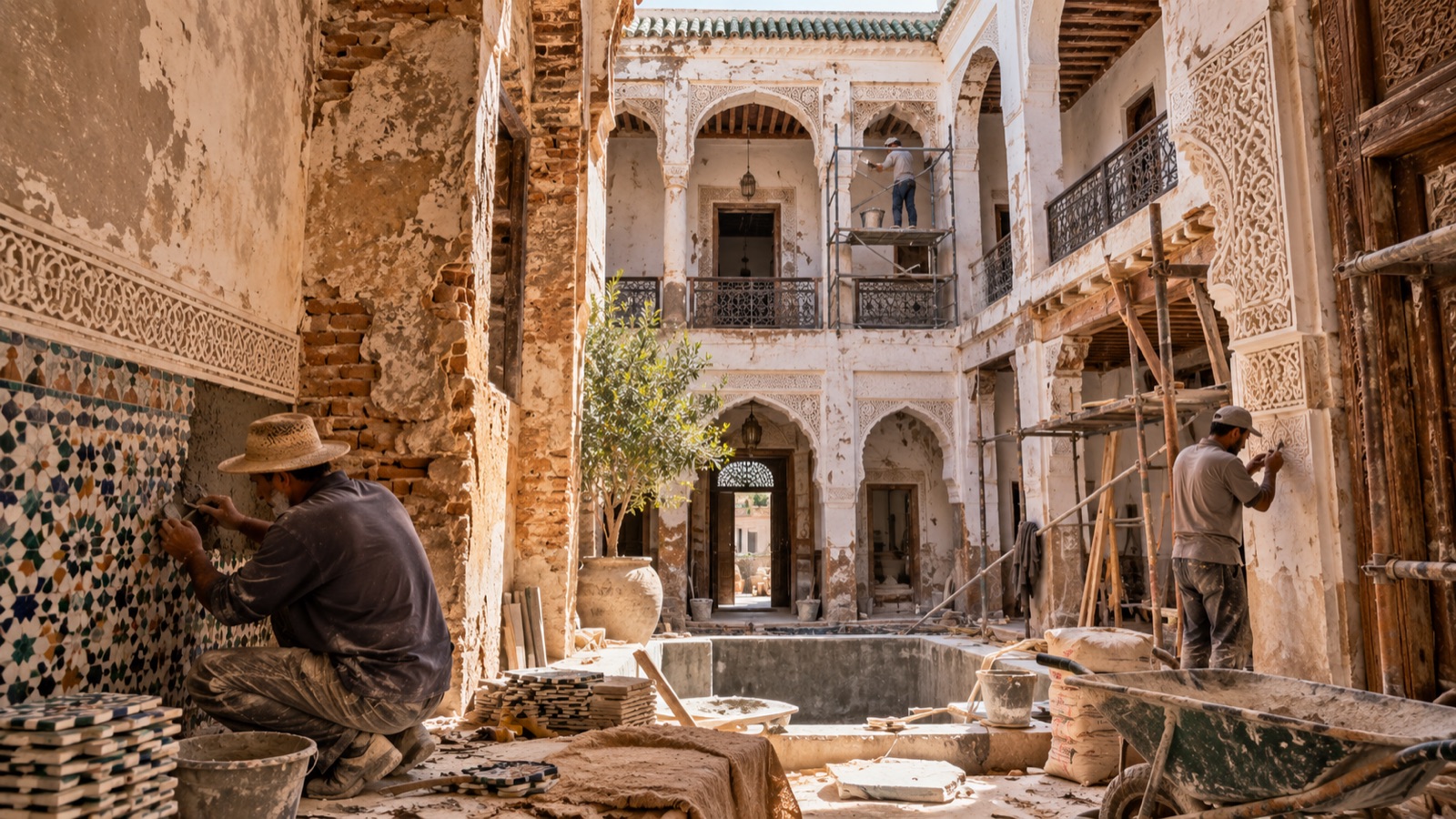
Renovating and creating a riad · 18 September 2026 · 11 min
How much does it cost to renovate a riad in Marrakech? Prices, budgets and advice for 2026
Costs per m², structure, craftsmanship, equipment and contingencies: build a realistic budget to transform a riad in Marrakech.
Read the article →