
Guides
Buying a riad in Marrakech in 2027: prices, process and advice for a successful purchase
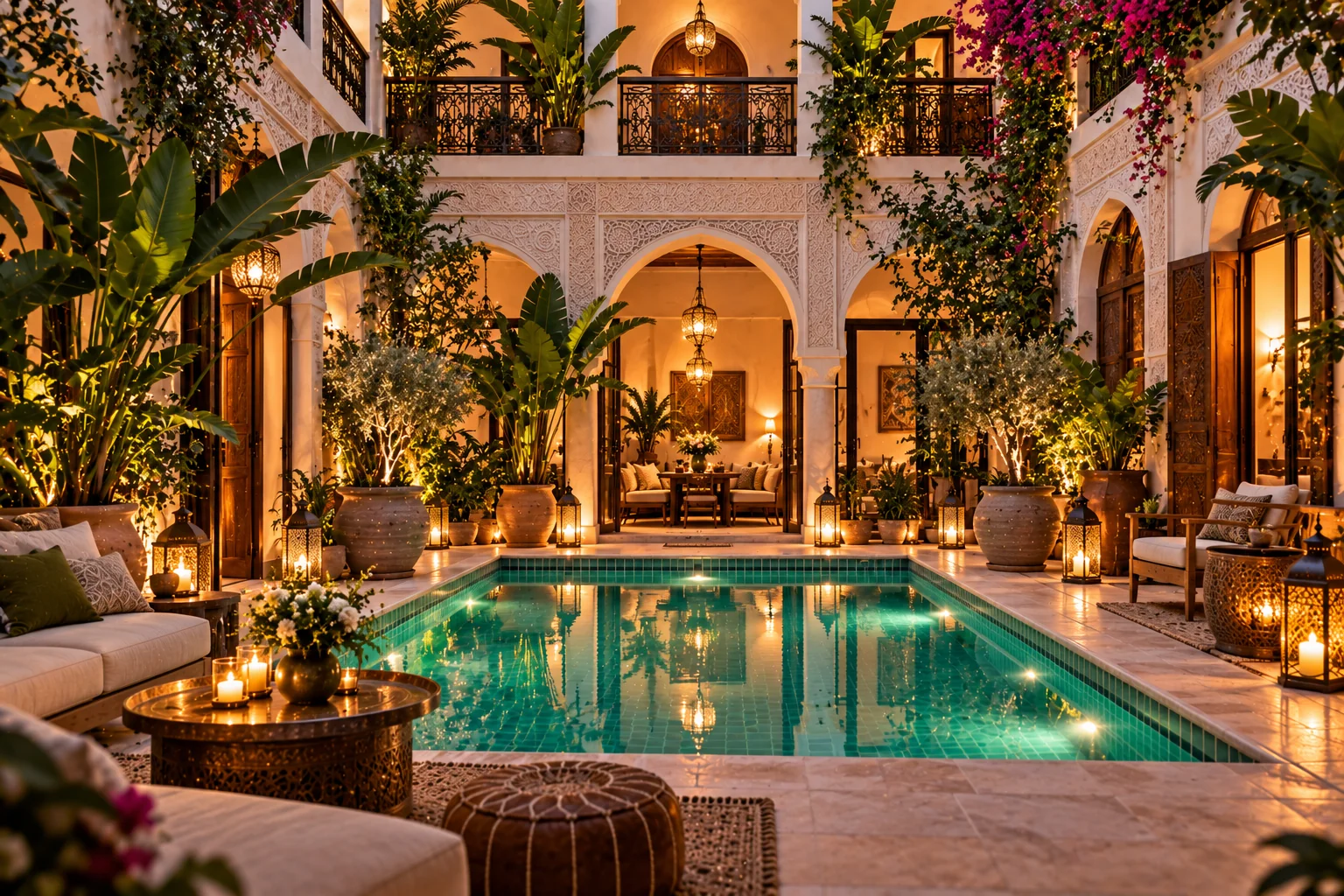
Buying a riad in Marrakech can serve several ambitions: owning a home with character, building assets abroad, opening a guesthouse or investing in a tourist accommodation business.
Yet there can be a considerable gap between the charm of a traditional courtyard and the realities of a property purchase.
Can you buy a riad in Marrakech with €200,000? Which neighbourhood should you choose? How do you verify ownership? What will renovation cost? And how can you tell whether the asking price is justified?
These questions deserve clear answers before you sign anything.
A riad listed at €280,000 may require a total investment approaching €500,000 once fees, works, equipment and working capital are included.
Conversely, a property with a higher purchase price may make better economic sense if its structure is sound, its location desirable and its authorisations suited to the project.
This guide takes you step by step through preparing a purchase in 2027, with financial simulations in euros, practical advice and links to the relevant Moroccan authorities.
Buying a riad in Marrakech: key answers
What total budget should you allow to buy a riad?
Allow for the purchase price, fees, works, furniture, equipment and working capital. In this guide’s Darnel example, a €280,000 purchase leads to a total investment of €490,000. This illustrative budget must be replaced with quotations and financing tailored to the property; it is not an observed market price.
What costs should you add to the purchase price?
Request a precise breakdown of duties, land registry fees, professional fees and disbursements. In the guide’s example, an 8% provision on €350,000 represents €28,000, bringing the total to €378,000 before works and furnishings. The 8% is a planning assumption, not a single statutory rate.
Which documents should you check before signing?
Have ownership documents, the seller’s identity and authority, encumbrances, areas and construction documents examined. For registered property, the ownership certificate is among the documents to review with the professional handling the purchase. A tourism project also requires checks on feasibility and applicable authorisations.
Darnel Collection’s method compares total cost, land ownership status, technical condition and operating potential before negotiation. The Dar Léon & Spa case study in this guide illustrates this approach without guaranteeing revenue. In Darnel’s 100-point assessment grid, a strong architectural score cannot offset a major legal problem: risks that rule out a purchase must be resolved before proceeding. See the grid and its limitations.
Origin of the figures: Darnel’s detailed €490,000 budget and the acquisition cost provision calculation. These are illustrative examples. For land ownership documents, consult the official ANCFCC services.
Why buy a riad in Marrakech?
A riad is a distinctive type of property.
Arranged around an internal courtyard, it can combine traditional architecture, privacy and living spaces open to the sky. Depending on its layout, it may include a plunge pool, several sitting rooms, bedrooms, a rooftop terrace and sometimes wellness facilities.
But buyers do not all want the same thing.
Buying a riad as your home
For residential use, priorities generally include comfort, access, natural light, insulation, the quality of equipment and a quiet neighbourhood.
A small riad with two or three bedrooms may be perfectly suited to this purpose.
There is no need to maximise the room count or create hotel infrastructure.
Buying a riad as a second home
A second home can combine personal enjoyment with a long-term asset strategy.
You must nevertheless plan for property supervision, rooftop maintenance, damp, technical systems and expenses while the property is unoccupied.
Buying a riad to develop a tourism business
This is a more entrepreneurial approach.
The buyer must examine both the property and its future operating model.
The main criteria then become:
- The number of rooms that can actually be operated.
- Ease of access for guests.
- The standard of comfort and service.
- Regulatory feasibility.
- The renovation budget.
- The achievable average nightly rate.
- Staffing and marketing costs.
Darnel advice: before your first viewing, write your objective in one sentence. For example: “Buy a five-room riad for an upscale tourism business, with a maximum total budget of €500,000.”
This sentence helps you avoid spending time on attractive properties that do not fit your strategy.
How much does a riad in Marrakech cost in 2027?
There is no single price for a riad in Marrakech.
Two buildings in the same neighbourhood may have very different values because of their condition, access, layout or land ownership status.
Six factors that influence the price
Location. A property on an easily accessible street, close to key points of interest, may have significant advantages.
Ground footprint. This must be distinguished from the total floor area across several levels.
Structural condition. A building requiring repairs to floors, walls or foundations can incur substantial costs.
Architectural potential. The courtyard, natural light, ceiling heights, terrace and layout influence the scope for development.
Legal status. Clear property documentation makes the transaction easier to assess and secure.
Operating potential. For a tourism project, the ability to create comfortable rooms and comply with regulatory requirements is decisive.
Four budget ranges to help prepare your search
The following figures are indicative search scenarios, not market averages or verified transactions.
On small screens, scroll the table horizontally if needed.
| Planned total budget | Project to consider |
|---|---|
| 150 000–250 000 € | Small traditional property, possibly requiring substantial renovation |
| 250 000–400 000 € | Compact riad or property requiring works |
| 400 000–700 000 € | Character riad project with several rooms, depending on location |
| Over 700 000 € | Upscale property or more ambitious tourism project |
These budgets do not guarantee that a matching property is available for sale.
To establish a genuine market benchmark, examine dated listings and, where possible, comparable transactions.
How do you compare the prices of several riads?
Consider three fictional properties, solely to illustrate an assessment method.
On small screens, scroll the table horizontally if needed.
| Criterion | Riad A | Riad B | Riad C |
|---|---|---|---|
| Asking price | 240 000 € | 320 000 € | 420 000 € |
| Ground footprint | 85 m² | 110 m² | 140 m² |
| Estimated works | 150 000 € | 95 000 € | 35 000 € |
| Planned fees and other expenses | 40 000 € | 45 000 € | 45 000 € |
| Total budget | 430 000 € | 460 000 € | 500 000 € |
Riad A has the lowest purchase price, but its total budget comes close to those of the other two.
Riad C costs €180,000 more to buy, but only €70,000 more once projected expenses are included.
It might be preferable if its location, condition and potential justify the difference.
Conversely, it could also be overpriced. The figures alone cannot decide this.
Darnel advice: always compare the asking price, total cost and final potential. Price per square metre is a useful indicator, but insufficient in the Medina.
Example: a riad listed at €280,000
Source of the figures: Darnel Collection’s illustrative simulation for a project requiring substantial renovation. The breakdown below explains how a €280,000 purchase becomes a total investment of €490,000; it is not an observed transaction.
On small screens, scroll the table horizontally if needed.
| Item | Estimated budget |
|---|---|
| Purchase | 280 000 € |
| Purchase cost allowance | 22 000 € |
| Renovation | 110 000 € |
| Furniture and equipment | 30 000 € |
| Studies and launch | 13 000 € |
| Contingencies and working capital | 35 000 € |
| Total investment | 490 000 € |
In this example, the purchase price represents only around 57% of the total budget.
An investor with €300,000 therefore cannot consider this project funded simply because the asking price is below their available capital.
These figures are assumptions and must be replaced by quotations, a fee breakdown and a financing plan tailored to the property.
Does your budget really cover the riad you want to buy?
Do you have €200,000, €400,000 or more available?
Before starting viewings, discover the expenses to plan for and the mistakes that can push your project over budget.
Receive Darnel Collection’s free Marrakech Riad Investor Kit.
Which Marrakech neighbourhood should you buy in?
The neighbourhood affects the owner’s daily life, the guest experience and the property’s long-term potential.
In Marrakech, however, it is essential to assess the individual street and building.
Two properties a few hundred metres apart may have very different access, disturbances and operating possibilities.
Bab Doukkala: an appealing neighbourhood for intimate projects
Bab Doukkala combines active local life, traditional shops and proximity to several parts of the Medina.
It may suit small guesthouse projects or homes with character.
Investors should check access, luggage carrying distances, alley widths and potential disturbances in particular.
Watch the video: Bab Doukkala in Marrakech — Darnel Collection Vlog.
The Kasbah: a strong heritage identity
The Kasbah has a distinctive historical setting.
It may suit characterful residential projects or upscale tourist accommodation.
Its potential must be assessed in light of the building’s quality, access and total development cost.
Mouassine: prioritising a central location
Mouassine enjoys a central position in the Medina.
This can benefit some tourism projects, but cannot justify any asking price on its own.
Foot traffic, disturbances and property quality also need to be assessed.
Dar El Bacha and Riad Laarous: areas to compare
These neighbourhoods may suit different property strategies.
Their characteristics vary with the street, access and property type.
The aim is to choose the neighbourhood that fits your project and budget, rather than the one considered most prestigious.
Five questions before choosing a neighbourhood
- How far away is the most convenient vehicle access point?
- Is it easy to transport luggage and building materials?
- What disturbances are present during the day and evening?
- What type of guest or use suits the surroundings?
- Are there genuinely comparable properties to help assess the asking price?
Darnel advice: visit the neighbourhood at different times. An alley that is pleasant at 11 a.m. may feel very different in the evening.
How do you find a riad for sale in Marrakech?
Finding a riad involves more than browsing property listings.
The market may include owner-sellers, agencies, intermediaries and specialist professionals.
The challenge is to identify properties that genuinely fit your project, then verify the quality of the information supplied.
Start with a clear brief
Before any search, define:
- Your maximum purchase budget.
- Your total budget, including works and fees.
- The neighbourhoods you will consider.
- The ground footprint you need.
- Your desired room count.
- The importance of the courtyard and rooftop terrace.
- Essential amenities.
- Your purchase timeline.
- Your intended residential or tourism use.
A precise brief makes discussions with sellers easier and avoids unnecessary viewings.
Compare several properties
Viewing a single riad is generally not enough to understand the market properly.
Comparing several properties helps identify differences in price, condition, layout and legal status.
You can use a scoring grid to make the comparison more objective.
A 100-point riad assessment grid
On small screens, scroll the table horizontally if needed.
| Criterion | Weighting |
|---|---|
| Location and access | 25 points |
| Legal and land ownership status | 25 points |
| Technical building condition | 20 points |
| Architectural and functional potential | 15 points |
| Price consistency | 15 points |
| Total | 100 points |
This grid helps prioritise viewings. It does not replace professional checks.
Caution: a major legal problem must not be offset by an excellent architectural score. Some risks should rule a property out until they are resolved.
Negotiate using facts
Serious property negotiations rely on documented evidence.
You can use, in particular:
- Comparable property references.
- Technical survey findings.
- Building quotations.
- Access constraints.
- The time required for the project.
- Differences between advertised and verified areas.
A €15,000 price reduction may be attractive. But it does not necessarily offset €60,000 in additional structural work.
Darnel advice: negotiate on total cost and property value, not just on the percentage discount achieved.
15 essential checks before buying a riad
This is probably the most important stage of the purchase.
A property may have remarkable architecture while carrying land ownership, technical or regulatory risks.
Here are the checks to carry out with the appropriate professionals.
A. Legal and land ownership checks
- 1. Verify the seller’s identity. Confirm that they have the rights and authority required to sell.
- 2. Examine the registered land title or ownership documents. Establish the property’s precise legal status. In the Medina, “melkia” refers to a traditional deed establishing ownership rights over unregistered property. It must not be confused with a registered land title. The deeds, chain of ownership, inheritances, boundaries and any third-party rights must be examined with the professional handling the purchase. If land registration proceedings are underway, their progress and any objections must also be checked.
- 3. Search for mortgages and encumbrances. Identify registrations and rights that could affect the transaction.
- 4. Check co-ownership and inheritances. Confirm that everyone concerned can validly participate in the sale.
- 5. Check areas and boundaries. Compare the documents with the actual layout.
For registered properties, the National Agency for Land Registration, Cadastre and Cartography (ANCFCC) provides access to services relating to ownership certificates and land information.
Official source: ANCFCC — Land registration and online services.
B. Technical checks
- 6. Examine the structure. Load-bearing walls, floors, foundations and any defective elements.
- 7. Check waterproofing. Roof, terraces, walls and signs of water ingress.
- 8. Check utilities and systems. Electricity, plumbing, drainage, water supply and technical equipment.
- 9. Obtain costings for the works. Get detailed estimates, including a contingency allowance.
- 10. Assess site access. Plan for material deliveries and removal of rubble.
C. Regulatory and economic checks
- 11. Check existing construction. Examine compliance and any available authorisations.
- 12. Assess the feasibility of alterations. Check whether volumes, levels or spaces can be modified.
- 13. Examine the authorisations required for the intended use. Buying property does not automatically grant the right to run a tourism business.
- 14. Build a total budget. Include purchase, fees, works, equipment, studies and working capital.
- 15. Check economic viability. For a rental or tourism project, weigh projected revenue against costs and risks.
Example: the cost of overlooking a technical survey
An investor buys a riad for €250,000.
They initially budget €90,000 for works.
After purchase, they discover structural defects requiring an additional €55,000.
Their renovation budget rises to €145,000, an increase of around 61%.
This is an educational simulation, but it illustrates a real risk: some expenses only become apparent after a thorough building assessment.
Darnel advice: before signing the final deed, consult a notary, an architect and, if needed, a structural engineer. Their involvement should reflect the specifics of the transaction.
Do not sign without your purchase checklist
Want to buy a riad in Marrakech without overlooking an essential check?
Receive the Marrakech Riad Investor Kit, with pointers for assessing your project’s budget, risks and feasibility.
Access the free Investor Kit →
What are the legal steps for buying a riad in Morocco?
The purchase process must be suited to the property’s legal status.
There is no single timeline that applies to every transaction.
Step 1: select the property and gather documents
Before making a significant commitment, request the documents identifying the seller, ownership and building characteristics.
This stage should reveal difficulties that could make the transaction impossible or too risky.
Step 2: have the file reviewed
A qualified legal professional must check the elements necessary for the transaction.
For registered property, land registry information plays a central role.
A property with a particular land ownership status may require further investigation.
Step 3: carry out technical checks
An architect or other qualified professional examines the building and project feasibility.
For a tourism investment, this assessment must take place before treating the room count as confirmed.
Step 4: define the purchase terms
Depending on the transaction, the parties may consider a preliminary agreement setting out their commitments.
The conditions must be tailored to the file: land ownership checks, financing, property status and other decisive factors.
Darnel advice: do not pay a deposit without understanding the conditions under which it can be refunded or retained.
Step 5: secure financing
Financing must be confirmed before making an irreversible commitment.
Foreign investors must also document fund transfers and check the applicable foreign exchange rules.
Step 6: sign the final deed
Signing takes place when the necessary transaction conditions have been met.
Drafting, authentication and formalisation must comply with applicable Moroccan rules.
Step 7: complete subsequent formalities
After signing, tax and land registration formalities must be completed according to the property’s status.
Keep a complete file containing deeds, payment receipts, bank records and technical documents.
Step 8: prepare works or operations
If the property needs renovation or conversion, establish a schedule, obtain the necessary authorisations and organise site supervision.
For a tourism business, regulatory and commercial procedures must be anticipated early enough.
Key point: a secure purchase rests on three independent assessments: legal, technical and economic.
What fees should you plan for when buying a riad in Marrakech?
The price negotiated with the seller is not the final amount to finance.
Several categories of expenses may be added.
Transaction-related costs
These may include:
- Registration duties.
- Land registry fees.
- Fees charged by professionals involved in the deed.
- Disbursements and formalities relating to the deed.
- Financing costs.
- Legal and technical due diligence costs.
The amount depends on the property type, its status and the transaction’s characteristics.
Example of a riad purchased for €350,000
For a provisional budget, assume an 8% allowance for notarised acquisition costs: registration duties, land registry fees, notary fees and disbursements. This allowance covers only these acquisition costs.
€350,000 × 8% = €28,000.
The acquisition budget therefore reaches €378,000 before works and furnishing.
This 8% allowance is a planning assumption. It is not a single statutory rate.
A precise fee breakdown must be requested before signing.
Official source: General Directorate of Taxes — General Tax Code 2026.
Further reading: What fees should you plan for when buying a riad in Marrakech?
Should you buy a renovated riad or one to renovate?
Both strategies can make sense.
But they involve different risks, timelines and financing needs.
Buying an already renovated riad
A renovated property may limit the works and shorten the wait before use.
The actual quality of the renovation must nevertheless be checked.
Recent decoration guarantees neither freedom from leaks nor compliant installations.
Buying a riad to renovate
This allows you to design a project that matches your objectives.
It can also create value, provided the works are well managed.
The main risks are unexpected technical issues, budget overruns, delays and authorisations.
Financial comparison: two strategies for five rooms
On small screens, scroll the table horizontally if needed.
| Item | Renovated riad | Riad to renovate |
|---|---|---|
| Purchase | 480 000 € | 270 000 € |
| Estimated fees | 35 000 € | 20 000 € |
| Works | 20 000 € | 155 000 € |
| Furniture and equipment | 15 000 € | 35 000 € |
| Studies, reserve and launch | 20 000 € | 45 000 € |
| Total budget | 570 000 € | 525 000 € |
These figures are educational assumptions.
The renovation project has a total budget €45,000 lower.
But it may take longer and expose the investor to greater unforeseen costs.
The decision must also consider the final quality of the properties and their commercial potential.
The cost of a delayed opening
Take a five-room establishment with an average nightly rate of €135 and projected occupancy of 60%.
A 90-day delay represents, with all assumptions unchanged:
5 × 90 × 60% × €135 = €36,450 in theoretical revenue not earned.
This is not a net loss: some variable costs would be avoided, while fixed costs might continue.
This difference must be included when comparing a renovated property with a renovation project.
Darnel advice: for a tourism project, compare the total cost per usable room and the opening schedule.
Also read: A riad to renovate or a turnkey riad in Marrakech: which strategy should you choose?
What returns can you expect after buying a riad in Marrakech?
A riad can be a long-term property investment or a tourism business.
In the latter case, its profitability depends on its ability to generate revenue exceeding its costs, taking invested capital into account.
Three variables directly influence room revenue:
The number of available rooms. This determines maximum sales capacity.
The average daily rate per sold room, or ADR. This reflects pricing positioning.
Occupancy rate. This measures the share of available rooms actually sold.
Three revenue scenarios
On small screens, scroll the table horizontally if needed.
| Indicator | 4 rooms | 5 rooms | 7 rooms |
|---|---|---|---|
| Assumed ADR | 110 € | 135 € | 155 € |
| Assumed occupancy | 50 % | 60 % | 65 % |
| Annual room revenue | 80 300 € | 147 825 € | 257 416 € |
Calculation: number of rooms × 365 days × occupancy rate × ADR.
These figures are commercial simulations, not market averages.
For simplicity, ADRs are treated here as revenue excluding VAT. They should therefore not automatically be equated with VAT-inclusive prices shown on booking platforms.
Example: a total investment of €500,000
Take a five-room riad.
On small screens, scroll the table horizontally if needed.
| Annual indicator | Amount |
|---|---|
| Room revenue excluding VAT | 147 825 € |
| Ancillary revenue excluding VAT | 22 175 € |
| Total revenue excluding VAT | 170 000 € |
| Assumed operating costs | 119 000 € |
| Simplified operating result | 51 000 € |
The indicative operating return would be:
€51,000 ÷ €500,000 × 100 = 10.2%.
This calculation is not a net return after tax.
It is before tax, financing and any additional equipment replacement expenditure. The amount actually available also depends on the composition of costs, depreciation and working capital needs.
Three scenarios to assess risk
For a five-room riad with an ADR of €135:
On small screens, scroll the table horizontally if needed.
| Scenario | Occupancy | Annual room revenue excluding VAT |
|---|---|---|
| Cautious | 45 % | 110 869 € |
| Base | 60 % | 147 825 € |
| Optimistic | 70 % | 172 463 € |
The difference between the cautious and optimistic scenarios is almost €61,600 in annual revenue.
This is why a project must remain financially viable under a less favourable scenario than the initial projections.
Costs you must not overlook
A tourism business may incur:
- Salaries and social contributions.
- Purchases for guest services and catering.
- Distribution commissions.
- Marketing expenditure.
- Water, electricity and telecommunications.
- Building and equipment maintenance.
- Insurance and administrative costs.
- Management fees.
- Furniture replacement expenditure.
- Applicable taxes and duties.
Darnel advice: never choose a riad solely because its theoretical revenue looks high. Also examine required capital, fixed costs and how sensitive the result is to lower occupancy.
Further reading: How much is really left after operating costs for a riad in Marrakech?
How much could your future riad really earn?
Before buying, test different assumptions for average rates, occupancy and costs.
Access Darnel Collection’s profitability simulator to compare scenarios for a 4-, 7- or 10-room establishment.
Access the free profitability simulator →
Your annual simulation in euros
Editable educational scenario: 365 available days. Revenue and costs are compared excluding VAT; total project cost represents actual cash outlays, with no anticipated VAT recovery.
Check the values. For VAT-inclusive revenue, enter both applicable rates. Total project cost must be greater than zero.
Result before depreciation, financing, taxes and equipment replacement. This is neither distributable net profit nor a guaranteed return. Variable costs apply to total VAT-exclusive revenue. Defaults: €105,000 fixed costs and 32.5% variable costs, totalling €196,000 in the reference scenario; this allocation is educational, not a quotation or management rate. VAT-exclusive revenue = VAT-inclusive revenue ÷ (1 + VAT rate / 100). For revenue subject to several regimes, enter its validated VAT-exclusive total directly. Room revenue is rounded to the nearest euro before totalisation, as in the guide. Launch occupancy and seasonality still require assessment.
Tax, regulation and foreign investment: what you need to know
Buying property and operating tourist accommodation are two separate subjects.
Investors must check the rules governing ownership, fund transfers, works and their intended activity.
Can a French citizen buy a riad in Morocco?
Yes, foreign investors can in principle acquire urban property in Morocco, subject to the property’s legal status and applicable rules.
Land ownership status must be examined before the transaction.
How can you secure financing from abroad?
Moroccan foreign exchange regulations provide a convertibility regime for foreign investments financed in foreign currency, under the conditions laid down in the regulations.
This regime may allow the transfer of investment income and sale proceeds.
It is therefore important to retain bank records and purchase documents.
Official source: Office des Changes — Making a foreign investment in Morocco.
Can you freely convert a riad into a guesthouse?
No.
Buying a building does not automatically grant the right to operate it as tourist accommodation.
Moroccan Law No. 80-14 on tourist establishments and other forms of tourist accommodation, and its implementing regulations, govern this activity.
The Ministry of Tourism publishes regulatory references for tourist accommodation establishments and certain construction standards.
Official source: Ministry of Tourism — Legal framework for tourist accommodation.
What taxes should you anticipate?
Taxation depends on how the property is held and used.
It may include:
- Duties and fees relating to the purchase.
- Taxes on rental income.
- Corporate income tax where a company operates the business.
- VAT on transactions and services subject to it.
- Local taxes.
- Any capital gains tax on resale.
An individual’s property rental income must be distinguished from the profits of a commercial or tourism business.
Official source: General Directorate of Taxes — General Tax Code 2026.
The rules applicable in 2027 must be checked at the time of investment.
Darnel advice: have your legal and tax structure validated before signing, especially if you are tax resident in France and planning a tourism business in Morocco.
Case study: Dar Léon & Spa by Darnel Collection
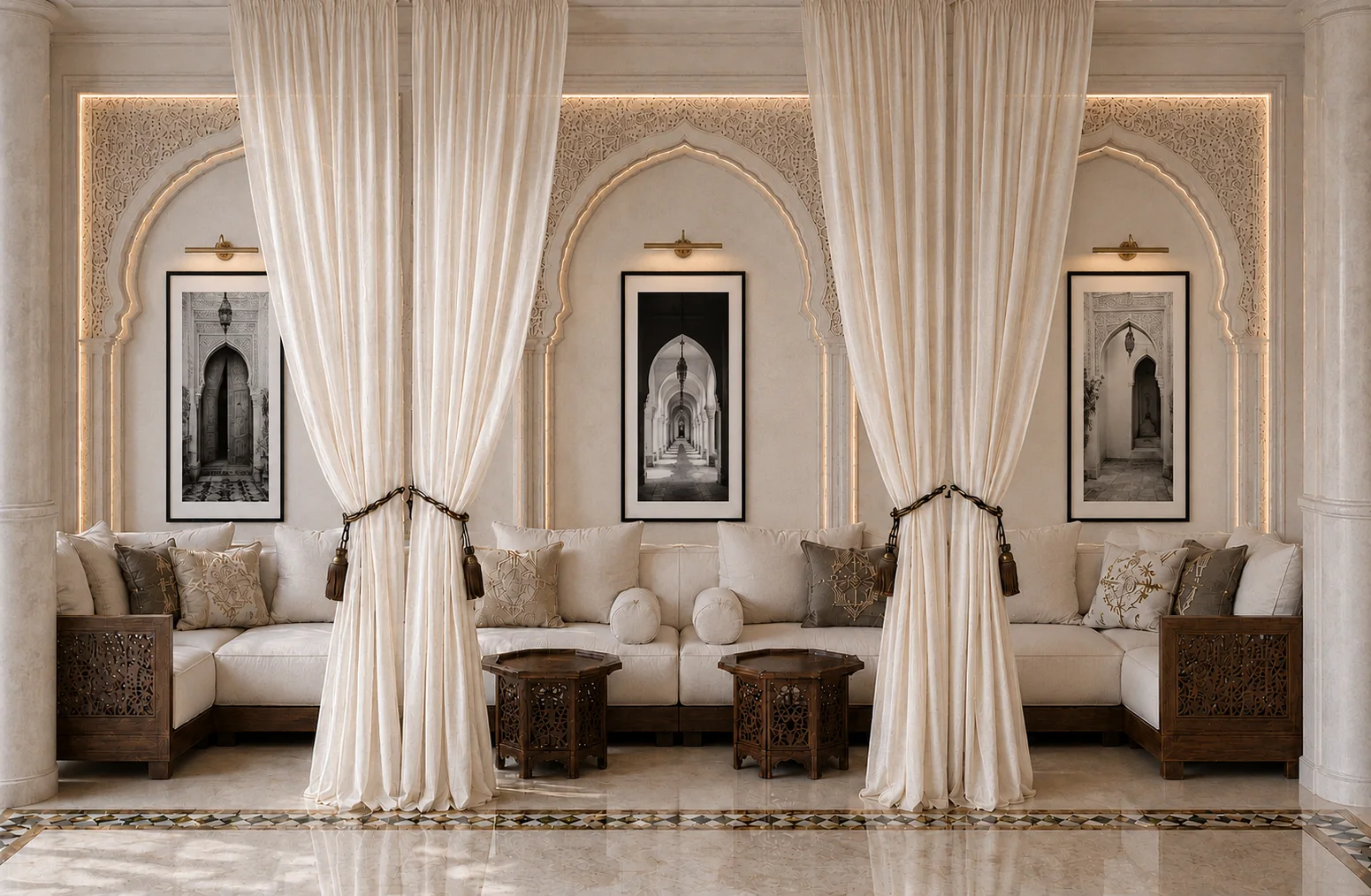
INVESTMENT CASE — DAR LÉON & SPA
4 rooms • Bab Doukkala • Riad & private spa
Dar Léon & Spa is a tourism property project in Marrakech’s Bab Doukkala neighbourhood.
It includes plans for four rooms, a courtyard with a plunge pool, a rooftop terrace and a private spa area.
The concept is to create an intimate establishment with a carefully developed architectural identity and an experience focused on upscale hospitality.
This project illustrates an approach in which value depends not only on room count, but also on the quality of spaces, positioning and the experience offered.
Three key figures
- 4 rooms planned.
- Approximately 200 m² of total floor area, including the terrace.
- Marketing price: €550,000, excluding acquisition costs.
Notarised acquisition costs are added to the marketing price.
Simulating the hotel potential
Take an educational scenario:
- Four rooms.
- ADR excluding VAT: €100.
- Occupancy rate: 75%.
- Operating over 365 days.
The theoretical room revenue would be:
4 × 365 × 75% × €100 = €109,500 per year.
This amount is neither a contractual forecast nor a revenue guarantee.
Calculating profitability would also require ancillary sales, operating costs, necessary investments and applicable taxes to be included.
Darnel advice: for a small upscale establishment, controlling fixed costs is just as important as the ability to charge a high average rate.
Discover Dar Léon & Spa and Darnel Collection projects →
How can you make a successful riad purchase in Marrakech in 2027?
A successful purchase does not rest on a single good decision.
It results from a series of consistent checks and trade-offs.
Rule one: buy with a clear objective
The property should fit your project, not the other way round.
A property ideal as a home is not necessarily suited to a tourism business.
Rule two: think in terms of total investment
Include the purchase price, fees, works, equipment, contingencies and expenses before the first revenue arrives.
Rule three: verify before final negotiations
A large discount does not always compensate for a legal or structural problem.
Rule four: anticipate timelines
Checks, works and authorisations can affect your project schedule.
Rule five: prepare an exit strategy
Even if you plan to keep the property for many years, consider its future resale.
Title quality, compliant works, location and the building’s functionality can all play an important role in its value.
Rule six: bring the right professionals together
Depending on the transaction, you may need a notary, architect, engineer, accountant and tourism operations specialists.
Rule seven: never confuse potential with certainty
A property can have strong architectural or commercial potential without future revenue being guaranteed.
Darnel advice: first seek to reduce the risks you can control. Profitability is then built on verifiable assumptions and rigorous execution.
Looking for a riad to buy in Marrakech?
Do you have a budget and want to move forward with a purchase, renovation or tourism development project?
Darnel Collection helps you explore character property projects in Marrakech, combining design, investment and operating potential.
Let’s discuss your budget, strategy and the characteristics of the property you are looking for.
Book an advisory appointment with Darnel Collection →
FAQ: buying a riad in Marrakech
What budget do you need to buy a riad in Marrakech?
Allow for the purchase price, fees, works, furniture, equipment and working capital. In this guide’s Darnel example, a €280,000 purchase leads to a total investment of €490,000. This illustrative budget must be replaced with quotations and financing tailored to the property; it is not an observed market price.
Can you buy a riad in Marrakech with €200,000?
This may be possible for some small properties or projects requiring works. However, the amount must not be treated as a guaranteed market price. Actual availability must be checked when searching.
What is the best neighbourhood for buying a riad?
There is no universally best neighbourhood. Bab Doukkala, the Kasbah, Mouassine, Dar El Bacha and Riad Laarous have different characteristics. The choice depends on budget, access and intended use.
Can a French citizen buy a riad in Morocco?
Yes, in principle a French citizen can acquire urban property in Morocco, subject to applicable rules and the necessary legal checks.
Which documents should you check before buying?
You should examine ownership documents, the seller’s identity, any land encumbrances, areas and construction-related documents in particular. The precise file depends on the property’s legal status.
What are the purchase costs for a riad?
Request a precise breakdown of duties, land registry fees, professional fees and disbursements. In the guide’s example, an 8% provision on €350,000 represents €28,000, bringing the total to €378,000 before works and furnishings. The 8% is a planning assumption, not a single statutory rate.
Should you buy a riad with a registered title?
A registered land title allows certain structured checks with the land registry. Properties with other legal statuses may require more detailed investigations. The choice should be validated with a legal professional.
Is buying a riad in Marrakech profitable?
A riad can be profitable if its total cost, revenue and expenses are consistent. A specific financial study is necessary, particularly for a tourism business.
Can a riad be converted into a guesthouse?
Yes, if the project is technically and legally feasible and complies with applicable authorisations and obligations. Buying the property does not guarantee this possibility.
Should you buy a renovated riad or one to renovate?
A renovated property may reduce delays and works, while a riad to renovate offers greater design freedom. The choice depends on the total budget, the building’s actual condition and the timeline.
Can you manage a riad from France?
Yes, with suitable local organisation, monitoring procedures and a reliable team. Professional management may also be considered for a tourism business.
How long does it take to buy a riad in Marrakech?
The timeline varies with land ownership status, necessary checks, financing and formalities. No single duration applies to every purchase.
Are the guide’s prices and budgets market benchmarks?
No. The search budgets, comparisons and simulations are Darnel Collection’s illustrative examples unless stated otherwise. The €490,000 budget adds up the costs in the €280,000 purchase case study. Replace it with quotations, a fee breakdown and dated comparables specific to the property. The 8% provision is not a single statutory rate.
Further reading: Réussir sa nouvelle vie au Maroc
Réussir sa nouvelle vie au Maroc: Le guide pratique pour s’installer, investir et prospérer
Buying a riad can be part of a broader project: building assets, preparing a move to Morocco or creating a new business.
This book provides additional pointers to help you think through your project and anticipate various procedures.
Conclusion: buying a riad in Marrakech takes preparation
Buying a riad in Marrakech can mean acquiring remarkable architectural heritage and, depending on your strategy, developing a property or tourism project.
But success depends on more than the property’s charm.
It rests on five fundamentals: a coherent price, secure legal status, a technically suitable building, a controlled budget and a realistic strategy for its use.
A well-bought riad is more than a beautiful building.
It is a property whose characteristics, constraints and prospects have been properly analysed before the financial commitment.
At Darnel Collection, we champion this approach: designing character property investments that combine a long-term asset perspective, architectural quality and economic analysis.
Would you like to buy a riad in Marrakech in 2027?
Discuss your purchase project with Darnel Collection →
About the author
Georges Lelièvre — Darnel Collection
Darnel Collection develops tourism property projects in Marrakech, combining investment, architectural design and an assessment of future operating conditions.
The approach in this guide prioritises risk checks, cost control and consistency between the property and its use.
Editorial note: the budgets, comparative prices and financial simulations in this article are educational examples unless otherwise stated. They are neither verified transaction benchmarks nor guarantees of returns. Legal, tax and regulatory information must be confirmed with the relevant authorities and professionals at the time of investment in 2027.