
Invest
Renovate or buy a turnkey riad in Marrakech: which investment strategy should you choose?
Compare both strategies through the total capital committed, the time involved, the risks and the hospitality property you want to create.
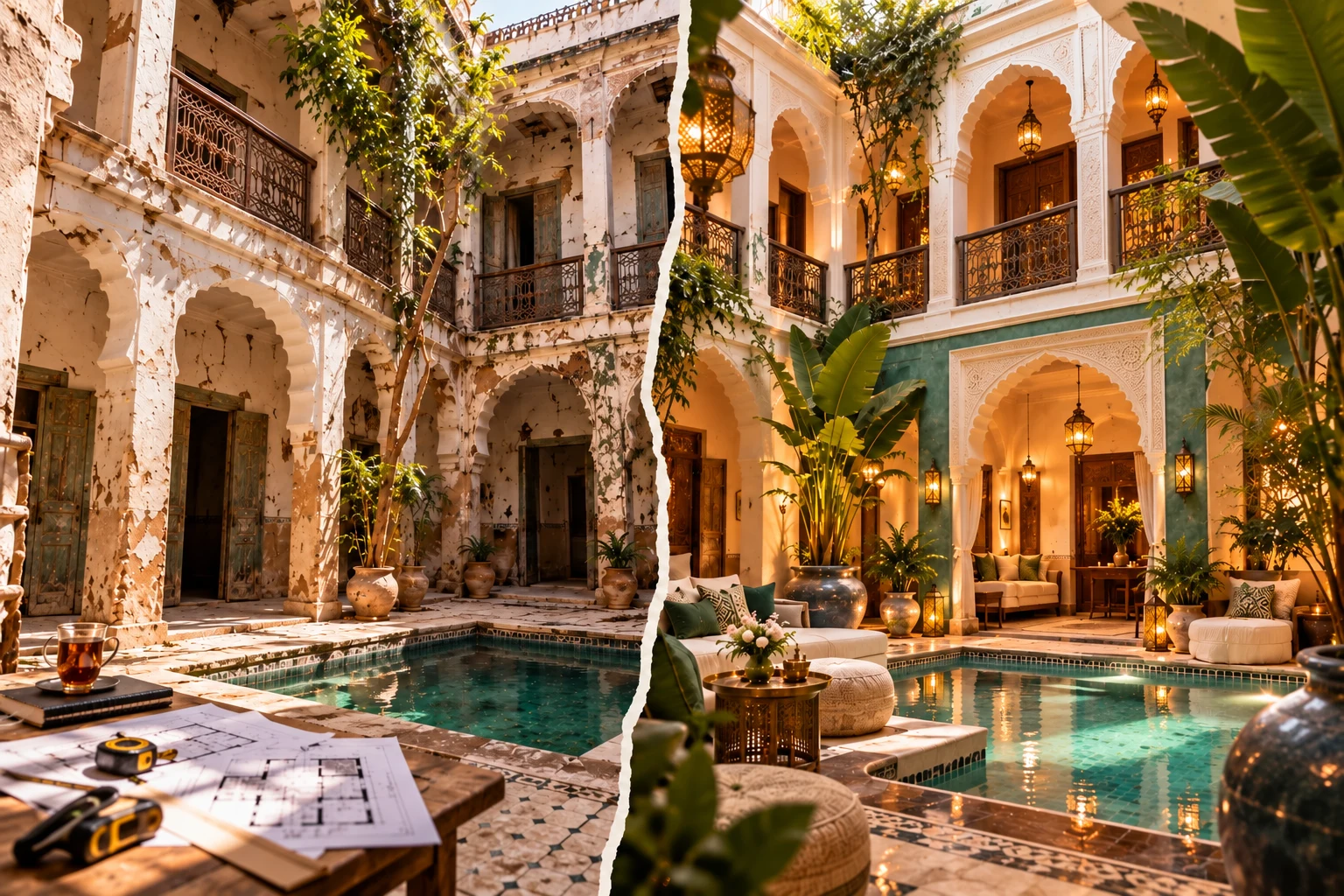
Renovation or turnkey: compare total capital, time to opening and risks, not just the purchase price. In our illustrative example, a €225,000 purchase and €90,000 in works become €415,000 with furniture, equipment, professional fees, launch and working capital. This total is neither a quotation nor an observed transaction. A turnkey property also needs technical, legal and commercial checks.
To secure the acquisition, use the riad buying guide; for overlooked works costs, consult our renovation budget guide. Darnel’s method compares both properties against the same programme and the same cost basis through to opening.
Two investors, two very different strategies
Reference conversions in this article use €1 = MAD 11, with rounded amounts. The existing simulator uses automatically updated exchange rates.
Imagine two investors, each with around €500,000.
The first visits a completed riad.
The courtyard has been renovated. The rooms are furnished. The air conditioning works. The rooftop has been fitted out. The photographs could almost go live on Booking tomorrow.
The second opens the door to a much less appealing house.
The walls look tired. The utility systems need replacing. The interior layout is unsuitable for hospitality operations. The rooftop has potential, but nothing has been developed yet.
The first investor is essentially buying time, greater visibility and a share of the risk that someone else has already absorbed.
The second is buying the opportunity to transform a property.
In Marrakech, that difference can amount to several hundred thousand euros.
These price gaps explain the appeal of properties that need renovation. They can also create an illusion.
Buying for less does not necessarily mean investing less.
And buying turnkey does not necessarily mean overpaying.
The right question is therefore less “Should I renovate or buy turnkey?” and more “Which strategy will allow me to create the most value, given my capital, my time and the hospitality product I want to build?”
To establish the foundations of your project, read our complete guide to investing in a riad in Marrakech.
Buying a riad to renovate: you are buying potential
The main advantage of a riad that needs renovation is clear.
You are not necessarily paying for all the value created by the previous owner.
You are buying a starting point.
It is then up to you to build the finished product.
Riad to renovate
MAD 1.2 million ≈ €109,000 to MAD 2.8 million ≈ €255,000
Renovated riad
MAD 4 million ≈ €364,000 to MAD 7 million ≈ €636,000
These ranges do not make the properties directly comparable.
The neighbourhood, floor area, title, building condition, access, number of possible rooms and finish quality can completely change the analysis. Nevertheless, the ranges illustrate how the process works.
With a riad to renovate, you are buying part of the project in the form of work still to be done.
The question is whether you can turn that work into value.
To assess the neighbourhood and its positioning, see the Medina guidance in our investment guide.
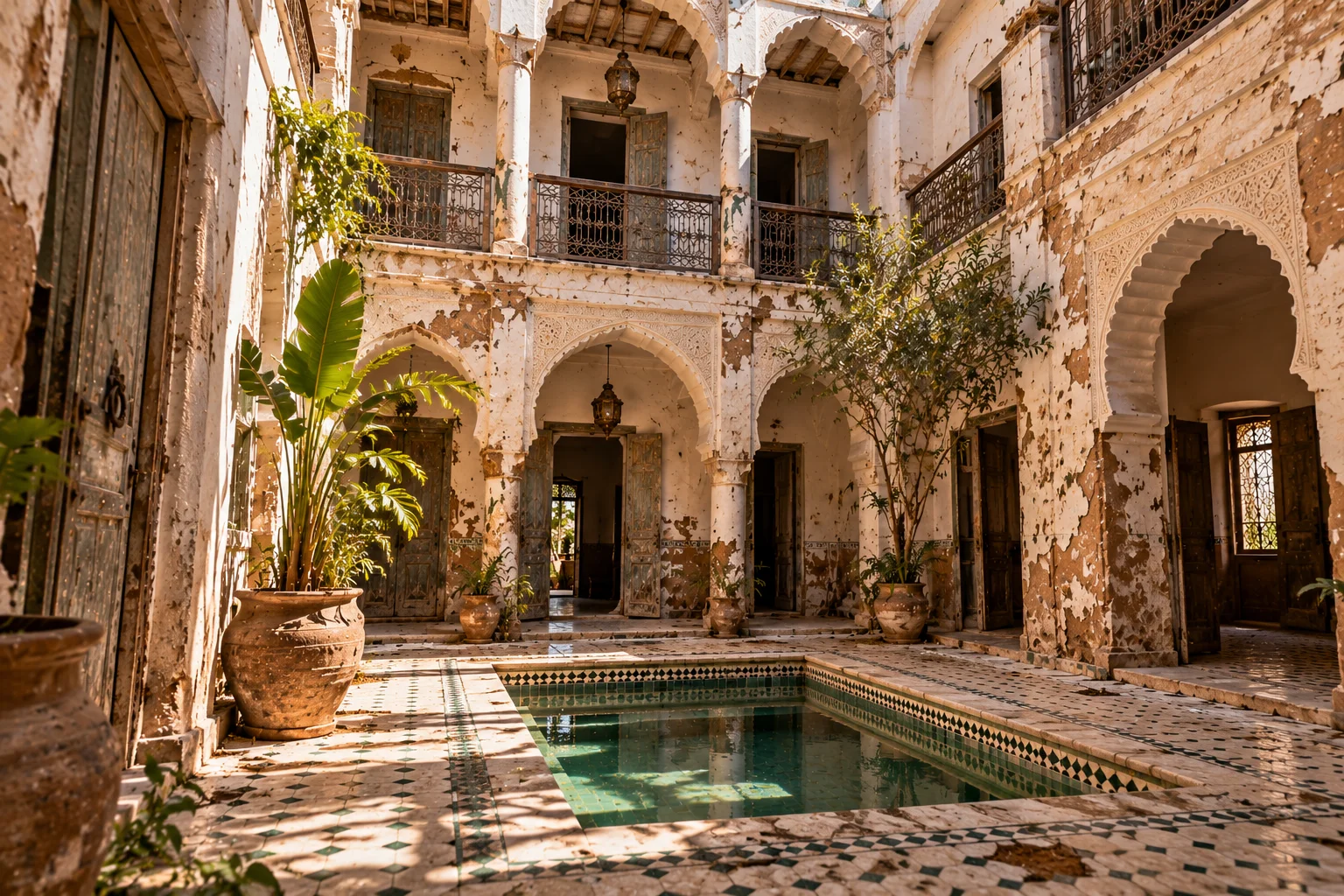
A riad that needs renovation is more than a deteriorating building: it is a hospitality product that does not yet exist.
The main advantage of renovation: creating the right product from the start
Buying a property to renovate gives you a freedom that turnkey properties rarely offer.
You can consider the number of rooms, their size, the guest journey and the operating layout together.
You can decide that a space which could have become a fifth bedroom should instead become a hammam.
Or design the rooftop as a space that can generate revenue: breakfast, private dinners, romantic experiences or events.
Consider a house that allows two configurations.
Option A
6 medium-sized rooms
Target average daily rate (ADR): €135
Option B
4 large suites + spa
Target ADR: €190
At first glance, six rooms might always seem preferable.
But assume 65% occupancy.
Option A
6 × 365 × 65% × €135 = approximately €192,100 in room revenue
Option B
4 × 365 × 65% × €190 = approximately €180,300 in room revenue
The gap is now only about €11,800 a year.
If the spa generates just €30,000 to €40,000 in additional revenue, the second configuration could ultimately produce more revenue while offering stronger market positioning.
Maximising the room count is therefore not always the best strategy.
The aim should be to maximise the value created by each square metre.
That is precisely why the architecture, business plan and future operations should ideally be considered together.
For more on room count and revenue, read How much revenue can a 5-, 7- or 10-room riad generate in Marrakech?.
The trap: assuming purchase price + renovation = final budget
This is where many projects become much less attractive.
Imagine an investor buying a riad for €225,000.
They then allow €90,000 for renovation.
In their mind, the total project budget is €315,000.
Renovation costs represent only part of the investment needed to turn a riad into a functioning hospitality property.
You still need to allow for the architect’s fees, technical surveys and acquisition costs, as well as all the furniture, bedding, air conditioning and equipment required for operations.
Depending on the concept, the budget must also include fitting out the kitchen, spa and service areas, along with the technology needed to run the property.
Finally, do not overlook launch expenses: professional photography, branding, a website, marketing, pre-opening preparations and an opening cash reserve.
The true project budget is never simply the purchase price plus renovation. You need to consider the total cost through to opening and retain enough cash to support the first few months of operations.
For a closer look at renovation spending, read How much does it cost to renovate a riad in Marrakech?.
The actual budget could become:
- Purchase price: €225,000
- Renovation: €90,000
- Furniture and decoration: €30,000
- Equipment: €20,000
- Fees and surveys: €15,000
- Launch and marketing: €10,000
- Cash reserve: €25,000
- Actual total: €415,000
We have just added €100,000 to a project the investor initially believed would cost €315,000.
That is why the essential question is never simply “How much does the riad cost?”
It is “How much will it have cost me by the time it is truly ready to generate revenue?”
Buying turnkey: paying more to reduce certain uncertainties
Now consider the other strategy.
You visit a riad that has already been renovated.
The rooms are finished.
The furniture is in place.
The pool works.
The rooftop has been fitted out.
If the property is already operating, it may even have a Booking listing, reviews and a revenue history.
You will probably pay more.
But you are buying something valuable: time already invested.
And time has an economic value.
Suppose a completed riad costs €550,000.
A comparable property to renovate ends up costing €440,000.
The difference is €110,000.
The renovation project seems more attractive.
But if the work takes 14 months, the comparison changes.
Imagine the finished property could generate around €18,000 in room revenue per month once trading has stabilised.
Twelve months of delayed trading represents €216,000 in potential revenue deferred. This amount is not a net loss.
The riad would not necessarily have achieved that performance immediately, and operating expenses would have absorbed part of the revenue.
Nevertheless, the example shows why time belongs in the business plan.
Compare the strategies on more than price
Here is a more useful way to assess them.
| Criterion | Riad to renovate | Turnkey riad |
|---|---|---|
| Entry price | Often lower | Often higher |
| Customisation | Extensive | More limited |
| Construction risk | Significant | Reduced |
| Time before revenue | Several months | Potentially short |
| Budget visibility | Lower | Higher |
| Creating an identity | Maximum freedom | May require adaptation |
| Potential value creation | High if well managed | Strongly dependent on the price paid |
| Oversight required | Substantial | Lighter |
| Trading history | Rare | Sometimes available |
| Complexity for an overseas investor | Higher | Generally lower |
The conclusion is not that renovating is better.
Nor that turnkey is safer in every case.
The two strategies simply suit different investor profiles.
Have you identified a riad to renovate or a completed property?
This is precisely the stage at which comparisons can become difficult.
Darnel Collection can help you weigh the acquisition price, renovation costs, achievable room count, timeline, potential ADR, additional revenue and final value of the product.
The aim is to compare both opportunities through the total capital actually committed, rather than the asking price alone.
COMPARE MY PROJECT WITH DARNEL COLLECTION →
A conversation to structure your project before signing.
The real purpose of renovation: creating value
Consider a simple scenario.
- Purchase: €250,000
- Renovation: €125,000
- Architecture, furniture, equipment, pre-opening and cash reserve: €45,000
- Total capital: €420,000
Imagine that, once completed, the market would value a truly comparable property at around €490,000.
The transformation would have created about €70,000 in theoretical value, before the costs of any eventual resale.
Now imagine the renovation costs overrun.
Your completed project no longer costs €420,000, but €540,000, while the value of the finished property remains around €490,000.
You may then have destroyed €50,000 in value before even opening.
That is why renovation should never be treated simply as an aesthetic exercise.
It is a property and hospitality transformation project.
Estimate the profitability of your own project
Estimate your riad’s profitability
Loading exchange rates…
Rates provided by ExchangeRate-API · Updated daily ·
Occupancy: +5 percentage points/year up to 90%, then +2.5 percentage points/year up to 95%.
Estimate based on the purchase price alone. Renovation costs, acquisition fees and financing are excluded from the return calculation.
Your 5-year projection
Version 4 · Exchange rates updated daily · Updated on 6 October 2026
| Year | Occupancy | Nightly rate | Additional sales | Annual revenue | Operating profit | After corporate tax | Return |
|---|
Understanding the assumptions and calculations
Operating profit is set at 45% of total revenue, meaning total operating expenses are estimated at 55%. Corporate tax is simulated at 20% of positive operating profit, without modelling depreciation, deductions or the project’s specific tax regime. Profit after corporate tax is not a calculation of cash flow after financing.
The average room rate per night increases by 7.5% per year, compounded. Occupancy increases by 5 percentage points per year up to 90%, then by 2.5 percentage points per year up to 95%: 60%, 65%, 70%… 90%, 92.5%, 95%. Additional sales increase by 5 percentage points per year up to 30% of room revenue, then by 2.5 percentage points per year, with no projection cap. If an increase crosses a threshold, it stops at that threshold for the year in question (examples: 88% → 90%; 28% → 30%). The operating margin remains constant.
The return equals annual profit after corporate tax divided by the purchase price. No return on equity is calculated. Owners may replace the purchase price with the reference value they wish to analyse.
Indicative conversions are updated automatically from ExchangeRate-API, with a 24-hour local cache. The rates’ publication date is displayed above the inputs. If the service is unavailable, the latest available rates are retained and flagged. Current rates are used to convert all projection years; they do not predict future exchange rates. Displayed amounts are rounded; calculations use unrounded values.
Indicative, non-binding simulation. These assumptions do not guarantee future performance or the applicable tax treatment.
Give your riad the means to achieve these results
Discuss your project and the drivers of its profitability with Darnel Hospitality.
Book an advisory appointmentInvestment case — Dar Léon & Spa
Dar Léon & Spa by Darnel Collection illustrates the third route between managing the renovation of an old riad yourself and buying a property already renovated around someone else’s concept.
Located in Bab Doukkala, the project is designed for turnkey delivery. The investor buys a property conceived from the outset around an architectural identity, four rooms, a courtyard with a pool, a rooftop and a wellness space. The aim is to reduce some of the complexity of construction while retaining the benefit of a project designed around a coherent experience from the start.
3 key figures
- 4 rooms
- Approximately 200 m² of total developed floor area
- Approximately 12 months’ projected delivery time
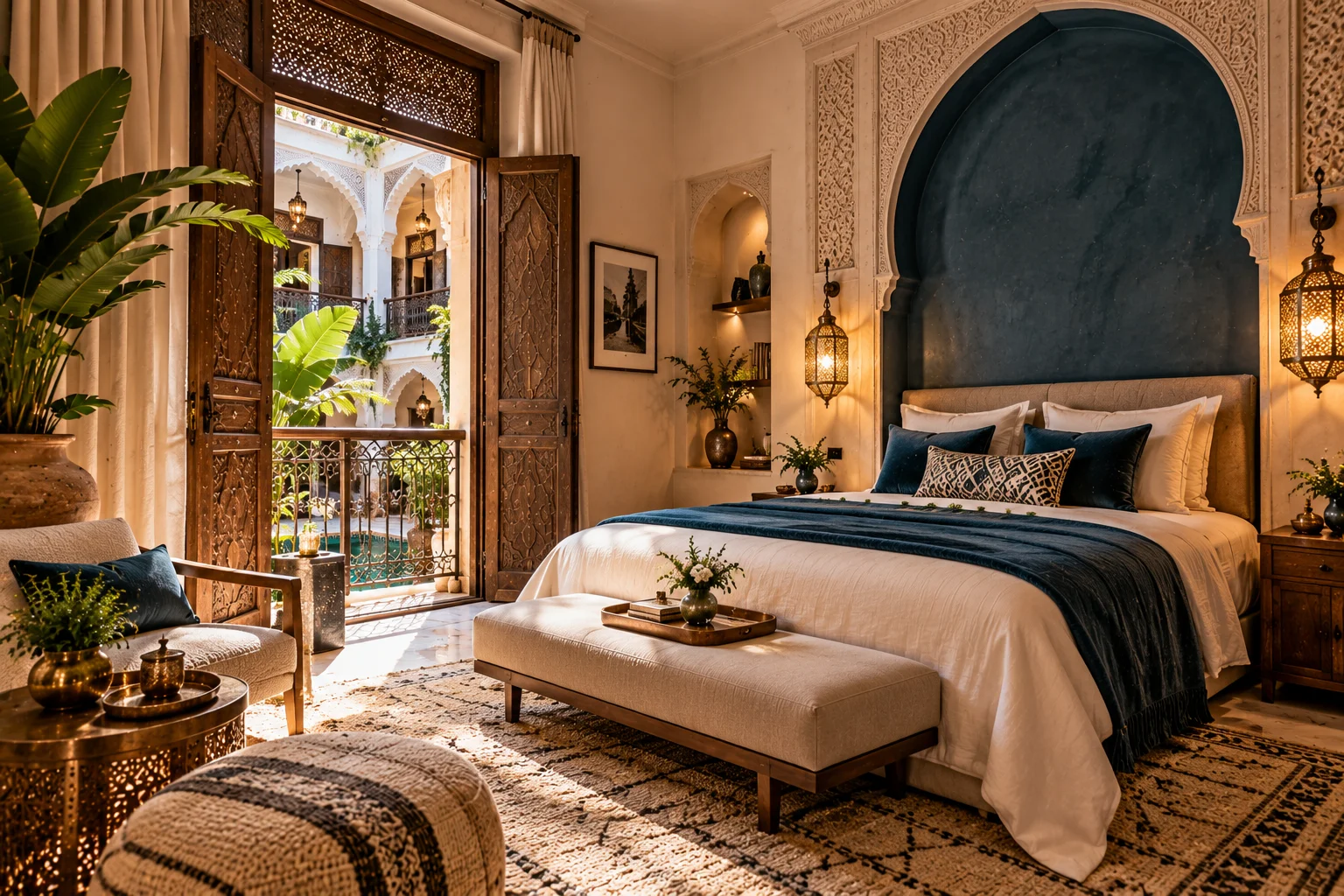
INVESTMENT CASE — DAR LÉON & SPA
4 rooms • Bab Doukkala • Distinctive Riad & Spa
Turnkey properties have their own pitfalls
“Turnkey” does not automatically mean “risk-free”.
A riad can be beautifully decorated and still have poor operating characteristics.
You therefore need to look beyond the photographs.
Was the renovation genuinely structural?
A coat of paint and new light fittings do not replace renewed utility systems.
Has waterproofing been properly addressed?
This is particularly important for terraces and rooftops.
Is the air conditioning suitable?
A hospitality property operates under different constraints from a second home.
Can the kitchen support the planned level of food service?
Are the staff areas adequate?
Do the rooms really support your target ADR?
A riad can be turnkey as a residence while remaining a long way from turnkey as a hospitality business.
Due diligence therefore needs to cover the building, the product and the operations together.
If the riad is already operating, you are also buying financial records
This is one of the potential advantages of a turnkey property that is already trading.
You can request historical performance data. That is the right approach, but do not stop at revenue.
Consider two properties.
Riad A
- Revenue: €300,000
- Actual margin: 15%
- Profit: €45,000
Riad B
- Revenue: €250,000
- Actual margin: 28%
- Profit: €70,000
The first generates more revenue. The second generates more profit.
Never buy on revenue alone.
Buy a business model you understand.
Complement this analysis with How much revenue can a 5-, 7- or 10-room riad generate in Marrakech?.
Investors based in France or elsewhere in Europe: time and distance change the decision
This question is particularly important for investors who do not live in Marrakech.
An owner based locally can visit the site several times a week, meet the architect easily, check progress or quickly approve a choice of materials. An investor based in Paris, Brussels or Geneva clearly does not have the same flexibility.
That does not mean investors living abroad should avoid renovating a riad. It does mean the project must be more carefully structured and managed from the outset.
You need to establish a precise budget, a schedule, each participant’s responsibilities and a clear remote approval process. Site supervision, regular reporting, materials approval and decisions on any necessary trade-offs must also be organised in advance.
Without that framework, the saving achieved by buying a property to renovate can quickly be absorbed by delays, changes during construction, mistakes and budget overruns.
This gives turnkey delivery a different kind of value. It saves time and reduces the project’s operational complexity and the number of decisions the investor has to manage remotely.
For an international investor, that simplicity can have real economic value, even if it is difficult to quantify when comparing purchase prices alone.
Is your Marrakech investment part of a wider life project?
Buying a riad sometimes accompanies a deeper ambition: moving to Morocco, starting a business, investing or dividing your time between several countries.
To explore these topics further:
Réussir sa nouvelle vie au Maroc
The practical guide to settling, investing and thriving in Morocco.
DISCOVER THE BOOK ON AMAZON →
If you want to build a hospitality brand, renovation has a particular advantage
When creating a strong hospitality brand, a riad to renovate has an obvious advantage: everything can be designed around the concept from the beginning.
The architecture, light, room layout, spa, rooftop and dining spaces can be developed alongside the brand identity. That thinking can extend to the smallest details: staff uniforms, photographic art direction, a signature scent, storytelling and the guest journey.
The property is not simply renovated and then marketed. It is built around a brand, a target audience and a specific experience.
With a completed property, the process is often different. You can still create a strong identity, but may need to adapt the concept to the existing architectural constraints and spaces.
This difference becomes especially important at the luxury end of the market. A property targeting an ADR of €250 or €300 needs strong consistency between its architecture, design, services, image and quality of hospitality.
At that price level, guests are buying more than a room: they are buying the whole experience.
A third route: a project designed and then delivered turnkey
Between buying a riad to renovate and buying a property already in operation, there is a third route: buying a turnkey project before construction or the full renovation is complete.
This approach offers many of the benefits of a project designed to suit a specific concept. The hospitality concept, architecture, design, equipment and positioning can be considered in advance to create a coherent whole.
The main difference lies in the support provided. Investors can take part in the project’s major decisions without necessarily managing the site themselves, coordinating every participant or making every operational decision.
This is precisely the approach Darnel Collection seeks to develop for some of its projects: bringing together the different elements needed to create a successful hospitality asset from the outset.
Property → Architecture → Design → Hospitality → Operations
The aim is to look beyond square metres, building work and decoration, and design a product suited to its future guests and operating model from the beginning.
Under this approach, the investor is buying more than a property in Marrakech. They are investing in a hospitality project planned from conception through to operation.
Before signing, always prepare three business plans
Never sign on the strength of a single scenario.
SCENARIO 1 — Ideal
- Renovation stays on budget.
- The property opens on time.
- The launch goes well.
- ADR meets projections.
SCENARIO 2 — Realistic
- Renovation costs rise by 10%.
- Opening is delayed by 2 months.
- Trading builds gradually.
SCENARIO 3 — Under pressure
- Renovation costs rise by 20%.
- Opening is delayed by 6 months.
- ADR falls below projections.
- Occupancy is lower.
Consider a €450,000 project.
If renovation represents €120,000:
- A 10% overrun adds €12,000.
- A 20% overrun adds €24,000.
Add six months without trading and the difference can become much greater.
If your investment only works in the ideal scenario, the problem is probably not your business plan. It is your margin of safety.
Which strategy should you choose?
The answer depends mainly on your investor profile.
A riad to renovate is probably more suitable if…
- You want to create value.
- You want a bespoke concept.
- You have time.
- You accept a period without revenue.
- You have a reliable local team.
- You want to build a brand from the outset.
A turnkey riad is probably more suitable if…
- You prioritise greater visibility.
- You want to start quickly.
- You are based abroad.
- You want to limit construction risk.
- You prefer analysing historical performance.
A project designed and delivered turnkey may suit you if…
You want to create a specific product without taking full responsibility for managing the property development yourself.
There is no universal answer.
The best model is the one that matches your capital, time, skills, risk tolerance and hospitality ambitions.
The Darnel Private Investors Club
Are you considering buying a riad in Marrakech but not yet ready to book an appointment?
Join the Darnel Collection Private Investors Club.
We share analysis, case studies, projects, tools and content about investing in riads and boutique hotels.
JOIN THE PRIVATE CLUB FOR FREE →
Free access · Unsubscribe at any time.
FAQ: renovating or buying a turnkey riad in Marrakech
How much does a riad to renovate cost in Marrakech?
As an indication, the purchase prices discussed in this article range from MAD 1.2 million to MAD 2.8 million, or approximately €109,000 to €255,000. The overall budget must then include renovation, fees, equipment, launch costs and a cash reserve.
These figures depend heavily on the property’s condition, neighbourhood, access, size and the desired standard.
How much does a riad renovation cost?
Renovation costs vary considerably with the building’s condition and the finish quality. As an indication, a light refurbishment may cost around MAD 2,500 to MAD 4,500 per m², while a full or high-end renovation can reach approximately MAD 8,000 to MAD 25,000 per m², depending on the structure, craftsmanship and equipment.
The budget depends on the extent of restructuring, craftsmanship, equipment and positioning. A light refurbishment and a premium project with a new layout, spa and high-end finishes should not be compared using the same cost per square metre.
How long does renovation take?
Depending on the building’s initial condition and the project’s ambition, renovation may take around 9 to 18 months. This is an indicative timeframe and depends in particular on the scope of work, surveys, permissions and how the site is organised.
Is buying a property to renovate always more profitable?
No. It depends on the purchase price, renovation costs, timelines, value created and future performance.
Is a turnkey riad always less risky?
It mainly reduces construction risk. You still need to check the technical condition, renovation quality, hospitality product, regulatory requirements and commercial potential.
Can a renovated riad start operating immediately?
Not automatically. A renovated building is not necessarily ready legally, technically or commercially for the intended tourism operation.
What should you check if the riad is already operating?
At a minimum, analyse ADR, occupancy, revenue per available room (RevPAR), revenue by channel, online travel agency (OTA) commissions, direct bookings, reviews, expenses, staffing, additional revenue and actual profit.
Which option is preferable for a first project?
Simplicity has considerable value for a first investment. The choice nevertheless depends on your experience, available time, team and the capital you are willing to tie up.
The best strategy is not to buy the cheapest riad
This is probably the most important conclusion.
A riad to renovate advertised at €225,000 may look like an outstanding opportunity.
It can then become a €500,000 or €550,000 project by the time it is finished.
Conversely, a turnkey riad offered at €540,000 may look expensive, yet become attractive if creating an equivalent product would have cost €570,000 and taken fifteen months.
The asking price alone cannot determine the choice.
To compare two investments properly, you need to include:
Total capital + time + risk + revenue potential + future value
Only then does the analysis become meaningful.
At Darnel Collection, we therefore prefer to start by defining the finished product.
- How many rooms?
- Which guests?
- What market segment?
- What ADR?
- What kind of spa?
- What dining offer?
- What additional revenue?
- What experience?
- What brand?
Only then do we look for the building and property strategy that will achieve that goal.
Ultimately, the real question is not “Renovate or buy turnkey?”
It is “Which asset will allow me to create the best hospitality project with the capital, time and risk I am prepared to commit?”
Considering two properties? Let us compare them using the same figures
Are you deciding between a riad to renovate and a completed property?
Do you already have the purchase prices, an initial renovation estimate or an idea of the room count?
During a Darnel Collection advisory appointment, we can compare the available scenarios in practical terms: buying a riad to renovate, choosing an existing property or investing in a turnkey project.
Let us discuss your investment options for 30 minutes.
Compare my two properties, works and timelines →
Or speak to us on WhatsApp.
About the author
Georges Lelièvre
Founder — Darnel Group
Through Darnel Collection and Darnel Hospitality, Georges Lelièvre develops an approach to investing in riads and boutique hotels in Marrakech that brings together property, architecture, concept creation, marketing and operations.
His approach compares assets through the total capital required to create a coherent, successful and lasting hospitality property, rather than their asking prices alone.