
Property investment in Marrakech
Investing in a riad in Marrakech in 2026: the complete guide
From purchase to operations, explore the criteria, figures, risks and levers involved in turning a riad into a performing hospitality asset.
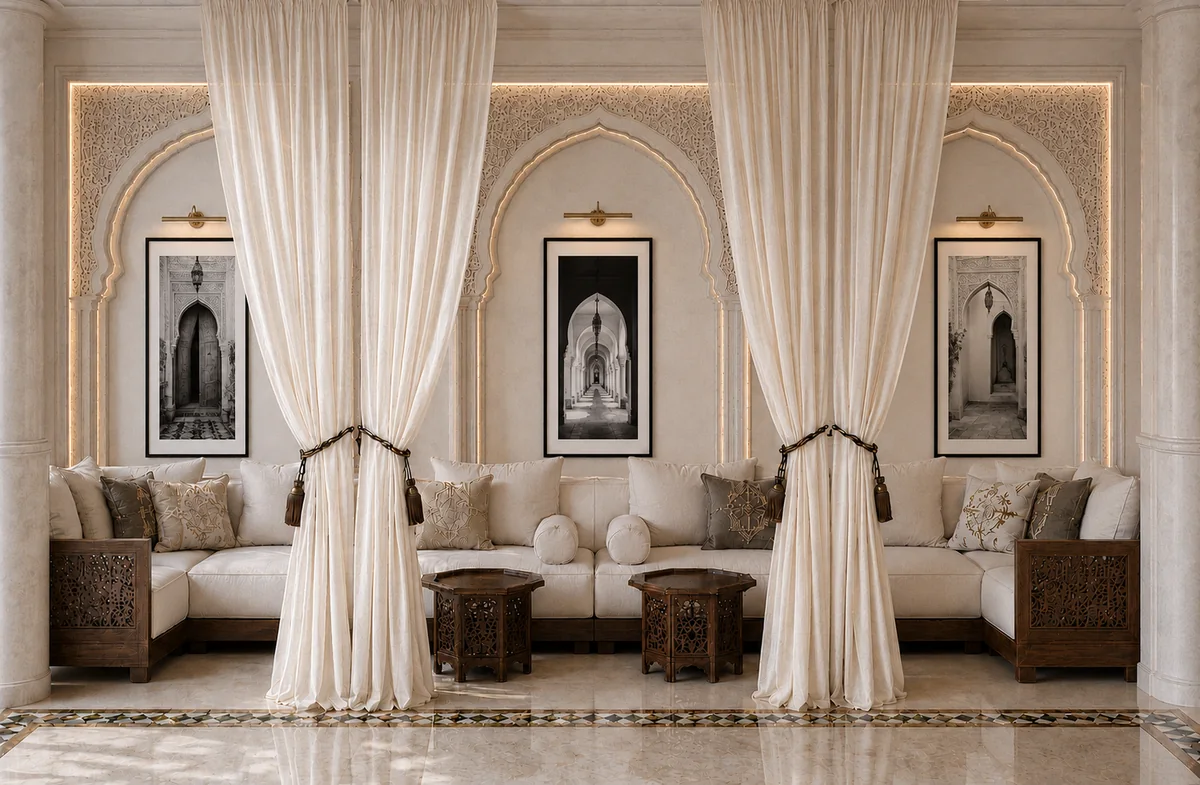
Investing in a riad in Marrakech captures the imagination. A discreet door in the Medina, a light-filled patio, rooms arranged around a pool, a terrace overlooking the city’s rooftops and sometimes the Atlas Mountains beyond. Behind that image, however, lies a much more complex reality.
Buying a riad in Marrakech is a property project. Investing in a profitable riad is an entrepreneurial project. Acquisition price is only part of the equation. You also need to analyse location, technical condition, architectural potential, works costs, hotel positioning, usable room count, average nightly rate, seasonality, operating costs and marketing strategy. A beautiful riad can be a poor investment.
Conversely, a fairly ordinary property at acquisition can become a strongly performing address when bought at the right price, intelligently renovated and properly operated. At Darnel Collection, we therefore see the riad as a three-dimensional asset:
Property + hospitality + experience.
This guide explains the main stages of investing in a riad in Marrakech in 2026, from finding the property to operating it. Have you identified a riad in Marrakech?
Before committing, Darnel Collection can assess its potential, positioning and the project’s principal economic assumptions with you.
Review my budget, conservative scenario and project
To invest in a riad, start with the hospitality offering and target guests, then check the property, total cost through to opening and income after costs under several scenarios. Darnel’s method links property, hospitality and experience; it does not infer profitability from room count or purchase price alone. This guide retains its 2026 context: its examples are not guaranteed operating results.
Preparing an investment for 2027? Consult the Marrakech investment guide for 2027 and, before signing, the riad buying guide. For the future property’s authorisations and classification, refer to the Ministry of Tourism’s official framework, to be checked against the programme.
Why invest in a riad in Marrakech?
Marrakech combines an international tourism destination with particularly recognisable property heritage. A riad is more than accommodation: it is itself part of the experience many travellers seek.
Patios, interior architecture, artisanal materials, terraces, vegetation, fountains, zellige, tadelakt and woodwork help create a hospitality product difficult to reproduce in a conventional building. This distinctiveness partly explains investor interest in the Medina. Four further factors make the market particularly worth studying.
1. Marrakech is an international tourism destination
Tourism accommodation performance first depends on the destination’s appeal. Marrakech attracts international and domestic guests and offers remarkable diversity: culture, food, wellness, golf, events, shopping, excursions, desert, mountains and high-end tourism. This diversity matters for investors.
It means a riad need not depend on one traveller type. According to positioning, a property may attract:
- couples
- groups of friends
- families
- premium travellers
- groups booking exclusive use of the whole riad
- businesses
- retreats and themed stays
travellers seeking a more authentic experience than a conventional hotel. The challenge is therefore not simply that Marrakech has tourists. It is to create an offer clear enough to capture part of that demand.
2. A riad is a scarce property asset
The Medina cannot expand indefinitely. New neighbourhoods of historic riads cannot be built like new residential developments on the outskirts. Every property also has its own characteristics:
footprint, floor count, patio width, orientation, access, terrace, neighbours, existing architecture and transformation potential. Two riads a few hundred metres apart can therefore have very different economic values. Scarcity obviously does not mean every riad will automatically appreciate.
Instead, intrinsic property quality and location are decisive from purchase onwards.
3. A riad combines property and operations
A rental apartment mainly produces rent. A riad operated as a guesthouse or boutique hotel has more levers. Revenue can come from overnight stays and, according to concept and applicable permissions, complementary services:
breakfast, dining, transfers, excursions, experiences, exclusive use, events, spa, massages, concierge services or packages. This is a fundamental distinction between buying a riad and investing in a professionally operated one. The investor owns more than square metres.
They potentially own a property asset associated with a hospitality business.
4. Marrakech supports different positioning strategies
There is no single profitable riad model. An ultra-premium four-room property follows a different approach from a ten-room guesthouse. Similarly, a riad mainly intended for exclusive use is not marketed like a boutique hotel sold room by room.
Possible models include:
The lifestyle riad: highly photogenic, built around design, social media and international guests. The premium riad:
few rooms, extensive services and a high average rate. The guesthouse riad: a more traditional model based on overnight stays and some additional services.
The exclusive-use riad: designed for families and groups with a total nightly price. The boutique hotel:
a more structured offer combining accommodation, dining and services. Concept directly influences which property to buy. We therefore recommend considering the hospitality product before acquisition.
How much does a riad cost in Marrakech in 2026?
This is generally an investor’s first question, and one of the hardest. There is no real “standard riad price in Marrakech”.
Value depends on many parameters:
- neighbourhood
- access
- area
- building condition
- legal situation
- architectural quality
- existing room count
- potential room count
- terrace
- plunge pool or swimming pool
- necessary works
commercial potential. General property statistics should therefore be used cautiously for Medina riads. For context, the official property asset price index published by Bank Al-Maghrib and the ANCFCC showed a quarterly price decline of 1.5% in Marrakech in the first quarter of 2026, with a 3.5% decline in the residential component. However, this concerns Marrakech’s aggregate property market, not an index specific to Medina riads.
A riad’s value must therefore be assessed individually.
The real budget is not the purchase price
A classic mistake is:
“I have €500,000 to invest, so I am looking for a €500,000 riad.”
For most transformation projects, this is dangerous. Instead, consider the budget as:
Acquisition + acquisition costs + works + decoration and furniture + equipment + studies and formalities + commercial launch + opening cash reserves + safety allowance. Suppose, solely for illustration, an investor has €600,000 overall. Buying at €350,000 or €400,000 and retaining a substantial allowance to create a stronger hospitality product may be far more appropriate than spending almost all capital on the purchase.
This naturally depends on the project and property. It nevertheless illustrates an essential principle:
a cheaper purchase is not necessarily less profitable, and a more expensive riad is not necessarily a better investment. Hesitating between several riads?
Darnel Collection can compare property, architectural and hospitality potential, helping you consider the whole project rather than the asking price alone. → Have my investment project assessed.
Where should you buy a riad in Marrakech?
Location is probably one of the criteria with the greatest investment impact. In the Medina, a few minutes on foot can change the traveller’s experience. Access, distance from vehicles, immediate surroundings, proximity to main attractions and neighbourhood perception matter as much as the address itself.
Districts regularly considered by investors include:
Kasbah
In the southern Medina, the Kasbah has a strong identity and significant historical heritage. It can be particularly interesting for guesthouses or riads seeking a more residential experience while remaining connected to tourist attractions.
Mouassine
Mouassine enjoys a central Medina location. Proximity to souks and main pedestrian routes can be a significant commercial advantage.
Dar El Bacha
This district is particularly sought after for its atmosphere and proximity to several premium Medina addresses. It can suit high-end concepts, naturally subject to acquisition price.
Riad Laarous
This district can offer an interesting balance between access and immersion in the Medina.
Mellah and the southern Medina
Proximity to several monuments and access points is also worth considering. The essential question, however, is not:
“What is Marrakech’s best neighbourhood?”
It is:
“Which neighbourhood best suits the hospitality concept I want to develop and the price I can pay?”
A premium location bought too expensively can sharply reduce profitability. A slightly less sought-after district bought on good terms may offer a better economic balance.
Renovated riad or riad to renovate: which should you choose?
This is one of the most important decisions.
Buying an already renovated riad
The principal advantage is obvious: operations can begin much sooner. Some construction risks are also reduced. But there is a major drawback.
You generally pay for the value created by the previous owner. Above all, you buy a product designed according to somebody else’s choices. Decoration, room layouts, circulation, kitchen, technical areas, rooftop and guest experience may not suit your intended positioning.
Buying a riad to renovate
This requires more skills and patience. In return, the property can be designed around future operations. That distinction is fundamental.
A hotel renovation should ask more than:
“Is it beautiful?”
It must also ask:
“Can it be operated effectively?”
Where will linen be stored?
How will staff circulate?
Where will breakfast be served?
How will noise between rooms be avoided?
Where will technical equipment be installed?
Can the terrace generate revenue?
Can a room be added without harming the experience?
Is reception genuinely necessary?
Where should storage go?
Design and operations must be considered together. This distinguishes renovating a private house from creating a boutique hotel.
How do you calculate a riad’s profitability in Marrakech?
This is probably the guide’s most important section. An investor should never buy a riad solely because it looks beautiful. They must build a hotel business plan.
Three variables are particularly important.
1. Occupancy rate
Occupancy is the percentage of available rooms actually sold. An eight-room riad open for 365 days has:
8 × 365 = 2,920 available room nights annually. At a hypothetical 65% occupancy:
2,920 × 65% = 1,898 room nights sold. Remember: projected occupancy is never guaranteed. It depends notably on positioning, price, product quality, distribution, online reputation and seasonality.
2. ADR, or average rate per room sold
ADR — Average Daily Rate — is the average rate actually received for a room sold. Again, imagine an example:
ADR: €150 with 1,898 room nights sold.
Theoretical room revenue would then be:
1,898 × €150 = €284,700 annually. This is obviously not a performance promise, but an example explaining the economic mechanism.
3. Additional revenue
This is where a well-designed property can develop revenue. A traveller can buy a room, but also:
- an airport transfer
- dinner
- an excursion
- a massage
- an experience
- a bottle
- a romantic package
- exclusive use
concierge services. The aim is not systematically to sell more. It is to offer services consistent with the desired experience.
The simplified formula
Start with:
Room revenue = available rooms × 365 × occupancy × ADR. Then add:
Additional revenue = dining + transfers + experiences + other services. Finally:
Operating result = revenue – operating costs. Only then can investors begin measuring their project’s potential economic performance. Want to understand a riad’s economic potential?
We can build several operating scenarios — conservative, central and ambitious — based on room count, positioning and intended average rate.
Assess my future riad’s profitability with Darnel Collection
Case studies: what can a riad in Marrakech really generate?
Discussing profitability without concrete figures offers little value to investors. Understanding riad economics requires connecting at least four variables:
capital invested, room count, occupancy and average nightly rate. Additional revenue and, above all, all costs needed to operate the property then follow. These case studies illustrate possible business models. They are neither promises of returns nor estimates automatically applicable to a future Darnel Collection project.
Case study 1 — A twelve-room boutique hotel in the Medina
Begin with an operating property positioned relatively high-end. A 2026 ReaConsult study presents a twelve-room boutique hotel in a premium Medina district near Bahia. It notably has two patios, a restaurant of approximately thirty covers, a hammam and a rooftop.
Communicated operating data for 2025 is as follows:
Indicator — Performance: room count
12; occupancy 68%
Average ADR MAD 2,100; RevPAR
MAD 1,428; room revenue MAD 6.26 million
Restaurant, hammam and services MAD 1.45 million; total revenue
MAD 7.71 million; GOP MAD 2.93 million
Published EBITDA MAD 2.40 million
The first lesson is particularly interesting. Rooms are not the whole revenue. Complementary activities here generate approximately MAD 1.45 million more, nearly 19% of total revenue.
This shows why we recommend never designing a riad around room count alone. Restaurants, rooftops, hammam, spa, experiences and services can contribute when coherent with the concept and properly operated. The study also estimates the operating business’s value at around MAD 27–31 million, depending on valuation assumptions. This is a published professional ReaConsult analysis, not a Darnel Collection valuation.
For investors, it illustrates an essential principle:
value can come from both property and operational quality.
Case study 2 — Darnel example: a seven-room riad sold room by room
Now consider a fictional project representative of an investment an owner might assess with Darnel Collection. Imagine a fully renovated seven-room boutique hotel. We deliberately use a relatively simple central scenario:
- seven rooms
- 365 operating days
- Average ADR: MAD 1,500
occupancy: 65%. Annual available room nights would be:
7 × 365 = 2,555. At 65% occupancy:
2,555 × 65% = approximately 1,661 room nights sold. At MAD 1,500 ADR:
1,661 × MAD 1,500 = approximately MAD 2,491,500 in room revenue. Add a 15% additional-revenue assumption from dining, transfers, experiences, massages, excursions and other services. This would represent approximately:
MAD 373,700 in complementary revenue. Theoretical annual total revenue would therefore approach:
MAD 2.87 million. This is obviously not the owner’s profit. Staff, consumables, distribution commissions, energy, maintenance, marketing, software, insurance, external services and other operating expenses must then be deducted.
A serious business plan must therefore always distinguish:
Gross revenue → operating margin → result → investor cash flow.
Own or considering buying a riad with five to ten rooms?
Darnel Collection can model its potential under different ADR, occupancy and complementary-revenue assumptions.
Request a personalised operating model from Darnel Collection
Case study 3 — The effect of positioning on revenue
Two riads with exactly the same room count can produce radically different results. Return to our fictional seven-room property and compare three scenarios.
Conservative scenario; central scenario; premium scenario
Rooms: 7; 7
- ADR: MAD 1,100
MAD 1,500; MAD 2,000. Occupancy:
55%; 65%; 72%
Room nights sold: ≈ 1,405; ≈ 1,661
≈ 1,840. Room revenue: ≈ MAD 1.55 million
≈ MAD 2.49 million; ≈ MAD 3.68 million
Room count has not changed between the conservative and premium scenarios. The building is the same. Yet theoretical room revenue rises from approximately MAD 1.55 million to 3.68 million.
Why?
Because hospitality asset performance depends on more than area. It depends on creating perceived value. Architecture, decoration, service quality, digital reputation, photography, location, guest experience and commercial strategy directly influence the price the market may accept.
Saving MAD 200,000 on renovation can therefore be a false economy if it prevents the property achieving the product level its positioning requires. Conversely, spending more absolutely does not guarantee higher ADR. Every expense must support perceived value or operational efficiency.
Case study 4 — The substantial impact of MAD 300 more ADR
Now imagine our seven-room riad operates at 65% occupancy. We have approximately:
1,661 room nights sold annually. At MAD 1,500 ADR:
Room revenue ≈ MAD 2.49 million. Suppose a better concept, photographs, strong reputation, more effective pricing and better experience allow MAD 1,800 average ADR without changing occupancy. Room revenue becomes:
1,661 × 1,800 = approximately MAD 2.99 million. Difference:
nearly MAD 500,000 more annual revenue, without building another room. This illustrates why revenue management and positioning matter as much as architecture.
The strategic question is more than:
“How do I fill my riad?”
It should be:
“How do I intelligently maximise revenue from every available room?”
This is precisely what RevPAR, revenue per available room, measures.
Case study 5 — Why direct bookings can change profitability
Consider distribution commissions. A 2026 case concerning an eight-room Medina riad states that approximately 80% of bookings initially came from Booking, with a reported effective commission of 18%. According to the study’s author, commissions then exceeded MAD 155,000 annually.
After developing direct bookings, their share reportedly reached 50%. OTA commissions would then have fallen from:
MAD 155,000 → MAD 72,000, a reported saving of approximately:
MAD 83,000 annually. This is particularly interesting because the property added no rooms and did not necessarily increase occupancy.
It simply changed distribution mix. For an owner, recovering MAD 83,000 annually can fund some marketing, SEO, advertising, photography or guest-experience improvements. Darnel Hospitality therefore considers distribution an integral part of profitability.
Booking and Airbnb are distribution tools. They should not be a riad’s entire commercial strategy.
Is your riad heavily dependent on Booking or Airbnb?
A strategy combining OTAs, website, SEO, social media, partnerships, email and direct bookings can progressively reduce dependence.
Discuss your distribution strategy with Darnel Hospitality
Case study 6 — The actual effect of occupancy
Return to our fictional seven-room riad at MAD 1,500 ADR. Look solely at occupancy’s effect:
At 50%:
7 × 365 × 50% × 1,500 = MAD 1,916,250. At 65%:
7 × 365 × 65% × 1,500 = MAD 2,491,125. At 75%:
7 × 365 × 75% × 1,500 = MAD 2,874,375. Between 50% and 75%, the difference is approximately:
MAD 958,000 in annual room revenue. This shows how poor marketing can harm a beautiful project’s performance, but also why business plans require caution.
Arbitrarily raising occupancy from 55% to 75% in Excel can make a project look highly profitable with no strategy supporting it. Occupancy must reflect market realities, positioning, seasonality, competition and commercial capability. For context, published Marrakech data showed 73% occupancy in classified tourism accommodation in 2025, up two points year on year. This concerns all classified tourism establishments in the destination, not a guaranteed rate for any particular riad.
What these case studies teach us
These examples reveal a fundamental conclusion. Riad profitability in Marrakech never depends on one figure. Successful investment results from mutually reinforcing levers:
buy well + design intelligently + control works + create distinctive positioning + optimise ADR + fill rooms + develop complementary revenue + control costs + progressively increase direct bookings. Assess this combination before purchase. Darnel Collection therefore prefers several scenarios to announcing a single theoretical return.
For one project, we can build:
Conservative scenario — deliberately cautious assumptions. Central scenario — performance matching the project’s operational objectives. High scenario — possible performance if positioning and operations achieve their aims.
This answers a question more important than “What can my riad generate?”:
“Does my investment remain attractive if performance is worse than expected?”
That distinguishes an appealing property opportunity from a genuinely considered hospitality investment.
Identified a riad in Marrakech?
Before signing, establish the full economic scenario: investment, renovation, room count, ADR, occupancy, complementary revenue and operations.
Book a meeting with Darnel Collection
Present your project directly on WhatsApp
What costs should you allow when operating a riad?
Revenue must never be confused with profitability. A riad has many expenses, including:
staff, energy, water, internet, linen, laundry, guest amenities, breakfast, maintenance, repairs, software, accounting, insurance, marketing and distribution. Also account for booking platform commissions. Heavy OTA dependence can generate many bookings alongside substantial distribution costs.
Progressively building a direct clientele is therefore strategic. Website, SEO, social media, email database, partnerships, ambassadors and loyalty should develop some direct sales.
Booking, Airbnb or direct bookings?
Generally, all three can play a role. Platforms bring considerable visibility, notably helping recent properties obtain their first bookings and reviews.
The medium-term aim should be a brand strong enough for some travellers to book directly. Imagine someone discovers the riad on a platform.
They search its name on Google, check Instagram and visit the website.
They read reviews, then book directly. The platform enabled discovery without necessarily becoming the final channel.
We therefore consider that a performing riad should be a hospitality brand, not simply a Booking or Airbnb listing.
What are the main risks when investing in a riad?
Like every investment, buying a riad carries risks. Ignoring them would be a mistake.
Risk 1: buying too expensively
An exceptional property can remain a poor investment if acquisition price prevents a coherent return.
Risk 2: underestimating works
Old buildings can reveal issues invisible at the first viewing. Structure, damp, waterproofing, electrical systems, plumbing and roofs need careful examination. Allow a safety margin.
Risk 3: prioritising decoration over operations
An Instagram-friendly riad is not automatically profitable. Poor layout can create additional costs for years.
Risk 4: overestimating average rates
An ADR of €250 because three nearby properties display that rate on Booking is not market research. The displayed rate is not necessarily the sold rate.
Risk 5: overestimating occupancy
The same problem applies. Ambitious assumptions can artificially turn any project into an excellent Excel deal. Include several scenarios.
Risk 6: neglecting legal and ownership status
Documentary checks are essential before acquisition. The ANCFCC notably notes that land registration and certain title operations require deeds and documents establishing existing rights. In the Medina, where situations can be more complex than in some recent developments, working with qualified professionals is particularly important.
A notary and, depending on circumstances, other legal or technical advisers should check the file before commitment.
Ten points to check before buying a riad in Marrakech
Before acquisition, we recommend at least examining:
1. Legal status
Who owns it? Which documents exist? Are there rights or charges to consider?
2. Actual area
Do not rely solely on a listing.
3. Structural condition
Some defects can have significant financial consequences.
4. Access
How far must you walk from a vehicle?
5. Neighbourhood and immediate surroundings
Visit at several times of day.
6. Room potential
A large area does not automatically mean many usable rooms.
7. Terrace
In Marrakech, it can be a major part of the experience.
8. Technical spaces
Anticipate storage, kitchen, linen, staff and equipment.
9. Architectural potential
Which features can be preserved and enhanced?
10. Business plan
What reasonable revenue could the project generate after renovation?
Found a property and want another perspective before committing?
Darnel Collection supports investors in assessing location, concept, architecture, works and future operating potential.
Show us the riad you are considering
How do you turn a riad into a genuine boutique hotel?
A riad becomes truly interesting when it has an identity. Offering “a beautiful Moroccan room” no longer necessarily differentiates an address. Travellers quickly compare dozens of properties.
Give them a reason to remember yours. Architecture, food, design, wellness, artistic character, a story or exceptional service can provide that distinction. Darnel Collection follows a simple approach:
Concept → architecture → experience → image → distribution → operations. Each reinforces the next. A premium concept with mediocre photography loses perceived value.
Beautiful images with a disappointing real experience lead to poorer reviews. An excellent experience without distribution leaves rooms empty. Performance comes from the system’s coherence.
Should you manage your riad yourself?
This mainly depends on the investor’s profile. Some owners want personal operational involvement. Others prefer a managed investment.
Understand, however, that a riad is a small hotel business. You must manage:
bookings, prices, staff, guests, reviews, incidents, suppliers, platforms, maintenance, marketing and finances — 365 days a year if open throughout the year. Professional management can therefore be relevant when the owner wants to focus on being an investor rather than everyday operations.
What strategy should you adopt for riad investment in Marrakech in 2026?
Our approach can be summarised in seven stages.
Stage 1 — Define the total budget
Not only acquisition budget.
Stage 2 — Define the business model
Rooms, exclusive use, boutique hotel, premium, lifestyle…
Stage 3 — Find the property matching the concept
Not the reverse.
Stage 4 — Carry out necessary checks
Legal, technical, architectural and economic.
Stage 5 — Design the hospitality product
Room count, shared spaces, rooftop, services and identity.
Stage 6 — Renovate with operations in mind
Every architectural choice should consider guest experience and operational constraints.
Stage 7 — Prepare marketing before opening
Photography, website, social media, OTAs, search visibility, partnerships and pricing must be prepared in advance.
Riad investment: think value creation rather than property purchase
This is probably the most important idea to retain. A riad project’s potential is not simply the difference between today’s purchase price and tomorrow’s resale price. Value can be created at several levels.
Property value
Rehabilitating the building and improving its quality.
Architectural value
Creating a coherent identity and enhancing existing heritage.
Hospitality value
The property’s capacity to generate revenue.
Brand value
Reviews, digital presence, returning guests and reputation.
Operational value
Processes, team and distribution that make the property perform. The most interesting project is therefore not necessarily the market’s most beautiful riad. It is the one with the best value-creation potential relative to invested capital and accepted risk.
Why seek support when investing in a riad in Marrakech?
A riad project brings several professions together:
property, architecture, construction, decoration, hospitality, revenue management, marketing and finance. Engaging each separately can work, but may also create contradictions.
The architect wants aesthetics. The operator wants simpler operations. Marketing wants striking spaces.
The investor wants budget control. An integrated approach aligns these interests around a shared objective:
creating a beautiful, operable and economically coherent asset.
Darnel Collection: from investment to operations
Darnel Collection takes a comprehensive approach to riads and boutique hotels in Marrakech. Our vision goes beyond purchase and considers the entire cycle:
Invest → Design → Renovate → Position → Market → Operate → Enhance value. This allows early questions that determine future performance. Which concept?
Which guests?
How many rooms?
What average rate?
Which services?
What experience?
What works budget?
What revenue potential?
Which distribution strategy?
Which management model?
These decisions, made before and during the project, can distinguish owning a beautiful riad from building a genuine hospitality asset.
Looking to invest in a riad in Marrakech?
Whether considering the idea, actively searching or already having identified a riad, the first step is to assess the whole project. Darnel Collection can examine with you:
- property potential
- location
- positioning
- architectural potential
- principal renovation assumptions
- operating model
- revenue scenarios
marketing strategy. The aim is more than finding a riad: it is building a coherent project capable of becoming an attractive address and performing hospitality asset.
Have an investment project in Marrakech?
Present it to us and let us discuss its potential.
Book a meeting with Darnel Collection
Speak directly on WhatsApp
Frequently asked questions about investing in a riad in Marrakech
Is investing in a riad in Marrakech profitable?
Profitability depends on acquisition price, works, room count, positioning, average rate, occupancy and operating costs. No profitability rate applies to every riad.
What budget should you allow to buy a riad in Marrakech?
Consider the total budget, not only purchase price: acquisition, costs, works, furniture, equipment, launch and cash reserves must be included.
What is the best neighbourhood for buying a riad in Marrakech?
No neighbourhood suits every project. Kasbah, Mouassine, Dar El Bacha, Riad Laarous and other Medina districts have different characteristics. Choose coherently with the concept, budget and intended guests.
Is it better to buy renovated or to renovate?
A renovated riad may shorten time to opening. One to renovate allows more customisation and may offer greater value-creation potential, but carries more construction risk.
How many rooms does a riad need to be profitable?
There is no universal count. A small property with high ADR can perform while a larger, poorly positioned one may not. Analyse potential revenue against investment and costs.
Can you delegate riad management?
Yes. Professional hotel management can notably cover operations, revenue management, distribution, teams and guest experience according to the chosen contract.
How do you find a riad with strong potential?
Look beyond current decoration. Location, structure, usable area, access, potential rooms, terrace and the possibility of creating a distinctive experience often matter more than appearance at the first viewing.
Darnel Collection — Invest. Transform. Operate.
Also read
Explore further
Property prices and the Marrakech market · 17 September 2026 · 9 min
How much does a riad cost in Marrakech? Neighbourhood prices and budgets for 2026
Neighbourhoods, building condition, renovation and operations: look beyond the asking price to establish the full budget for your riad project.
Read the article →
Property investment in Marrakech · 25 September 2026 · 13 min
Investing in a boutique hotel in Marrakech: what profitability can you expect?
Room nights, spa, dining, additional sales and packaged stays: analyse a distinctive boutique hotel’s target profitability.
Read the article →
Renovating and creating a riad · 18 September 2026 · 11 min
How much does it cost to renovate a riad in Marrakech? Prices, budgets and advice for 2026
Costs per m², structure, craftsmanship, equipment and contingencies: build a realistic budget to transform a riad in Marrakech.
Read the article →