
Invest
Investing in a riad in Marrakech: how much is really left after all expenses?
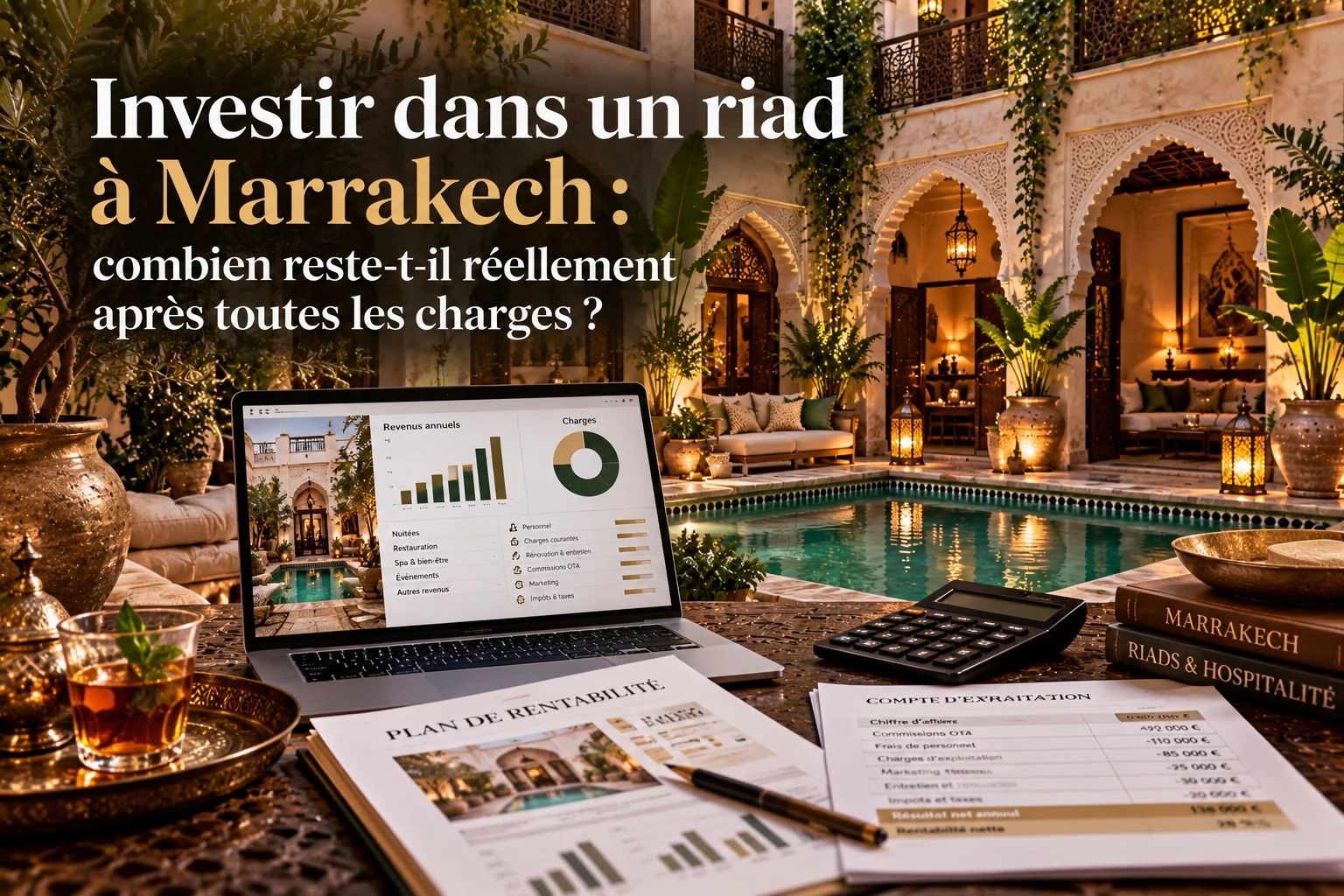
A riad in Marrakech generates €300,000 in annual revenue.
On paper, it looks appealing.
With seven rooms, an attractive courtyard, a rooftop and a few additional services, you may imagine an investment capable of bringing you €100,000 or even €150,000 each year.
But one question deserves to be asked before you sign: of that €300,000 in revenue, how much actually ends up in your pocket?
Between Booking commissions, salaries, operating expenses, management fees, maintenance work, taxes and possible loan repayments, the difference can be considerable.
This is probably one of the most common mistakes in hotel investment: confusing a property that generates substantial revenue with one that actually makes money.
A riad can report 80% occupancy and deliver disappointing earnings.
Conversely, a guesthouse with lower occupancy but better positioning can achieve greater profitability.
At Darnel Collection, we believe an investment should be assessed across three dimensions: the capital invested, operating performance and the cash actually available.
In this article, we break down the expenses of a riad in Marrakech, build a complete financial example and compare three scenarios to understand what an owner can reasonably expect to retain.
Direct answer: in our seven-room simulation, €284,113 in revenue produces an operating result of €68,725, simulated net profit of €27,725 and theoretical cash remaining of €24,725 after the movements detailed below. These amounts are not interchangeable. The €7,000 tax amount is an illustrative provision, not a verified Moroccan tax calculation; the remaining cash is not automatically distributable.
To connect these costs with the capital required, consult the Marrakech investment guide for 2027; before buying, use the checks in the riad buying guide.
1. A riad's revenue: the starting point, never the final result
Take a seven-room riad in the Marrakech Medina.
Imagine a renovated, properly marketed property with a rooftop and a few additional services.
Its annual assumptions are as follows:
On small screens, scroll the table horizontally if needed.
| Indicator | Assumption |
|---|---|
| Number of rooms | 7 |
| Average daily rate (ADR) | €150 |
| Occupancy rate | 65% |
| Room nights sold | About 1,661 |
| Room revenue | €249,113 |
| Additional revenue | €35,000 |
| Total revenue | €284,113 |
The calculation of accommodation revenue is simple:
7 rooms × 365 days × 65% occupancy × €150 = €249,112.50.
The additional €35,000 may come from dining, massages, transfers and experiences, provided these are revenues that can properly be recognised by the property. When the property receives only a commission on a service sold by a partner, the full price paid by the guest should not automatically be recorded as its own revenue.
This gives us theoretical annual revenue of approximately €284,000.
But this amount does not represent the money earned by the owner.
It represents only the revenue generated by the business.
To understand what remains, we must now examine the expenses.
All simulations in this article are expressed in euros, on an annual basis and with an assumed consistent scope of revenue and expenses excluding taxes on sales. These amounts are not observed market averages.
2. First expense: Booking commissions and booking platforms
Booking platforms play a major role in marketing riads in Marrakech.
They provide visibility, simplify reservations and help reach international guests.
But using them has a cost.
Suppose 70% of our riad's accommodation revenue comes from platforms, with a hypothetical average commission of 18%.
The calculation becomes:
€249,113 × 70% × 18% = €31,388 in annual commissions.
Over five years, with identical activity and terms, this would amount to almost €157,000.
This does not mean you should abandon Booking or Airbnb.
The aim is to gradually build a more balanced distribution mix: platforms, your website, returning guests, agencies, referrals and partners.
A direct booking is not free either. It may require advertising expenditure, booking tools and sales staff.
But every percentage point saved on commission can help improve earnings.
Darnel advice: do not measure only the number of bookings. Measure the revenue actually retained after the costs of each channel.
3. Second expense: salaries and day-to-day operations
A seven-room riad is a small hotel business.
But being small does not mean having no expenses.
To offer a professional experience, you need reception, housekeeping, breakfast preparation, coordination of service providers, maintenance and sometimes dining or spa services.
In our simulation, we use €85,000 in annual staffing costs, or approximately €7,083 per month. This item should be understood as the full staffing cost assumed for the example: salaries, employer contributions and any additional staff, without counting services already invoiced by a manager a second time.
This budget is illustrative: it depends on organisation, pay levels, social contributions, outsourced services and the level of service.
A premium property may require a larger team than a riad offering accommodation alone.
The challenge is to find the right balance.
Cutting staff too far can damage the guest experience, reviews and ultimately the average room rate.
Conversely, an oversized organisation can absorb an excessive share of revenue.
So the right question is not simply: “How can we pay fewer employees?”
It is rather: “What organisation delivers the expected service level at the most appropriate cost?”
4. Third expense: the costs investors underestimate
Beyond salaries and commissions, a riad incurs many recurring expenses.
Linen, laundry, water, electricity, guest amenities, consumables, food, software, insurance and maintenance must be included in the business plan.
Here is our complete simulation.
On small screens, scroll the table horizontally if needed.
| Annual expense item | Amount |
|---|---|
| OTA commissions | €31,388 |
| Staff | €85,000 |
| Dining and spa purchases | €14,000 |
| Energy and water | €18,000 |
| Linen, housekeeping and consumables | €11,000 |
| Routine upkeep and maintenance | €12,000 |
| Marketing and direct bookings | €9,000 |
| Administration, insurance and software | €10,000 |
| Outsourced management and coordination | €25,000 |
| Total operating expenses | €215,388 |
This simulation describes a hypothetical organisation, not a contractual Darnel Hospitality budget. To compare self-management with delegated management, the budget must be rebuilt line by line: specify the manager's responsibilities, apply their rate to the base defined in the contract and remove tasks already included in other items. Simply adding a management percentage to the €215,388 risks counting some functions twice.
With €284,113 in revenue, simplified operating earnings before depreciation, interest, taxes and certain property costs amount to:
€284,113 − €215,388 = €68,725.
That is already a considerable difference.
The riad generates almost €284,000 in revenue, but retains only about €69,000 at this stage of the calculation.
Please note: the €25,000 in outsourced management is a purely illustrative assumption and does not correspond to Darnel Hospitality's contractual fees. For delegated operations, fees must be calculated on the applicable contractual base and functions already covered by the manager must be removed from other expenses to avoid double counting. The results shown must therefore not be used as a forecast for Darnel Hospitality management.
Are you considering buying a riad in Marrakech?
Before committing, have the total cost of your project, its revenue potential and the expenses needed to operate it analysed.
Book my Darnel Collection advisory appointment →

5. Operating earnings and net profit: two very different figures
The €68,725 calculated above is still not the owner's net profit. The €8,000 in other expenses shown below must be itemised and justified for each project: taxes, property-related costs and expenses not already counted in operations. It is not a flat charge applicable to every riad.
We still need to examine expenses outside our operating scope, depreciation, financing interest and taxation.
Take the following assumptions:
On small screens, scroll the table horizontally if needed.
| Calculation step | Amount |
|---|---|
| Annual revenue | €284,113 |
| Operating expenses | −€215,388 |
| Simplified operating earnings | €68,725 |
| Other expenses outside the operating scope | −€8,000 |
| Depreciation | −€18,000 |
| Financing interest | −€8,000 |
| Profit before tax | €34,725 |
| Hypothetical tax | −€7,000 |
| Simulated net profit | €27,725 |
We therefore move from approximately €284,000 in revenue to €27,700 in net profit.
That is a net margin of nearly 9.8%.
This result is not a performance forecast for Marrakech riads. It demonstrates the importance of expenses.
Depreciation, interest and taxes vary according to the ownership structure, depreciable investments, financing and applicable tax regime. The €7,000 tax amount is an illustrative provision, not the result of a verified Moroccan tax calculation. Accounting net profit does not necessarily correspond to the investor's personal income, particularly where dividends are distributed.
High revenue never guarantees high profit.
6. And how much is actually left in the bank account?
There is one final fundamental distinction.
Accounting net profit is not necessarily equal to available cash.
Why?
Because depreciation reduces accounting earnings without causing a cash outflow when it is recorded.
Conversely, repayment of loan principal consumes cash without being an expense in the income statement.
Equipment replacement can also require substantial expenditure.
Returning to our example:
On small screens, scroll the table horizontally if needed.
| From profit to cash | Amount |
|---|---|
| Simulated net profit | €27,725 |
| Depreciation added back | +€18,000 |
| Loan principal repayment | −€12,000 |
| Equipment replacement | −€9,000 |
| Theoretical remaining cash | €24,725 |
This calculation assumes there are no other significant cash movements, particularly changes in working capital requirements.
And the €24,725 does not automatically represent an amount freely distributable to the owner: reserves and obligations may still apply.
That is why we recommend preparing both an income statement and a cash flow plan.
A riad can be profitable on paper yet struggle to meet its payment obligations.
Simulator: from revenue to cash
Change the example’s annual assumptions. Entered expenses stay fixed when you change occupancy or the average rate; adjust each item to your scenario.
Estimated annual results
- Room revenue
- Total revenue
- OTA commissions
- Operating expenses
- Simplified operating earnings
- Profit before tax
- Simulated net profit
- Theoretical remaining cash
- Net margin
- Net profit / invested capital
Educational simulation in euros, with an assumed consistent scope excluding taxes on sales, rounded to the nearest euro. No automatic tax calculation: tax is an entered provision independent of earnings. The management item is illustrative and unrelated to Darnel Hospitality contractual fees; avoid overlapping functions. Cash assumes unchanged working capital and is not automatically distributable. The profit/capital ratio is an accounting measure. No performance forecast or guarantee.
7. Three scenarios: how much can a seven-room riad earn?
Clearly, not every riad performs the same way.
Location, architectural quality, room count, ADR, distribution and organisation can produce very different results.
Let us compare three illustrative scenarios. The table below is a sensitivity grid for revenue and assumed margins; it is not a complete operating forecast. The net profits shown cannot be derived from occupancy and ADR alone: they assume expense budgets, depreciation and taxation specific to each scenario.
On small screens, scroll the table horizontally if needed.
| Indicator | Conservative | Central | Strong performance |
|---|---|---|---|
| Rooms | 7 | 7 | 7 |
| ADR | €110 | €150 | €200 |
| Occupancy | 50% | 65% | 75% |
| Room revenue | €140,525 | €249,113 | €383,250 |
| Additional revenue | €15,000 | €35,000 | €65,000 |
| Total revenue | €155,525 | €284,113 | €448,250 |
| Assumed net margin (not modelled) | 0% | 9.8% | 20% |
| Hypothetical net profit (not modelled) | €0 | ≈ €27,700 | ≈ €89,650 |
To measure sensitivity to expenses more concretely, take another educational assumption: €135,000 in annual fixed operating costs and variable costs equal to approximately 28.3% of revenue. Before depreciation, interest and taxes, this simplified model gives approximately −€23,500 in the conservative scenario, +€68,700 in the central scenario and +€186,400 in the strong-performance scenario. These are not net profits: they illustrate only the effect of spreading fixed costs over greater revenue. In practice, staffing costs, commissions, purchases and management do not all move at the same rate; each scenario therefore requires its own detailed budget. The net margins in the table remain unvalidated assumptions, not observed industry rates.
The strong-performance scenario requires the ability to sustain a higher ADR, maintain solid occupancy and control costs despite business growth.
These scenarios demonstrate one thing: profitability is determined not only by the building, but by how it is designed, positioned and operated.
8. The purchase price completely changes your return
Now imagine our riad generates €60,000 in annual net profit.
If it required a total investment of €500,000, the ratio of accounting net profit to invested capital is 12%. This ratio is not the cash return actually distributed to the owner.
If it cost €900,000, the same accounting ratio falls to just 6.7%.
The hotel performance is identical.
But the return on invested capital is very different.
That is why you must consider the full project cost: acquisition, fees, renovation, furniture, equipment, pre-opening and tied-up capital.
Darnel advice: before buying, set a target return and build a conservative scenario. Do not choose the return after choosing the riad.
9. Five ways to improve your profit
Once expenses have been identified, several actions can improve results.
First lever: increase ADR. A €10 increase in the average room rate for a seven-room riad at 65% occupancy represents approximately €16,608 in additional annual revenue, with occupancy unchanged.
Second lever: develop direct bookings. A better channel mix can reduce the weight of commissions, provided guest acquisition costs are controlled.
Third lever: develop profitable additional sales. Spa, dining and experiences can increase revenue per guest, but each service must be assessed after its direct costs.
Fourth lever: optimise organisation. Better planning of teams, purchasing and maintenance can limit unnecessary expenses without damaging service quality.
Fifth lever: strengthen the brand. Professional photography, a consistent identity, excellent reviews and a distinctive experience can help sustain rates.
Is your project profitable in a conservative scenario?
Do not rely solely on the revenue claimed by a seller or on an optimistic projection.
Have my business plan analysed with Darnel Collection →
10. The real risk: buying a riad whose operations do not justify the price
A riad can be magnificent, perfectly renovated and located in a sought-after neighbourhood.
But if its purchase price is too high relative to its earnings capacity, the investment can become unattractive.
That is why we recommend carrying out the financial analysis before the final negotiation.
In particular, check the number of rooms that can actually be sold, historical expenses where the property is already operating, the necessary permits and future works.
An incorrect expense assumption can profoundly change a project's economic value.
Read our analysis of seven mistakes that can turn buying a riad in Marrakech into a bad investment.
Conclusion: what matters is not what your riad takes in, but what it retains
Investing in a riad in Marrakech can help develop both a property asset and a hotel business.
But profitability is never measured by revenue alone.
You must understand commissions, salaries, expenses, management fees, taxation, future investments and cash requirements.
Our example demonstrates this: a property generating €284,000 in revenue may produce only about €27,700 in net profit in a given configuration.
Another property, better positioned and more efficiently operated, may achieve a higher result.
Before investing, ask the essential question: how much will really remain after all expenses?
At Darnel Collection, we favour a comprehensive approach: analyse the property asset, build a coherent hotel concept and test each project against realistic financial assumptions. For decision-making, we recommend three complementary measures: operating margin, accounting net profit and cash available after debt service and equipment replacement. Assumptions must be tested against actual accounts and quotations before any investment decision.
Review my costs and cash flow plan →
FAQ: expenses and net profit of a riad in Marrakech
What percentage of revenue does the owner actually retain?
There is no universal percentage. In our illustrative scenario, net profit of €27,725 on revenue of €284,113 represents approximately 9.8%. After the detailed cash movements, €24,725 theoretically remains, without being automatically distributable. The €7,000 tax amount is an illustrative provision; this is not an observed market margin.
Are Booking commissions deductible from revenue?
To analyse performance, distinguish gross accommodation revenue from commissions incurred. Their exact accounting and tax treatment must be validated for the property concerned.
How much does managing a riad in Marrakech cost?
The cost depends on the services and contract. At Darnel Hospitality, the communicated management plans are 30% including tax over one year, 25% including tax over three years and 20% including tax over five years, based on a defined contractual base. They must not be applied automatically to total revenue.
Can a five-room riad be more profitable than a seven-room riad?
Yes. A higher average room rate, better distribution and controlled expenses can offset lower capacity.
Should maintenance work be included in the business plan?
Yes. Routine maintenance is part of operating expenses, while some replacements or major works may constitute separate capital investments.
Does repaying a loan reduce net profit?
Interest can affect accounting earnings. Repaying principal affects cash, but is not an expense in the income statement.
What return should you target before buying a riad?
Define a target return consistent with the risk, invested capital, operating constraints and alternative investments. No single rate suits every project.
How can you tell whether a riad offered for sale is genuinely profitable?
Request operating accounts, booking data, commissions, expenses, permits and required works. Then have a conservative scenario built independently of the seller's forecasts.