
Riad profitability
What profitability can you expect from a riad in Marrakech? Calculations, figures and 2026 examples
ADR, occupancy, RevPAR, costs and additional revenue: three scenarios for assessing a riad’s potential profitability in Marrakech.
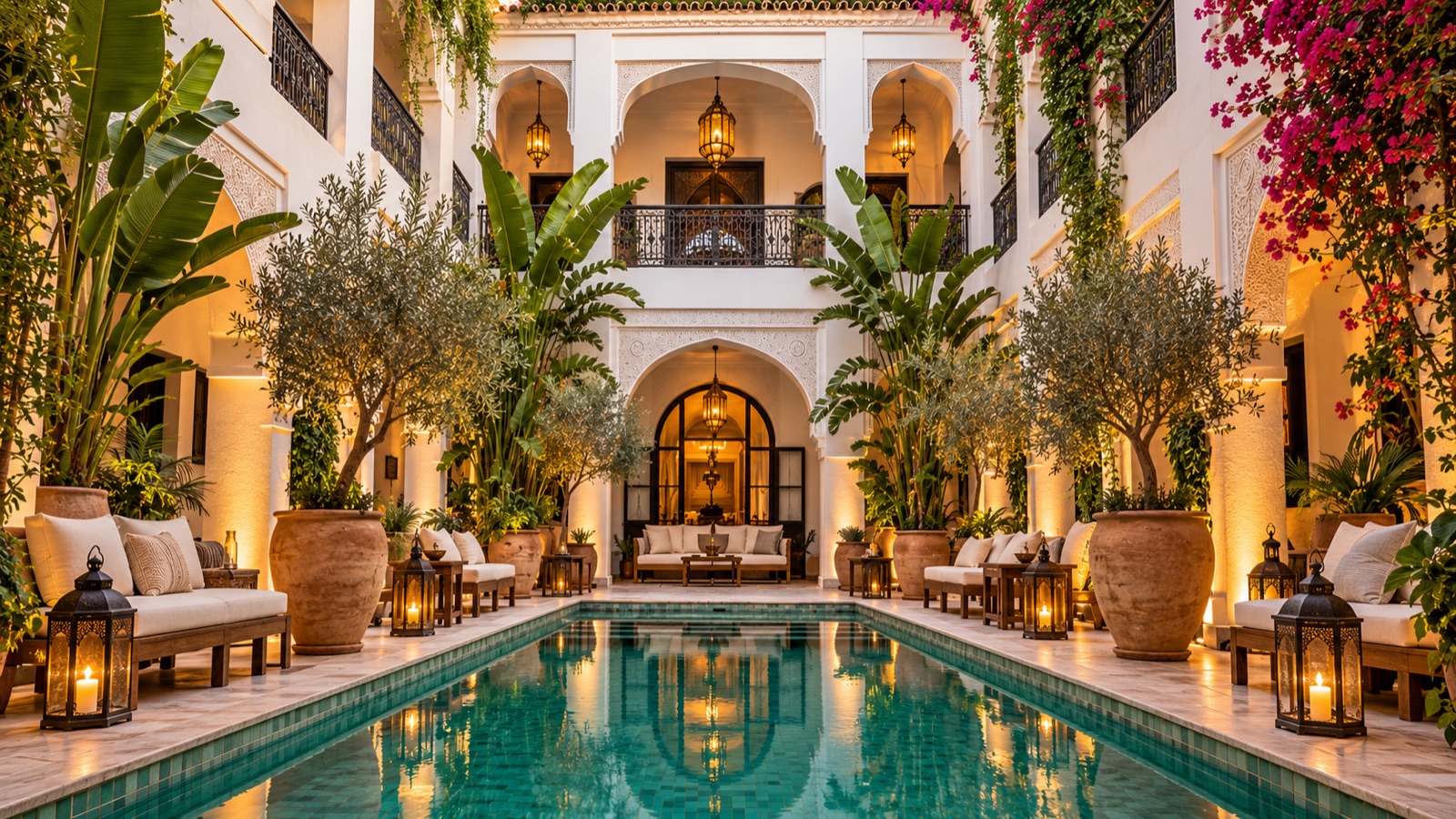
What can a riad in Marrakech really generate? This is one of an investor’s first questions before buying in the Medina. Yet the answer depends on many factors: acquisition price, renovation budget, room count, average nightly rate, occupancy, additional revenue and operating costs.
An exceptionally well-positioned five-room riad can generate more revenue than an eight-room property sold much more cheaply. At Darnel Collection, we therefore prefer to analyse projects through several scenarios rather than announce a theoretical return applicable to every riad.
This guide explains how to calculate a riad’s potential profitability in Marrakech, using market data and several examples. If hospitality investment is new to you, start with our complete guide to investing in a riad in Marrakech in 2026.
There is no standard return for a riad. In Darnel’s simulation, seven rooms available for 365 days, at 65% occupancy and an ADR of MAD 1,500, generate MAD 2,491,125 in annual room revenue, not profit. To calculate a return, specify the earnings measure and costs included, then divide by total capital committed. Darnel’s method compares several scenarios on a consistent basis.
To distinguish operating earnings, profit and cash flow, consult our analysis of riad operating costs. Before setting your acquisition price, compare these assumptions with the Marrakech investment guide for 2027.
At a glance: what can a riad in Marrakech generate?
Consider a deliberately simple example. A seven-room riad operating all year at 65% occupancy and an average room rate of MAD 1,500 could theoretically generate:
MAD 2,491,125 in annual room revenue.
If additional revenue equalled 15% of room revenue, theoretical total revenue would reach approximately MAD 2.87 million annually.
Remember: revenue is not profit. Staff, energy, food service, linen, maintenance, distribution commissions, marketing, management and other costs must then be deducted. This example is therefore neither a forecast nor a promise of returns.
What you will learn
- recent tourism figures for Marrakech;
- how to calculate riad revenue;
- how to understand ADR, occupancy and RevPAR;
- three profitability scenarios;
- the actual effect of room count;
- the potential of additional revenue;
- the main costs to anticipate;
- ways to improve performance.
Marrakech: a tourism market to analyse before investing
Before calculating riad profitability, understand the market in which it will operate. The latest available data confirms sustained tourism activity in Marrakech.
By the end of May 2026, Marrakech’s classified tourism accommodation establishments had recorded 6.05 million overnight stays, up 10% on the first five months of 2025. Marrakech then represented approximately 33% of nationally recorded overnight stays.
Occupancy in classified establishments reached 72% over the first five months of 2026 and 78% for May alone. These figures, published from Tourism Observatory data, are available on the official portal of the Kingdom of Morocco.
They must nevertheless be interpreted cautiously. They concern Marrakech’s classified tourism accommodation as a whole. They certainly do not mean a new Medina riad will automatically achieve 72% occupancy. This is precisely why a business plan must use project-specific assumptions.
Three essential indicators for calculating riad profitability
Before discussing returns, understand three indicators.
1. Occupancy rate
Take a seven-room riad open throughout the year. It theoretically has:
7 × 365 = 2,555 available room nights.
At 65% occupancy:
2,555 × 65% = approximately 1,661 room nights sold.
Occupancy matters, but should never be analysed alone. A property filled to 90% through very low rates is not necessarily performing better than a riad at 65% with premium positioning.
2. ADR
Average Daily Rate is the average price actually obtained for each room sold. If 100 rooms sell at MAD 1,200 and another 100 at MAD 1,800, ADR is MAD 1,500.
3. RevPAR
Revenue Per Available Room combines rate and occupancy.
ADR × occupancy rate = RevPAR
With ADR of MAD 1,500 and occupancy of 65%, we obtain RevPAR of MAD 975.
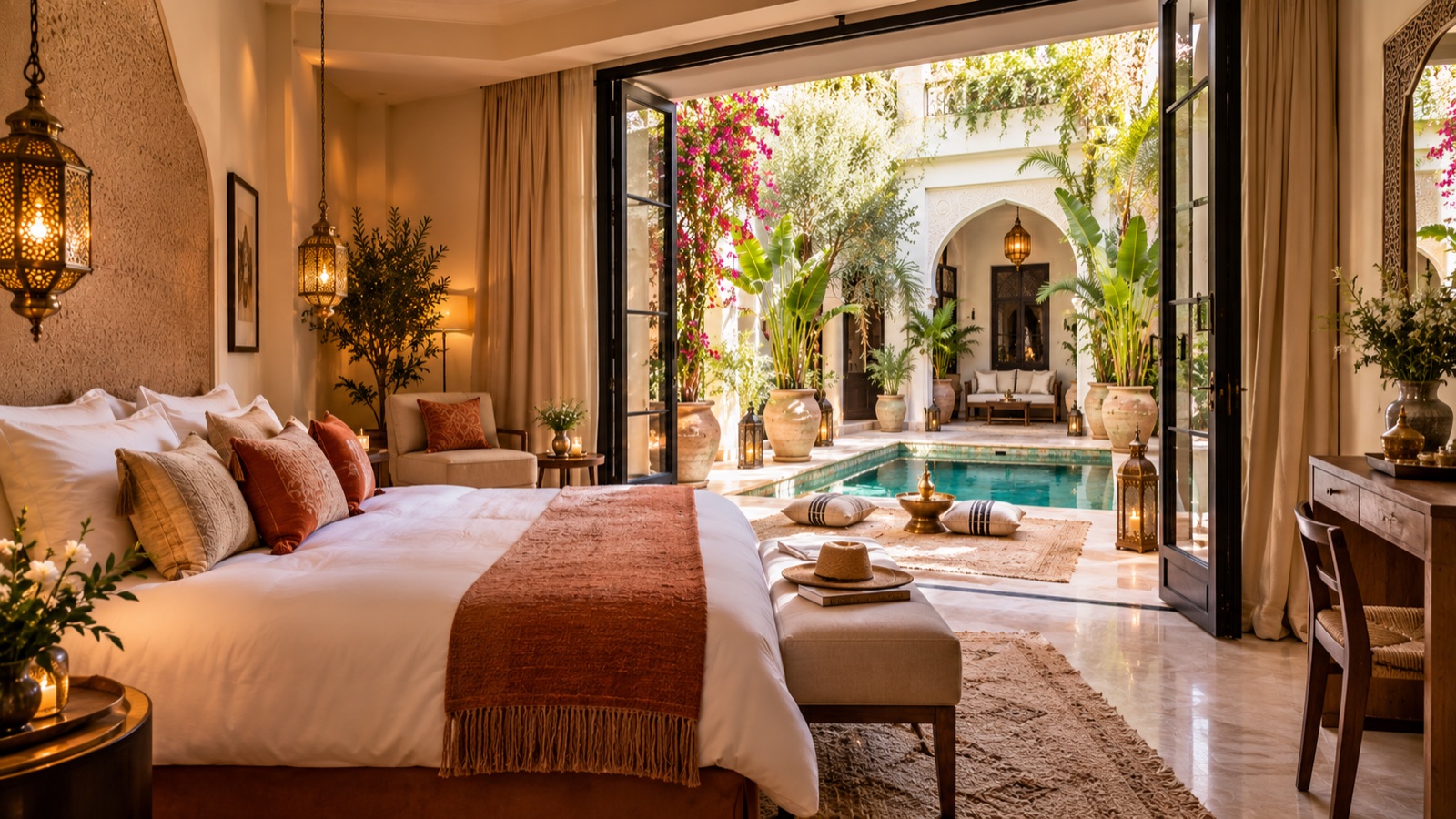
A riad’s economic performance notably depends on creating enough perceived value to support its average rate.
Considering investing in a riad? Access the free masterclass: The 7 keys to a successful investment: acquisition, renovation, positioning and operations.
How do you calculate riad revenue?
The starting formula is relatively simple:
Room count × 365 × occupancy × ADR
Take our fictional seven-room riad:
7 × 365 × 65% × MAD 1,500 = MAD 2,491,125 in theoretical annual room revenue.
This is only the first stage. To establish actual profitability, add other revenue and, above all, account for costs. Revenue must also be compared with total capital invested, not only the purchase price. We explain this distinction in How much does a riad cost in Marrakech?.
Three scenarios for assessing potential profitability
At Darnel Collection, we recommend never basing an investment decision on one scenario. Take exactly the same seven-room riad.
Conservative scenario
- Occupancy: 50%
- ADR: MAD 1,100
- Room nights sold: approximately 1,278
- Room revenue: approximately MAD 1.41 million
Central scenario
- Occupancy: 65%
- ADR: MAD 1,500
- Room nights sold: approximately 1,661
- Room revenue: approximately MAD 2.49 million
High scenario
- Occupancy: 72%
- ADR: MAD 1,900
- Room nights sold: approximately 1,840
- Room revenue: approximately MAD 3.50 million
The essential point: the same building and seven rooms do not mean the same performance. Theoretical revenue here ranges from approximately MAD 1.4 million to 3.5 million.
Why? Because riad profitability depends on more than property. It also depends on the hospitality product: architecture, decoration, guest experience, photographs, reputation, distribution, revenue management, services and positioning.
Do more rooms mean greater profitability?
Not necessarily. Compare two fictional riads.
Riad A: five premium rooms
5 × 365 × 70% × MAD 2,000 = MAD 2,555,000 in room revenue.
Riad B: eight rooms
8 × 365 × 55% × MAD 1,100 = MAD 1,766,600 in room revenue.
In this example, the five-room riad generates around MAD 788,400 more room revenue.
This is an important lesson. An extra room is worthwhile only if it does not diminish the product’s overall value. Sacrificing a lounge, excessively shrinking some rooms or overcrowding a rooftop to add another key can sometimes be counterproductive.
Already identified a riad in Marrakech? Book a strategic analysis to compare purchase price, works, room count, positioning and economic potential.
Additional revenue can change the equation
A riad does not necessarily sell only rooms. Depending on the concept, facilities and applicable framework, various services can enhance the experience:
- food service;
- transfers and excursions;
- massages, spa or hammam;
- private experiences and culinary activities;
- romantic packages;
- exclusive-use bookings.
Return to our central scenario, with MAD 2.49 million in room revenue. If additional revenue equalled 15% of this amount, it would add approximately MAD 374,000, bringing theoretical total revenue to around MAD 2.87 million annually.
This example shows why a space with no rooms can still have real value. A striking rooftop, wellness area or exceptional patio can contribute to the experience, marketing and possibly additional revenue.

A distinctive space can strengthen perceived value, support positioning and open opportunities for additional revenue.
A Darnel Collection project: Kasbah Nelaria, considering performance from design onwards
Kasbah Nelaria boutique riad hotel, a ten-room project developed by Darnel Collection, illustrates an essential conviction: riad performance begins at design, not on opening day.
Creating a successful boutique hotel in Marrakech requires more than renovating a building, choosing attractive decoration and setting a rate on Booking or Airbnb. The whole project must be considered:
Architecture → experience → positioning → marketing → operations.
Kasbah Nelaria thus illustrates Darnel Collection’s approach: considering the riad simultaneously as a property asset, a hospitality product and an experience to market.
In the internal financial scenario communicated for this project, projected operating profitability reaches 16.1% in the first year and 25% in the fifth year, with after-tax net profit close to €500,000 at that point. These figures remain projections tied to the project’s assumptions; they do not promise performance.
Learn more about Kasbah Nelaria
Revenue and profitability: do not confuse them
A riad generating MAD 3 million in revenue is not necessarily more profitable than one generating 2 million. Analyse costs, including:
- staff;
- electricity and water;
- linen and laundry;
- guest amenities;
- breakfast and food service;
- maintenance, software and insurance;
- marketing and OTA commissions;
- banking and management fees.
The calculation becomes:
Revenue – operating costs = operating result
Then, in a simplified approach:
Annual result ÷ total capital invested = indicative operating return
Scenario A
- Capital invested: MAD 6,500,000
- Result before financing and tax: MAD 900,000
- Indicative operating return: 13.8%
Scenario B
- Same investment: MAD 6,500,000
- Result before financing and tax: MAD 450,000
- Indicative operating return: 6.9%
Property capital is identical, but performance is halved. Buying a good riad is therefore not enough: it must then be operated well.
Looking to invest in hospitality in Marrakech? Join the Private Investors’ Club free of charge to receive selected opportunities, market insights, case studies, new projects and private invitations.
How can you improve riad profitability?
Once the property is open, four levers become particularly important.
1. Increase occupancy intelligently
Distribution, search visibility, online reputation, seasonality and commercial strategy must be managed together. Increasing occupancy by sacrificing rates excessively can harm profitability.
2. Increase ADR
Positioning, product quality, photography, experience and revenue management directly influence the average rate.
Take just MAD 200 more ADR for our seven-room riad at 65% occupancy:
1,661 room nights × MAD 200 = approximately MAD 332,000 more annual room revenue.
A relatively limited change in average rate can therefore have substantial impact.
3. Develop additional revenue
Every guest may generate more than their overnight stay, provided the services truly enhance the experience and comply with the operating framework.
4. Develop direct bookings
OTAs remain excellent distribution channels. But progressively developing the website, SEO, social media, email and loyalty also builds a direct channel.
If the property has already been bought or is operating, the focus changes: occupancy, average rate, RevPAR, distribution, guest experience, direct bookings and cost control must be addressed. Darnel Hospitality supports owners in managing and marketing their properties.
Conclusion: what profitability can you expect from a riad in Marrakech?
No magic figure applies to every riad. The right question goes beyond “What can a riad in Marrakech generate?” to:
- How much must I invest in total?
- How many rooms can I operate?
- What ADR can my product realistically support?
- What occupancy can I reasonably target?
- What additional revenue can I develop?
- What will my costs be?
Together, these variables allow serious assessment of an investment’s potential profitability. Above all, test one last question: does my project remain attractive if performance is below forecast?
If the answer is yes under a reasonably conservative scenario, the project merits deeper analysis.
Have a concrete project in Marrakech? Present your project to Darnel Collection and book your strategic meeting.
Frequently asked questions about riad profitability in Marrakech
What profitability can you expect from a riad in Marrakech?
No return applies to every riad. Performance depends notably on total capital invested, room count, average rate, occupancy, additional revenue and costs.
What can a seven-room riad in Marrakech generate?
In our central example, seven rooms at 65% occupancy and MAD 1,500 ADR generate approximately MAD 2.49 million in theoretical annual room revenue, before additional revenue and costs.
What is hotel occupancy in Marrakech?
By the end of May 2026, occupancy in Marrakech’s classified tourism accommodation reached 72% over the year’s first five months. This represents the overall classified market, not a forecast for an individual riad.
What is a riad’s ADR?
ADR, or Average Daily Rate, is the average price actually achieved for each room sold. It should be considered alongside occupancy.
What is RevPAR?
RevPAR measures room revenue per available room. A simplified formula multiplies ADR by occupancy.
How can you improve a Marrakech guesthouse’s profitability?
The main levers generally concern average rate, occupancy, additional revenue, distribution, direct bookings and cost control.
Can a five-room riad be profitable?
Potentially, yes. Performance depends more on the balance between investment, ADR, occupancy and costs than solely on room count.
Is a riad in Marrakech a good investment?
The answer depends on acquisition price, necessary works, hospitality potential and possible operating performance. Every project therefore needs its own analysis.
Continue your investor journey
- Complete guide — Investing in a riad in Marrakech in 2026: acquisition, renovation, profitability and operations.
- Budget and acquisition — How much does a riad cost in Marrakech?: why the asking price is only part of the actual investment.
- Coming soon — Buying a riad in Marrakech: 15 points to check before signing.
About Darnel Collection
Darnel Collection takes a comprehensive approach to riad and boutique hotel projects in Marrakech, from investment planning to design, transformation, positioning and marketing.
Through this Journal, we share analysis, methods, case studies and experience relating to investment and hospitality in Marrakech.
Darnel Collection — Invest. Transform. Operate.
Also read
Explore further
Property investment in Marrakech · 25 September 2026 · 13 min
Investing in a boutique hotel in Marrakech: what profitability can you expect?
Room nights, spa, dining, additional sales and packaged stays: analyse a distinctive boutique hotel’s target profitability.
Read the article →
Buying a riad in Marrakech · 19 September 2026 · 12 min
What costs should you allow when buying a riad in Marrakech? Complete 2026 guide
Taxes, land registration, professional fees, agencies, assessments and financing: establish your acquisition’s real budget in Marrakech.
Read the article →
Renovating and creating a riad · 18 September 2026 · 11 min
How much does it cost to renovate a riad in Marrakech? Prices, budgets and advice for 2026
Costs per m², structure, craftsmanship, equipment and contingencies: build a realistic budget to transform a riad in Marrakech.
Read the article →