
Property investment in Marrakech
Marrakech Medina: 7 neighbourhoods to know before investing in a riad
Choose an address that supports your hotel concept, clientele and investment budget.
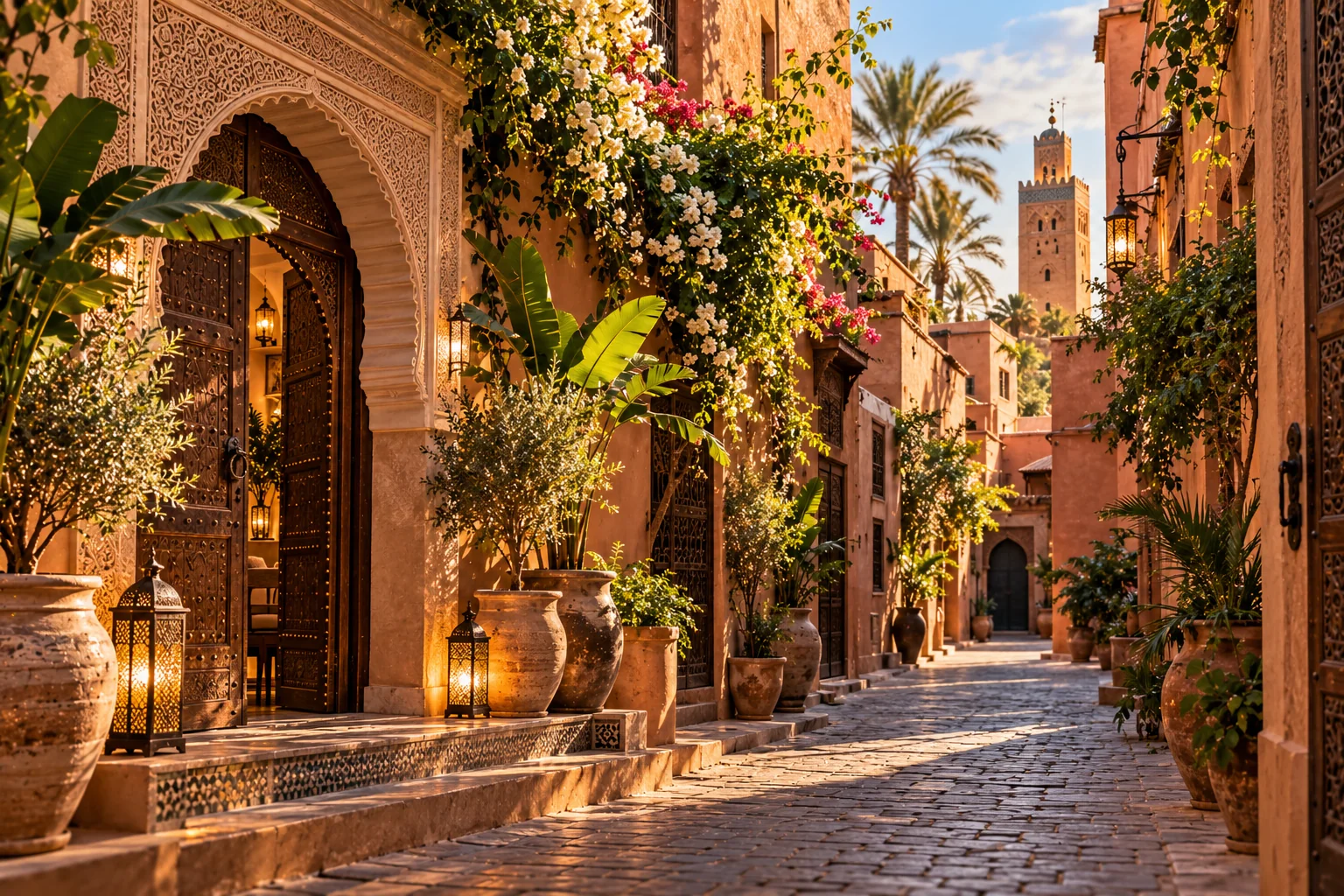
The right neighbourhood depends on your clientele, full budget, access and hospitality programme. Compare addresses and buildings rather than neighbourhood names alone. Darnel’s method examines the guest’s actual route, nuisance and technical constraints before retaining a scenario. The listing prices in this guide are not validated sale prices.
The official UNESCO Medina profile documents the inscribed heritage. Its World Heritage property boundary must be distinguished from the approximate area mentioned in this guide; the profile validates neither listing prices nor their historical snapshot.
Before making an offer, prepare the checks in the riad buying guide and calculate the total investment budget. Historical listing snapshots must be documented and updated before a personalised valuation.
Investing in a Marrakech riad starts with choosing an address
When you first discover Marrakech’s Medina, it is easy to feel that you are visiting a single property market.
Narrow lanes, carved wooden doors, courtyards hidden behind old walls and rooftops overlooking the city.
Yet a few hundred metres can profoundly change a traveller’s experience and, sometimes, the economics of a hospitality project.
The historic Medina, a UNESCO World Heritage Site since 1985, covers roughly 700 hectares. It contains a remarkable variety of neighbourhoods, monuments, markets and architecture.
Within this area, property and tourism conditions are far from uniform.
A traveller staying in the Kasbah experiences Marrakech differently from a guest in Mouassine. Bab Doukkala has a particular connection with the modern city. Dar El Bacha suggests a more heritage-led, premium setting. Ben Youssef benefits from an exceptional cultural environment.
For an investor, these differences affect far more than an address’s charm.
They can change the purchase price, the renovation required, the hotel positioning, the target clientele, achievable room rates and the property’s future value.
What does a riad in the Medina cost in 2026?
According to the listing figures supplied in the original study and attributed to 2 October 2026, an aggregator listed 292 riads for sale in the Medina, with a median asking price of approximately €576,000.
A second, smaller sample showed asking prices between approximately €1,281 and €3,325 per square metre of habitable area.
These figures require care: they come from listings, rather than certified property transactions. Geographic coverage, area definitions and property characteristics can vary considerably.
| Indicator | Original study figure |
|---|---|
| Listings analysed | 292 |
| Date attributed in the original document | 2 October 2026 |
| Median asking price | €576,000 |
| Median price per m² | €3,164 |
The figures attributed to 2 October are retained from the supplied document. No dated archive or listing export was available to independently confirm that historical snapshot. Current listings do not establish what was available on that date.
These differences illustrate an essential principle: Marrakech does not have a single riad price, but many local markets.
The question should therefore go beyond “Which neighbourhood should I buy in?”
It should become “Which neighbourhood suits the hospitality product I want to create and the price I can reasonably invest?”
Here are seven Medina sectors we recommend studying before choosing a riad.
1. The Kasbah: heritage, character and hospitality potential
In the southern Medina, the Kasbah holds a distinctive place in Marrakech’s history.
It is associated with Bab Agnaou, the Saadian Tombs and the Kasbah Mosque. This concentration of heritage gives it a strong identity, particularly attractive for a property seeking to develop a hotel experience rooted in Moroccan culture.
For an investor, heritage offers more than visual appeal.
It can become part of the commercial positioning.
A boutique hotel in the Kasbah can build its experience around the neighbourhood’s history, craftsmanship, architecture and proximity to major heritage sites.
This can shape the property’s name, visual identity, photography, guest experiences and communication.
But an address in the Kasbah does not guarantee a good investment.
Two riads in the same neighbourhood can have very different operating conditions.
One may offer relatively easy access, quiet surroundings and an attractive rooftop.
Another may sit at the end of a hard-to-find derb, with disturbances or difficult logistics.
These differences can affect guest satisfaction, reviews and everyday operations.
Five checks to make in the Kasbah
During a visit, we recommend looking beyond the building:
- The actual route from the drop-off point to the riad.
- The quality of the immediate surroundings, especially at night.
- Noise or disruptive activities.
- The building’s ability to accommodate the proposed hotel concept.
- Whether the acquisition price matches the commercial potential.
An investor should inspect more than rooms and courtyards.
They should also put themselves in the position of a guest arriving in Marrakech for the first time.
2. Bab Doukkala: a useful balance between the Medina and modern city
Bab Doukkala has a different geographical relationship with the city from the Kasbah.
Historically, it is one of the Medina’s important gateways. This gives it a particular connection to the areas outside the walls and the modern city.
For some tourism projects, that can become a commercial advantage.
Some travellers want to stay in a traditional riad, enjoy the Medina’s atmosphere and easily reach other parts of Marrakech.
Accessibility has a value that a price per square metre rarely captures.
Imagine two riads offering comparable rooms.
The first is a two-minute walk from a transfer drop-off point.
The second requires twelve minutes on foot through several lanes.
On a map, the difference seems small.
With luggage, a late arrival or children, the experience can be quite different.
Accessibility can influence guest reviews, perceptions of service and even the type of clientele a property attracts.
What does a riad in Bab Doukkala cost?
The listing snapshot mentioned in the original study indicated 37 riads for sale in Bab Doukkala in early October 2026.
The median asking price was approximately €505,000, or around €2,604 per m².
These are figures from the supplied study, with no dated archive available for independent historical confirmation. They are asking prices, rather than completed sale prices. A differently constructed sample produced a lower median.
The conclusion is therefore not that Bab Doukkala has one universal reference price.
It is that the building, derb, access and hospitality potential must be assessed individually.
Darnel Collection vlog: Bab Doukkala — staying, living and investing in Marrakech
Watch the official Darnel Collection vlog on YouTube (French audio)
In this vlog, we explore Bab Doukkala to show what a property listing does not reveal: access, the atmosphere of the lanes, shops, foot traffic, architecture and the neighbourhood’s relationship with the rest of Marrakech.
This kind of immersion is especially useful before investing.
An address should never be selected solely through Google Maps.
Looking for a riad in the Kasbah?
Have you identified a property, or would you like to find the neighbourhood that best suits your budget?
Before arranging visits, Darnel Collection can help you assess the address, architectural potential, possible room count and business model of your future property.
3. Dar El Bacha: a premium address must justify its price
Dar El Bacha has a strong image within Marrakech’s Medina.
Its heritage setting, fine houses, shops and sought-after establishments contribute to premium positioning.
This appeal can be reflected in property prices.
But investors face a trap: buying a prestigious address does not guarantee creating a high-end hotel product.
Consider two illustrative scenarios.
The first investor commits €818,000 to acquiring and transforming a property in Dar El Bacha.
The second invests €545,000 in another neighbourhood.
The difference in capital is approximately €273,000.
If both properties then generate similar revenue and profit, the first property’s more prestigious address does not alone justify the additional investment.
A higher entry price generally requires stronger positioning, higher revenue, greater property value or a combination of these benefits.
That requires a coherent product.
Room sizes, beds, bathrooms, rooftops, common spaces, service, decoration and photography must match the promise made to travellers.
The address creates expectations.
The property must then meet them.
How can you check whether a premium address is worth its price?
Before paying a location premium, build a specific business plan.
Suppose the address really allows you to sell a room for €25 more than a comparable property.
With five rooms and 65% occupancy, that would mean approximately €29,656 in additional annual room revenue, at identical occupancy.
That extra revenue is not net profit. Associated costs must be deducted, and customers’ willingness to pay that rate must be tested.
Over five years, the theoretical revenue difference would reach approximately €148,000.
This analysis helps compare the additional capital committed with realistically achievable additional revenue.
4. Mouassine: investing at the heart of the Medina experience
Mouassine offers another relationship with Marrakech.
Souks, craftsmanship, monuments and everyday Medina life are especially present here.
For travellers, this immersion can be decisive.
They want more than a comfortable room. They also want to experience Marrakech, discover workshops, explore lanes and enjoy a cultural setting on their doorstep.
For a hotel, the neighbourhood can become a natural extension of the guest experience.
But this central location can also come at a cost.
Investors must avoid confusing tourist appeal with automatic profitability.
Example: two investments, the same annual result
Imagine two riads capable of generating hypothetical annual operating profit of €63,600.
The first requires total investment of €500,000.
The second requires €727,000.
| Indicator | Project A | Project B |
|---|---|---|
| Capital invested | €500,000 | €727,000 |
| Hypothetical annual operating profit | €63,600 | €63,600 |
| Profit / capital ratio | 12.7% | 8.7% |
The first project has a higher profit-to-capital ratio.
That does not necessarily make it better: asset quality, risks, tax, financing, appreciation prospects and future renovation needs also matter.
The example nevertheless shows that a better address only makes economic sense if it creates sufficient additional value.
Deciding between several neighbourhoods?
Are you comparing two riads whose prices and locations make the decision difficult?
Darnel Collection can help you build a comparison framework covering total budget, hospitality potential, accessibility, renovation, achievable average rates and commercial risks.
5. Riad Laarous: understanding the value of the immediate location
Riad Laarous illustrates an important feature of the Medina property market: a riad’s value can depend as much on its derb as on its neighbourhood.
Two houses a few dozen metres apart may have very different characteristics.
One has relatively easy access, a bright courtyard and a usable terrace.
Another has a more restrictive layout, rooms that are difficult to adapt or less favourable immediate surroundings.
To compare properties, progressively examine several levels:
Marrakech → Medina → Neighbourhood → Derb → Building.
Why price per m² is not enough
Consider an illustrative example involving a 150 m² riad.
| Asking price per m² | Approximate theoretical property price |
|---|---|
| €1,818/m² | €273,000 |
| €2,727/m² | €409,000 |
| €3,636/m² | €545,000 |
For the same area, the difference between the extremes is approximately €272,000.
Structural condition, architectural quality, achievable room count, access, permits or precise location may justify that difference.
It may also reflect an overly ambitious asking price.
That is why we recommend never valuing a riad solely by multiplying its area by a neighbourhood average.
Six factors that can change a riad’s actual value
Before making an offer, assess land-title status, building condition, transformation possibilities, hospitality capacity, accessibility and regulatory constraints.
Consider a riad offered at €400,000 that appears able to accommodate six rooms.
After an initial architectural study, you discover that only four rooms can meet the comfort standards your positioning requires.
The acquisition cost has not changed.
But the number of sellable rooms, and therefore the revenue capacity, may have fallen by one third.
This difference can undermine the entire business plan.
The investor must buy realistic economic capacity, as well as square metres.
6. Ben Youssef–Assouel: when the neighbourhood becomes part of the brand
A riad does not have to create its entire experience within its walls.
Its surroundings can become an extension of its identity.
This is particularly attractive around Ben Youssef and Assouel, where heritage, craft workshops, fondouks and local life provide rich material for a tourism experience.
Imagine two properties with comparable rooms and facilities.
The first mainly promotes its suites, courtyard and breakfasts.
The second also tells its neighbourhood’s story. It introduces the craftspeople who worked on its renovation, recommends cultural itineraries, selects local addresses and produces videos showing Marrakech at different times of day.
The second property is starting to develop something harder to replicate: a destination identity.
Why can this strategy improve commercial performance?
A strong hotel brand offers several potential advantages.
It can attract guests specifically seeking that experience, enrich website content, improve differentiation on booking platforms and encourage direct bookings.
An article about Ben Youssef’s history, a video about craftspeople or a guide to experiences near the riad can introduce the property before a traveller even searches for a room.
The Medina becomes a source of content and visibility.
But this strategy must remain authentic.
A few craft photographs or phrases such as “local experience” are not enough to build a real identity.
The content must correspond to what guests can actually experience during their stay.
7. The Mellah: a historical identity and surroundings to assess carefully
The Mellah has a distinct history and identity within Marrakech.
Its architecture, heritage and relationship with other Medina sectors can inspire hotel concepts different from those developed in Mouassine or Dar El Bacha.
As elsewhere, the immediate location remains decisive.
Investors should examine access quality, pedestrian activity, shops, disturbances and the feel of the surroundings at different times.
A simple method: visit the same neighbourhood three times
9 am — Observe daily life
Watch deliveries, shops, residents’ movements and the first activities of the day. Check the access needed for operations too.
3 pm — Understand foot traffic and disturbances
Observe tourist movements, sunlight, shops and possible noise sources. Assess the neighbourhood’s actual daytime atmosphere.
9 pm — Test the guest experience
Walk the route from the drop-off point to the riad again. Check lighting, wayfinding, comfort and noise levels.
This method takes a few hours.
It can prevent a much more expensive investment mistake.
8. Comparing seven neighbourhoods: which suits your project?
The seven sectors offer different advantages. None is systematically better than the others.
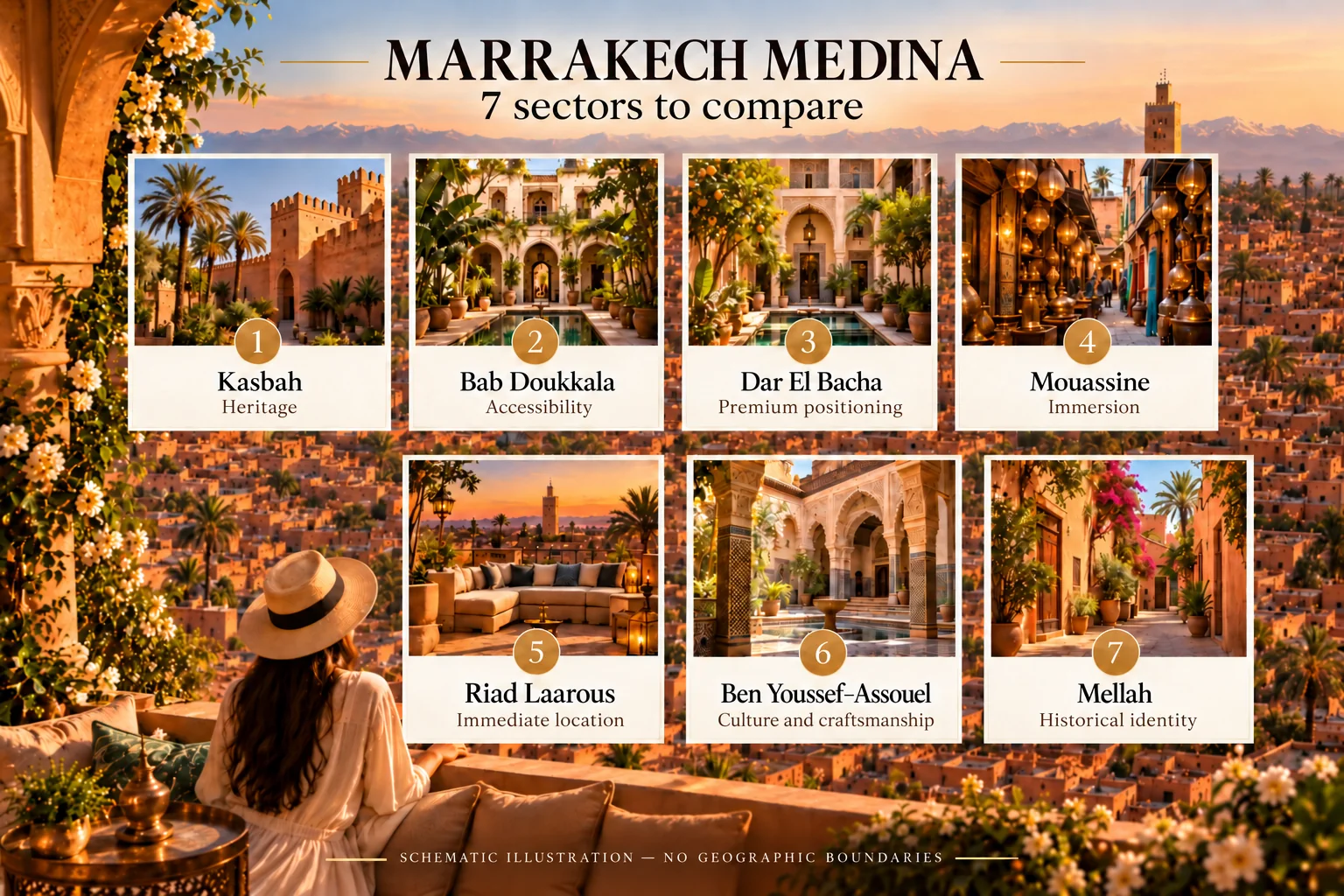
| Neighbourhood | Main strength to assess | Priority concern |
|---|---|---|
| Kasbah | Heritage and hotel identity | Access and derb quality |
| Bab Doukkala | Medina / modern city connection | Actual accessibility |
| Dar El Bacha | Premium positioning | Acquisition price |
| Mouassine | Medina immersion | Price, noise and logistics |
| Riad Laarous | Variety of properties | Immediate location |
| Ben Youssef–Assouel | Heritage and storytelling | Concept consistency |
| Mellah | Historical identity | Immediate surroundings |
Use this table by starting with your project.
For an intimate four- or five-room riad, atmosphere, quiet and courtyard quality may take priority.
For a seven-room guesthouse, accessibility and service organisation may become more important.
For a ten-room boutique hotel with a spa and restaurant, assess logistics, circulation, available floor area and the address’s ability to support a high-end position as well.
9. What does a riad in Marrakech’s Medina really cost?
The listings examined in the original document show significant price differences.
The first sample had a median asking price of approximately €576,000, with a median price of roughly €3,164/m².
A second, smaller sample had the following figures:
| Indicator | Original document’s rounded value |
|---|---|
| Lowest observed price | €1,281/m² |
| Median | €2,205/m² |
| Mean | €2,251/m² |
| Highest observed price | €3,325/m² |
These rounded conversions use €1 = MAD 11. The figures are retained from the supplied study; the historical snapshot attributed to 2 October has not been independently confirmed.
The Sawim Medina listing page changes as active listings change. The Villas Ambar price study describes nine properties observed on 25 August 2026: habitable areas, asking prices and a small sample. These sources have different dates and methods; they do not establish completed sale prices or a verified 2 October market valuation.
These figures must not automatically determine a property’s value.
A riad requiring renovation, an operating property and a recently converted boutique hotel are not directly comparable.
Investors must consider the completed project’s total cost.
That includes acquisition, fees, studies, renovation, furniture, equipment, pre-opening and required working capital.
A seemingly cheaper property can become much more expensive if its transformation requires major works or reduces the sellable room count.
For more detail, read our guide to the budget needed to invest in a Marrakech riad.
10. Can an address really change a riad’s profitability?
Yes, but its influence must be measured rather than assumed.
Consider an illustrative example.
Two riads each sell 1,500 room nights per year.
The first has a location, accessibility and surroundings that allow it to achieve an average rate €10 higher per night.
The annual revenue difference would be:
1,500 room nights × €10 = €15,000 additional revenue.
Over five years, with identical activity, that would represent €75,000.
That does not mean a better location automatically generates an extra €10 per night.
The aim is to show that a qualitative feature can have a measurable economic consequence.
The additional acquisition price must also remain consistent with that potential.
Simulate your future riad’s profitability
You can now test your assumptions about budget, room count, average rate and occupancy.
Estimate your riad’s profitability
Loading exchange rates…
Rates provided by ExchangeRate-API · Updated daily ·
Occupancy: +5 percentage points/year up to 90%, then +2.5 percentage points/year up to 95%.
Estimate based on the purchase price alone. Renovation costs, acquisition fees and financing are excluded from the return calculation.
Your 5-year projection
Version 4 · Exchange rates updated daily · Updated on 6 October 2026
| Year | Occupancy | Nightly rate | Additional sales | Annual revenue | Operating profit | After corporate tax | Return |
|---|
Understanding the assumptions and calculations
Operating profit is set at 45% of total revenue, meaning total operating expenses are estimated at 55%. Corporate tax is simulated at 20% of positive operating profit, without modelling depreciation, deductions or the project’s specific tax regime. Profit after corporate tax is not a calculation of cash flow after financing.
The average room rate per night increases by 7.5% per year, compounded. Occupancy increases by 5 percentage points per year up to 90%, then by 2.5 percentage points per year up to 95%: 60%, 65%, 70%… 90%, 92.5%, 95%. Additional sales increase by 5 percentage points per year up to 30% of room revenue, then by 2.5 percentage points per year, with no projection cap. If an increase crosses a threshold, it stops at that threshold for the year in question (examples: 88% → 90%; 28% → 30%). The operating margin remains constant.
The return equals annual profit after corporate tax divided by the purchase price. No return on equity is calculated. Owners may replace the purchase price with the reference value they wish to analyse.
Indicative conversions are updated automatically from ExchangeRate-API, with a 24-hour local cache. The rates’ publication date is displayed above the inputs. If the service is unavailable, the latest available rates are retained and flagged. Current rates are used to convert all projection years; they do not predict future exchange rates. Displayed amounts are rounded; calculations use unrounded values.
Indicative, non-binding simulation. These assumptions do not guarantee future performance or the applicable tax treatment.
Give your riad the means to achieve these results
Discuss your project and the drivers of its profitability with Darnel Hospitality.
Book an advisory appointmentThe simulator provides indicative estimates. It does not replace a complete business plan covering acquisition fees, renovation, financing, depreciation and the actual tax regime. Its return uses the purchase price entered: add costs to the denominator for a separate total-project comparison. The built-in assumptions do not guarantee future performance.
How can you use the simulator to compare two neighbourhoods?
Consider two six-room projects.
The first needs total investment of €550,000, with an expected average rate of €130.
The second requires €700,000, but its location and positioning might support an average rate of €165.
Start by applying the same occupancy rate to both projects.
Then compare the results.
Finally, create a cautious scenario by reducing the average rate and occupancy.
This helps identify the project whose performance depends least on optimistic assumptions.
Have your figures assessed before buying
A simulator is a useful way to understand orders of magnitude. It does not know the building’s actual condition, exact location, permits or required renovation.
Darnel Collection can help you test your assumptions against a real project and identify the key checks before committing.
Have my budget and project assessed
The Darnel method: spend 60 minutes in the neighbourhood before visiting the riad
Before negotiating a price, we recommend spending at least an hour in the property’s immediate surroundings.
The method is simple, but particularly revealing.
15 minutes — Test the arrival route
Start from the most practical drop-off point. Walk to the riad as a traveller arriving with luggage would. Observe wayfinding difficulties, obstacles and the overall impression.
15 minutes — Explore nearby streets
Identify access routes, shops, restaurants, activities and possible disturbances. Check whether the neighbourhood really suits your intended clientele.
15 minutes — Assess the tourism experience
Identify monuments, craftspeople, experiences and addresses that could enrich future guests’ stays. The neighbourhood should contribute to the property’s promise.
15 minutes — Listen to the building and its surroundings
Spend a few minutes in the courtyard, rooms and on the rooftop without speaking. Listen to the sounds, observe the light and imagine the experience of a paying guest.
This first hour does not replace technical, land-title or legal studies.
It can nevertheless reveal problems that a property listing or photographic dossier can easily hide.
Is your Marrakech investment part of a wider life project?
For many investors, buying a riad means much more than a property transaction.
It may accompany a move to Morocco, a career change, an entrepreneurial project or a desire to build long-term wealth.
These decisions involve financial, administrative, tax and personal considerations deserving the same attention as the future property’s location.
To explore this further, discover the French-language book Réussir sa nouvelle vie au Maroc : Le guide pratique pour s’installer, investir et prospérer.
It covers the different dimensions of moving to Morocco, investing and entrepreneurship.
Darnel Collection’s Private Investors Club
Are you considering a riad investment but want to understand the market better before taking action?
Darnel Collection’s Private Investors Club provides analyses, case studies, exclusive content and information about projects developed in Marrakech.
You can explore acquisition strategies, renovation, operations and different hospitality investment models.
Join the Private Club free of charge
Free access. Unsubscribe at any time.
FAQ: investing in Marrakech’s Medina neighbourhoods
What is the average price of a riad in Marrakech’s Medina?
The listing figures supplied with this article indicated a median asking price of approximately €576,000 in early October 2026. The historical snapshot has not been independently confirmed. This is not an official transaction benchmark and must be interpreted according to each property’s characteristics.
Which is the best neighbourhood to buy a riad in Marrakech?
There is no universally best neighbourhood. Kasbah, Bab Doukkala, Dar El Bacha, Mouassine, Riad Laarous, Ben Youssef–Assouel and Mellah have different characteristics. The right choice depends on your concept, clientele and budget.
Where should you create a high-end boutique hotel?
Several sectors may suit. Dar El Bacha can support a premium image, the Kasbah a strong heritage identity and Mouassine an immersive experience. The building and its immediate surroundings remain decisive.
Is Bab Doukkala attractive for a riad investment?
Bab Doukkala may suit projects combining the Medina experience with access to the modern city. The derb, drop-off point and traffic constraints still need to be examined.
Why do prices per m² vary so much in the Medina?
Riads are highly non-standardised assets. Architecture, condition, legal status, access, hospitality potential and facilities can create substantial differences in value.
Should you buy in the most prestigious neighbourhood?
No. A high acquisition price must be justified by heritage quality, commercial potential or another identifiable source of value. A prestigious address does not automatically ensure higher profitability.
Can any riad operate as a guesthouse?
No. Feasibility depends on the building, permits and applicable regulatory requirements. Administrative and technical assessment must precede any purchase intended for tourism operations.
How many times should you visit a riad before buying?
Several visits are preferable, especially at different times of day. They should be complemented by appropriate technical, legal and financial checks.
How can you compare riads in different neighbourhoods?
Compare total cost, realistically sellable room count, positioning, potential revenue, operating costs, risks and property value. Price per m² is not enough.
Does a better location allow higher room rates?
It can help, but the effect also depends on comfort, service, reputation and positioning. A rate premium must be tested against comparable properties rather than automatically assumed.
Continue your investment journey
Explore three complementary topics in the Darnel Collection Journal.
How much do you really need to invest in a Marrakech riad?
Compare budgets and different investment envelopes.
Seven mistakes that can turn a riad purchase into a bad investment
Understand the checks to make before signing.
Read the investment mistakes guide
Renovate or buy turnkey: which strategy should you choose?
Understand the differences between design freedom, renovation risk and speed to operation.
There is no single best neighbourhood in Marrakech
This is probably the most important lesson of this study.
Asking which Medina neighbourhood is best for investing often starts the thought process backwards.
The first question should be:
What property do you want to create, for which clientele and with which business model?
A ten-room boutique hotel with a spa does not necessarily need the same address as an intimate four-room riad.
A property targeting premium guests will not seek the same characteristics as a family-oriented guesthouse.
A project with dining and wellness must anticipate constraints that a small accommodation-only property does not face.
The appropriate sequence is:
Clientele → Concept → Business model → Neighbourhood → Building → Final budget.
Rather than the reverse.
Marrakech’s Medina has enough diversity to accommodate very different hospitality projects.
The challenge goes beyond finding a riad for sale.
It is identifying an address that can support your project for the next ten years.
The neighbourhood will appear in photography, videos, guest reviews, recommendations, proposed experiences and sometimes the property’s name itself.
The address is more than a line on an acquisition deed.
It is part of the hospitality product.
At Darnel Collection, we advocate precisely this approach: analysing property, architecture, hospitality and future operations together.
Have you identified a riad in the Medina?
Have you already found a property in Marrakech, or would you like to select the neighbourhood that best suits your project?
Darnel Collection offers a discussion to assess the initial features of your investment: location, accessibility, architectural potential, room count, total budget and hotel positioning.
The aim is to help you ask the right questions before committing.
Compare my address, full budget and hospitality concept
About the author
Georges Lelièvre — Founder, Darnel Group
Through Darnel Collection and Darnel Hospitality, Georges Lelièvre develops an approach to riad and boutique hotel investment in Marrakech combining property, hotel concept creation, marketing and operations.
His analyses help investors look beyond the asking price: neighbourhood, architecture, guest experience, business model and operations must be considered together to build a coherent hospitality asset.
The property prices presented come from the listing figures supplied with the original article. Current Sawim and Villas Ambar pages have been consulted, but no documentary evidence confirms the snapshot attributed to 2 October 2026. Euro conversions are indicative. Financial examples and simulations are neither property valuations nor guarantees of return.