
Invest
Six-room riad in Marrakech: how much could it really generate in 2027?
Dar Chemaa case study — Financial forecast over 5 years

Dar Chemaa case study — Financial forecast over 5 years
Could a six-room riad in Marrakech exceed €150 000 in annual profit after the costs and fees included in the forecast? In the model studied for Dar Chemaa, this level is reached in the fifth year, rather than at launch.
This is the level projected by Dar Chemaa's financial model by its fifth operating year. The forecast presents a five-year trajectory, with the first year corresponding to the proposed launch scenario for 2027.
With six rooms, the forecast shows the total economic aggregate rising from €179 946 in the first year to €329 396 in the fifth year.
After deducting the operating costs and management fees included in the model, projected profit would rise from €72 165 in year 1 to €154 920 in year 5.
These figures may interest French, Belgian and Swiss investors looking to acquire or develop a guesthouse in Marrakech.
But how can this level of income be achieved? What occupancy rate should you target? What contribution can you expect from additional sales and the spa? And how much would the owner actually retain?
Here is our analysis of Dar Chemaa's first five years.
Important: the amounts presented come from the supplied forecast. They are assumptions, rather than achieved performance. Profit after management does not necessarily correspond to accounting net profit or cash available for distribution after tax and financing.
Why invest in a six-room riad in Marrakech?
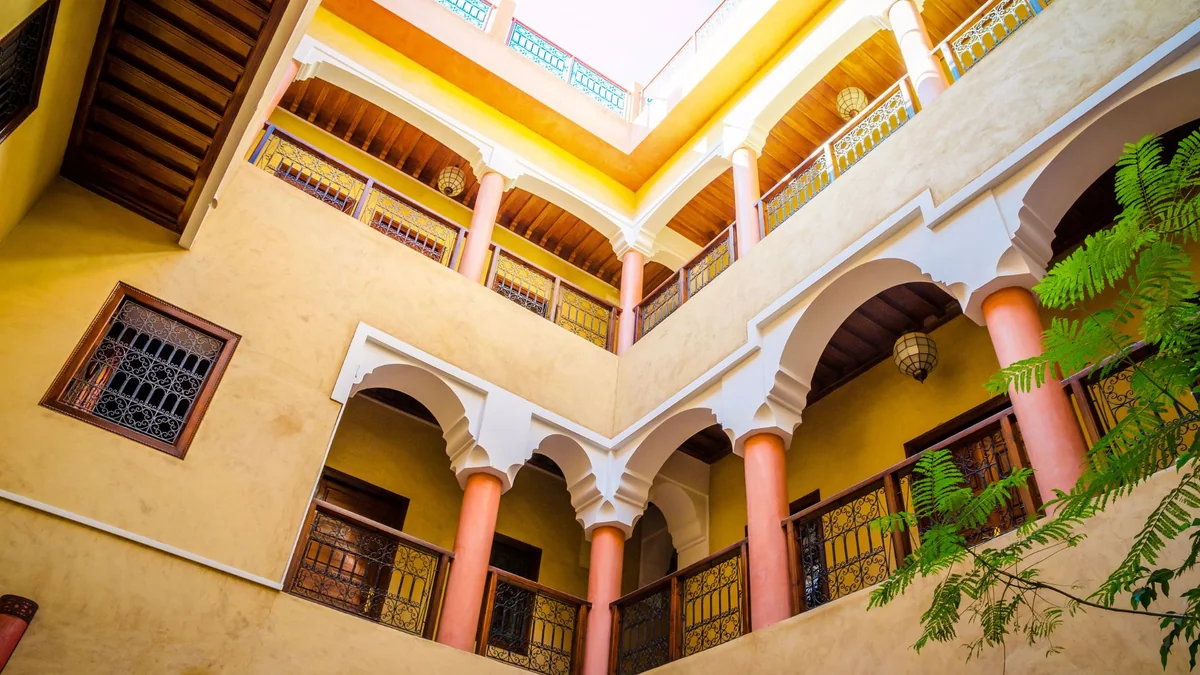
A six-room riad sits between a family guesthouse and a boutique hotel.
It offers an intimate experience while spreading certain fixed costs across a larger capacity than a small riad.
With six rooms, theoretical annual capacity reaches:
6 × 365 = 2 190 available room nights.
At 75% occupancy, this represents around 1 643 room nights sold; at 90%, nearly 1 971.
However, the number of room nights alone does not determine profitability.
Average room rate, booking commissions, operating costs, staffing and complementary services directly influence profit.
A riad marketed at €100 per night does not have the same potential as an establishment able to sustain an ADR of €150.
Conversely, a high rate does not make up for insufficient occupancy.
Darnel advice: define your target guests, positioning and operating model before selecting the building.
Dar Chemaa: an economic model of €179 946 from the first year
Dar Chemaa is a six-room riad project in Marrakech.
Its forecast is based on room income, additional sales, packages and the spa.
First-year assumptions
| Indicator | Year 1 |
|---|---|
| Rooms | 6 |
| ADR | 100 € |
| Occupancy rate | 75 % |
| Model net room receipts | 140 983 € |
| Additional sales | 24 100 € |
| All-in package margin | 3 000 € |
| Spa margin | 11 863 € |
| Modelled economic aggregate | 179 946 € |
Net room receipts represent around 78% of the modelled economic aggregate. Additional sales and package and spa margins account for around 22%. These proportions describe the forecast's aggregate; they should not be treated as the breakdown of a homogeneous accounting revenue figure.
A riad can offer transfers, experiences, wellness services and combined packages to increase the value of each stay.
An essential financial distinction
With six rooms, an ADR of €100 and 75% occupancy, theoretical gross room revenue reaches €164 250 (6 × 365 × €100 × 75%). The model includes €140 983 in net room receipts.
The €23 267 difference corresponds to deductions between theoretical room revenue and the net receipts included. It must be reconciled with the detailed OTA commissions and other deductions in the forecast; without a detailed breakdown in the table presented, it cannot be attributed to a single item.
The table adds net room receipts and additional sales to margins on packages and the spa. Its €179 946 total is therefore an economic management aggregate specific to the model, rather than a homogeneous accounting revenue figure.
How could the total reach €329 396 in the fifth year?
The scenario assumes growth in average room rate, occupancy and complementary sales.
Forecast progression
| Indicator | Year 1 | Year 3 | Year 5 |
|---|---|---|---|
| ADR | 100 € | 110 € | 120 € |
| Occupancy | 75 % | 85 % | 90 % |
| Net room receipts | 140 983 € | 182 919 € | 211 089 € |
| Additional sales | 24 100 € | 54 600 € | 86 700 € |
| Package margin | 3 000 € | 9 000 € | 15 000 € |
| Spa margin | 11 863 € | 14 235 € | 16 608 € |
| Economic aggregate | 179 946 € | 260 754 € | 329 396 € |
Over five years, the economic aggregate would increase by around 83%.
This progression depends on three drivers:
- An ADR rising from €100 to €120.
- An occupancy rate rising from 75% to 90%.
- Additional sales rising from €24 100 to €86 700.
Caution: annual occupancy of 90% is an ambitious target. It requires an excellent reputation, an effective distribution strategy and strong low-season sales.
The model illustrates potential, rather than a guarantee.
Additional sales: an income accelerator
When investing in a riad, rooms are usually the first consideration.
Yet Dar Chemaa illustrates the potential of complementary services.
The “additional sales” item would rise from €24 100 in the first year to €86 700 in the fifth year, an increase of approximately 3.6 times. These are the amounts included in the forecast; their exact nature and associated direct costs must be tracked separately.
Transfers, catering, excursions, private events, cultural experiences and wellness services can contribute to this growth.
Practical example
A couple books three nights.
They may also book an airport transfer, a private dinner, a massage or an excursion.
Each service can potentially increase average guest spending.
However, the amount invoiced must be distinguished from the margin retained.
A transfer sold for €40 and purchased from the supplier for €25 generates a gross contribution of €15, before any other costs.
Darnel advice: build a service catalogue with a clearly identified selling price, direct cost and margin.
The objective is not simply to sell more, but to develop profitable sales.
Spa and all-in packages: two further sources of contribution
The forecast includes margins from packages and the spa.
Annual package margins would rise from €3 000 to €15 000 between years 1 and 5.
The spa margin would increase from €11 863 to €16 608.
These two activities can strengthen the establishment's economic contribution.
However, the concept of margin implies that a certain range of costs has already been deducted.
The treatment of staffing, consumables, energy, maintenance and commissions must therefore be checked.
These costs must not be counted twice.
In a small riad, an underused spa can become a significant expense.
A properly sized wellness area can, on the other hand, improve the experience and support commercial positioning.
Are you considering investing in a six-room riad?
Before buying, have its hotel potential and forecast operating costs analysed.
Book a Darnel Collection advisory appointment →
What operating costs should you budget for a six-room riad?
Salaries, water, electricity, laundry, maintenance, insurance, consumables, software and administrative fees must be anticipated.
The Dar Chemaa model includes the following costs:
| Year | Annual operating costs |
|---|---|
| Year 1 | 65 760 € |
| Year 2 | 72 336 € |
| Year 3 | 79 570 € |
| Year 4 | 87 527 € |
| Year 5 | 96 279 € |
Costs rise with activity, but less quickly than the economic aggregate presented.
They represent around 36.5% of this aggregate in the first year and 29.2% in the fifth year.
This favourable trend assumes an organisation able to absorb growth.
Nevertheless, the direct costs of additional sales, renewal provisions, ownership expenses and other unspecified costs must be checked.
Financing costs and taxes also require specific treatment.
Darnel advice: request an itemised budget and allow a reserve for unexpected expenses.
Profit before Darnel management: up to €233 117
After deducting the stated costs, the model presents the following results:
| Year | Profit before Darnel |
|---|---|
| Year 1 | 114 186 € |
| Year 2 | 145 737 € |
| Year 3 | 181 185 € |
| Year 4 | 206 154 € |
| Year 5 | 233 117 € |
These amounts correspond to the model's economic aggregate less the costs presented.
They do not constitute accounting net profit.
They nevertheless demonstrate the potential importance of average room rate, occupancy and complementary services.
This is why a riad's architectural design should not be separated from its future operation.
Why include professional management?
Owning a riad in Marrakech and running a hotel establishment are two different professions.
An owner may wish to invest without handling bookings, teams, guests and sales on a daily basis.
Professional management helps organise these functions and monitor performance.
Professional management nevertheless represents a cost that must be included in the business plan. In this model, fees have already been deducted to arrive at the profit after management presented below.
The fees shown in the forecast must not be reconstructed by applying a uniform percentage to the economic aggregate: the contractual fee base and detailed calculation are not specified in the data presented. For a real investment, the forecast must be reconciled with the management agreement and its financial terms.
For an investor living in France, Belgium or Switzerland, calculating profitability after management fees is essential.
Also read our article on managing a riad in Marrakech from abroad.
How much would remain after Darnel fees?
This is generally the figure investors most want to see.
Projected profit after operating costs and management fees
| Year | Annual profit | Monthly average |
|---|---|---|
| Year 1 | 72 165 € | 6 014 € |
| Year 2 | 94 185 € | 7 849 € |
| Year 3 | 119 555 € | 9 963 € |
| Year 4 | 136 293 € | 11 358 € |
| Year 5 | 154 920 € | 12 910 € |
In the fifth year, projected profit after the costs and fees included in the model would average €12 910 per month (€154 920 ÷ 12). This arithmetic average does not account for seasonal cash receipts.
However, this average is neither guaranteed income nor an amount necessarily available for monthly distribution to the owner.
Actual cash flow depends on seasonality, receipts, investment, taxes and financing.
The result presented is a forecast indicator after only the items explicitly included in the model. Accounting net profit and cash actually available for distribution remain to be established after checking depreciation, financing costs, taxes, replacement investment and any omitted costs.
This distinction is essential to present an investment opportunity transparently.
What return could the investor achieve?
One essential figure is missing to calculate Dar Chemaa's actual return: the total capital invested.
The acquisition price, fees, any works, furnishings and initial working capital are not included in the supplied table.
We can nevertheless illustrate the effect of invested capital using the fifth-year projected profit.
| Hypothetical total capital | Profit / capital |
|---|---|
| 600 000 € | 25,8 % |
| 800 000 € | 19,4 % |
| 1 000 000 € | 15,5 % |
These ratios are arithmetic comparisons between the fifth-year projected profit (€154 920) and different hypothetical capital amounts. They illustrate sensitivity to capital invested, but do not constitute a net yield or an IRR.
They do not replace a full profitability study accounting for taxation and financing.
They do not account for the investment timetable, risk or the property's future value.
Sensitivity test: what if occupancy fell?
With six rooms and a constant ADR of €120, a fall in annual occupancy from 90% to 70% represents, for rooms alone:
2 190 × 20% × €120 = €52 560 less in theoretical gross room revenue, before commissions, deductions and any effects on additional sales.
This calculation does not directly measure the drop in profit, since some expenses may also vary.
It nevertheless shows why a cautious scenario is essential.
Simulate your own project
The public Dar Chemaa simulator uses its own simplified assumptions and does not reproduce the tables in this article. Results are not guaranteed income.
Compare different assumptions for average room rate, occupancy, costs and complementary income.
Present my investment project to Darnel Collection →
Risks to anticipate before investing
Dar Chemaa's performance depends on demanding commercial targets.
First risk: occupancy. Reaching 90% over a full year requires around 1 971 room nights sold.
Second risk: average room rate. An increase from €100 to €120 depends on demand, positioning and competition.
Third risk: additional sales. Reaching €86 700 requires a structured sales strategy and services that guests actually want.
Fourth risk: costs. Staffing, energy and maintenance costs may rise faster than expected.
A business plan should therefore include cautious, central and optimistic scenarios.
A sound investment should remain understandable even when the most favourable assumptions do not materialise.
Our vision: turning a riad into a hotel business

A six-room riad is more than a rental property.
It is a business that must attract travellers, offer an experience, control costs and build guest loyalty.
Its success depends on several skills: architecture, positioning, marketing, distribution, hospitality and financial management.
The Dar Chemaa forecast illustrates this approach.
Room nights form the economic foundation. Complementary services can accelerate growth. Professional management helps structure the operation.
However, success will always depend on the results actually achieved.
Explore our Darnel Collection projects
INVESTMENT CASE — DAR LÉON & SPA
4 rooms • Bab Doukkala • Riad & Spa
Dar Léon & Spa illustrates our ambition to create distinctive establishments designed for a differentiated experience and professional operation.
Discover Darnel Collection projects →
FAQ: six-room riad profitability in Marrakech
How much could a six-room riad generate?
In the Dar Chemaa model, profit after the stated costs and fees reaches €72 165 in the first year and €154 920 in the fifth year, subject to the assumptions being achieved.
What occupancy rate should you target?
The forecast assumes 75% in the first year and 90% in the fifth year. The latter is an ambitious target, rather than a market average.
Does a spa improve profitability?
It can contribute to profit and differentiation, provided that demand and margins justify its costs.
Can you manage a riad from France?
Yes, with a local team, professional organisation and regular financial reporting.
Further reading for your investment
Join the Darnel Collection Private Club →
Conclusion: could a six-room riad become a profitable investment in 2027?
The Dar Chemaa study presents an ambitious scenario.
In the first year, the modelled economic aggregate would reach €179 946, with projected profit of €72 165 after deducting the costs and fees included in the model.
In the fifth year, these figures would rise to €329 396 and €154 920 respectively. The first is an economic aggregate combining receipts and margins; the second remains a projected profit before accounting net profit, taxation and distributable cash flow are established.
These projections show the potential of a diversified hotel model.
However, actual profitability will depend on capital invested, full costs, taxation, financing and the operation's actual performance.
Before investing in a riad in Marrakech, therefore, do not simply ask how many rooms you can sell.
Ask what experience you will create, how it will be marketed and what margin the establishment can retain.
This approach is what turns a property purchase into a real hotel business.
Book my Darnel Collection strategic appointment →
Georges Lelièvre — Darnel Collection