
Operate
How can you make your Marrakech riad profitable while living in France? The 10 golden rules of effective hotel management
Do you own a riad in Marrakech but live in France, Belgium or Switzerland? Discover how to turn your property investment into a profitable hospitality business without managing bookings, teams and guests yourself.

You have invested €400,000, €500,000 or sometimes more in a riad in Marrakech. But who is actually working to grow that investment while you are in France?
This is probably one of the most important questions to ask before buying a riad.
Owning a beautiful property in the medina is absolutely no guarantee of profitability.
You may have an exceptional courtyard, a rooftop overlooking the Atlas Mountains and tastefully decorated rooms…
Yet still struggle to fill your property, control costs or generate enough profit.
Why?
Because property investment and hotel operations are two different professions.
The first involves acquiring, designing and enhancing an asset.
The second involves attracting guests, optimising rates, organising teams, selling services and controlling expenditure.
And when you live thousands of kilometres away, this distinction becomes fundamental.
At Darnel Hospitality, we believe a riad should be run as a proper hotel business, with measurable performance targets and a development strategy spanning several years.
Here are the ten rules we recommend to investors who want to make their Marrakech riad profitable while living abroad.
Managing a Marrakech riad from France requires a local team, a contract defining responsibilities and reporting reconciled with receipts and expenditure. Darnel Hospitality recommends comparing results after commissions, costs and fees, including a cautious scenario. Delegating operations does not remove the owner’s obligations; traceable decisions and continuity of service must be organised.
Control of access forms part of this oversight. For the Google profile, the official role documentation distinguishes owners and managers: each person uses their own account without sharing your password. Our advice is to define access and its return in the management contract.
To structure your monthly review, compare riad operating costs and cash flow with the direct-booking strategy. This guide’s simulations test assumptions rather than report observed performance.
1. Do not rely on location alone: your reputation is a commercial asset
A riad three minutes from Jemaa el-Fna square may perform less well than a property on a quieter lane in the medina.
The reason?
The guest experience.
Today, travellers compare photographs, facilities, rates and above all guest reviews before booking.
A property with an excellent reputation can inspire greater trust and sustain its prices more effectively.
Conversely, repeated negative comments about cleanliness, noise, service or the welcome can hurt bookings.
Metrics to monitor
- The average rating on Booking.com and Google.
- The number and recency of reviews.
- Recurring comments about the welcome and cleanliness.
- Response times to guest enquiries.
- Complaint rates and incident resolution.
We recommend aiming for a rating above 9/10 on platforms using that scale, while monitoring other satisfaction indicators.
This is a demanding quality target, not a guarantee of occupancy.
How Darnel Hospitality helps
Hotel management begins with the quality of daily operations: staff training, welcome procedures, room inspections, complaint handling and review monitoring.
Our philosophy is simple:
Reputation is not built on booking platforms. It is built every day inside the riad.
2. Choose the right number of rooms to reach break-even
A four-bedroom riad can be profitable.
A six-bedroom riad can be more profitable.
But a poorly operated ten-bedroom riad can also lose money.
It all depends on the cost structure, average room rate and quality of operations.
Some expenses are relatively fixed: night watch, management, maintenance, subscriptions and part of the administrative costs.
Increasing the number of rooms can sometimes spread these costs over more room nights sold.
Example: four rooms versus six rooms
Take a simplified assumption:
- ADR: €110.
- Occupancy rate: 75%.
- Operating period: 365 days.
A four-bedroom riad could generate approximately €120,450 in annual gross room revenue.
With six rooms, the potential would reach approximately €180,675 before commissions, taxes and expenses.
That is an additional €60,225 in gross revenue.
But be careful: two extra rooms also entail construction, upkeep, staffing and running costs.
The additional profits must therefore be compared with the investment required.
Our advice
Prioritise comfortable rooms, good internal circulation and, where the layout allows, a family suite.
A suite can help increase average spending, but its performance will depend on actual demand and pricing.
Before buying or extending, have your break-even point calculated.
This is one of the first areas to examine in a hotel performance audit.
3. Create a distinctive positioning to increase your average room rate
Many riads in Marrakech offer a similar proposition.
A courtyard.
A few rooms.
A terrace.
Breakfast.
But why would a traveller choose your property over another?
And above all, why would they agree to pay more?
The answer lies in your positioning.
Price should not be your only selling point
Take two comparable riads.
The first is a traditional property with an ADR of €85.
The second offers a premium experience, with a spa, personalised service and particularly refined décor.
Its ADR could reach €120 in a favourable scenario.
This represents a difference of €35 per room sold.
For six rooms occupied at 75% over a year, this difference would represent approximately €57,488 in additional annual gross revenue, at the same occupancy.
Of course, premium positioning requires more investment and sometimes higher operating costs.
But this example shows why the commercial strategy should be defined from the design stage.
Take inspiration from properties with a real identity
Riad Dar Augusta, in the Kasbah, has notably developed a positioning around golf holidays.
Other properties focus on gastronomy, wellness, architecture or private stays.
At Darnel Hospitality, we favour concepts that can justify their rates through a real experience.
A riad should not simply look beautiful on Instagram. It should give travellers a concrete reason to choose it.
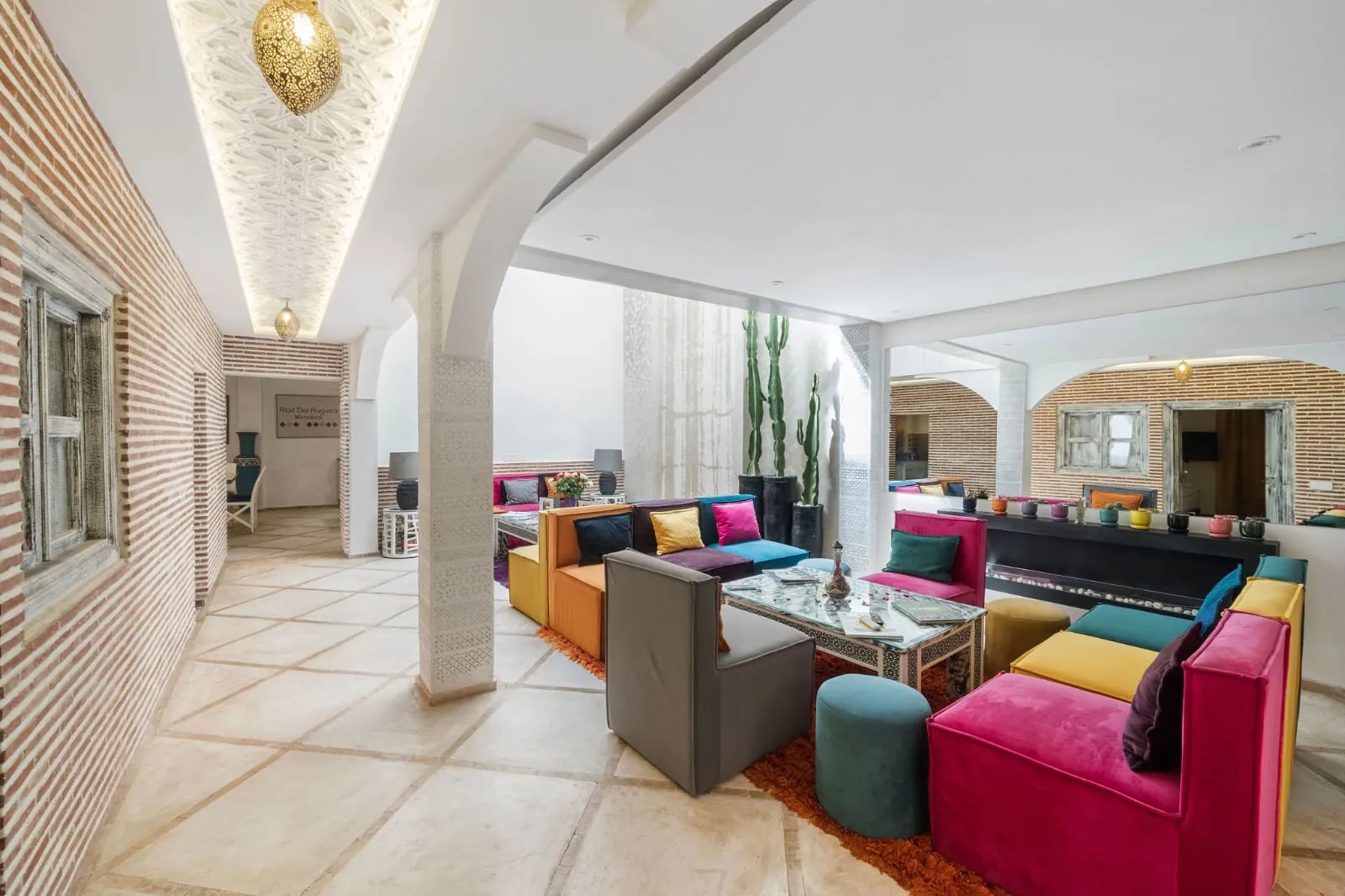
Lounge and courtyard at Riad Dar Augusta in Marrakech
4. Develop at least three revenue streams
This is one of the most common mistakes in running a guesthouse.
Focusing exclusively on room nights.
Yet a guest staying at your property may need many additional services.
And these services represent revenue opportunities.
First stream: room nights
This is generally the core business.
The aim is to optimise the following simultaneously:
- ADR, or average daily rate per room sold.
- Occupancy rate.
- RevPAR, or revenue per available room.
A high rate is not enough if rooms stay empty.
Conversely, systematically filling rooms at heavily discounted rates can damage profitability.
Second stream: ancillary sales
Airport transfers, excursions, meals, private experiences, treatments, sporting activities…
The aim is to offer the right services to the right guests.
In a premium property, a well-structured strategy can generate a significant additional margin per stay.
However, revenue from services must be distinguished from their actual margin after supplier payments and delivery costs.
Third stream: themed stays and packages
Imagine a seven-night stay including accommodation, half board and several activities.
The guest is no longer simply buying a room.
They are buying an organised experience.
Golf, gastronomy, wellness or cultural discovery: these offers can make it easier to market to targeted audiences.
They also enable partnerships with travel agencies and tour organisers.
The Darnel Hospitality method
We work on three complementary pillars:
Room nights + ancillary sales + packaged stays.
Where the layout and authorisations allow, a property can also develop a spa or restaurant business serving outside customers.
This is one reason why we believe a riad should be managed as a fully fledged hotel business.
5. Control operating costs before they erode your profits
Revenue often attracts all the attention.
But costs determine a large share of the final result.
A riad can achieve excellent occupancy and still be insufficiently profitable.
Why?
Because its costs are not suited to its capacity.
Example of how to organise a small riad
Depending on the layout and services offered, a property with five to six rooms may require several functions:
- Supervisor or manager.
- Housekeeping staff.
- Kitchen and breakfast service.
- Night reception or security.
- Maintenance and occasional extra staff.
These functions can be allocated differently depending on the organisation.
It would be risky to set a universal salary of €500 per person: pay and employer costs vary with qualifications, hours, contracts and social obligations.
The real challenge is to size the team to match the business.
Costs to monitor monthly
Wages and contributions, water, electricity, upkeep, laundry, guest amenities, maintenance, insurance, software, booking commissions and commercial expenses.
Not forgetting provisions for furniture replacement and future work.
At Darnel Hospitality, we recommend monthly monitoring of costs and their share of revenue.
A good operator does not simply seek to cut expenditure. They seek to improve results without damaging the guest experience.
6. Diversify acquisition channels to reduce dependence on platforms
If 90% of your bookings come from a single platform, you are highly dependent on its commissions, algorithm and commercial terms.
This is a risk.
An effective distribution strategy relies on several complementary channels.
Depending on the riad's size, positioning and budget, several channels can be used:
- OTAs, such as Booking.com and Expedia, for their international visibility.
- An official website with a booking engine to develop direct sales.
- Organic Google search visibility through targeted pages and useful content.
- Social media, particularly Instagram, to build the property's image and awareness.
- Travel agencies and tour operators to reach specific audiences and markets.
- Loyalty and referrals to turn former guests into repeat customers and ambassadors.
Targeted advertising campaigns and specialist partnerships can complement this approach.
Why direct bookings matter so much
Take a property generating €200,000 in annual room sales.
If 80% go through platforms charging an average 18% commission, commissions would total €28,800.
If that share falls to 50%, the amount would be €18,000.
The theoretical difference is €10,800 per year before deducting the costs needed to generate direct bookings.
This is why the share of direct sales is a key indicator.
Darnel Hospitality support
Our approach is to work simultaneously on visibility, pricing, distribution channels, partnerships and loyalty.
The aim is not to eliminate platforms, but to build more balanced and economically effective distribution.
7. Set aside a proper commercial launch budget
You have just invested several hundred thousand euros in your riad.
The work is finished.
The rooms are beautiful.
Your team is ready.
But who knows about your property?
Many owners ask themselves this question too late.
A riad does not start marketing itself on opening day.
Ideally, it should start building visibility several months beforehand.
Example initial marketing budget: €10,000
| Item | Indicative budget |
|---|---|
| Multilingual website and booking engine | 1,500 € |
| Photography, video and short content | 1,500 € |
| Digital activity over six months | 3,000 € |
| Advertising campaigns and acquisition | 4,000 € |
| Total | 10,000 € |
This budget is an example allocation, not a quotation or guarantee of results. It may be insufficient depending on service level, the number of languages, software and advertising management fees.
Metrics to track
Measuring website visits is not enough.
You need to track:
- The cost of acquiring a booking.
- The website's conversion rate.
- Revenue generated directly.
- Return on advertising spend.
- The share of repeat guests.
A website receiving 2,000 qualified visits and generating 40 bookings may be commercially more valuable than one attracting 20,000 visitors with little interest.
The objective is not to buy traffic. It is to acquire guests profitably.
8. Motivate your teams and turn every satisfied guest into an ambassador
You may own the most beautiful riad in Marrakech.
Without a competent, motivated team, you will struggle to build a lasting reputation.
Hospitality relies on the women and men who welcome guests every day.
They must therefore have the means to do their jobs well.
A motivating pay policy
We recommend considering pay combining an appropriate fixed salary with team bonuses based on measurable criteria.
For example:
- Guest satisfaction.
- Service quality.
- Ancillary sales.
- Compliance with procedures.
- Overall property performance.
These bonuses must be transparent, fair and compliant with employment law.
Review quality should reward authentic service, without pressuring guests or encouraging fake reviews.
Developing a loyalty programme
A satisfied guest can become one of your best ambassadors.
You can offer benefits for a future stay or a clearly defined referral scheme.
The essential point is to maintain the relationship after departure.
A thank-you message.
A personalised stay proposal.
A useful newsletter.
A thoughtful gesture for a birthday or a return to Marrakech.
Loyalty does not rely solely on discounts.
It relies on guests feeling they have not been forgotten after leaving.
9. Run your riad with a five-year development strategy
This is probably the most important point for an investor living abroad.
A riad should not be managed solely by looking at the transfers received each month.
It needs a proper development plan.
This plan should include commercial, operational and financial targets.
Example trajectory for a six-bedroom riad
| Indicator | Year 1 | Year 5 |
|---|---|---|
| Average room rate (ADR) | 100 € | 120 € |
| Occupancy rate | 75% | 90% |
| Target share of direct bookings | 20% | 50% |
| Ancillary revenue | Initial development | Structured offering and loyalty |
| Commercial strategy | Launch | Several mature channels |
This is an ambitious growth scenario, not an automatic progression.
Achieving 90% annual occupancy is a particularly ambitious assumption. It should not be regarded as a market average or a guaranteed target. Cautious, base-case and ambitious scenarios should be compared.
What your manager should report every month
At Darnel Hospitality, we believe the owner should be able to monitor at least:
Revenue, ADR, occupancy, RevPAR, the share of direct sales, commissions, ancillary sales, costs, operating results and marketing performance.
An owner living remotely must be able to understand what works, what does not and which decisions will be made.
Financial transparency is an essential condition for trust between owner and operator.
Managing a riad from France: organising responsibilities and controls
A non-resident owner needs a clearly defined local organisation, not simply access to bookings. Before operations begin, it is necessary to establish who is the legal operator, who holds the required authorisations, who employs staff, who signs supplier contracts and who assumes tax and social obligations. These responsibilities depend on the legal structure and management contract; they must be confirmed with competent Moroccan professionals.
The contract should specify the manager's powers, spending limits without authorisation, collection procedures, access to accounts and booking tools, reporting frequency and exit arrangements. Service continuity must also be organised in the event of the manager's absence, a technical incident or a serious complaint.
Each month, the owner should receive a dashboard reconciling room nights sold, receipts, OTA commissions, documented expenses, management fees and cash. Periodic reviews of accounts, guest feedback, contracts and the building's condition complement this oversight. Remote management works when decisions are traceable and responsibilities explicit.
Tax and regulations: points to check before operating
The ability to operate a riad as a guesthouse or other tourist accommodation depends on its status, any classification and applicable authorisations. Owning the property does not automatically authorise operations. Safety, hygiene, guest registration, employment and tax rules must be checked against the actual activity, particularly where a restaurant or spa serves outside customers.
For an investor who is tax-resident in France, the treatment of income, distributions and property ownership may involve Moroccan and French rules and the applicable tax treaty. No universal rate or regime can be assumed: the situation must be validated with a tax adviser competent in both countries. This check is required before announcing any net return.
10. Choose a partner who develops your profitability, not just a concierge service managing bookings
This is where much of your investment's success is determined.
A concierge service can be perfectly suited to certain needs: welcoming guests, cleaning, coordination and daily management.
But when you own a multi-room riad with dining, a spa and permanent staff, the challenges become more complex.
You need a proper hotel organisation.
What a management partner should provide
A good partner should be able to:
- Build a realistic operating budget.
- Define a pricing strategy.
- Develop several revenue streams.
- Reduce commercial dependencies.
- Recruit, organise and support teams.
- Monitor guest satisfaction.
- Control costs.
- Produce regular financial reports.
- Set improvement targets over several years.
We created Darnel Hospitality precisely to address these challenges.
Our ambition is to support owners who want to operate their Marrakech riad without being there every day.
We do not view a riad as a simple holiday let.
We see it as a hotel property with commercial potential, a cost structure and long-term asset value to develop.
Darnel Hospitality: support organised around three pillars
1. Hotel operations
Team organisation, guest welcome, service quality, operational monitoring and expenditure control.
2. Commercial performance
Revenue management, distribution, direct sales, partnerships and development of ancillary services.
3. Owner oversight
Monthly reporting, performance indicators, budgets and a continuous improvement plan.
Our goal is for every owner to have a clear view of their investment, even when living in France, Belgium or Switzerland.
Financial study: how much can a well-operated six-bedroom riad in Marrakech earn?
Now take a concrete example.
We have built a five-year financial scenario to illustrate the potential of a six-bedroom riad with several revenue streams and professional management.
The figures below are working projections, not historical results or guaranteed returns. They represent neither net accounting profit, distributable cash flow nor an investment rate of return. Detailed costs, OTA commissions, taxation and replacement expenditure must be checked for each property.
Main assumptions
ADR rises from €100 in year one to €120 in year five.
Occupancy rises from 75% to 90%.
Ancillary revenue increases progressively through additional sales, packages and the spa.
Costs and management fees are included in the model. Under the chosen commercial rule, Darnel Hospitality fees are calculated at 25% of total revenue less OTA platform commissions. The table amounts assume implicit OTA commissions that must be documented before any contractual use.
Five-year scenario results
| Indicator | Year 1 | Year 3 | Year 5 |
|---|---|---|---|
| ADR | 100 € | 110 € | 120 € |
| Occupancy rate | 75% | 85% | 90% |
| Modelled revenue | 179,946 € | 260,754 € | 329,396 € |
| Operating costs | 65,760 € | 79,570 € | 96,279 € |
| Result before Darnel fees | 114,186 € | 181,185 € | 233,117 € |
| Darnel fees | 42,021 € | 61,630 € | 78,197 € |
| Result after Darnel fees | 72,165 € | 119,555 € | 154,920 € |
Source: forecast scenario provided for a six-bedroom riad. Amounts rounded to the nearest euro. The fees shown reflect the model assumptions and do not constitute a contractual quotation.
What should you take from these figures?
In this scenario, the annual result after management fees rises from €72,165 in year one to €154,920 in year five.
This corresponds to approximately €6,014 per month in year one and €12,910 in year five, expressed as monthly equivalents.
The increase is substantial.
But it depends on demanding assumptions: rising rates, high occupancy, growing ancillary sales and controlled costs.
This projected result must also be distinguished from net accounting profit, cash actually available and the investor's actual return. In year 5, stated costs represent approximately 29.2% of modelled revenue: this ratio requires line-by-line validation, particularly for staffing, ancillary services and maintenance.
Depending on the legal and financial structure, taxes, loan interest, depreciation, replacement investments and other expenses not included in the model may still need to be incorporated.
Why professional management can change results
Darnel Hospitality's role is not simply to charge fees for managing a property.
It is to implement actions that may improve its economic performance.
Increase ADR when the market allows.
Develop direct bookings.
Sell more relevant services.
Improve guest satisfaction.
Control costs.
These levers must be evaluated using measurable results, taking into account the fees and costs required to implement them.
An effective manager should seek to create more value than they cost the owner.
This principle guides our approach.
Do you own a riad in Marrakech? Let us start by measuring its true potential.
Before changing managers, raising rates or investing in new facilities, it is essential to know your property's actual situation.
At Darnel Hospitality, we offer the DARNEL RIAD PERFORMANCE AUDIT™.
This audit examines, among other things:
- Your riad's positioning.
- Its pricing policy and occupancy.
- Its booking channels.
- Its ancillary revenue.
- Its cost structure.
- Its main opportunities for improvement.
- Its five-year financial potential under several assumptions.
The aim is to provide a structured analysis and practical recommendations.
Whether your riad is already operating or still at the project stage, this approach gives you greater visibility when investing.
Discover Darnel Hospitality on darnelcollection.com and access the dedicated hotel audit journey.
Review my reporting, costs and remote management arrangements →
Conclusion: your riad can be in Marrakech while your life remains in France
Investing in a Marrakech riad without living there is entirely possible.
But it requires the right organisation.
A beautiful property is not enough.
A Booking.com listing is not enough.
And a friendly team, however important, does not replace a proper hotel strategy.
To develop your investment, you must work simultaneously on guest experience, distribution, rates, ancillary revenue and costs.
You must also be able to monitor your property's results transparently.
At Darnel Hospitality, our ambition is simple: enable owners to oversee their investment remotely while entrusting daily operations to a structured local team.
Because your riad should be an asset that works for you.
Not a second job you have to manage from France.
FAQ — Managing a riad in Marrakech and making it profitable
Can you manage a riad in Marrakech from France?
Yes. Operations can be entrusted to a local hotel management company with contractually defined responsibilities and regular reporting. Owners nevertheless retain their legal, tax and financial obligations according to their status.
How profitable is a six-bedroom riad in Marrakech?
It depends on the amount invested, average room rate, occupancy, costs, commissions and ancillary revenue. A simulation should incorporate several scenarios, including a cautious one, before calculating the investment return.
What is the difference between a concierge service and a hotel management company?
A concierge service often focuses on operational services related to stays. A hotel management company may cover a broader scope including teams, commercial strategy, revenue, costs and operational oversight. The exact services depend on the contract.
How can a riad increase direct bookings?
It needs an effective official website, a booking engine, organic search visibility, loyalty initiatives, partnerships and an appropriate commercial strategy. The goal is to improve revenue net of distribution costs, not merely reduce commissions.
Can Darnel Hospitality support a riad that is already open?
Support can begin with an audit of existing operations to identify opportunities for improvement before defining a possible management assignment.
Discover our other articles
Aïcha El Ouahidi — Darnel Hospitality