
Invest
How much does a seven-bedroom riad in Marrakech really earn? A five-year profitability simulation
Revenue, occupancy, operating costs, management fees and profit: the calculations to understand before investing in a riad in Marrakech in 2027.
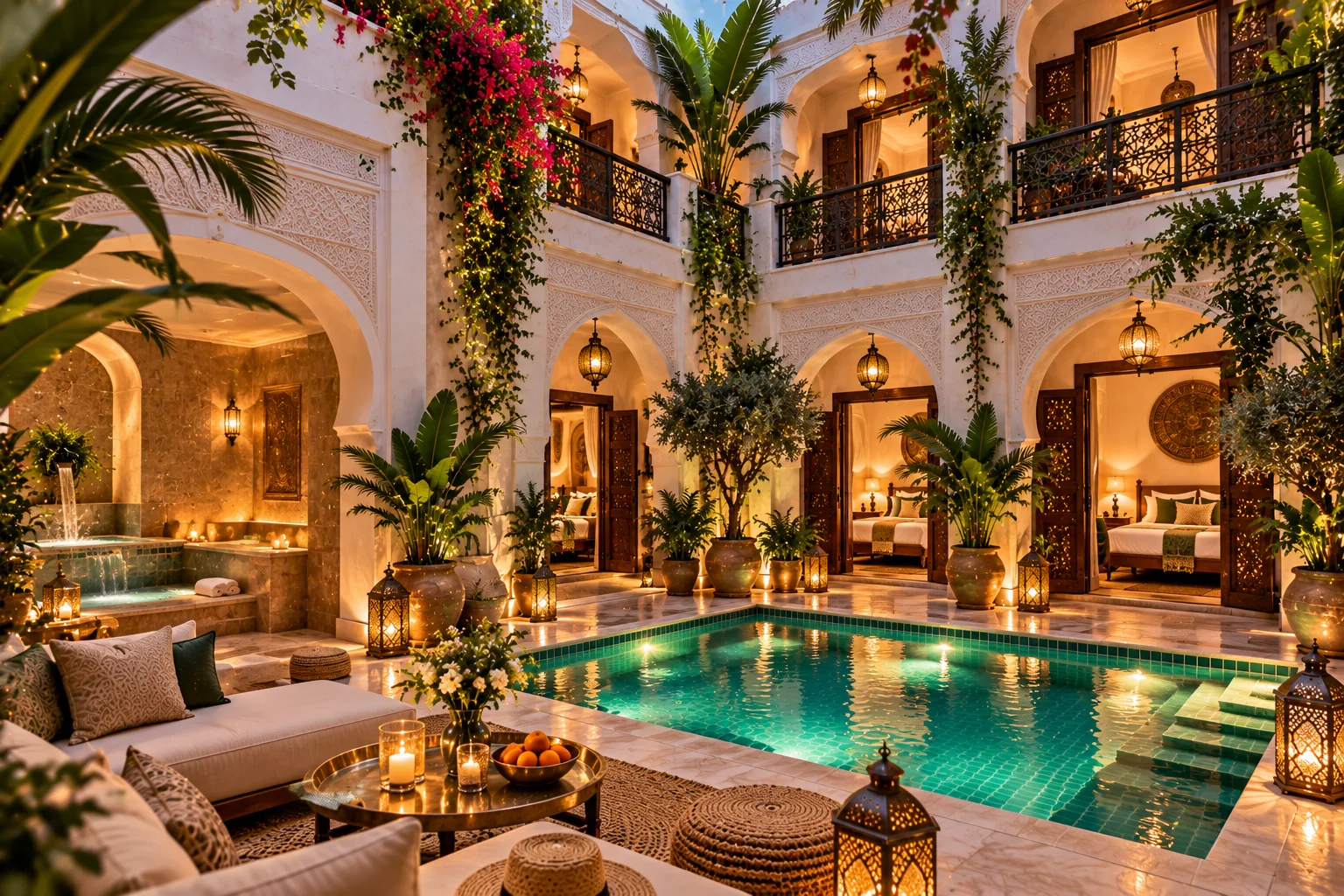
Can a seven-bedroom riad generate an annual result of more than €150,000 in Marrakech?
That is what an ambitious simulation reviewed by Darnel Collection suggests for its fifth year: an aggregate of €329,396 combining receipts and margins, alongside a reported result of around €155,000 after management fees. Neither amount has been validated as revenue or net profit, and neither should be used to promise a return.
On paper, these figures are particularly attractive.
But before investing several hundred thousand euros, one question matters more than any other:
How much will the owner actually retain once commissions, salaries, operating costs, management fees, taxes and any loan repayments have been taken into account?
A riad is more than a property asset.
It is a hospitality business that must sell rooms, welcome guests, control its costs and build its reputation.
In this business, a few percentage points of occupancy or a €20 difference in the average room rate can substantially change the annual result.
In this guide, we will examine:
- The commercial potential of a seven-bedroom riad.
- The differences between gross room revenue and receipts after commissions.
- Ancillary income: dining, spa services and experiences.
- Operating costs and management fees.
- Three profitability scenarios.
- A five-year forecast.
- The occupancy level needed to cover costs.
- The mistakes to avoid before investing.
- An operating example in the Kasbah district.
Important: the simulations presented are illustrative assumptions expressed in euros. They represent neither actual performance nor promised returns.
In Darnel’s example, seven rooms available for 365 days, at 60% occupancy and a €115 ADR, generate €176,295 in annual room revenue excluding tax, before commercial deductions. The five-year base case shows a simplified operating balance of €42,135 in year five, before taxes, financing and replacement expenditure. These simulations are neither observed performance nor guaranteed net profit.
To interpret the calculations, the STR/CoStar glossary defines ADR as room revenue divided by rooms sold. This source documents the indicator, not the commercial assumptions in Darnel’s model. Our method separates revenue, contributions, costs and fees, without treating a sum of sales and margins as revenue.
Connect this forecast with the total investment budget and riad operating costs and cash flow. To explore the hospitality concept illustrated here, discover Dar Léon & Spa; its architectural renderings do not substantiate the simulated results.
How many room nights can a seven-bedroom riad sell?
Let us start with theoretical capacity.
A riad with seven rooms available for sale throughout the year has:
7 rooms × 365 days = 2,555 available room nights per year.
These are available rooms, rather than room nights actually sold.
Room revenue depends primarily on two indicators:
Occupancy: the proportion of available rooms that are sold.
ADR (Average Daily Rate): the average rate excluding tax for rooms actually sold.
The formula is straightforward:
Available room nights × occupancy × ADR = gross room revenue excluding tax.
An example at 60% occupancy
With seven rooms, 60% occupancy and an ADR of €115:
2,555 × 60% × €115 = €176,295 in annual gross accommodation revenue excluding tax.
However, this amount does not necessarily correspond to the receipts retained after distribution commissions.
The role of booking platforms
For illustration, suppose that commissions and commercial discounts together represent 18% of room revenue.
The calculation becomes:
€176,295 × 82% = €144,562 in room receipts after commercial deductions, rounded to the nearest euro.
This amount must be distinguished from accounting revenue, whose presentation depends on the treatment of commissions, taxes and contracts.
Darnel advice: track your gross ADR, room revenue and distribution costs separately. Without this distinction, you risk overstating your property's performance.
Three revenue scenarios for a seven-bedroom riad
Not every riad in Marrakech can achieve the same performance.
The neighbourhood, comfort, service quality, guest reviews, seasonality and booking channels all influence results.
To understand the potential differences, let us build three scenarios.
| Indicator | Cautious | Base case | Ambitious |
|---|---|---|---|
| Rooms | 7 | 7 | 7 |
| ADR excluding tax | 95 € | 115 € | 135 € |
| Occupancy | 45% | 60% | 75% |
| Gross room revenue excluding tax | 109,226 € | 176,295 € | 258,694 € |
| Assumed commercial deductions | 18% | 18% | 18% |
| Room receipts after deductions | 89,566 € | 144,562 € | 212,129 € |
Calculations rounded to the nearest euro. The three scenarios are illustrative and do not represent Marrakech market averages.
What this comparison tells us
The ambitious scenario generates approximately €122,500 more in room receipts than the cautious scenario.
This shows why commercial performance matters just as much as the property investment.
However, achieving 75% occupancy over a full year already requires an effective distribution strategy.
An occupancy rate of 90%, as envisaged in the initial simulation examined below, should be considered particularly ambitious.
Darnel advice: a sound business plan should not rely solely on the best possible scenario. It should show how the riad would withstand lower occupancy.
How much can ancillary services earn?
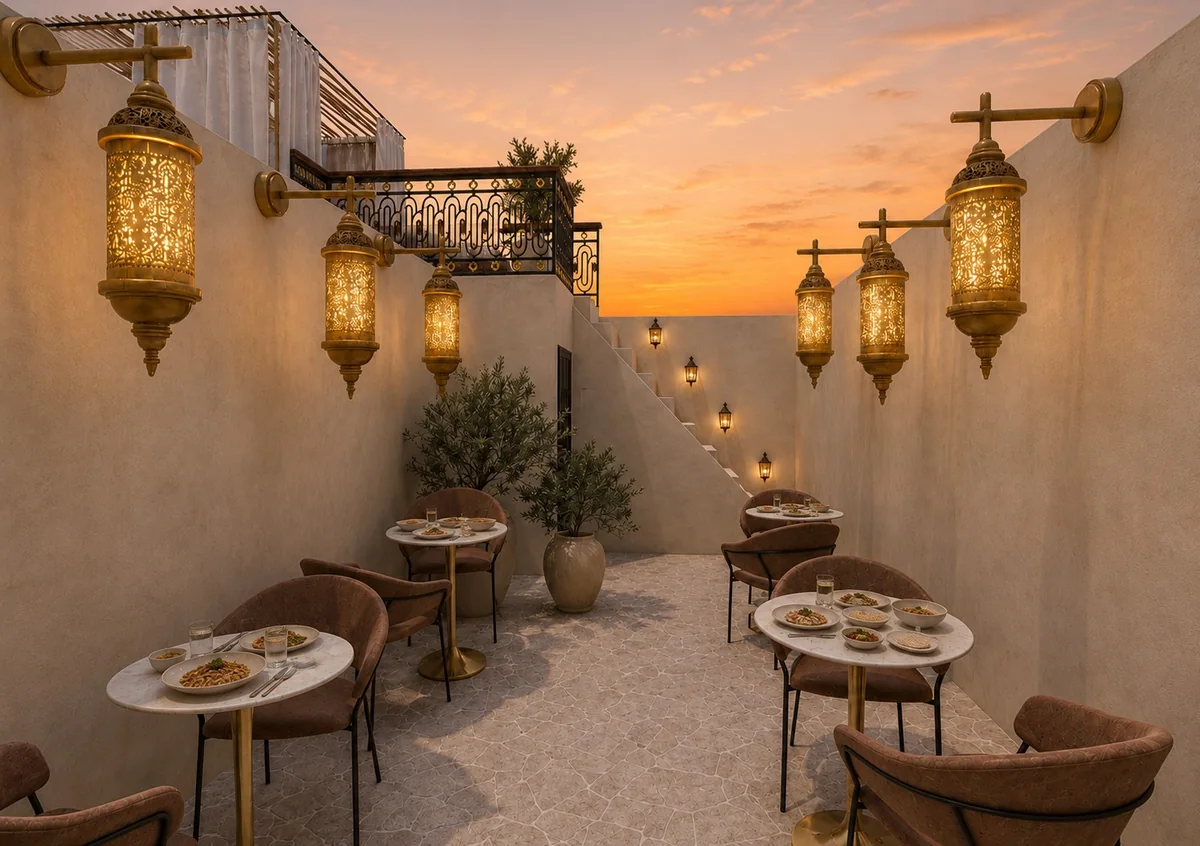
Architectural rendering of the rooftop restaurant at Dar Léon & Spa
A riad can develop several revenue streams without increasing its room count.
This is one of the attractions of hospitality operations.
However, the amount charged to the guest must be distinguished from the margin actually retained.
Dining
Breakfasts, dinners and culinary experiences can increase average guest spending.
For example:
Four dinners sold at €35 each, over 200 evenings:
4 × €35 × 200 = €28,000 in annual sales.
If direct costs represent 55%, the contribution before shared overheads is:
€28,000 × 45% = €12,600.
This is not net profit: shared overheads still need to be covered.
Spa and wellness
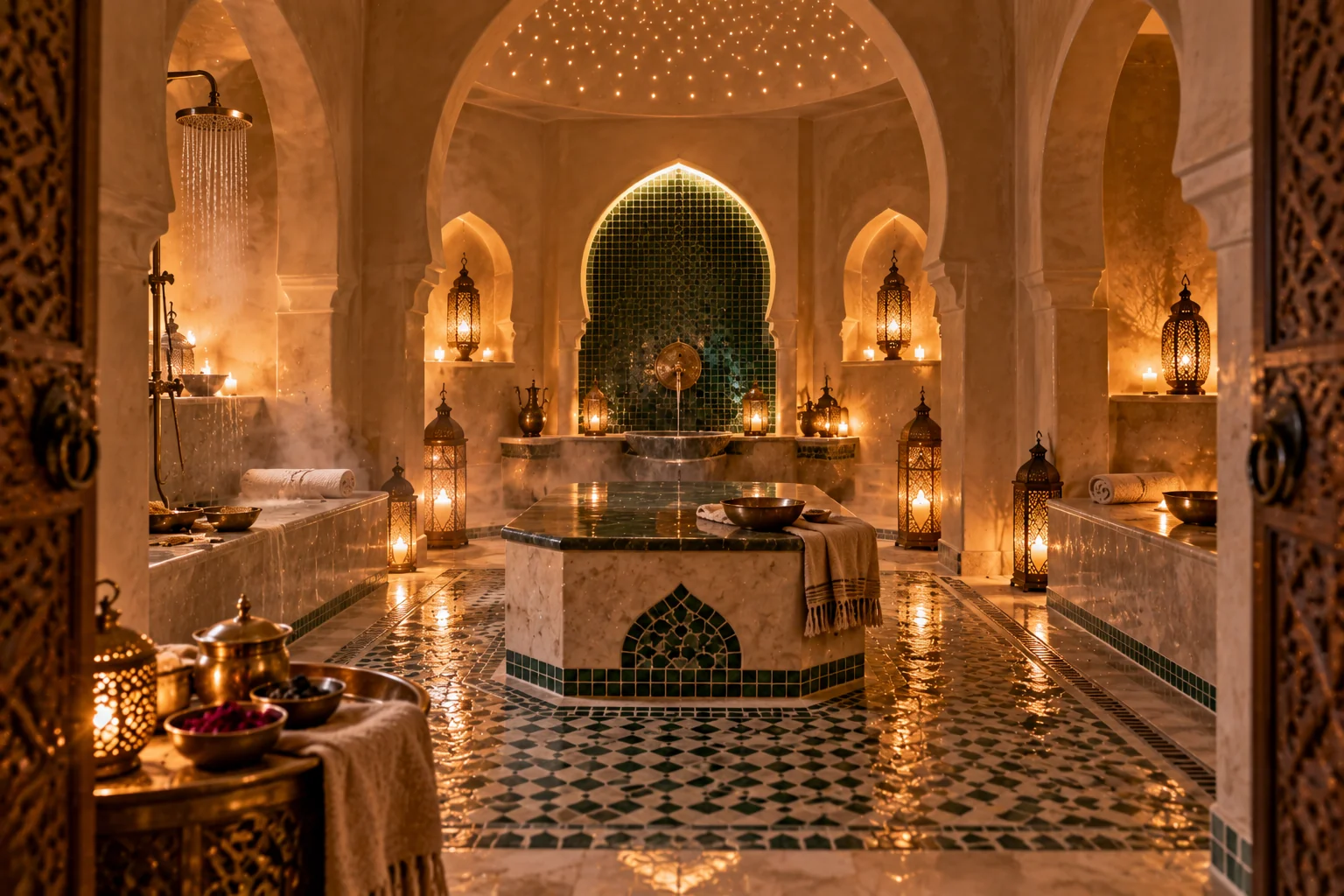
Illustration of a riad hammam, Darnel Collection resource
A riad equipped with a hammam and a massage room can offer treatments to guests.
For example:
Two treatments at €60 each, over 200 days:
2 × €60 × 200 = €24,000 in annual sales.
With direct costs of 50%:
€12,000 in contribution before shared overheads.
These figures assume that demand exists and that the services comply with applicable requirements.
Experiences and transfers
Excursions, transfers, workshops and activities can enhance the stay.
However, the accounting treatment depends on the property's role.
If the riad acts solely as an intermediary, its economic income may be a commission rather than the full price paid to the service provider.
Exclusive-use stays and packages
A seven-bedroom riad can also offer exclusive-use stays.
Be careful to avoid double counting.
If a two-night package includes all the rooms, accommodation revenue must be recognised only once.
Only additional services not already included in other lines can be added to the model.
The right approach
For each activity, track:
- Sales invoiced.
- Direct costs.
- Contribution margin.
- Resources required.
- Guest satisfaction.
Darnel advice: a service that increases revenue without improving its economic contribution is not automatically a worthwhile activity.
Auditing an ambitious simulation: an aggregate that cannot be treated as revenue
Let us now return to the ambitious simulation that prompted this study.
It assumes an increase in ADR from €100 to €120 and a rise in occupancy from 75% to 90%.
Room receipts after deductions
| Year | Stated ADR | Occupancy | Net room receipts in the model |
|---|---|---|---|
| 1 | 100 € | 75% | 140,983 € |
| 2 | 105 € | 80% | 161,661 € |
| 3 | 110 € | 85% | 182,919 € |
| 4 | 115 € | 87.5% | 197,196 € |
| 5 | 120 € | 90% | 211,089 € |
These amounts come from the initial simulation.
An important limitation: they are below the gross room revenue calculated from ADR and occupancy. The exact deductions must therefore be documented before the model can be presented as a validated forecast.
Ancillary receipts and margins
| Category | Year 1 | Year 3 | Year 5 |
|---|---|---|---|
| Room receipts after deductions | 140,983 € | 182,919 € | 211,089 € |
| Ancillary sales | 24,100 € | 54,600 € | 86,700 € |
| Package margin | 3,000 € | 9,000 € | 15,000 € |
| Spa margin | 11,863 € | 14,235 € | 16,608 € |
| Dining margin | 0 € | 0 € | 0 € |
| Aggregate receipts and margins (not revenue) | 179,946 € | 260,754 € | 329,396 € |
The totals come from the initial model; they mix room receipts after deductions, gross ancillary sales and service margins. They represent neither accounting revenue nor an overall margin. The €1 rounding difference in year five is retained to preserve traceability to the original document. Any publication of a €155,000 profit requires a complete operating statement, a justified management-fee base and a breakdown of direct costs.
What this table really means
The model illustrates a substantial increase in ancillary services.
However, in its current form it does not allow total revenue excluding tax to be determined precisely.
This would require the gross sales and direct costs of each activity.
Furthermore, the increase in ancillary sales from €24,100 to €86,700 requires a commercial rationale: guest numbers, purchase rates, average spending and operational capacity.
Darnel advice: a simulation becomes credible when every line can be explained through a formula and verifiable assumptions.
What are the operating costs of a seven-bedroom riad?
Operating costs determine the difference between a property that makes substantial sales and one that actually generates a surplus.
They include, in particular:
- Staff and employer social contributions.
- Consumables.
- Energy and water.
- Maintenance.
- Insurance.
- Marketing.
- Software.
- Administrative costs.
- Any management fees.
Costs included in the initial simulation
| Year | Annual operating costs |
|---|---|
| 1 | 65,760 € |
| 2 | 72,336 € |
| 3 | 79,570 € |
| 4 | 87.527 € |
| 5 | 96,279 € |
These figures come from the model supplied.
On their own, they are insufficient to validate the operating-cost budget of a seven-bedroom riad.
Why is a breakdown essential?
A staffing budget may suit a highly flexible team yet be insufficient for a property offering extended reception, dining and spa hours.
Similarly, some commercial expenses may already have been deducted from room revenue.
It is therefore essential to avoid subtracting them twice.
An example of an operating-budget breakdown
To illustrate the approach, let us use an annual fixed-cost budget of €82,000.
| Category | Illustrative budget |
|---|---|
| Staff and social contributions | 48,000 € |
| Energy, water and telecommunications | 10,000 € |
| Maintenance and upkeep | 8,000 € |
| Insurance, software and administration | 8,000 € |
| Fixed marketing and miscellaneous costs | 8,000 € |
| Total fixed costs | 82,000 € |
Variable costs associated with room sales and ancillary services are added to this budget.
These amounts must be replaced with a budget based on actual staffing, contracts, consumption and suppliers.
Darnel advice: request an operating statement with a separate line for each cost category. An overall cost percentage is insufficient to manage a guesthouse.
Further reading: Riad operating costs in Marrakech: how much do you really retain?
Is professional management always profitable?
No.
The owner's result after management fees must be compared with that of a self-managed operation, factoring in working time, the skills required, commercial costs and actual performance.
Professional management must deliver measurable value: distribution, average room rate, direct bookings, guest satisfaction and cost control.
Darnel advice: compare results after all costs, rather than revenue before management fees alone.
Do you already own a riad?
Darnel Hospitality supports owners with marketing, performance management and the optimisation of their property.
Request a Darnel Hospitality performance review →
A new five-year business plan with explicit assumptions
To take the analysis further, let us build a different model from the initial simulation.
This base-case scenario uses more moderate assumptions.
Common assumptions
- Seven rooms.
- 2,555 available room nights per year.
- Commercial deductions from room revenue: 18%.
- Contribution margin on ancillary sales: 45%.
- Additional variable room costs: 12% of room receipts after deductions.
- Management fees: a purely illustrative assumption of 20% of the simplified fee base (room receipts after deductions + ancillary contribution). This does not represent Darnel Hospitality's contractual pricing.
- Itemised, increasing fixed costs.
- Neither financing nor taxation is included in the result presented.
Commercial deductions are applied upstream: they are not repeated in fixed costs.
Base-case forecast
| Indicator | Year 1 | Year 2 | Year 3 | Year 4 | Year 5 |
|---|---|---|---|---|---|
| ADR excluding tax | 105 € | 110 € | 115 € | 120 € | 125 € |
| Occupancy | 50% | 55% | 60% | 63% | 66% |
| Gross room revenue excluding tax | 134,138 € | 154,578 € | 176,295 € | 193,158 € | 210,788 € |
| Room receipts after deductions | 109,993 € | 126,754 € | 144,562 € | 158,390 € | 172,846 € |
| Gross ancillary sales | 16,000 € | 20,000 € | 25,000 € | 30,000 € | 35,000 € |
| Contribution from ancillary sales | 7,200 € | 9,000 € | 11,250 € | 13,500 € | 15,750 € |
| Fixed costs | 78,000 € | 80,000 € | 82,000 € | 85,000 € | 88,000 € |
| Variable room costs | 13,199 € | 15,210 € | 17,347 € | 19,007 € | 20,741 € |
| Illustrative management fees (20% of the simplified base) | 23,439 € | 27,151 € | 31,162 € | 34,378 € | 37,719 € |
| Simplified operating balance | 2,555 € | 13,392 € | 25,302 € | 33,505 € | 42,135 € |
Calculations rounded to the nearest euro. The management-fee line is a simulation assumption rather than a Darnel Hospitality proposal. The model does not allow VAT to be treated correctly. The balance is neither accounting net profit nor distributable cash flow.
Why is this simulation more cautious?
It assumes occupancy increasing from 50% to 66%, rather than from 75% to 90%.
It makes fixed costs, variable costs and management fees visible.
It also shows that the first few years may generate limited operating cash flow.
The main lesson
A riad's performance depends less on spectacular revenue figures than on the coherence of its business model.
A property can generate more than €200,000 in gross room revenue while retaining a relatively modest operating balance after all expenses.
Darnel advice: always request three forecasts before investing: cautious, base case and ambitious.
Simulate the operating balance of seven rooms
Educational tool reproducing the base-case model: 7 × 365 available room nights, 18% commercial deductions, 45% ancillary contribution, 12% variable room costs and illustrative fees of 20% of the simplified base. Calculations use unrounded amounts, then display results rounded to the nearest euro. Excludes VAT, taxation, financing and replacement expenditure; no return is guaranteed. These fees are not a Darnel Hospitality offer.
Check the values entered.
- Room receipts after deductions
- —
- Ancillary contribution
- —
- Variable room costs
- —
- Illustrative management fees
- —
- Simplified operating balance
- —
- Break-even occupancy with constant assumptions
- —
Also explore the Darnel Collection project simulators (each uses its own assumptions)
Three scenarios: how much can the owner actually retain?
Let us now compare three situations in a stabilised operating year.
The fixed-cost and ancillary-sales assumptions are adapted to each scenario.
| Indicator | Cautious | Base case | Ambitious |
|---|---|---|---|
| ADR excluding tax | 95 € | 115 € | 135 € |
| Occupancy | 45% | 60% | 75% |
| Room receipts after deductions | 89,566 € | 144,562 € | 212,129 € |
| Ancillary contribution | 5,400 € | 11,250 € | 18,000 € |
| Fixed costs | 90,000 € | 100,000 € | 115,000 € |
| Variable room costs | 10,748 € | 17,347 € | 25,455 € |
| Illustrative management fees | 18,993 € | 31,162 € | 46,026 € |
| Simplified operating balance | −24,775 € | 7,302 € | 43,648 € |
These scenarios illustrate an operating year with cost levels that differ from the previous forecast. They are not actual market observations.
Cautious scenario
The property does not cover all the expenses included.
The owner needs a financial reserve or must improve performance quickly.
Base-case scenario
The operation produces a positive but limited balance.
A substantial loan or unexpected works could absorb this result.
Ambitious scenario
The property benefits from high occupancy and a stronger average room rate.
It can generate a larger contribution, but taxation, financing and replacement capital expenditure must still be taken into account.
Darnel advice: investors should ask not only how much they could earn, but also how much they could lose if occupancy falls short of expectations.
How much cash will the investor actually retain?
This is the final question.
The operating balance shown in the tables does not automatically correspond to distributable cash flow.
An illustrative example
Suppose a riad generates an operating balance of €42,135.
Depending on the structure, you must then consider:
- Replacement capital expenditure.
- Taxes actually payable.
- Loan repayments.
- Any cash-flow timing differences.
- Other expenses excluded from the model.
If, for example, €8,000 is allocated to replacing equipment, the remaining amount is:
€42,135 − €8,000 = €34,135, before taxes, financing and other adjustments.
This still does not constitute net personal income.
Why financing changes everything
A riad can show a positive operating result while facing cash-flow difficulties if its loan repayments are high.
An annual and monthly cash-flow statement is therefore essential.
What about the return on invested capital?
Imagine a total investment of €600,000.
With an operating balance of €42,135:
€42,135 ÷ €600,000 = approximately 7.02%, before equipment replacement, taxation and financing. After an illustrative reserve of €8,000, the ratio falls to €34,135 ÷ €600,000 = 5.69%, still before taxes and financing.
This is a simplified operating ratio rather than a net return after taxation and financing.
Darnel advice: compare projects on the basis of the total capital committed and the cash actually available, rather than advertised revenue alone.
Six ways to improve a riad's profitability
1. Improve the average room rate
A pricing strategy adapted to demand can increase revenue without increasing capacity.
2. Diversify distribution
Booking, Airbnb, agencies, a website and partnerships can help reduce dependence on a single channel.
3. Develop direct bookings
The objective is not just to reduce commissions, but to measure total acquisition costs.
4. Increase revenue per guest
Spa services, dining and experiences can improve the economic contribution when well managed.
5. Optimise operating costs
Staff organisation, purchasing and maintenance must be monitored regularly.
6. Monitor indicators every month
Occupancy, ADR, RevPAR, commissions, average guest spending and the operating balance should feature in a dashboard.
A 90-day approach
Month one: audit revenue, operating costs, rates and channels.
Month two: optimise distribution and introduce ancillary offers.
Month three: measure results and adjust actions.
Darnel advice: prioritise actions with measurable effects over marketing expenditure without a clear objective.
FAQ: how much does a seven-bedroom riad in Marrakech earn?
What revenue can a seven-bedroom riad generate?
With an ADR excluding tax of €115 and 60% occupancy, theoretical annual gross room revenue reaches €176,295, before commissions and other deductions.
Can a seven-bedroom riad generate €300,000 per year?
This level may be envisaged in an ambitious scenario combining high occupancy, a strong average room rate and ancillary services. It should not be presented as an average or a guaranteed result.
What occupancy rate is needed to be profitable?
It depends on costs and rates. There is no universal threshold. With ADR, fixed costs, variable costs, ancillary income and management fees held constant, the threshold is calculated by solving “room contribution + ancillary contribution − fixed costs − management fees = 0”. The threshold must be recalculated for each property.
How much do booking-platform commissions cost?
They depend on platforms, contracts, promotions and the channels used. The actual rate borne by the property must be measured.
Are ancillary services profitable?
They can be, but their contribution must be calculated after direct costs.
How much are management fees?
Management terms depend on the contract. For the Darnel Hospitality reference model, the working assumption is 25% of the contractual fee base comprising accommodation, spa services and dining, after OTA commissions have been deducted. The treatment of tax, exclusions and other services must be specified in the contract. The 20% fees used in the simulation are not a commercial offer.
Can a riad be operated remotely?
Yes, with a suitable local organisation, commercial monitoring and control procedures.
What is the difference between profit and cash flow?
Accounting profit and available cash do not measure the same thing. Taxes, capital expenditure and loan repayments can change the amounts available.
Should you buy a riad that is already operating?
It depends on the price, property condition, authorisations, historical results and works required.
How can I assess my project's profitability?
You need a total investment budget, a market study, an operating-cost forecast and several revenue scenarios.
Take your project further
Explore our other guides:
Get the tools to prepare your investment
Join the Private Investors Club →
You can also discover our book Réussir sa nouvelle vie au Maroc, which covers preparing a new life and investment project in Morocco.
Conclusion: how much does a seven-bedroom riad really earn?
A seven-bedroom riad in Marrakech can develop an attractive tourism business.
However, results depend heavily on the ability to sell rooms at the right price, develop ancillary services and control spending.
The initial simulation refers to almost €155,000 after management fees in year five, but this result cannot be considered validated until sales, direct costs, operating expenses, management fees and tax treatments have been reconciled.
The alternative model shows that, with more moderate assumptions and explicit costs, the year-five operating balance is €42,135 before taxes, financing and replacement expenditure. This is not a guaranteed net return.
The real challenge is therefore not to find the most attractive figure. It is to build a business plan capable of withstanding less favourable commercial conditions than expected.
Before buying a riad, have its location, budget, clientele, potential income and operating costs assessed.
Would you like to invest in a riad in Marrakech?
Darnel Collection supports you in analysing your property project and its operating potential.
Review my revenue, cost and cash-flow assumptions →
Do you already own a riad?
Darnel Hospitality can support you with the marketing, distribution and performance management of your property.
Request a performance review →
Georges Lelièvre — Darnel Collection
The financial assumptions are provided for educational purposes. Budgets, results and contractual terms must be verified for each property. No return is guaranteed.