
Tourism operations and regulations
Creating a Guesthouse in Marrakech in 2027: Budget, Permits, Profitability and Opening Steps
The complete guide to investing in, designing, opening and running a guesthouse or riad in Marrakech.
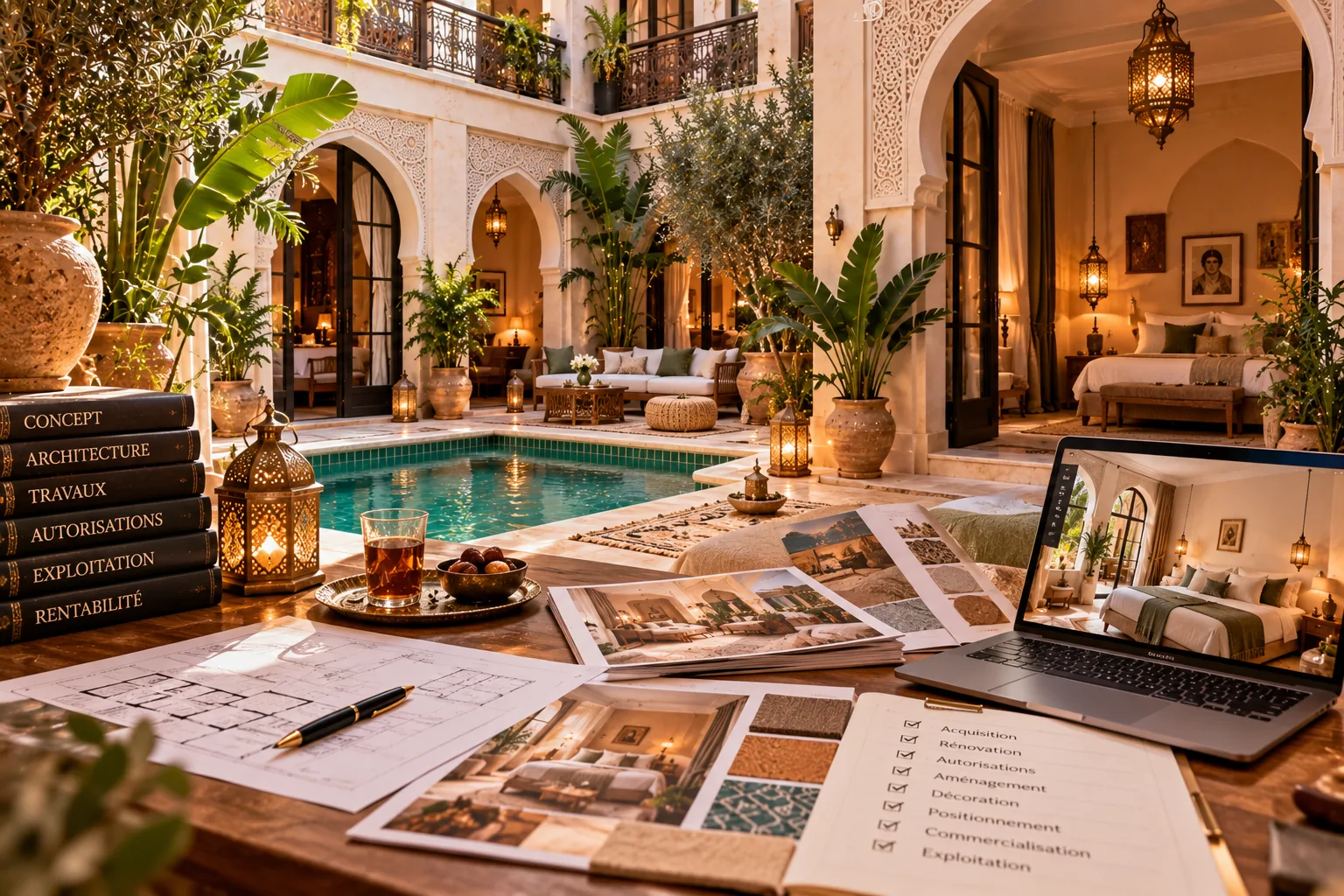
Creating a guesthouse in Marrakech appeals to many French, Moroccan and international investors.
Imagine a traditional riad in the heart of the Medina: a bright courtyard, elegant rooms, a rooftop for breakfast, a hammam and a team welcoming travellers with care.
Yet between buying a property and welcoming the first guests, many decisions need to be made.
Buying a beautiful riad is not enough to create a profitable guesthouse.
You must select a suitable building, check permits, define a commercial concept, finance the works, recruit a team and prepare room distribution.
A mistake at any stage can increase costs, delay opening or weaken operations over the long term.
At Darnel Hospitality, we believe a guesthouse should be planned as a real hospitality business from the outset.
Key points for preparing your project
Budget: three illustrative scenarios of €350,000, €500,000 and €1,100,000, depending on capacity and scope.
Permits: check feasibility, the regulatory category, compliance and operating requirements before opening.
Schedule: twelve months in the favourable scenario presented; major restructuring requires its own schedule.
Performance: monitor revenue, margins, operating break-even and available cash.
Remember: the amounts in this guide are working assumptions expressed in euros. They are neither verified market prices nor quotations or promises of returns. The rules presented are based on legislation known in October 2026; their application to a 2027 opening must be reconfirmed.
To create a guesthouse in Marrakech, define the concept and intended category, assess the property, then coordinate budget, authorisations, works, team and marketing. Darnel’s method connects the property programme with future operations from the feasibility stage. This guide’s scenarios are illustrative; its favourable schedule is not a guaranteed timeframe for major restructuring.
The official opening procedure requires electronic submission to the relevant regional investment centre for provisional classification and operating authorisation. Prepare the documents before pre-opening and confirm current requirements with the tourism delegation.
To prepare an acquisition decision, use the riad buying guide; to turn the concept into commercial and operational organisation, consult the tourist riad operations guide. Dar Léon and Kasbah Nelaria below illustrate project concepts, not the guide’s simulated results.
1. Guesthouse, riad or boutique hotel: which concept should you create in Marrakech?
Before looking for a property, answer one fundamental question:
What type of tourist accommodation do you actually want to operate?
Property listings often use “riad” to describe a traditional house arranged around a courtyard.
In Morocco, however, tourism operations are governed by regulatory categories.
Guesthouse: a regulated accommodation activity
Moroccan Law No. 80-14 defines a guesthouse as, among other things, a commercial establishment in the form of a villa or house offering equipped rooms or suites and certain ancillary services.
Riad: a specific tourism category
The same law also defines a riad by reference to traditional Moroccan architecture and decoration.
This distinction goes beyond marketing: it can affect the standards and classification to be met.
Boutique hotel: a commercial positioning
“Boutique hotel” generally describes a small establishment with a strong architectural identity and a personalised experience.
It does not replace the regulatory category required for authorisation and classification.
Three business models
On small screens, scroll the table horizontally if needed.
| Concept | Indicative capacity | Positioning | Main challenge |
|---|---|---|---|
| Intimate riad | 4 rooms | Couples, private stays, premium experience | Generating sufficient margin per room |
| Charming guesthouse | 6 to 7 rooms | Couples, families, small groups | Balancing revenue and fixed costs |
| Premium establishment | 10 rooms | Luxury stays, wellness, dining | Organising multiple revenue centres |
These capacities illustrate possible projects; they do not, by themselves, determine eligibility for a regulatory category.
Darnel advice: do not start by choosing the number of rooms. Define your guests, service level and business model, then find a compatible building.
2. Why open a guesthouse in Marrakech in 2027?
Marrakech has major strengths for a hospitality project: heritage, gastronomy, crafts, architecture, wellness and a wealth of tourism experiences.
The Medina is particularly suited to intimate establishments offering a different experience from large hotels.
An attractive destination does not automatically make every establishment profitable.
Two riads in the same neighbourhood can perform very differently.
The first decision: choose your guests
A guesthouse can target several segments.
Couples often seek comfort, privacy and personalised experiences.
Families and small groups place more importance on capacity, shared spaces and exclusive hire.
High-end travellers may value distinctive architecture, wellness services and attentive service.
Culture lovers seek immersion in the Medina, encounters and local experiences.
Why positioning affects profitability
Imagine two five-room establishments.
The first offers pleasant rooms without a particularly distinctive commercial identity.
The second develops a coherent concept around contemporary Moroccan architecture, wellness and gastronomic experiences.
The second might justify a higher ADR, provided demand exists and the experience truly fulfils its promise.
ADR is the average price per room sold: room revenue divided by the number of room nights sold. In this guide it excludes tax. A room night is one room sold for one night, regardless of the number of occupants.
Practical exercise
Before looking for a property, complete this sentence:
“Our guesthouse targets [target guests] and offers [distinctive experience] in [desired setting], with a target average price of [amount] per night.”
This sentence will be the starting point for your project brief.
Darnel advice: do not build a guesthouse for everyone. A clear concept makes design, communication and marketing easier.
3. Which Marrakech neighbourhood should you choose for your guesthouse?
Location affects the purchase price, works, guest experience and commercial potential.
Yet in the Medina, properties only a few hundred metres apart can have very different access conditions.
The Kasbah
The Kasbah may suit guesthouse and riad projects seeking a heritage identity.
Examine access quality, proximity to attractions, the immediate surroundings and the building's characteristics.
Bab Doukkala
Bab Doukkala may appeal to investors looking to develop an intimate establishment.
Accessibility, walking routes and delivery arrangements need close study.
Mouassine and Dar El Bacha
These areas may meet the expectations of travellers seeking a central Medina location.
But an address's commercial appeal must always be weighed against its property cost.
Seven checks before choosing a riad
- The actual access time from a drop-off point.
- Noise during the day and evening.
- The building's structural condition.
- The possibility of organising service areas.
- The feasibility of the proposed works.
- Compatibility with the intended tourism activity.
- Revenue potential relative to the total investment.
Practical example: a riad with a magnificent courtyard but difficult luggage access may require a more expensive reception service.
Anticipate that cost before buying.
Darnel advice: visit with an architect and someone experienced in hotel operations. A commercial perspective should complement the property assessment.
Further reading: Which Medina neighbourhoods should you prioritise for investment in Marrakech?
4. What budget do you need to create a guesthouse in Marrakech in 2027?
The purchase price is only part of the investment.
You must also fund studies, works, equipment, permits, marketing and start-up cash.
Three budget examples: 4, 6 and 10 rooms
The following scenarios are deliberately constructed as educational examples. They are not market price ranges.
On small screens, scroll the table horizontally if needed.
| Item | 4 rooms | 6 rooms | 10 rooms |
|---|---|---|---|
| Purchase | €170,000 | €250,000 | €550,000 |
| Fees and studies | €20,000 | €25,000 | €55,000 |
| Works | €95,000 | €140,000 | €320,000 |
| Furniture and equipment | €25,000 | €35,000 | €80,000 |
| Marketing and opening | €8,000 | €10,000 | €20,000 |
| Cash and contingencies | €32,000 | €40,000 | €75,000 |
| Total investment | €350,000 | €500,000 | €1,100,000 |
These budgets illustrate hypothetical programmes and initial conditions. They are not Darnel Collection offers. The four-room scenario at €350,000 does not correspond to Dar Léon; the ten-room scenario at €1,100,000 does not correspond to Kasbah Nelaria. To compare projects, consider floor areas, building condition, works, equipment, finish quality and what the price includes.
What does each room created cost?
On small screens, scroll the table horizontally if needed.
| Project | Total capital | Capital per room |
|---|---|---|
| 4 rooms | €350,000 | €87,500 |
| 6 rooms | €500,000 | €83,333 |
| 10 rooms | €1,100,000 | €110,000 |
Cost per room is useful but incomplete.
A project including a spa, pool or large shared spaces may need more capital while targeting a higher average rate.
Compare capital invested, room count, potential ADR and operating costs together.
Frequently overlooked expenses
Investors sometimes underestimate:
- Technical studies and structural repairs.
- Safety and compliance equipment.
- Storage and linen areas.
- IT equipment and software.
- Photography and marketing materials.
- Staff training.
- Pre-opening expenses.
- Cash needed during the ramp-up period.
Allowing for contingencies
The “cash and contingencies” line in the table must be split into two separate allocations before financing is approved.
A construction overrun reserve should not be used as operating cash without revising the financing plan.
Darnel advice: prepare an itemised investment budget and obtain works estimates before making a final commitment.
Would you like to create your own guesthouse?
Darnel Collection supports riad creation projects in Marrakech, from property planning through to delivery.
Discover Darnel Collection and request a project study →
5. Buy, renovate or build: which strategy should you choose?
Option 1: buy an operating guesthouse
This can reduce some of the development stages.
But review accounts, contracts, equipment, permits and any works needed.
Check historical revenue, occupancy, ADR, commissions, costs and administrative status.
Option 2: buy a riad to renovate
This strategy provides more design freedom.
It allows you to create an establishment for a specific clientele and positioning.
In return, it involves technical and financial risks.
Check structure, damp, utilities, heritage constraints, site access and tourism feasibility.
Option 3: build or restructure an establishment
A new building or major restructuring allows hotel requirements to be incorporated from the planning stage.
But schedules and permits can be decisive.
Comparison
On small screens, scroll the table horizontally if needed.
| Criterion | Existing establishment | Riad to renovate | Construction or restructuring |
|---|---|---|---|
| Customisation | Limited | High | Potentially very high |
| Construction risk | Variable | High | High |
| Trading history | Sometimes available | Generally absent | Absent |
| Time to opening | Potentially shorter | Depends on works | Depends on studies and permits |
| Main issue | Audit of the existing operation | Controlling construction | Overall feasibility |
Darnel advice: before comparing properties, compare their total cost through to opening, rather than the purchase price alone.
Further reading: Buying a riad in Marrakech: the complete guide
6. Which permits are needed to open a guesthouse in Morocco?
Secure this stage before making the main investments.
Operating a guesthouse or tourist riad is governed in particular by Law No. 80-14 on tourist establishments and other forms of tourist accommodation, its implementing decrees and classification orders.
Building, equipment and service requirements depend on the establishment's type and category.
Guesthouses and riads: different classifications
Under Law No. 80-14 and the classification texts, including Joint Order No. 985-24 of 24 December 2024, published in the Official Bulletin in 2025:
- Guesthouses are classified from 1 to 5 stars.
- Riads may fall into the 3-, 4-, 5-star or luxury categories.
Choose the category according to regulatory definitions and applicable standards, rather than the trading name alone.
The administrative process to anticipate
On small screens, scroll the table horizontally if needed.
| Stage | Objective | Parties to consult |
|---|---|---|
| 1. Title checks | Securing rights over the property | Notary, legal adviser |
| 2. Planning feasibility | Checking intended works and use | Architect, planning authorities |
| 3. Category selection | Determining applicable standards | Tourism delegation, specialist adviser |
| 4. Studies and works permits | Preparing compliant works | Architect, engineering consultants, competent authorities |
| 5. Building compliance | Checking completion and required documents | Professionals and competent authorities |
| 6. Provisional classification and operating authorisation | Submitting the application under the applicable procedure | Regional Investment Centre and relevant authorities |
| 7. Opening and operating classification | Following required declarations, visits and checks | Operator, regional commission and tourism services |
This is a preparatory roadmap. The exact order, required documents and conditions for each decision must be confirmed for the project concerned.
What does the classification system provide for?
The implementing decree provides, in particular, for electronic submission to the Regional Investment Centre when applying for provisional classification and operating authorisation.
The documents mentioned include the regulatory application, a copy of the compliance certificate and the form covering dimensional and functional standards.
The procedure then includes stages relating to opening and operating classification.
Quality standards to anticipate
Order No. 985-24 sets mandatory and supplementary standards by establishment type and category.
The system requires all mandatory standards to be met and a points threshold for supplementary standards.
The mystery-visit system covers, in particular, guesthouses and riads rated 3 stars and above, at initial classification and renewal. It assesses service quality throughout the guest journey.
A checklist before works begin
Before approving the plans:
- Identify the intended regulatory type.
- Download the corresponding classification grid.
- Check required dimensions and equipment.
- Have safety and hygiene requirements checked.
- Check compliance with planning rules.
- Define the spaces required for staff.
- Prepare the administrative application schedule.
- Allow a margin for required adaptations.
Darnel advice: have the architect and an operations specialist review the classification grid before works begin. Changing a plan generally costs less than altering a completed building.
Official sources
- Ministry of Tourism — Tourist accommodation
- Ministry of Tourism — Operating classification procedure
- Law No. 80-14 — official text
- Classification standards — Order No. 985-24
Ministry of Tourism — Provisional classification and operating authorisation
Ministry of Tourism — Mystery visits: scope of the system
2027 checkpoint: before final publication and any application, check for changes to legislation, forms and procedures.
7. How do you design a comfortable, profitable guesthouse?
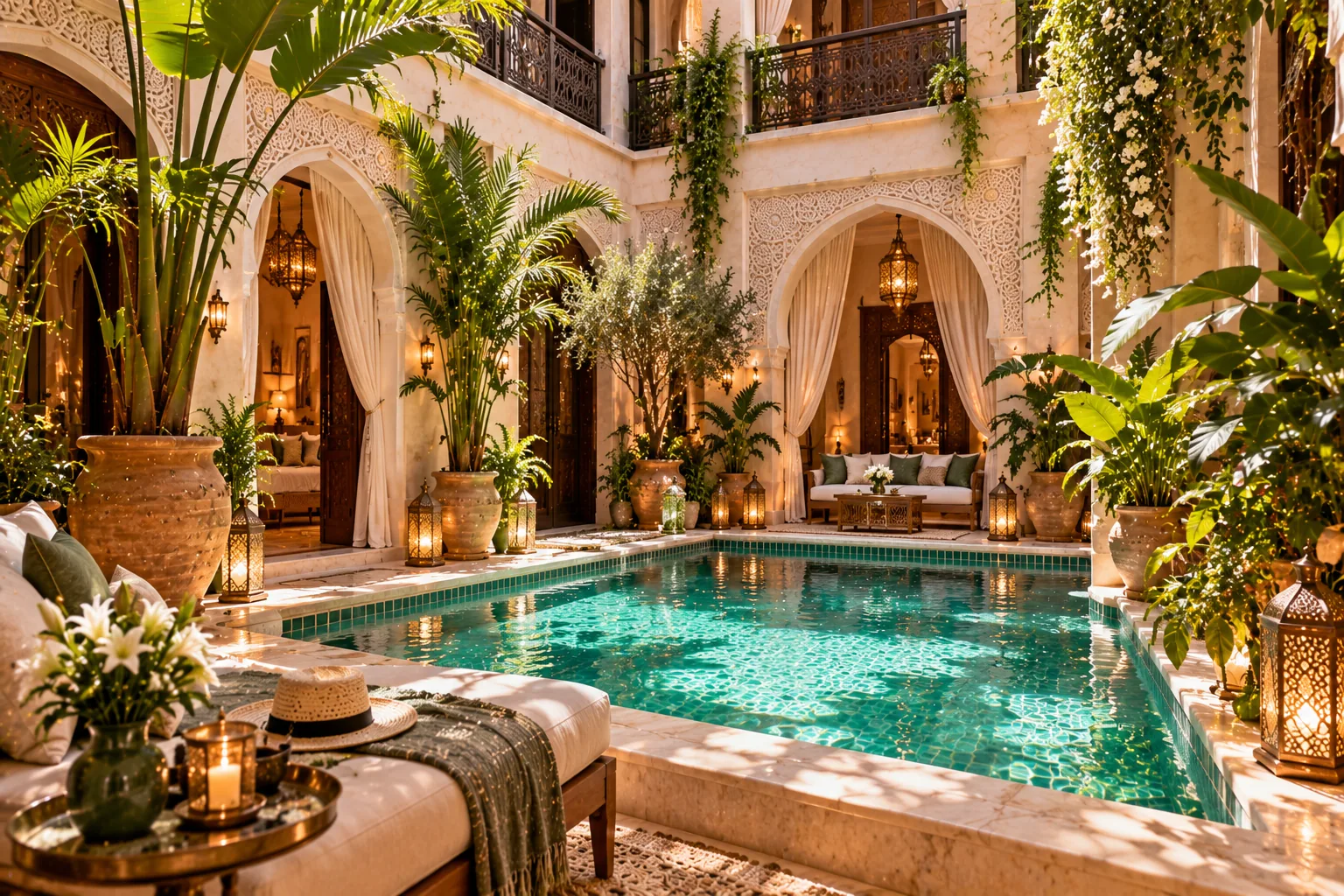
Design a guesthouse for both guests and the people who work there.
A photogenic establishment that is difficult to operate can generate unnecessary costs.
Rooms
Comfort must come first.
Consider acoustics, bedding, ventilation, lighting, storage and bathroom quality in particular.
Shared spaces
The courtyard, lounges and rooftop contribute to the establishment's identity.
Their use must remain consistent with the concept and operating constraints.
Service areas
This is too often overlooked.
Provide, in particular:
- A functional linen room.
- Storage space.
- An area for cleaning products.
- A kitchen suited to the intended services.
- Accessible plant and utility rooms.
- A layout that makes staff movement easier.
Example: the hidden cost of a poor layout
Imagine a riad where linen has to cross the courtyard during breakfast.
Teams lose time, circulation becomes difficult and the guest experience may suffer.
Suitable design can reduce movement and improve service efficiency.
Darnel advice: commission an operational review of the plans before construction. Assess each additional room against the service and shared areas required.
8. How much staff is needed to run a guesthouse?
Staff costs depend on room count, opening hours, service level and the services offered.
There is no universal staffing structure.
Example A: six-room guesthouse with streamlined service
On small screens, scroll the table horizontally if needed.
| Role | Illustrative organisation |
|---|---|
| Management and bookings | Owner or multi-skilled manager |
| Reception | Multi-skilled team with shift cover |
| Housekeeping | Dedicated staff and cover according to activity |
| Breakfast | Shared role depending on organisation |
| Maintenance | External providers |
| Spa and experiences | Qualified providers for the services offered |
Hypothetical annual budget: €48,000, provided the service scope, contracts and employment obligations make this allocation feasible.
Example B: six-room guesthouse with extended service
On small screens, scroll the table horizontally if needed.
| Role | Illustrative organisation |
|---|---|
| Management | Establishment manager |
| Reception and bookings | Cover organised around working hours |
| Housekeeping | More structured team |
| Food and beverage | Dedicated staff or providers |
| Spa | Professionals according to volume |
| Maintenance and security | Internal or outsourced organisation |
Hypothetical annual budget: €78,000.
These two budgets are not salary scales. Replace them with an itemised estimate including social contributions, leave, cover and legal working hours.
How should you choose your organisation?
A six-room establishment at 40% occupancy does not have the same variable needs as one at 80%.
But some roles must be covered regardless of occupancy.
The right approach is to distinguish between:
- Permanent functions.
- Needs linked to the number of occupied rooms.
- Services triggered by sales.
- Activities that can be outsourced.
Darnel advice: prepare three staffing schedules for low, medium and high occupancy without reducing legal requirements or minimum service quality.
9. The five revenue sources of a guesthouse
Room sales generally drive most revenue.
But a well-positioned establishment can develop ancillary revenue.
1. Room nights
They depend on three variables: room count, occupancy and ADR.
2. Food and beverage
Breakfast, dinners and culinary experiences can increase average guest spending.
However, calculate the costs of ingredients, staff and consumables.
3. Spa and wellness
Hammam, massages and treatments can offer differentiation.
Their appeal depends on demand, costs and the necessary permits.
4. Experiences and services
Transfers, excursions, workshops and other services can be offered directly or through authorised partners.
5. Exclusive hire and packages
Exclusive stays allow several rooms to be sold together with additional services.
Take care not to count room nights already included in room revenue twice.
Example: a six-room guesthouse at maturity
On small screens, scroll the table horizontally if needed.
| Activity | Hypothetical annual revenue excluding tax |
|---|---|
| Room nights | €190,530 |
| Food and beverage | €28,000 |
| Spa and wellness | €22,000 |
| Experiences and services | €12,000 |
| Specific additional package services | €7,470 |
| Total revenue | €260,000 |
Accommodation revenue from exclusive hire is already included in room nights. Ancillary revenue totals €69,470; this breakdown corresponds to year 4 of the forecast below.
Amounts from services sold on behalf of partners must be treated according to the accounting nature of the transactions.
Why margins must be monitored
An activity can increase revenue while reducing profitability.
For example, a dinner sold for €40 with €30 of direct costs generates only €10 of contribution before shared costs.
Darnel advice: measure the revenue and margin of each activity separately.
Estimate your future establishment's revenue
Would you like to compare the potential performance of a four-, six- or ten-room guesthouse?
Access the simulator and Private Investors' Club resources →
Try the investment guide profitability simulator →
10. How much can a four-, six- or ten-room guesthouse generate?
Let us compare three capacities with different commercial assumptions.
On small screens, scroll the table horizontally if needed.
| Indicator | 4 rooms | 6 rooms | 10 rooms |
|---|---|---|---|
| ADR excluding tax | €120 | €145 | €200 |
| Occupancy | 55% | 60% | 65% |
| Annual room revenue excluding tax | €96,360 | €190,530 | €474,500 |
These figures cover room revenue only.
They are neither market averages nor guaranteed results.
Example operating statement: six rooms
Return to the mature six-room scenario: €190,530 in room revenue excluding tax and €69,470 in ancillary revenue excluding tax, totalling €260,000 excluding tax. This operating statement corresponds to year 4 of the five-year forecast.
On small screens, scroll the table horizontally if needed.
| Item | Annual amount |
|---|---|
| Revenue excluding tax | €260,000 |
| Staff and social contributions | €65,000 |
| Purchases and consumables | €34,000 |
| Commissions and marketing | €38,000 |
| Energy, maintenance and insurance | €30,000 |
| Administration and management | €33,000 |
| Total operating costs | €200,000 |
| Simplified operating surplus | €60,000 |
The “administration and management” line hypothetically covers accounting, administrative expenses and oversight or management fees. Booking commissions and marketing are separate. This €33,000 allocation is not a Darnel Hospitality rate: any management contract must be priced according to its scope without double-counting staff or distribution costs.
The operating margin is:
€60,000 ÷ €260,000 = 23.1%.
What about the return on capital invested?
If the project cost €500,000:
€60,000 ÷ €500,000 = 12%.
This ratio is an indicative operating return before depreciation, financing, tax and certain sustaining capital expenditure.
It must not be presented as a net return.
What an owner really needs to calculate
To know how much can be withdrawn from the business, move from operating surplus to available cash.
In particular, account for:
- Any interest and loan repayments.
- Tax.
- Replacement capital expenditure.
- Changes in cash requirements.
- Any other cash outflows not included in operating costs.
Darnel advice: a project can have a healthy operating margin but insufficient cash to service substantial financing.
11. What occupancy rate is needed to break even?
Break-even is the level of activity needed to cover the costs included in the model.
Independent example: break-even based on rooms alone
Assumptions:
- Six rooms.
- 365 days of theoretical availability.
- ADR excluding tax: €145.
- Annual fixed costs: €120,000.
- Variable costs: 25% of room revenue.
- No ancillary revenue is included. This educational exercise uses its own cost structure: the €120,000 fixed costs and 25% variable rate are not those of the operating statement in sections 10 and 12. Do not apply the resulting threshold directly to that forecast.
Step 1: calculate contribution per room sold
€145 × (1 − 25%) = €108.75.
Each room night sold therefore contributes €108.75 towards fixed costs.
Step 2: calculate the room nights required
€120,000 ÷ €108.75 = 1,103.45 room nights.
Around 1,104 room nights must therefore be sold in the year.
Step 3: calculate break-even occupancy
Annual capacity:
6 × 365 = 2,190 room nights.
Occupancy threshold:
1,103.45 ÷ 2,190 × 100 = 50.4%.
In this example, simplified operating break-even is reached at around 50.4% occupancy.
Sensitivity to ADR
With unchanged costs:
On small screens, scroll the table horizontally if needed.
| ADR excluding tax | Break-even occupancy |
|---|---|
| €120 | 60.9% |
| €145 | 50.4% |
| €170 | 43.0% |
The result shows the importance of the average rate.
However, a higher ADR can also affect demand and therefore achievable occupancy.
This calculation does not cover tax, financing repayments or sustaining capital expenditure. It is therefore not the investor's overall cash break-even.
Darnel advice: calculate break-even before buying. It will help assess whether the commercial targets required are realistic.
12. Guesthouse business plan: a five-year projection
An establishment does not necessarily reach a stable operating level in its first year.
Central scenario assumptions
- Six rooms.
- Theoretical availability: 365 days a year.
- Increasing ADR and occupancy.
- Development of ancillary revenue.
- Costs increasing with activity.
- Initial capital of €500,000.
Simplified forecast
On small screens, scroll the table horizontally if needed.
| Indicator | Year 1 | Year 2 | Year 3 | Year 4 | Year 5 |
|---|---|---|---|---|---|
| ADR excluding tax | €120 | €130 | €140 | €145 | €155 |
| Occupancy | 45% | 50% | 55% | 60% | 65% |
| Room revenue excluding tax | €118,260 | €142,350 | €168,630 | €190,530 | €220,643 |
| Ancillary revenue excluding tax | €25,000 | €35,000 | €50,000 | €69,470 | €80,000 |
| Total revenue excluding tax | €143,260 | €177,350 | €218,630 | €260,000 | €300,643 |
| Operating costs | €125,000 | €145,000 | €165,000 | €200,000 | €220,000 |
| Operating surplus | €18,260 | €32,350 | €53,630 | €60,000 | €80,643 |
Amounts are rounded to the nearest euro where necessary.
This table extends the operating statement in section 10, reproducing its figures in year 4. Annual costs are educational allocations to be itemised; their fixed and variable shares must be established to calculate each year's own threshold. The 50.4% threshold in section 11 belongs to a separate exercise. This forecast has not been validated for a real establishment.
What the forecast reveals
Year 1 can be relatively fragile.
Fixed costs start accruing before reputation and clientele are fully developed.
Later years assume improved bookings, average rates and ancillary sales.
Three scenarios to prepare
Conservative scenario: slow ramp-up, occupancy below target and cost pressure.
Central scenario: gradual revenue growth with a controlled organisation.
Ambitious scenario: strong demand, better room pricing and successful ancillary sales.
For each, prepare an operating statement, cash-flow plan and sustaining capital expenditure schedule.
What if occupancy stays at 45%?
With six rooms and an ADR of €145 excluding tax:
6 × 365 × 45% × €145 = approximately €142,898 in room revenue excluding tax.
At 60% occupancy, room revenue would be €190,530.
The difference is therefore about €47,633 excluding tax per year, before changes in costs.
A guesthouse must be able to absorb this kind of gap without immediately facing financial difficulty.
Darnel advice: use the conservative scenario to size your cash reserve, rather than simply illustrate risks in a sales document.
13. What schedule should you allow for creating a guesthouse?
The schedule below runs from the launch of the feasibility study to pre-opening. It illustrates a favourable operation with limited or controlled works and procedures compatible with this timeframe. It is not a demolition-and-rebuild or major restructuring schedule.
For a major operation, commission a dedicated schedule separating studies, acquisition, permits, construction, equipment and operational preparation. A construction duration measured from the start of works is not the total time to opening.
Months 1–2: define the concept and budget
Define your guests, intended establishment category, overall budget and commercial strategy.
Deliverables: project brief, initial financial assumptions and search criteria.
Months 2–3: select and audit the property
Study title, structure, access, works and regulatory feasibility.
Deliverables: property audit, feasibility study and acquisition decision conditional on the necessary checks.
Months 3–5: prepare plans and applications
Work with the architect and relevant specialists.
Deliverables: plans, studies, detailed budget and administrative applications.
Months 5–9: carry out the limited-scope works
This window of around four to five months assumes works suited to this duration and all necessary permits obtained beforehand. A major operation requires later stages to be postponed. Organise trades, budget monitoring and quality checks.
Deliverables: site reports, cost tracking and an updated schedule.
Months 8–10: prepare operations
Define roles, procedures, IT tools and suppliers.
Deliverables: staffing organisation, procedures and an operating forecast.
Months 9–11: prepare marketing
Work on identity, photography, the website, offers and partnerships.
Deliverables: marketing materials, distribution channels and a launch calendar.
Months 11–12: organise pre-opening
Check equipment, training, procedures and administrative opening requirements.
Deliverables: pre-opening audit and validation of the requirements for welcoming guests.
Darnel advice: do not confirm non-refundable stays until the opening date and necessary permits are sufficiently secure.
14. How should you market a guesthouse before opening?
Prepare marketing before welcoming the first guests.
Waiting until works finish to build visibility can delay commercial ramp-up.
180 days before opening: define the brand identity
Choose the name, positioning, target guests and main messages.
120 days before opening: build marketing materials
Prepare the website, room descriptions, content and initial partnerships.
90 days before opening: structure distribution channels
Prepare platform accounts, booking tools and the pricing strategy.
60 days before opening: produce launch content
Take photographs and videos when the works allow.
Present the concept and experiences offered.
30 days before opening: test the booking journey
Check rates, terms, payments, automated messages and reception procedures.
The actual start of sales must remain consistent with permits and confidence in the delivery date.
Five channels to develop
1. Booking platforms: to reach existing demand.
2. The website: to present the establishment and grow direct bookings.
3. Social media: to build identity and showcase the experience.
4. Travel agencies: to diversify guest segments.
5. Partnerships and referrals: to develop additional booking sources.
Example: reducing distribution costs
Suppose €25,000 of bookings move from a channel costing 18% to a direct channel whose actual cost is 7%.
The theoretical saving would be:
€25,000 × (18% − 7%) = €2,750.
This gain assumes comparable booking volumes and prices.
Darnel advice: measure each channel's full acquisition cost, including advertising, tools and payment fees.
Preparing to open a riad?
Darnel Hospitality supports owners with marketing, distribution and the organisation of their operations.
Request a pre-opening assessment →
15. The first 90 days after opening
The initial operating period should stabilise service quality and identify problems quickly.
Days 1–30: secure the guest experience
Check rooms, cleanliness, equipment, breakfasts and reception procedures.
Collect guest feedback and correct problems.
Days 31–60: optimise room revenue
Analyse ADR, occupancy, commissions and bookings.
Adjust rates to demand and booking pace.
Days 61–90: develop ancillary services
Test food, wellness and experience offers.
Keep those that actually improve margins or guest satisfaction.
Weekly dashboard
On small screens, scroll the table horizontally if needed.
| Indicator | Purpose |
|---|---|
| Occupancy | Measuring occupancy |
| ADR | Tracking average rates |
| RevPAR | Measuring room revenue per available room: ADR × occupancy rate expressed as a decimal |
| Distribution cost | Assessing commercial efficiency |
| Ancillary revenue | Tracking average guest spending |
| Operating margin | Assessing economic performance |
| Guest reviews | Identifying quality issues |
Darnel advice: hold a weekly performance meeting during the first three months, then adapt the frequency to the establishment's operations.
16. Project case: Kasbah Nelaria & SPA
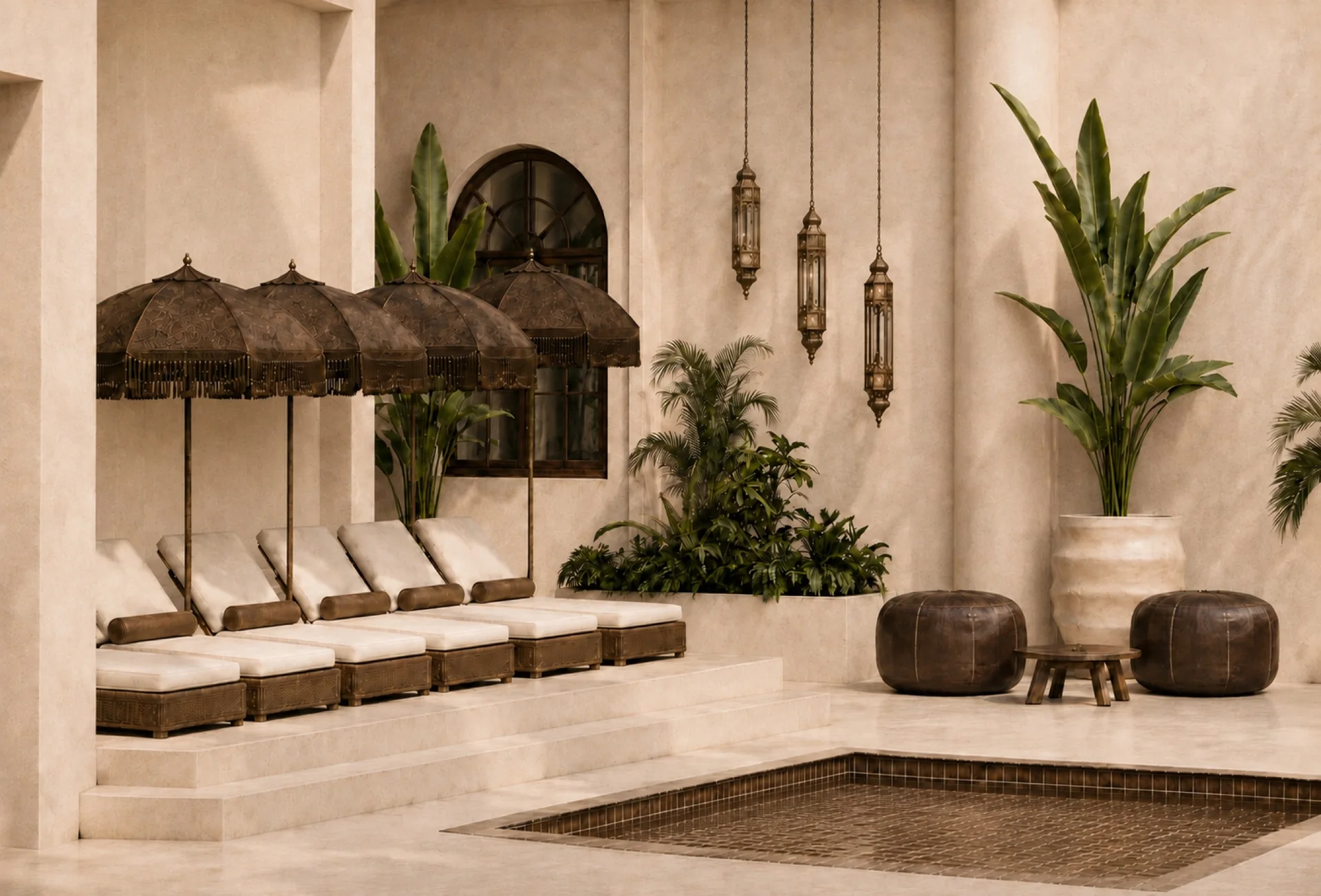
10 suites • Marrakech • Spa open to external guests
Kasbah Nelaria & SPA is a Darnel Collection boutique hotel project with 10 suites in Marrakech. Its Berber Chic concept combines Moroccan architecture, natural materials and inspiration from the desert.
The project includes a spa as well as those staying at the hotel. It brings together two activities that need to be organised together: accommodation and wellness.
The project is being finalised. The images shown are official architectural renderings of the future spaces.
A business model to assess by activity
The business plan should distinguish accommodation revenue and costs from those of the spa: capacity, appointment scheduling, staffing, consumables and operating costs. Welcoming external guests must be incorporated into the design and service organisation.
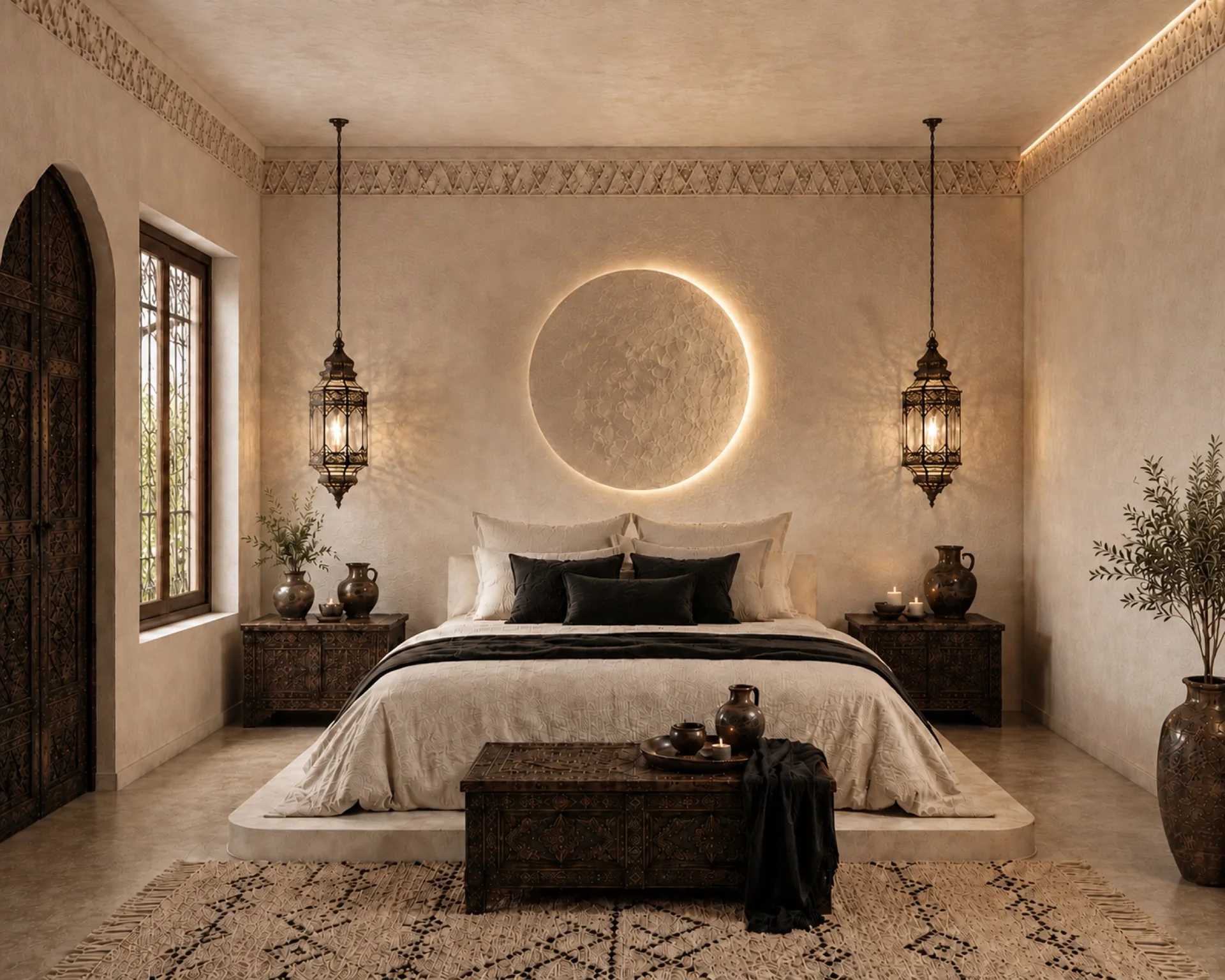
This case presents the project concept. The guide’s educational scenarios are not operating forecasts for Kasbah Nelaria & SPA.
Explore the official Kasbah Nelaria & SPA project page →
17. Investment case: Dar Léon & Spa by Darnel Collection
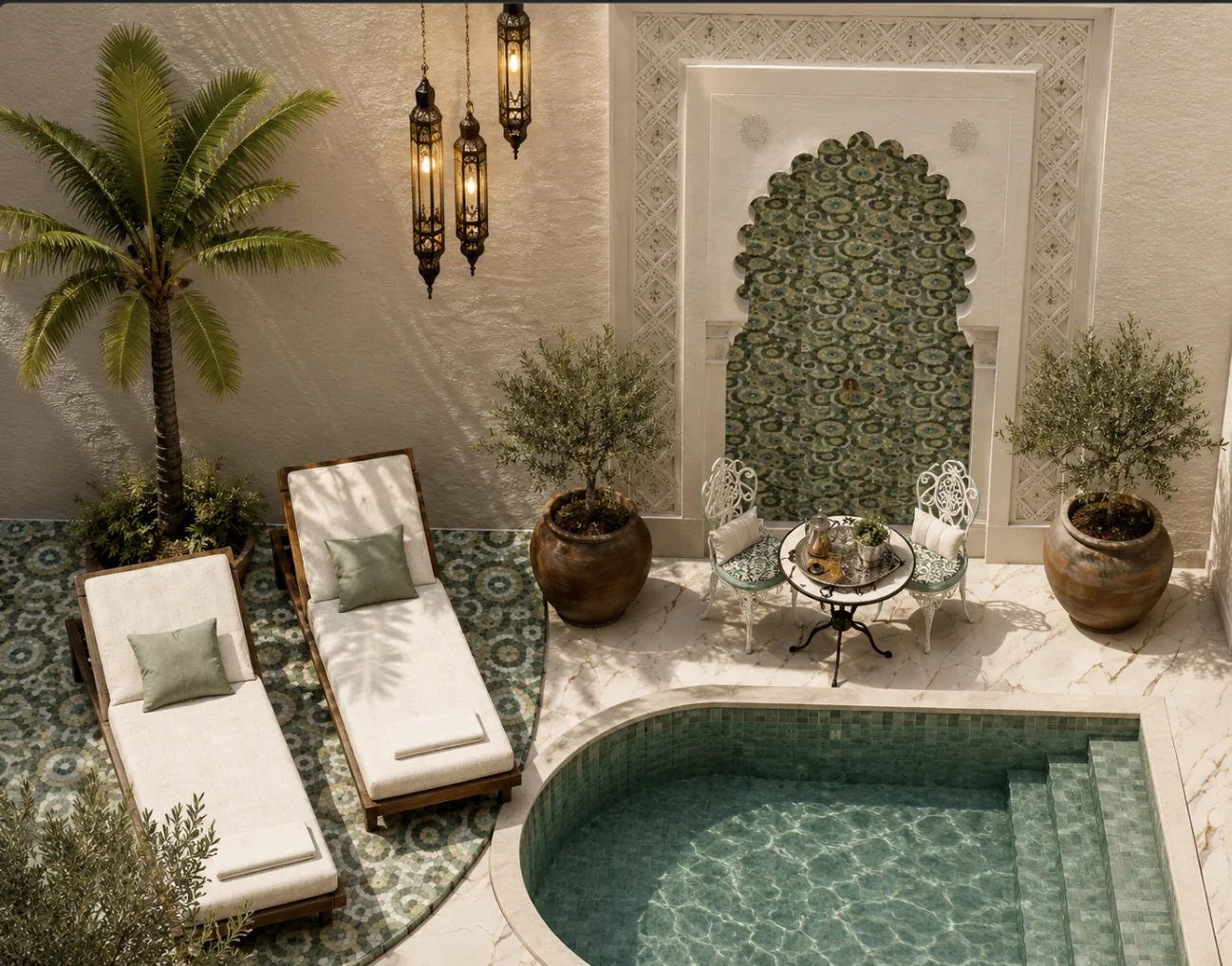
INVESTMENT CASE — DAR LÉON & SPA
4 rooms • Bab Doukkala • Riad & private spa
Dar Léon & Spa illustrates the creation of an intimate, high-end establishment.
The project includes four rooms, a courtyard with a plunge pool, a rooftop and a private spa.
The official project details state approximately 210 m².
The advertised price starts at €550,000, excluding land acquisition fees. In the arrangement combining the land sale and the project delivery contract, acquisition fees relating to the land sale apply to the land price, rather than the entire project. They must be calculated by the notary; any other fees should be identified separately.
Three key figures
- 4 rooms planned.
- Approximately 210 m² stated.
- From €550,000, excluding land acquisition fees.
What room revenue should you target?
Consider three scenarios without presenting them as project forecasts.
On small screens, scroll the table horizontally if needed.
| Scenario | Conservative | Central | Ambitious |
|---|---|---|---|
| ADR excluding tax | €130 | €180 | €230 |
| Occupancy | 50% | 60% | 70% |
| Annual room revenue excluding tax | €94,900 | €157,680 | €235,060 |
The final result will also depend on ancillary revenue, costs and the capital actually committed.
The main lesson
With four rooms, each room represents a large share of total capacity.
One room unavailable for an extended period can significantly affect revenue.
Premium positioning must therefore be backed by excellent service, coherent pricing and a well-managed organisation.
What should be analysed before buying?
- Study demand for the intended positioning.
- Compare ADRs of genuinely comparable establishments.
- Cost permanent expenses.
- Calculate break-even.
- Prepare several cash-flow scenarios.
- Check permits and operating requirements.
Darnel advice: a small premium riad can be attractive, but its profitability must be demonstrated with a complete business plan, rather than its average room rate alone.
Discover Darnel Collection projects →
18. Ten mistakes to avoid before opening a guesthouse
1. Buying before checking feasibility
An attractive property may be unsuitable for the intended tourism project.
2. Underestimating works
Structural and technical constraints can substantially change the budget.
3. Maximising room count at the expense of comfort
An additional room does not always compensate for lost shared or service areas.
4. Neglecting service areas
Poor organisation can increase operating costs.
5. Providing insufficient cash reserves
Commercial ramp-up can take time.
6. Recruiting without an activity forecast
An excessively heavy organisation can weaken margins.
7. Depending on one booking channel
Commercial diversification can limit certain risks.
8. Setting rates solely by reference to competitors
Rates must also reflect positioning, costs and demand.
9. Adding services without measuring their profitability
An additional activity should improve economic contribution or the guest experience.
10. Opening without a marketing plan
Sales preparation must begin before opening.
Darnel advice: conduct a pre-opening audit covering compliance, equipment, the team, forecasts and commercial strategy.
19. FAQ: creating a guesthouse in Marrakech in 2027
What budget is needed to create a guesthouse in Marrakech?
The budget depends on property prices, works, capacity and service level. In our educational scenarios, total investment is €350,000 for four rooms, €500,000 for six and €1,100,000 for ten. These are not average market prices.
Can any riad be converted into a guesthouse?
No. Check title, planning, technical and regulatory feasibility before committing.
Which permits must be obtained?
The project must comply with the planning, works, compliance, operating authorisation and classification rules applicable to its category.
How long does opening take?
Twelve months is a favourable scenario here, with limited or controlled works. Major restructuring requires a dedicated schedule covering studies, permits, construction and pre-opening. Always state whether a quoted duration runs from project launch or the start of works.
How many rooms are needed to be profitable?
There is no universal number. Profitability depends on capital invested, ADR, occupancy, ancillary services and costs.
Which is the best neighbourhood?
The best neighbourhood depends on guests, concept, access and budget. The Kasbah, Bab Doukkala, Mouassine and Dar El Bacha are among the areas to consider.
How much can a six-room guesthouse generate?
With an ADR of €145 excluding tax and 60% occupancy, six rooms available all year generate €190,530 in room revenue excluding tax, before costs.
What is the minimum occupancy needed to be profitable?
It depends on fixed costs, variable costs and average rates. The independent exercise in section 11 gives 50.4% for six rooms, an ADR of €145 excluding tax, €120,000 of fixed costs and variable costs of 25% of room revenue. This threshold is neither a market average nor the threshold of the five-year forecast.
Can a guesthouse be run from France?
Yes, subject to a suitable local organisation, compliance with applicable obligations and regular oversight.
Must a company be set up in Morocco?
The legal structure depends on the project and investors' circumstances. Legal, accounting and tax analysis is needed before choosing.
Can you offer a hammam and massages?
These services may be considered subject to technical feasibility, the necessary permits and compliance with applicable obligations.
When should marketing begin?
Preparation can begin several months before opening. Firm sales must, however, remain consistent with delivery dates and permits.
How can direct bookings be improved?
Develop a clear website, an effective booking journey, a brand strategy and marketing activities with measured acquisition costs.
Can management be entrusted to a professional?
Yes. Compare costs, responsibilities, services and the expected economic performance after fees.
How do I know whether my project is viable?
Prepare a feasibility study, a complete budget, a business plan, a break-even calculation and several cash-flow scenarios.
Conclusion: a profitable guesthouse is prepared before opening
Creating a guesthouse in Marrakech in 2027 can develop property assets while building a tourism business.
Choose a concept suited to the market, select an operable building, secure permits, control works and prepare the team.
At Darnel Collection and Darnel Hospitality, we distinguish two complementary needs.
Would you like to create your guesthouse?
Darnel Collection can support property planning, design and delivery of your Marrakech project.
Discuss my project with Darnel Collection →
Preparing for opening or operations?
Darnel Hospitality can support commercial preparation, distribution and management of your establishment.
Prepare my operations and marketing before opening →
Further reading: Darnel guides
Explore your project further:
- Buying a riad in Marrakech: complete guide
- Building a riad in Marrakech: complete guide
- Property taxation in Morocco in 2027
- Riad operating costs and net profit
- The twelve riad profitability indicators
Our book to prepare your project in Morocco
Réussir sa nouvelle vie au Maroc : Le guide pratique pour s'installer, investir et prospérer
A book for people preparing their move and projects in Morocco. Published in French.

About the author
Aïcha El Ouahidi — Founder, Darnel Hospitality
Darnel Hospitality supports riad and guesthouse owners in Marrakech with marketing, distribution and operational management.
Editorial note: the budgets, staff costs, occupancy rates, prices and profitability simulations in this article are educational assumptions. Replace them with project-specific data before making any decision. Confirm legal and administrative rules with competent professionals and authorities, particularly for an opening planned in 2027.