
Tourism operations and regulations
Property taxation in Morocco in 2027: taxes, charges and strategies for investing in a riad

Buying an apartment in Morocco, investing in a riad in Marrakech or developing a boutique hotel can be an attractive wealth-building or business project.
But investors repeatedly ask one question: how much is really left after taxes and charges?
Property taxation in Morocco extends beyond acquisition costs.
Registration duties, land registry fees, rental income tax, housing tax, corporation tax, VAT, tourist taxes and taxation on resale can significantly affect an investment's returns.
The same rules do not apply to everyone.
A French buyer who purchases an apartment for year-round rental is not necessarily subject to the same regime as an investor running a seven-room guesthouse in Marrakech.
Likewise, owning a property personally or through a company can have different consequences during operation and on resale.
This guide covers the main Moroccan property taxes, numerical examples in euros and the questions to ask professionals before investing.
Important — position as at 22 October 2026: this guide is based on the Moroccan General Tax Code for 2026 and the rules known on that date. The 2027 Finance Bill, examined by the Government Council on 20 October 2026, is not a finally adopted and promulgated law. Rates, exemptions and procedures that may change must be checked after the final legislation is published. The examples are indicative and do not constitute individual tax advice.
To assess a riad’s taxation, separate acquisition, ownership, operating income, distributions and resale. The owner’s status and the classification of the activity determine the analysis; one tax rate is insufficient. Darnel includes these items in the property budget and forecast, while the notary and tax adviser validate the individual treatment.
The guide’s documentary reference is the 2026 General Tax Code published by the Ministry of Finance. For a 2027 project, have the final rules applying to the tax year checked before using the numerical examples.
Prepare that review with acquisition costs and riad operating costs and cash flow. In the guide’s illustrative case, profit after tax, net dividends and available cash are three different concepts.
Which property taxes should you budget for in Morocco in 2027?
Property investment may be taxed at different stages of its life cycle.
Distinguish four stages: acquisition, ownership, receipt of income and resale.
Overview of Moroccan property taxation
On small screens, scroll the table horizontally if needed.
| Tax or charge | Relevant situation | 2026 tax reference |
|---|---|---|
| Registration duties | Property purchase | Rate depends on the deed and property |
| Land registry | Transfer formalities | Proportional fees and possible fixed fees |
| Housing tax | Properties within its scope | Based on rental value and applicable rules |
| Municipal services tax | Certain properties | Depends on location and taxable base |
| Personal income tax | Property income and relevant activities | Depends on income classification |
| Tax on property gains | Certain property disposals | General regime and possible exemptions |
| Corporation tax | Taxable company profits | General or special regime |
| VAT | Taxable services and transactions | Rate depends on the transaction |
| Tourist taxes | Relevant tourist accommodation | Depends on category and applicable rules |
Official reference: the Moroccan General Tax Code for 2026, published by the Directorate General of Taxes (DGI). Land registry tariffs are covered by ANCFCC references; local and tourist taxes must be checked against the relevant legislation and with the competent authorities.
This table identifies potential taxes. It does not mean that all of them apply cumulatively to every investor.
Why consider the entire investment period?
Imagine two investors each buying a property for €400,000.
The first wants to hold it for fifteen years and collect rent.
The second plans to create a tourist establishment and sell the investment after seven years.
Their income, costs, taxation and exit strategies may be very different.
Darnel advice: request a projection covering at least the acquisition, five years of operations and a resale scenario. This assesses the investment beyond its gross yield.
What costs and taxes are payable when buying property in Morocco?
When buying an apartment, villa or riad, the price agreed with the seller is not the whole budget.
Several expenses must be anticipated.
Registration duties
Under the 2026 tax framework, purchases of certain built residential properties generally attract registration duty of 4%, subject to the precise classification of the deed and applicable provisions.
Other transactions, particularly land purchases, may be subject to different rates.
Do not automatically apply 4% to every property purchase. Under article 133-I-G of the 2026 General Tax Code, purchases of undeveloped land or land with buildings intended for demolition are in principle subject to 5%, unless an exemption or specific classification applies. Article 133-I-F notably provides 4% for the built premises concerned. For Darnel projects combining land acquisition and construction project management, the notary must distinguish the land assessment base from construction services and verify each deed.
Reference: Moroccan General Tax Code for 2026, provisions on registration duties and tariffs, notably article 133.
Land registry fees
For certain standard property transfers, a proportional component of 1.5% may apply, potentially alongside other fees.
The calculation depends on the formality and the property's status.
Official source: ANCFCC — Land Registry.
Professional fees and other costs
Buyers may also need to budget for notarial fees, any agency commissions, administrative fees and due diligence costs.
Example: buying a riad for €400,000
Assume a property transaction subject to 4% registration duty and proportional land registry fees of 1.5%.
On small screens, scroll the table horizontally if needed.
| Item | Amount |
|---|---|
| Purchase price | €400,000 |
| Registration duty, assumed 4% | €16,000 |
| Land registry, assumed 1.5% | €6,000 |
| Estimated fees and additional costs | €5,000 |
| Indicative total budget | €427,000 |
The investor must provide an additional €27,000 here, excluding any commissions and specific expenses not included in the example.
The notary must establish the exact breakdown.
Pay attention to payment methods
The 2026 tax rules also strengthen the traceability of certain property transactions, with an additional duty potentially applying when the legal conditions are met.
Payment methods and banking evidence should be checked in particular.
Darnel advice: never transfer funds before qualified professionals have validated the payment route and required documents.
Further reading: Riad purchase costs in Marrakech: the complete guide.
What annual taxes must a property owner pay in Morocco?
After the purchase, certain taxes and charges may be due while holding the property.
Housing tax
Housing tax applies to properties within its scope.
It is calculated notably using a rental value determined under tax rules.
Exemptions, reductions or specific arrangements may exist.
Municipal services tax
This tax relates to local services and depends notably on the rental value and the property's location.
Business tax
A property used for a business activity may also fall within the scope of business tax.
This is separate from tax on profits.
Temporary exemptions may be available in certain circumstances, subject to conditions.
Darnel advice: establish the annual taxes applicable to the property before buying. A second home and a hotel establishment require different analyses.
How is rental income taxed in Morocco?
Taxation depends on the nature of the rental and the status of the person receiving the income.
Distinguish conventional property rental from a professional accommodation activity.
Conventional property rental
In certain situations covered by the property income regime, the 2026 tax framework provides a flat-rate deduction of 40% to determine net taxable income.
This income is then subject to the taxpayer's applicable tax rules, subject to specific arrangements and any withholding.
Reference: Moroccan General Tax Code for 2026, property income provisions, notably article 64.
Example: an apartment rented for €1,000 per month
On small screens, scroll the table horizontally if needed.
| Calculation | Amount |
|---|---|
| Annual gross rent | €12,000 |
| Illustrative 40% deduction | €4,800 |
| Indicative taxable base | €7,200 |
Note: €7,200 is not the tax payable.
It is a calculation base before applying the tax regime corresponding to the taxpayer's circumstances.
Why is a guesthouse different?
A guesthouse may offer overnight stays, breakfasts, catering, transfers and wellness services.
It therefore carries on an economic activity that should not automatically be treated as the receipt of property rent.
Darnel advice: have your activity classified for tax purposes before comparing apartment income with that of a tourist riad.
How are property capital gains taxed in Morocco?
When an individual resells a property, the gain may be subject to personal income tax on property profits.
How is the property gain calculated?
The tax calculation is not simply the sale price minus the purchase price.
Depending on the applicable rules, it may include certain acquisition costs, eligible expenses and indexation mechanisms.
The general rate
The 2026 framework generally provides a 20% rate on taxable property gains, with a minimum tax of 3% of the sale price in the situations specified by law.
Exemptions and specific rules may apply.
Reference: Moroccan General Tax Code for 2026, notably article 73 and property gain provisions.
Detailed example: reselling a riad
Consider the following simplified tax assumptions:
On small screens, scroll the table horizontally if needed.
| Item | Amount |
|---|---|
| Initial purchase price | €300,000 |
| Resale price | €450,000 |
| Gross difference | €150,000 |
| Assumed tax-allowable costs and adjustments | €30,000 |
| Illustrative taxable gain | €120,000 |
Tax calculated at 20% would be:
€120,000 × 20% = €24,000.
The minimum of 3% of the sale price would be:
€450,000 × 3% = €13,500.
In this simplified scenario, the amount calculated at 20% would exceed the minimum.
The final calculation may differ, notably because of indexation rules, the nature of the costs and exemptions.
What exemptions may exist?
Certain sales of main residences may benefit from specific provisions, subject to duration and circumstance conditions.
A professionally operated riad does not automatically qualify for the main residence regime.
Darnel advice: retain deeds, works invoices, payment evidence and banking documents. These may be crucial on resale.
Buying personally or through a company: what tax differences?
The ownership structure should be considered before acquisition.
It can affect income, deductible costs, accounting obligations, succession and exit taxation.
Buying personally
This approach may suit certain residential or rental projects.
It does not necessarily mean lower taxes, but may involve a different organisation.
Buying through a company
A company can structure a business investment, particularly tourist accommodation.
It nevertheless entails specific accounting and tax obligations.
Comparison
On small screens, scroll the table horizontally if needed.
| Criterion | Personal ownership | Company |
|---|---|---|
| Organisation | Depends on the project | Separate legal structure |
| Taxation | Depends on income type | Depends on the company's regime |
| Accounting | Depends on applicable obligations | Generally more structured |
| Costs and depreciation | Depends on the tax regime | Depends on accounting and tax rules |
| Profit distribution | Not applicable in the same form | May trigger additional taxation |
| Resale | Depends on the owner's regime | Depends on sale of the property or shares |
The pitfall of comparing corporation tax alone
Assume a company makes €65,000 in taxable profit.
Even if hypothetical corporation tax were €13,000, the remaining €52,000 is not automatically a net sum the investor can transfer to a personal account.
A dividend distribution may have its own tax treatment.
Darnel advice: compare structures over the entire project, including operations, potential distributions and resale.

What taxation applies to operating a riad or guesthouse in Marrakech?
A tourist riad is a hospitality business.
Its revenue may come from several activities:
- Accommodation.
- Catering.
- Spa services.
- Transfers.
- Excursions.
- Exclusive bookings.
- Additional services.
Each revenue category must be properly recorded and analysed.
Corporation tax
When a company operates a riad, its taxable profits may be subject to corporation tax (IS).
A 20% rate is a working assumption for many companies under the 2026 framework, but must not be presented as universal. Its application depends notably on the taxable base, thresholds, tax regime and specific provisions; the rate actually applicable to the project must be validated.
It must not be applied without verification.
Reference: Moroccan General Tax Code for 2026, article 19 and related provisions.
What expenses may be deductible?
Subject to tax and accounting conditions, a hotel business may recognise notably:
- Wages and social security costs.
- Purchases of consumables.
- Maintenance expenses.
- Water and electricity bills.
- Distribution commissions.
- Marketing expenses.
- Insurance.
- Professional fees.
- Tax-allowable depreciation.
Are works immediately deductible?
Not necessarily.
Routine repairs and lasting property improvements do not always receive the same treatment.
Some expenses must be capitalised and then depreciated.
Darnel advice: distinguish operating expenses, capital expenditure, depreciation and cash spending from the business plan onwards.
What tax benefits are available to hotel businesses in Morocco?
This is one of the most important issues for investors planning to operate a riad or boutique hotel.
The corporation tax exemption linked to certain foreign-currency receipts
Article 6 of the General Tax Code for 2026 provides a specific regime for hotel businesses.
Under article 6-I-B-5° of the 2026 General Tax Code, full corporation tax exemption for five consecutive financial years may cover the portion of the taxable base corresponding to eligible revenue earned in duly repatriated foreign currency, directly or through travel agencies. The period starts in the financial year of the first accommodation transaction in foreign currency. Claiming the exemption notably requires a statement, submitted with the required tax returns, detailing each establishment's income and foreign-currency revenue and the exempt portion. Hotel-business classification, foreign-currency traceability and filing conditions must be validated for the riad concerned.
The period is linked to the financial year in which the first eligible accommodation transaction in foreign currency takes place.
This does not mean that a new tourist establishment is automatically exempt from corporation tax on all its profits.
Official reference: General Tax Code for 2026 — article 6.
Educational example: a riad with several revenue sources
Imagine a hotel company with taxable profit of €100,000.
Some revenue might come from eligible transactions in duly repatriated foreign currency, while another portion would not meet the regime's conditions.
It would be incorrect to apply an exemption directly to the full €100,000.
The professional handling the case must determine the portion of the taxable base that is genuinely eligible under the legislation and supporting evidence.
The four essential checks
- Does the establishment fall within the scheme's scope?
- Do the relevant receipts meet the foreign-currency and repatriation conditions?
- Are the evidence and filing obligations satisfied?
- Does the exemption period actually apply?
Darnel advice: never build a project's returns around a tax exemption before obtaining documented confirmation of eligibility.
VAT, tourist taxes and accounting obligations for a riad
What VAT applies to tourist accommodation?
The Moroccan tax framework provides a reduced 10% rate for certain tourist accommodation and catering services within legally specified categories.
The standard rate is 20%.
The exact classification of the service remains decisive.
Reference: Moroccan General Tax Code for 2026, article 99 and applicable provisions.
Example: a room sold for €165 including VAT
Assuming a service subject to 10% VAT:
On small screens, scroll the table horizontally if needed.
| Indicator | Amount |
|---|---|
| Price paid by the guest | €165 including VAT |
| Revenue excluding VAT | €150 |
| VAT collected | €15 |
The €15 of VAT collected is not profit.
VAT payable depends notably on deduction rules and applicable returns.
Taxes linked to overnight stays
A tourist establishment may also be subject to municipal accommodation tax and tourism promotion tax.
Their amount depends on the applicable rules, notably the establishment's category and the stays concerned.
Social security obligations
When a riad employs staff, it must also organise social security declarations, contributions and payroll obligations.
The five indicators to distinguish in the accounts
Revenue including VAT.
Revenue excluding VAT.
VAT and taxes collected.
Operating expenses.
Taxable profit and cash flow.
Darnel advice: configure your hotel software and accounts to separate the different receipts and taxes from opening day.
Already operating a riad in Marrakech?
An establishment's performance depends on revenue, but also on costs, distribution commissions and the quality of management.
Darnel Hospitality supports hotel marketing and management challenges.
Explore Darnel Hospitality support →
Case study: taxation of a seven-room riad
Consider a seven-room establishment professionally operated in Marrakech.
The aim is to distinguish revenue, operating profit, taxable profit and profit after tax.
Commercial assumptions
- Seven rooms.
- ADR excluding VAT: €150.
- Occupancy rate: 65%.
- Operating 365 days a year.
- Additional revenue excluding VAT: €30,887.
Step 1: calculate revenue
Theoretical room revenue is:
7 × 365 × 65% × €150 = €249,112.50 excluding VAT.
With additional revenue:
€249,112.50 + €30,887 = €279,999.50 excluding VAT, or approximately €280,000.
Step 2: calculate profit
On small screens, scroll the table horizontally if needed.
| Annual indicator | Amount |
|---|---|
| Revenue excluding VAT | €280,000 |
| Operating costs excluding depreciation (overall assumption to be broken down: staff and social security costs, energy, maintenance, consumables, marketing and commissions, insurance, management and administration) | €190,000 |
| Simplified operating surplus | €90,000 |
| Assumed depreciation | €25,000 |
| Simplified profit before tax | €65,000 |
Step 3: illustrate corporation tax
Assume taxable profit is also €65,000, no tax benefit applies and the assumed rate is 20%.
Theoretical corporation tax would be:
€65,000 × 20% = €13,000.
Simplified accounting profit after this tax would therefore be €52,000. This is neither a net dividend nor an amount automatically available to the investor: cash requirements, financing, investment and any taxation of distributions still need to be examined.
This calculation excludes any tax adjustments, minimum levies, contributions, financing costs or special regimes.
Step 4: understand cash flow
Depreciation reduces accounting profit without representing a cash outflow for the year.
Conversely, repaying loan principal may reduce cash without being an equivalent deductible expense.
Assuming no other adjustments, theoretical cash flow before new capital expenditure and financing could be approximated as:
€52,000 + €25,000 = €77,000.
But this sum is not automatically distributable or available to the investor.
Loan repayments, replacement investments, working capital requirements and any other obligations must still be examined.
The five figures every investor should know
- Revenue excluding VAT.
- Operating surplus.
- Taxable profit.
- Profit after tax.
- Cash actually available.
Darnel advice: request a forecast distinguishing these five levels. A quoted yield without an explanation of costs and taxes is insufficient for an investment decision.
Further reading: Investing in a riad in Marrakech: how much is really left after all costs?
How much could your future riad really earn?
Compare revenue, costs and operating scenarios using Darnel Collection's financial resources.
Access the returns simulator and investor resources →
Conventional rental or tourist operation: what difference after tax?
An investor may hesitate between a home for conventional rental and a tourist establishment.
These models have different economic and tax characteristics.
Comparative example for a €400,000 investment
The following figures are entirely hypothetical.
On small screens, scroll the table horizontally if needed.
| Indicator | Conventional rental | Tourist operation |
|---|---|---|
| Total investment | €400,000 | €400,000 |
| Annual revenue excluding VAT | €24,000 | €120,000 |
| Operating costs | €5,000 | €84,000 |
| Balance before depreciation and tax | €19,000 | €36,000 |
| Activity | Property rental | Tourist accommodation |
| Taxation | Depends on property income and status | Depends on business regime |
| Organisation | Rental management | Hotel management |
The tourist operating surplus is higher here, but the activity requires more organisation and involves other risks.
Why not compare the taxes directly?
Conventional rental may fall under a property income regime, while a tourist operation may be subject to business income tax or corporation tax.
Taxable bases, deductions, depreciation and obligations differ.
Applying one uniform tax rate to both columns would therefore be misleading.
Which strategy should you choose?
The answer depends on the time the investor wants to devote to the activity, their budget, tax residence and wealth objectives.
Darnel advice: always compare both models after allowing for costs, applicable taxation and the management time required.
What taxation applies to a French investor in Morocco?
An investor who is tax resident in France and buys property in Morocco must examine obligations in both countries.
Nationality alone does not determine the tax regime.
First question: where are you tax resident?
Tax residence depends on domestic rules and, where relevant, the France–Morocco tax treaty.
Second question: what type of income do you receive?
Distinguish:
- Property rent.
- Profits from a hotel business.
- Company dividends.
- Property capital gains.
- Capital gains on securities.
These income categories may fall under different treaty provisions.
Third question: where is the income taxable?
The France–Morocco tax treaty notably sets rules for income from immovable property located in either State.
Property income and gains from its disposal must be examined under the applicable treaty articles.
Business profits and dividends fall under other provisions.
Fourth question: must this income be declared in France?
A French tax resident must examine French reporting obligations even when the treaty grants Morocco a right to tax. Treatment varies according to direct or company ownership, income classification (rent, operating profits, dividends or capital gains), tax residence and the precise France–Morocco treaty provisions. No absence of double taxation should be promised without an individual assessment of the applicable treaty mechanisms.
Mechanisms for avoiding double taxation depend on the nature of the income and the treaty provisions.
This does not imply that Moroccan property income is automatically exempt from all French reporting.
Official sources:
- France–Morocco tax treaty — impots.gouv.fr
- French administrative guidance on the France–Morocco treaty — BOFiP
Documents to prepare
Investors should notably retain acquisition deeds, banking evidence, tax returns, accounting documents and proof of tax payments.
Darnel advice: if you are tax resident in France, have your structure assessed by a professional familiar with both countries' taxation before buying property or forming a company in Morocco.
Ten tax mistakes to avoid before investing in Morocco
Mistake 1: confusing revenue including and excluding VAT. VAT collected is not revenue permanently retained.
Mistake 2: applying a tax rate without checking conditions. A general rate does not necessarily cover every situation.
Mistake 3: treating a guesthouse as conventional rental. The activities may fall under different regimes.
Mistake 4: treating all works as immediately deductible. Some investments must be capitalised and depreciated.
Mistake 5: forgetting local and tourist taxes. Include them in forecasts.
Mistake 6: assuming a company always pays less tax. Distributions and resale must also be assessed.
Mistake 7: overlooking France–Morocco taxation. Tax residence and income type are decisive.
Mistake 8: failing to retain supporting documents. They can be essential during an inspection or resale.
Mistake 9: assuming an exemption without validation. A tax benefit may have strict conditions.
Mistake 10: forgetting exit taxation. Selling the property or company shares can substantially alter overall returns.
Darnel advice: a tax benefit does not turn a poor investment into a good one. Property and economic coherence must remain the priority.
Darnel Collection investment case: Dar Léon & Spa
INVESTMENT CASE — DAR LÉON & SPA
4 rooms • Bab Doukkala • Riad & private spa
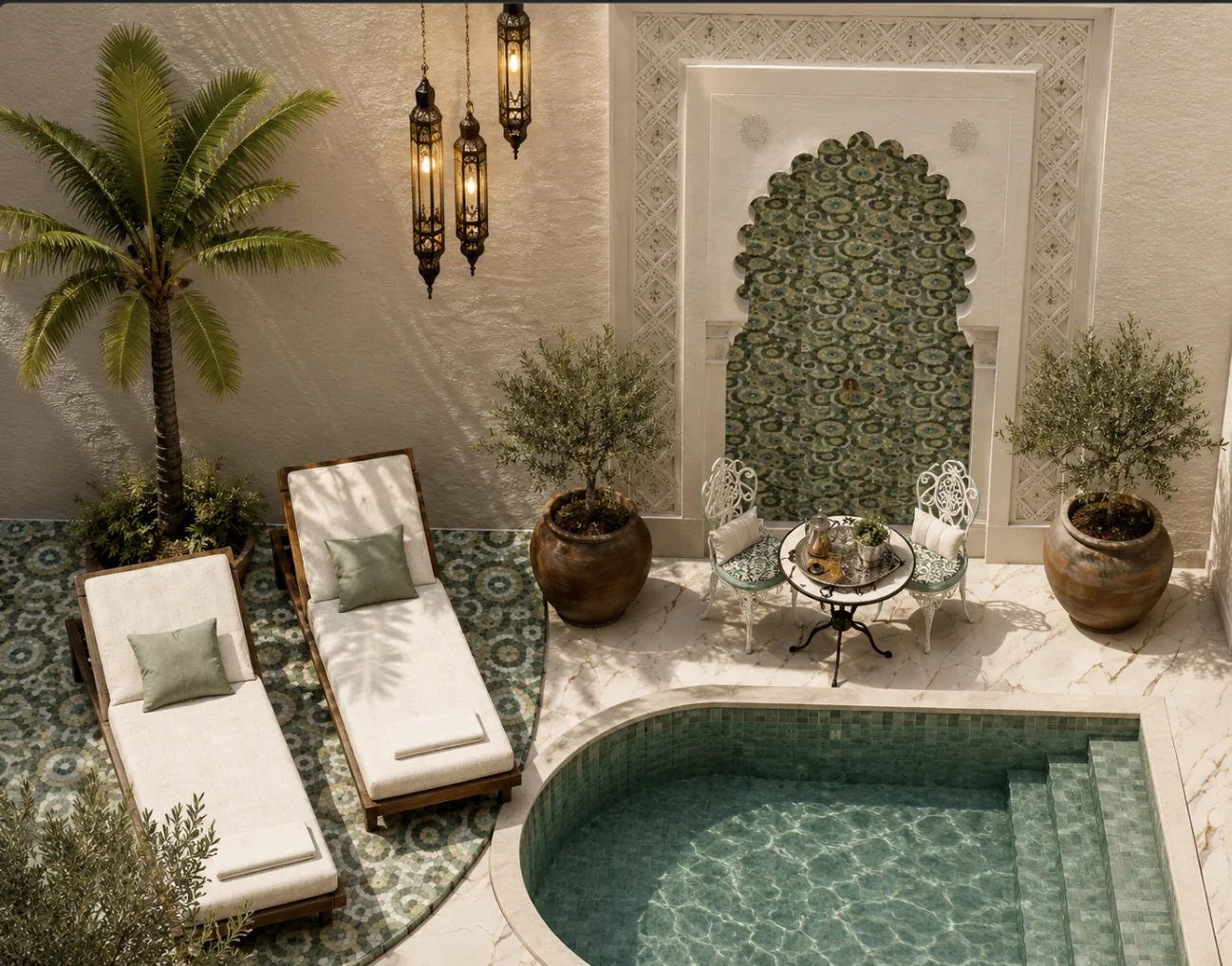
Dar Léon & Spa is a tourist property project in Bab Doukkala, in Marrakech's Medina.
The programme includes four rooms, a courtyard with a pool, a rooftop and a private spa area.
It illustrates an investment strategy combining architectural design, hotel positioning and operating potential.
Three key figures
4 planned rooms.
Approximately 200 m² of stated developed floor area.
Indicative asking price of €550,000, excluding acquisition costs. For Dar Léon, the proposed transaction distinguishes the land purchase from the construction project management contract. Registration duties and land registry fees must therefore not automatically be calculated on €550,000: their assessment base depends on the price and legal classification of the transferred property, the deeds signed and applicable rules. Construction services and any VAT treatment must be analysed separately. The final calculation is for the notary and tax adviser to establish from the documents.
Why taxation must be anticipated
For a project of this kind, investors must establish:
- The property's ownership structure.
- The classification of the tourist activity.
- The treatment of construction and equipment expenses.
- Any depreciation.
- VAT applicable to services.
- Eligibility conditions for any hotel tax regimes.
- Taxation of a future resale.
These factors must be examined before treating an operating result as a net return.
Discover Darnel Collection property projects →
FAQ: property taxation in Morocco in 2027
What taxes are payable when buying property in Morocco?
Acquisition may involve registration duties, land registry fees and other expenses. Rates depend on the nature of the transaction.
What is the registration duty rate when buying a riad?
Certain purchases of built residential properties generally attract 4% under the 2026 framework. The exact classification of the deed must be checked.
How is rental income taxed in Morocco?
The regime depends on the nature of the rental and the taxpayer's status. Certain property income may benefit from a 40% flat-rate deduction to establish the taxable base.
What tax applies to property capital gains?
The general 2026 regime notably provides a 20% rate on taxable property gains, with a minimum in legally specified situations. Exemptions may exist.
Must a French national pay taxes in Morocco?
A French investor may have Moroccan tax obligations depending on income and transactions. Tax residence and the France–Morocco treaty must also be considered.
What VAT applies to riad rooms?
Certain tourist accommodation services are subject to 10% VAT, depending on the applicable rules and service classification.
Is a guesthouse exempt from corporation tax for five years?
Not automatically. The hotel regime contains conditional provisions notably concerning a portion of the taxable base linked to eligible receipts in duly repatriated foreign currency.
Can riad renovation works be deducted?
It depends on the nature of the works and tax rules. Some expenses may be deductible, while others must be capitalised and depreciated.
Must you form a company to operate a riad?
The choice depends on the project, regulatory obligations and wealth strategy. A company may suit a business activity but is not always the best tax solution.
Must income from a Moroccan riad be declared in France?
A French tax resident must examine French reporting obligations and the France–Morocco tax treaty, even when income is taxable in Morocco.
How do you calculate net returns after tax?
Distinguish revenue, costs, depreciation, taxable profit, taxes, financing and available cash. Gross yield alone is insufficient.
Will Moroccan property taxation change in 2027?
Changes are possible. Final rules must be checked after the legislation applicable to 2027 is adopted.
Further reading for your property investment in Morocco
Taxation should be assessed alongside the project's other dimensions: acquisition, renovation, operation and resale.
Explore our related guides:
- Investing in Marrakech in 2027: the complete guide
- Buying a riad in Marrakech: prices and procedures
- Riad purchase costs in Marrakech
- Riad operating costs: how much is really left?
- Twelve indicators of riad profitability in Marrakech
Our book: Réussir sa nouvelle vie au Maroc
Réussir sa nouvelle vie au Maroc: the practical guide to settling, investing and prospering
Planning a property project, starting a business or preparing to move to Morocco?
This book offers additional guidance for thinking through your project and anticipating some procedures.
Conclusion: anticipate taxation to invest better in Morocco
Investing in Moroccan property in 2027 requires an overall view.
Purchase price, income and potential resale value are not enough to assess real performance.
Acquisition duties, annual taxes, income taxation, business expenses and disposal taxation can significantly affect the final outcome.
For a riad or boutique hotel, analysis must also include VAT, depreciation, tourist taxes and any specific tax regimes.
A successful property investment is prepared before purchase, managed during operations and assessed after all applicable costs and taxes.
At Darnel Collection, we combine property analysis with an economic approach to tourist operations.
Want to invest in a riad or boutique hotel in Marrakech?
Tell us about your budget, project and objectives.
We can discuss its property coherence and operating potential; individual tax questions must be validated with qualified professionals.
Review my property project and the items requiring tax validation →
About the author
Georges Lelièvre — Darnel Collection
Darnel Collection develops tourist property projects in Marrakech, combining architectural design, investment and analysis of operating performance.
Editorial note and validation limits: this guide presents a documentary review of the main tax rules known on 22 October 2026; it is neither individual tax advice nor professional certification. Projections for 2027 remain subject to the adoption and publication of final legislation. The assessment base and fee rates for Dar Léon depend on the notarial deeds and the land/construction structure. For French investors, the France–Morocco treaty must be assessed according to tax residence, ownership structure and income category. Before any investment decision or publication of personalised simulations, ask a notary and a qualified tax adviser to confirm these points, along with any hotel exemptions, VAT and local taxes.