
Operate
Staffing a riad in Marrakech: how many employees and what budget for 4, 7 or 10 rooms?
Should you hire 3, 6 or 14 people to run a riad in Marrakech? And what does a hospitality team really cost over twelve months?
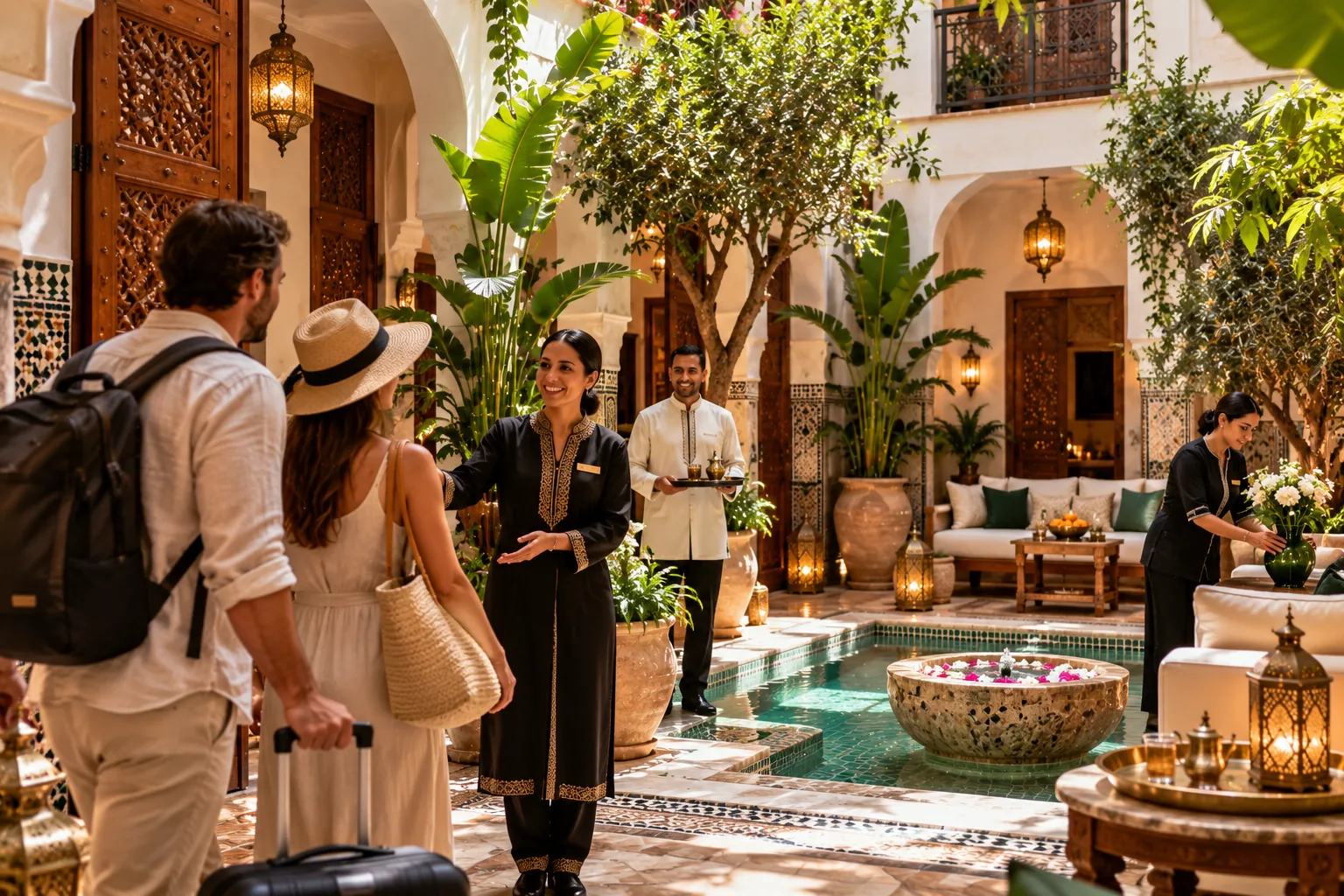
A riad can achieve excellent occupancy yet lose a substantial share of its profitability through a poorly sized team.
Conversely, reducing staffing to the bare minimum can mean poorly prepared rooms, difficult arrivals, exhausted employees and negative guest reviews.
Staff are both a major operating expense and one of the main drivers of guest satisfaction in a riad.
This is particularly true in Marrakech, where the hospitality experience goes beyond a comfortable room.
Travellers expect a warm welcome, a carefully prepared breakfast, personalised advice and sometimes dining, spa or concierge services.
At Darnel Hospitality, we believe the question goes beyond how many employees to recruit.
The real question is: how do you organise a team that can deliver the promised level of service, seven days a week, without undermining profitability?
In this guide, we compare three types of property:
An intimate 4-room riad.
A 7-room guesthouse.
A 10-room boutique hotel with a spa and dining.
We examine staffing levels, payroll costs, schedules, productivity ratios and mistakes to avoid.
QUICK ANSWER — How many employees does a riad in Marrakech need?
As an indication, a 4-room riad may require 3 to 4 employees, a 7-room riad 5 to 7 employees, and a 10-room boutique hotel with a spa and dining 12 to 16 people, including additional staff.
These ranges are neither legal minimums nor professional standards: they depend on working hours, days off, outsourcing and service levels.
Indicative annual budgets: €24,000 to €36,000 (4 rooms), €44,400 to €54,000 (7 rooms) and €102,000 to €138,000 (10 rooms).
These budgets are editorial assumptions that must be checked role by role, including employer contributions and cover, before any investment decision.
Further reading: How much does a 7-room riad in Marrakech earn? ; Making a riad in Marrakech profitable over 7 years ; Opening a guesthouse in Marrakech in 2027.
How many people does it really take to run a riad?
Before discussing recruitment, it is important to understand one feature of hospitality.
A property may welcome guests seven days a week, but an employee cannot be available at all times.
Operations must therefore cover arrivals, departures, rooms, breakfasts, guest requests and unexpected events, while allowing for rest days and holidays.
The six functions to cover
1. Reception and guest relations
Prepare arrivals, arrange transfers, respond to travellers, handle departures and resolve complaints.
2. Housekeeping
Clean rooms, change linen, prepare bathrooms and check the cleanliness of shared spaces.
3. Cooking and dining
Prepare breakfasts, organise purchasing and, where offered, provide lunches or dinners.
4. Maintenance
Maintain the pool, technical equipment, air conditioning, plumbing and wellness facilities.
5. Sales and reservations
Monitor booking platforms, answer enquiries, adjust rates and develop direct bookings.
6. Management and quality control
Prepare schedules, train teams, control spending and monitor performance.
These functions do not necessarily require six separate employees.
In a small riad, some roles can be combined. In a boutique hotel, they gradually become distinct departments.
Employees, FTEs and service providers: three different concepts
To avoid staffing errors, distinguish between:
An employee: a person employed by the property.
A full-time equivalent (FTE): a measure of workload calculated against the reference contractual working hours.
An external service provider: a company or professional engaged as needed.
A riad may therefore operate with five permanent employees and several occasional service providers.
These providers must be budgeted for, even when they do not appear on the payroll.
Staffing a 4-room riad: a team of 3 to 4 employees
A four-room riad is generally an intimate property.
Its small capacity allows staff to cover several roles, provided the services offered remain manageable.
For a property serving breakfast and organising arrivals, with no restaurant open to the public, a team of three to four employees can be a starting point.
Example staffing structure
| Role | Indicative headcount |
|---|---|
| Head housekeeper | 1 |
| Housekeeper | 1 |
| 1 night attendant | 1 |
| Additional reception / housekeeping cover | 0 to 1 |
| Total | 3 to 4 |
The head housekeeper may oversee reservations, guest relations and quality control. They may also sell meals and prepare breakfasts.
The housekeeping employee looks after rooms and shared spaces.
The night attendant takes on the head housekeeper's role overnight and may also sell additional services to increase both the riad's income and their own.
What can be outsourced?
Specialist maintenance, transfers and certain spa services can be entrusted to external providers.
However, additional cover must be planned for each role to handle emergencies, absences and days off.
Monthly staffing budget
For this model, consider the following illustrative budget:
| Assumption | Monthly employer cost |
|---|---|
| Lean team | 2,000 € |
| Intermediate team | 2,400 € |
| Expanded team | 3,000 € |
That is €24,000 to €36,000 per year.
Profitability example
Imagine a four-room riad with:

- ADR excluding tax: €120.
- Occupancy: 75%.
- Annual staffing budget: €30,000.
Room revenue:
4 × 365 × 75% × €120 = €131,400 excluding tax.
Payroll as a share of room revenue:
€30,000 ÷ €131,400 = 22.8%.
In this example, staff therefore account for approximately one fifth of room revenue.
This ratio is not a net margin and excludes other expenses and income, such as sales of additional services.
The mistake to avoid
A four-room riad may seem simple to run.
However, three employees cannot provide continuous on-site coverage 24 hours a day, seven days a week, with normal rest periods.
Late-arrival procedures, suitable on-call arrangements or replacement cover must therefore be planned.
Investment example: Dar Léon, a 4-room riad and spa
For a concrete illustration of this format, discover Dar Léon, our premium four-room riad and spa project in Marrakech. Its programme shows how premium services can be combined with a versatile team.
Staffing a 7-room riad: a team of 5 to 7 employees
With seven rooms, operations become more structured.
There are more rooms to clean, arrivals may overlap, and additional services require better coordination.
One housekeeper can no longer maintain the property and all its rooms alone.
Indicative organisation
| Role | Headcount |
|---|---|
| Riad manager | 1 |
| Night attendant | 1 |
| Housekeeper | 2 |
| Cook | 1 |
| General service / additional cover | 0 to 2 |
| Total | 5 to 7 |
Spa treatments and specialist maintenance can be outsourced.
This organisation assumes that service hours and replacement cover are compatible with the staffing level chosen.
Why does a riad manager become essential?
In a seven-room riad, several operations often take place at once.
One guest arrives while another leaves.
A room needs to be prepared quickly.
A supplier delivers to the kitchen.
A traveller requests a transfer.
The spa has a treatment booked.
Without coordination, delays accumulate.
The manager must therefore control service quality, organise the team and monitor results.
Payroll budget for a seven-room riad
| Assumption | Monthly cost | Annual cost |
|---|---|---|
| Lean team | 3,700 € | 44,400 € |
| Intermediate team | 4,100 € | 49,200 € |
| Expanded team | 4,500 € | 54,000 € |
These figures are assumptions to be adjusted for roles, pay levels and services.
Revenue example
Assume:
- Seven rooms.
- ADR excluding tax: €120.
- Occupancy: 75%.
- Staffing: €49,200 per year.
Room revenue:
7 × 365 × 75% × €120 = €229,950 excluding tax.
Payroll ratio:
€49,200 ÷ €229,950 = 21.4%.
The real lesson
With payroll unchanged, falling occupancy automatically increases staffing costs as a share of revenue.
A property must therefore adapt additional staffing, schedules and organisation to seasonality, without compromising employee rights or service quality.
Investment example: Dar Chemaa, a 6-room riad and spa
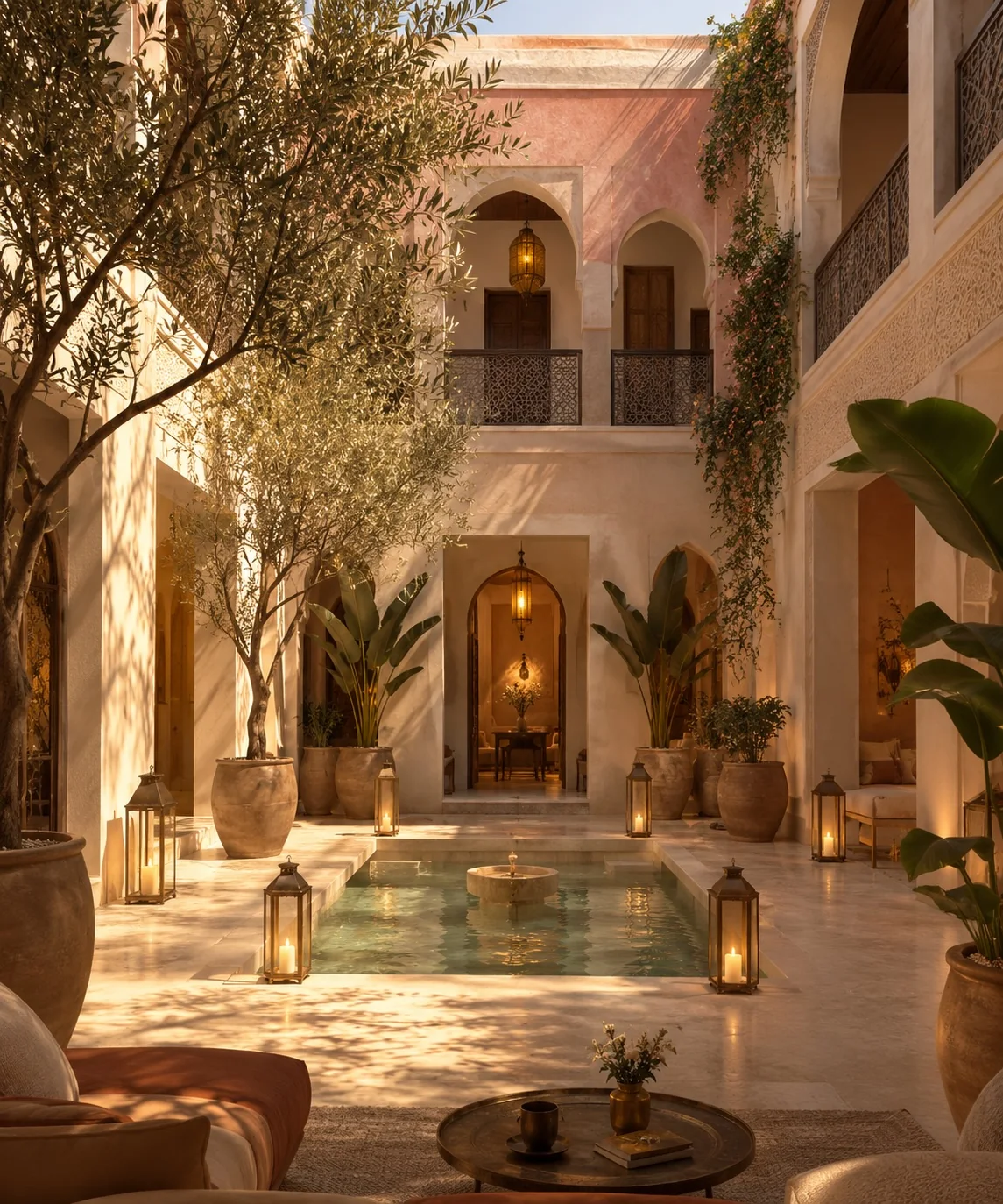
INVESTMENT EXAMPLE — DAR CHEMAA
6 rooms including 1 family suite • Marrakech • Riad & Spa
Dar Chemaa illustrates a configuration between a four-room riad and the general seven-room model. Its programme combines five standard rooms, one family suite and a spa. The family suite can accommodate more guests; the spa adds coordination, cleaning and specialist service requirements, to be included in the schedule or outsourced according to demand.
Staffing organisation
Indicative target team: 5 to 6 employees for accommodation and breakfast. Versatile supervisor: 1; night attendant: 1; housekeeping: 2; cooking and breakfast: 1; additional general support: 0 to 1. This simulation assumes spa treatments are outsourced; if the spa employs dedicated staff, staffing levels and budgets must be revised. Days off, absences and cover still need to be organised.
Three key project figures
6 saleable units, including 1 family suite.
5 to 6 employees envisaged, subject to the service schedule.
€208,050 excluding tax in annual accommodation revenue in the illustrative simulation below.
What payroll budget should you consider?
As an assumption, an annual budget of €45,000 for the accommodation and breakfast team would represent 21.6% of simulated accommodation revenue. This budget excludes spa providers and spa-specific costs; spa revenue is also excluded from the calculation. It is not an approved budget; employer contributions and replacement cover must be checked.
Revenue example
Illustrative assumptions: five standard rooms at €120 excluding tax per night, one family suite at €160 excluding tax per night, and 75% occupancy for each of the six units.
(5 × €120 + 1 × €160) × 365 × 75% = €208,050 excluding tax per year.
€45,000 ÷ €208,050 = 21.6%.
These rates and occupancy levels are not the project's official forecast.
Staffing a 10-room boutique hotel: 12 employees
With ten rooms, especially when a property has a spa, restaurant and spaces open to outside customers, operations start to resemble those of a small hotel.
Responsibilities need a clear structure.
Indicative staffing structure
| Role | Headcount |
|---|---|
| Direction / management | 1 |
| Night attendant | 1 |
| Housekeeping | 4 |
| Kitchen | 2 |
| Dining service | 1 |
| Spa and wellness | 2 |
| General maintenance | 1 |
| Core team | 12 |
| Potential additional staff | 4 |
| Possible total | 12 to 16 |
The need for additional staff depends particularly on restaurant opening hours, days off and spa activity.
Staffing budget
| Assumption | Monthly cost | Annual cost |
|---|---|---|
| Optimised team | 8,500 € | 102,000 € |
| Intermediate team | 10,000 € | 120,000 € |
| Expanded team | 11,500 € | 138,000 € |
These are indicative budgets, to be confirmed against a role-by-role pay scale.
A restaurant open to outside customers or a spa operating all day may create additional expenses.
Revenue example
Assume:
- Ten rooms.
- ADR excluding tax: €220.
- Occupancy: 75%.
Room revenue:
10 × 365 × 75% × €220 = €602,250 excluding tax.
With annual staffing costs of €120,000:
€120,000 ÷ €602,250 = 19.9%.
This ratio appears similar to those of the previous properties, but conclusions should not be drawn too quickly. A boutique hotel may have higher dining, spa and maintenance costs.
The assumed ADR of €220 must also be supported by the positioning and a competitor study.
Comparison: what does staffing cost for 4, 7 and 10 rooms?
Here is a summary of the three formats.
| Indicator | 4 rooms | 7 rooms | 10 rooms |
|---|---|---|---|
| Indicative headcount | 3 to 4 | 5 to 7 | 12 to 16 |
| Monthly budget | 2,000–3,000 € | 3,700–4,500 € | 8,500– 11,500 € |
| Annual budget | 24,000–36,000 € | 44,400–54,000 € | 102,000–138,000 € |
| Main organisational approach | Versatility | Coordination | Structured departments |
| Main risk | Dependence on a few people | Poor coordination | Complexity and fixed costs |
These ranges are not verified market prices. They are working budgets from the editorial model presented and must be recalculated for each property.
Recommended pay scale by role
Indicative monthly net salaries in MAD. These figures are not full employer costs: contributions, contractual obligations and replacement cover must be added and checked.
| Role | 4–7-room riad | 8–20-room boutique hotel |
|---|---|---|
| Manager / property supervisor | 6,000–9,000 MAD | 9,000–15,000 MAD |
| Night attendant | 3,300–4,000 MAD | 3,800–5,000 MAD |
| Housekeeper | 3,300–4,000 MAD | 3,500–4,500 MAD |
| Cook | 4,000–5,500 MAD | 5,000–7,500 MAD |
| Head housekeeper | 4,500–6,000 MAD | 6,000–9,000 MAD |
| Spa therapist | 3,500–4,500 MAD | 4,500–6,500 MAD |
| Waiting staff | 3,300–4,200 MAD | 3,800–5,000 MAD |
| General maintenance employee | 3,500–4,500 MAD | 4,000–6,000 MAD |
How can staffing adapt to Marrakech's seasonality?
Tourism demand is not uniform throughout the year.
A riad may experience periods of strong demand and quieter periods.
But fixed costs do not disappear when bookings decline.
Example for seven rooms
With an ADR excluding tax of €140:
| Occupancy | Theoretical annual room revenue |
|---|---|
| 35 % | 125,195 € |
| 50 % | 178,850 € |
| 65 % | 232,505 € |
| 75 % | 268,275 € |
With annual payroll held constant at €45,000:
| Occupancy | Staffing / room revenue |
|---|---|
| 35 % | 35.9% |
| 50 % | 25.2% |
| 65 % | 19.4% |
| 75 % | 16.8% |
These figures show how the weight of payroll changes with activity levels.
How can you act without reducing service quality?
Plan holidays around expected activity and applicable obligations.
Train staff to cover several roles where skills and duties allow.
Use occasional additional staff for irregular services.
Schedule maintenance during suitable periods.
Develop additional sales without systematically adding permanent roles.
In-house or outsourced: what strategy should a riad adopt?
Some functions need to be available daily.
Others can be entrusted to service providers.
Functions generally prioritised in-house
Reception, quality control and routine cleaning often require an organisation closely connected to the property.
Functions that may be outsourced
- Specialist maintenance.
- Transfers.
- Certain spa services.
- Laundry.
- Accounting and payroll.
- Certain marketing and distribution activities.
Example: the spa
Suppose the riad sells 20 massages per month.
Hiring a permanent therapist may be difficult to justify financially.
A partnership with a qualified provider can offer greater flexibility.
Conversely, a boutique hotel whose spa operates daily may benefit from a dedicated team.
The three decision criteria
Volume: how many hours or services are actually needed?
Full cost: which solution costs less at an equivalent quality level?
Quality control: which organisation can guarantee the promised experience?
The seven staffing mistakes that reduce a riad's profitability
Mistake 1: recruiting solely according to room count
Service levels and working hours matter as much as capacity.
Mistake 2: forgetting days off
An organisation that works only when everyone is present is not robust.
Mistake 3: underestimating the employer's full cost
Take-home pay is not the total cost of a role.
Contributions, contractual obligations and other applicable expenses must be included.
Mistake 4: failing to plan for absences
Replacement cover and unexpected events must be anticipated.
Mistake 5: adding roles without defining responsibilities
This creates duplication and complicates management.
Mistake 6: failing to train the team
A poorly trained team can cause errors, complaints and lower additional sales.
Mistake 7: managing payroll costs alone
Service quality, guest reviews and productivity are equally important.
Investment example: Kasbah Nelaria & Spa, a 10-suite boutique hotel
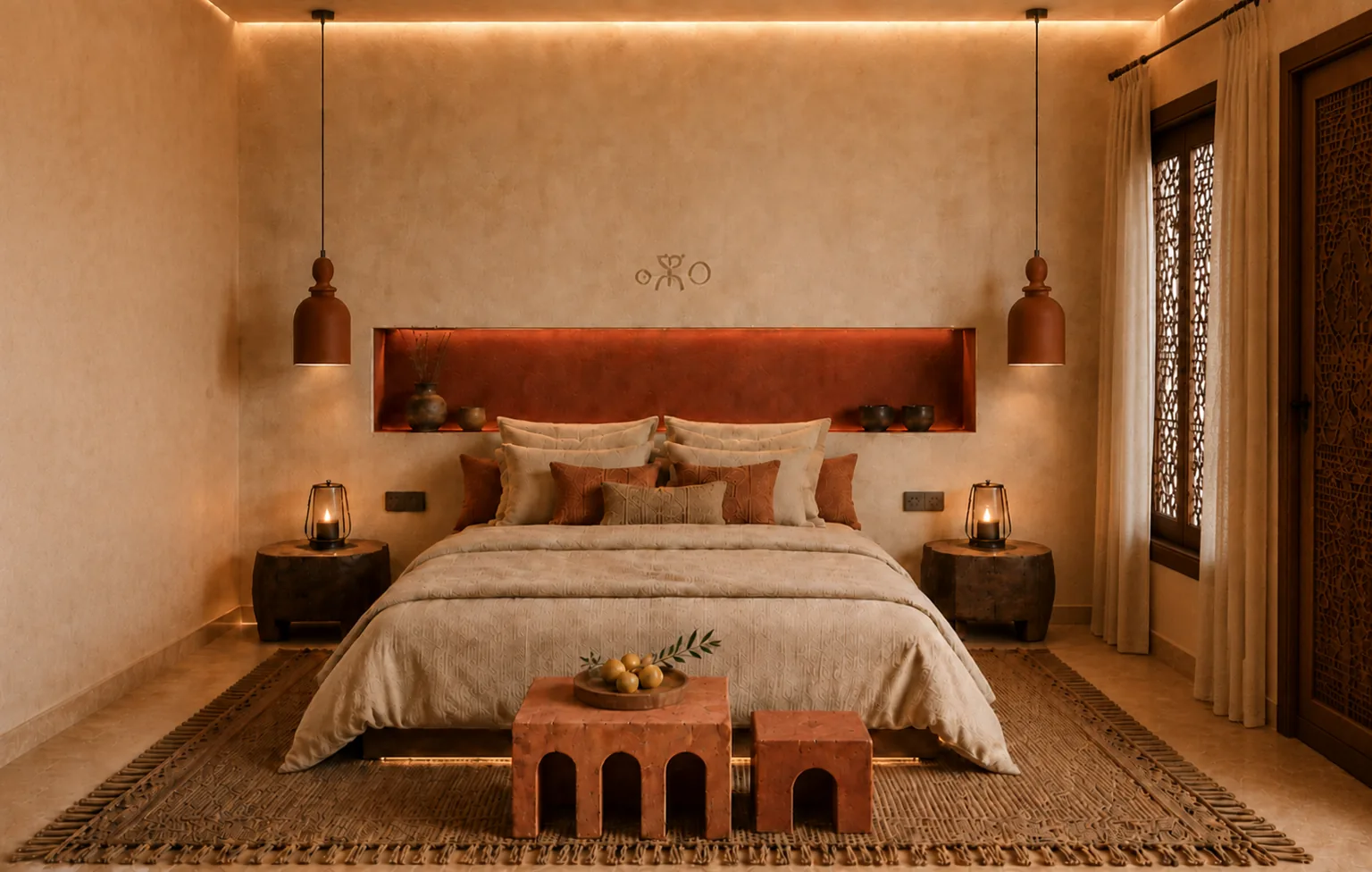
INVESTMENT EXAMPLE — KASBAH NELARIA & SPA
10 suites • Kasbah, Marrakech • Boutique hotel & Spa
Kasbah Nelaria & Spa is a boutique hotel project developed by Darnel Collection in Marrakech's Kasbah district.
The programme includes ten suites, a rooftop, dining areas and a spa.
This type of project illustrates why staffing should be considered from the architectural design stage.
Staff circulation, storage, linen rooms, technical areas and dining operations directly influence productivity.
Three key project figures
- 10 suites.
- Developed floor area: approximately 800 m².
- Commercial price: from €2,000,000.
What payroll budget should you consider?
For a ten-room boutique hotel with dining and a spa, an illustrative annual budget of €102,000 to €138,000 can provide an initial simulation framework.
Actual staffing will depend on restaurant operations, spa hours and the service level chosen.
Team organisation should therefore be studied alongside the business plan, rather than just weeks before opening.
How can you build your staffing budget before opening?
Here is a practical six-step method.
Step 1: define the guest experience
List the services you will actually offer.
Step 2: build the staffing structure
Identify the functions required and opportunities to combine roles.
Step 3: prepare the weekly schedule
Allow for working hours, rest days and cover.
Step 4: calculate the full employer cost
Use actual pay levels and have applicable employment obligations validated.
Step 5: include staffing in the business plan
Test several occupancy rates and revenue levels.
Step 6: define management indicators
Monitor costs, productivity and guest satisfaction.
Simulate your riad's profitability
The existing simulator uses its own simplified model: a €550,000 project price, €40,000 in year-one fixed costs, increasing rates and occupancy, and a flat 20% deduction from the surplus. Its net-return and valuation labels remain indicative: they are neither a personalised tax calculation nor a property valuation. It does not reproduce the illustrative tables above, particularly their variable-cost assumption. Check all costs, financing, taxes and replacement expenditure in your business plan.
Test how room count, occupancy, average rates and staffing costs affect your operating result.
Receive the Investor Kit and access the Private Club →
How Darnel Hospitality supports riad owners
Staff management does not end with recruitment.
It involves daily organisation, training, quality control and financial monitoring.
At Darnel Hospitality, our approach is to adapt the organisation to each property's capacity and positioning.
The main areas of support
Operational organisation: define functions, responsibilities and procedures.
Quality management: monitor reception, housekeeping and service standards.
Commercial performance: coordinate operations with pricing and distribution strategy.
Financial monitoring: measure staffing costs and performance indicators.
Continuous improvement: adjust procedures and resources according to observed results.
Do you already operate a riad in Marrakech?
An audit can identify spending areas, organisational problems and opportunities for improvement.
Request a Darnel Hospitality performance audit →
FAQ: staffing and payroll for a riad in Marrakech
How many employees does a four-room riad need?
Three to four employees can provide a starting organisation for a riad offering limited services, provided working hours, days off and absences are covered.
How many people does a seven-room riad need?
A team of five to seven employees can be considered, with services outsourced as needed.
How many employees does a ten-room boutique hotel need?
For the ten-room model with dining and a spa presented here, an indicative team of 12 employees, rising to 16 with additional staff, must be adapted to actual service hours.
What staffing budget should you allow for a riad?
In our illustrative assumptions, monthly budgets range from €2,000 to €3,000 for four rooms, €3,700 to €4,500 for seven rooms, and €8,500 to €11,500 for ten rooms. These budgets must be recalculated for each property.
How do you calculate the payroll ratio?
Divide total staffing costs by the corresponding revenue excluding tax for the period, then multiply by 100.
Does a seven-room riad need an operations manager?
It is strongly recommended that one person be clearly responsible for coordination, quality control and daily organisation.
Can the spa be outsourced?
Yes, where service volumes, contracts and applicable rules allow.
How should late arrivals be handled?
A reliable procedure is needed, consistent with service commitments and employment rules.
How can staffing costs be reduced without lowering quality?
By improving schedules, procedures, training, productivity and the organisation of occasional services.
What is the difference between an employee and an FTE?
An employee is a person. An FTE measures workload against reference working hours.
Are staff a riad's largest expense?
They can be a substantial expense, but their share also depends on commissions, energy, consumables, maintenance and other costs.
Why plan several payroll scenarios?
Because revenue can vary with the season and occupancy, while some staffing costs remain fixed.
Explore other Darnel Collection and Darnel Hospitality guides
To develop your project further:
Are you also considering moving to Morocco to develop a business? Discover the book Réussir sa nouvelle vie au Maroc.
Conclusion: how many staff does it take to run a profitable riad in Marrakech?
For a four-room riad, a team of three to four employees can be a starting point.
For seven rooms, five to seven people allow for a more structured organisation.
For ten rooms with dining and a spa, twelve to sixteen people may be needed, including additional staff, depending on the services.
But these ranges are not universal rules.
Profitability does not depend on minimising headcount. It depends on the team's ability to deliver a quality experience at the right cost.
A property that cuts staffing too far may lose guests.
A property that recruits without a method may lose its margin.
The right balance is built through a staffing structure, a realistic schedule, a complete budget and performance indicators.
Are you preparing to open a riad in Marrakech?
Darnel Collection can help you assess your project and build its business model.
Book an advisory appointment →
Do you already own a riad?
Darnel Hospitality helps you organise and optimise its operations.
Request a performance assessment →
Aïcha El Ouahidi — Founder, Darnel Hospitality
The staffing levels, budgets and revenue scenarios presented are indicative. They must be adapted to each property's service level, legal structure and applicable employment obligations.