
Hospitality operations
Making a Marrakech riad profitable in seven years: five revenue streams and a complete operating strategy
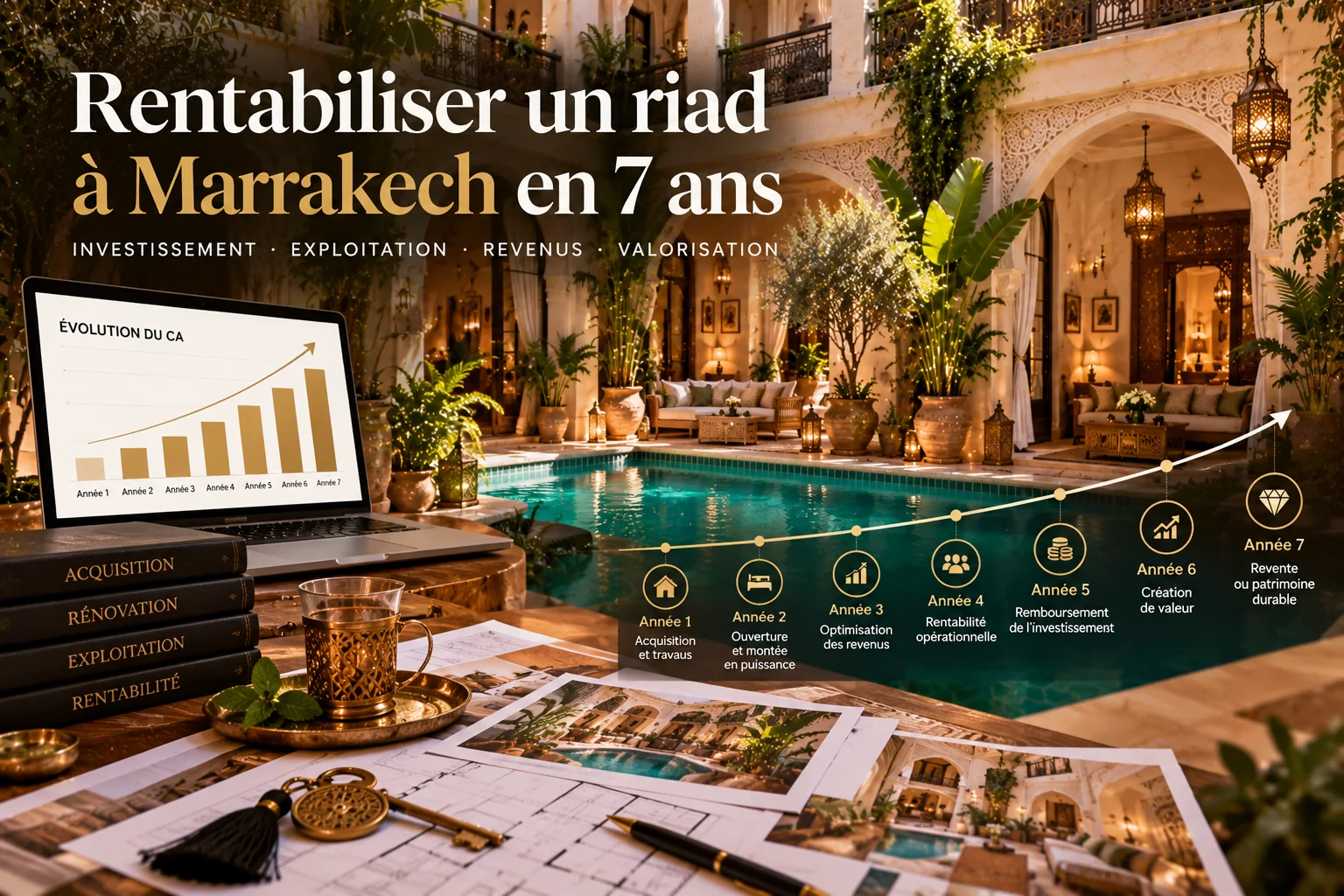
How can you turn a riad into a profitable hospitality business?
Owning a beautiful riad in Marrakech does not guarantee that it will make money.
You may have magnificent rooms, a courtyard with a pool, a rooftop terrace and a hammam, yet still struggle to fill your property or generate a satisfactory profit.
Why?
Because a riad’s profitability depends on more than its architecture or location.
It depends on attracting the right guests, selling rooms at the right price, developing additional revenue and controlling operating expenses.
A profitable riad is, above all, a well-managed hospitality business.
At Darnel Hospitality, we help owners improve their sales and distribution, structure their operations and build lasting financial performance.
In this guide, you will discover:
- How to assess your riad’s current profitability.
- The five revenue streams to develop.
- A detailed financial example for a six-room riad.
- A seven-year capital recovery projection.
- Three scenarios to understand the risks.
- The financial impact of outsourced management.
- A practical 90-day commercial action plan.
- The indicators to monitor when running your property.
The aim is not to promise you a return.
It is to give you the tools to make better decisions.
Unless stated otherwise, all financial figures and results presented are illustrative simulations. They are neither actual recorded performance nor guarantees of returns.
Recovering a riad’s capital in seven years requires enough cumulative available cash, rather than revenue alone. Darnel’s base case compares €455,000 in cumulative cash flows with €450,000 invested, leaving a €5,000 buffer. This debt-free model is a simulation sensitive to costs, taxes and maintenance investment; it does not demonstrate a guaranteed return.
The Reserve Bank of Australia explains the limits of simple payback: it ignores the time value of money and cash flows beyond the chosen cut-off. This methodological reference does not validate the guide’s commercial assumptions.
To test your trajectory, compare riad operating costs and cash flow and the direct-booking strategy. Darnel’s method tracks each activity’s contribution and cash after expenditure before comparing cautious, base and optimistic scenarios.
Making a riad profitable in seven years: what does this objective really mean?
Before looking at revenue, we need to distinguish three concepts.
Revenue
This is the income generated by rooms, dining, the spa and other services. A riad can generate €250,000 in annual revenue without being particularly profitable.
Operating profit
This is revenue less the operating expenses included in the model.
It measures business performance before certain items, such as depreciation, financing costs and taxes.
Cash actually available
This is the amount left after the relevant cash outflows, including expenses, taxes, necessary capital expenditure and, where applicable, loan repayments.
It is this last measure that allows you to assess the recovery of invested capital.
Example: a riad acquired and renovated for €450,000
Imagine an owner who has invested:
On small screens, scroll the table horizontally if needed.
| Item | Budget |
|---|---|
| Riad purchase | €250,000 |
| Fees and studies | €25,000 |
| Renovation and fit-out | €115,000 |
| Furniture and equipment | €35,000 |
| Launch and initial cash reserve | €25,000 |
| Total investment | €450,000 |
To recover the full €450,000 in seven years solely from operating cash flows, the average annual cash generation would need to be:
€450,000 ÷ 7 = €64,286 a year.
That is approximately 14.3% of the initial capital each year.
However, this average does not account for the time needed to build the business.
A riad may generate less cash in its early years, then more as its reputation and customer base grow.
An important distinction
Recovering the initial investment through seven years of cumulative cash flows does not necessarily mean an annualised investment return of 14.3%.
This simple calculation does not account for the time value of money, risk, inflation or the building’s residual value.
Darnel’s advice: base your profitability target on the capital actually invested and the cash available, rather than forecast revenue alone.
Quick assessment: is your riad profitable enough?
Before improving performance, you need to establish your starting point.
Here are six figures to gather for your property.
On small screens, scroll the table horizontally if needed.
| Indicator | Your property |
|---|---|
| Number of rooms available for sale | To be completed |
| Annual ADR excluding tax | To be completed |
| Annual occupancy rate | To be completed |
| Additional revenue excluding tax | To be completed |
| Annual operating expenses | To be completed |
| Commissions and distribution cost | To be completed |
Calculate your room revenue
The formula is:
Number of rooms × available days × occupancy rate × ADR excluding tax.
Example for a six-room riad:
6 × 365 × 60% × €140 = €183,960 excluding tax.
Calculate your RevPAR
RevPAR is room revenue per available room.
With an ADR of €140 and occupancy of 60%:
€140 × 60% = €84 RevPAR.
Calculate your operating margin
Assume:
Total revenue excluding tax: €220,000.
Operating expenses: €170,000.
Operating surplus: €50,000.
The operating margin would be:
€50,000 ÷ €220,000 = 22.7%.
This margin is not a net profit after tax.
Three questions to ask yourself
1. Are you selling your rooms at the right price?
High occupancy with an ADR that is too low can limit your margin.
2. Do your guests buy additional services?
A property with a spa or dining facilities may have underused commercial potential.
3. Are your expenses growing more slowly than your revenue?
If expenses rise faster than revenue, profitability deteriorates.
Could your riad generate more revenue?
Darnel Hospitality offers a DARNEL RIAD PERFORMANCE AUDIT™ to analyse the main commercial and operational drivers.
The aim is to identify opportunities for improvement, without promising predetermined results.
Request a performance audit for my riad →
Five revenue streams to improve a riad’s profitability
A riad does not necessarily have to depend solely on room sales.
However, diversifying revenue does not mean adding activities without a clear method.
Each service must be assessed against demand, cost and margin.
Revenue stream 1: overnight stays
Rooms generally provide the main source of revenue.
For a six-room riad:
On small screens, scroll the table horizontally if needed.
| Indicator | Cautious scenario | Strong-performance scenario |
|---|---|---|
| ADR excluding tax | €110 | €160 |
| Occupancy | 45% | 68% |
| Annual room revenue excluding tax | €108,405 | €238,272 |
The difference is €129,867 a year, with the same room capacity.
This illustrates the importance of positioning, pricing and distribution.
How can you increase room revenue?
Improve your photographs and descriptions.
Build your property’s reputation.
Adjust rates to the season and the pace of bookings.
Develop direct bookings where their acquisition cost is competitive.
Darnel’s advice: do not always aim to fill every room. The objective is to optimise revenue and margin per available room.
Revenue stream 2: dining
A riad can develop a dining offering that suits its positioning and permitted activities.
Consider this example:
- Four paying diners per evening.
- Average spend of €35 excluding tax.
- 250 evenings available for bookings.
Annual revenue would be:
4 × €35 × 250 = €35,000 excluding tax.
If directly attributable costs represent 55% of sales:
- Direct costs: €19,250.
- Contribution before shared overheads: €15,750.
This contribution is not net profit.
Three commercial actions
Offer dinners before guests arrive.
Create a distinctive culinary experience.
Measure sales and margin per diner.
Darnel’s advice: dining that generates substantial revenue but requires too many staff can reduce overall profit.

Revenue stream 3: spa and wellness
Massages, hammam sessions and treatments can provide an attractive revenue stream.
A spa may also attract external guests where permissions and operating arrangements allow.
Example: two treatments a day
Assume:
- Two treatments sold per operating day.
- Average price of €55 excluding tax.
- 250 operating days.
Annual revenue would be:
2 × €55 × 250 = €27,500 excluding tax.
With direct costs of 45%:
- Direct costs: €12,375.
- Contribution before shared overheads: €15,125.
How can you improve performance?
Offer treatments as soon as guests book.
Create experiences for couples.
Measure treatment-room utilisation.
Analyse the margin on each service.
Darnel’s advice: treat a spa as a potential profit centre, rather than simply a facility that enhances your property’s photographs.
Revenue stream 4: experiences and additional services
Travellers may seek transfers, guided visits, culinary experiences and personalised services.
These services can be offered directly or through authorised partners.
Example: 300 services a year
Assume:
- 300 services.
- Average selling price of €60 excluding tax.
- Direct costs representing 70% of sales.
Revenue would be €18,000 excluding tax.
Contribution before shared overheads would be €5,400.
Please note: if the riad acts solely as an intermediary, its accounting revenue may be its commission rather than the full amount paid by the traveller.
The treatment should be confirmed with the property’s accountant.
Darnel’s advice: select services based on quality, margin and their contribution to guest satisfaction.
Revenue stream 5: exclusive-use stays and packages
A riad can offer private stays for families, groups of friends or small events.
Exclusive-use bookings can also help fill periods of lower demand.
Example: ten exclusive-use stays
Imagine ten exclusive-use stays a year, each lasting two nights.
For each stay:
On small screens, scroll the table horizontally if needed.
| Package component | Amount excluding tax |
|---|---|
| Accommodation | €1,500 |
| Meals and additional services | €500 |
| Total stay price | €2,000 |
Across ten stays:
- Accommodation: €15,000.
- Additional services: €5,000.
- Total revenue: €20,000.
Important: the €15,000 in accommodation revenue must not be added to room revenue a second time.
Similarly, the €5,000 in additional services must be allocated to the relevant categories and not counted twice.
In the consolidated model below, we include only €5,000 of specific additional services, excluding revenue already recorded in the other categories.
Darnel’s advice: a package should increase the total booking value and secure dates, rather than simply discount several services.
Financial study: how much can five revenue streams generate?
Consider a six-room riad with an established commercial operation.
We use the following assumptions:
On small screens, scroll the table horizontally if needed.
| Revenue stream | Annual revenue excluding tax |
|---|---|
| Overnight stays | €238,272 |
| Dining | €35,000 |
| Spa and wellness | €27,500 |
| Experiences and services | €18,000 |
| Specific additional services | €5,000 |
| Total | €323,772 |
Exclusive-use revenue already included in overnight stays and other activities is not added a second time.
Calculate each activity’s contribution
On small screens, scroll the table horizontally if needed.
| Activity | Revenue excluding tax | Assumed direct costs | Contribution |
|---|---|---|---|
| Overnight stays | €238,272 | €50,000 | €188,272 |
| Dining | €35,000 | €19,250 | €15,750 |
| Spa | €27,500 | €12,375 | €15,125 |
| Experiences | €18,000 | €12,600 | €5,400 |
| Specific services | €5,000 | €2,500 | €2,500 |
| Total | €323,772 | €96,725 | €227,047 |
Direct room costs here include variable expenses attributable to accommodation. The other direct costs are illustrative assumptions.
Add shared overheads
Assume the following annual expenses:
On small screens, scroll the table horizontally if needed.
| Item | Amount |
|---|---|
| Permanent staff and social contributions | €65,000 |
| Marketing and distribution not already accounted for | €18,000 |
| Energy, upkeep and maintenance | €20,000 |
| Administration, insurance and management | €18,000 |
| Total shared overheads | €121,000 |
The simplified operating surplus would then be:
€227,047 − €121,000 = €106,047.
This represents an operating margin of approximately 32.8% of revenue excluding tax.
This is an ambitious assumption that needs to be assessed against actual operating accounts. The €121,000 of shared overheads is an illustrative allowance, not a validated budget: the €18,000 allocated to “Administration, insurance and management” is not sufficient on its own to confirm that any outsourced management fees are covered. Before any commercial use, OTA commissions, management fees, salaries and social contributions, and fixed and variable costs must be itemised, and the operating surplus recalculated without omissions or double counting.
Why this simulation matters
A riad can generate more than €300,000 in revenue without making €300,000 in profit.
You still need to consider:
- Depreciation.
- Any interest charges.
- Taxes.
- Replacement expenditure.
- Loan repayments.
- Changes in cash balances.
Darnel’s advice: track the margins for rooms, dining, the spa and experiences separately. Assess each additional activity on its actual contribution.
Estimate your own riad’s potential
Would you like to test different assumptions for occupancy, ADR, expenses and additional revenue?
Access the resources and profitability simulator →
Simulate revenue and capital recovery
Two independent calculations: a mature operating year, then a seven-year cash flow path. All amounts are in euros and revenue excludes tax. Values are illustrative, with no guarantee of performance.
How can you recover your investment in a riad in seven years?
Let us return to the initial investment of €450,000.
We will construct a scenario covering seven full operating years, without debt, as the business builds up.
Assumptions
- Six rooms.
- 365 days of theoretical availability.
- Progressively increasing ADR and occupancy.
- Growing additional revenue.
- Operating expenses aligned with activity levels.
- Taxes and maintenance capital expenditure included in final cash flow.
The tax amounts here are hypothetical modelling allowances, rather than amounts calculated under a specified tax regime.
Seven-year forecast
On small screens, scroll the table horizontally if needed.
| Year | ADR excluding tax | Occupancy | Total revenue excluding tax | Operating expenses | Operating surplus |
|---|---|---|---|---|---|
| 1 | €120 | 45% | €148,260 | €93,260 | €55,000 |
| 2 | €130 | 50% | €182,350 | €116,350 | €66,000 |
| 3 | €140 | 55% | €218,630 | €141,630 | €77,000 |
| 4 | €150 | 60% | €254,100 | €166,100 | €88,000 |
| 5 | €160 | 65% | €290,760 | €191,760 | €99,000 |
| 6 | €170 | 68% | €323,116 | €213,116 | €110,000 |
| 7 | €180 | 70% | €351,940 | €230,940 | €121,000 |
Total revenue includes overnight stays and additional services.
For each year, additional revenue is the difference between total revenue and theoretical room revenue. For reference, it is €30,000 in year 1 (€148,260 less €118,260 from overnight stays) and €76,000 in year 7 (€351,940 less €275,940 from overnight stays). This €46,000 increase assumes that dining, wellness and additional services genuinely gain traction; it must be justified through activity-specific volumes, prices and margins.
From operating profit to cash flow
On small screens, scroll the table horizontally if needed.
| Year | Operating surplus | Assumed taxes and maintenance capital expenditure | Available cash flow |
|---|---|---|---|
| 1 | €55,000 | €20,000 | €35,000 |
| 2 | €66,000 | €21,000 | €45,000 |
| 3 | €77,000 | €22,000 | €55,000 |
| 4 | €88,000 | €23,000 | €65,000 |
| 5 | €99,000 | €24,000 | €75,000 |
| 6 | €110,000 | €25,000 | €85,000 |
| 7 | €121,000 | €26,000 | €95,000 |
This table is a simplified simulation. The combined tax and maintenance capital expenditure amounts are not statutory tax calculations. The model assumes no debt and that other cash movements are zero or already included. It does not replace a detailed income statement or cash flow forecast. With only €5,000 between cumulative cash flows of €455,000 and the €450,000 invested, cost overruns or unforeseen capital expenditure could delay capital recovery beyond seven years.
Cumulative cash flow over seven years
On small screens, scroll the table horizontally if needed.
| Year | Annual cash flow | Cumulative total |
|---|---|---|
| 1 | €35,000 | €35,000 |
| 2 | €45,000 | €80,000 |
| 3 | €55,000 | €135,000 |
| 4 | €65,000 | €200,000 |
| 5 | €75,000 | €275,000 |
| 6 | €85,000 | €360,000 |
| 7 | €95,000 | €455,000 |
In this central scenario, cumulative cash flows exceed the initial €450,000 capital during year seven.
This is nominal capital recovery through operating cash flows, without discounting.
The property’s residual value is not included.
Why this scenario remains ambitious
ADR rises from €120 to €180.
Occupancy increases from 45% to 70%.
Additional revenue also grows.
These results would require an effective commercial strategy, consistent positioning and sound expense control.
This trajectory should not be treated as the market’s natural course.
Darnel’s advice: compare actual performance with the forecast each year. If results persistently diverge from your targets, adjust your strategy immediately.
Three scenarios: cautious, central and optimistic
An investor or owner should never rely on a single scenario.
To understand the risk, let us compare three seven-year cumulative cash flow assumptions, based on initial capital of €450,000.
On small screens, scroll the table horizontally if needed.
| Year | Cautious | Central | Optimistic |
|---|---|---|---|
| 1 | €15,000 | €35,000 | €45,000 |
| 2 | €20,000 | €45,000 | €60,000 |
| 3 | €25,000 | €55,000 | €75,000 |
| 4 | €30,000 | €65,000 | €90,000 |
| 5 | €35,000 | €75,000 | €105,000 |
| 6 | €40,000 | €85,000 | €120,000 |
| 7 | €45,000 | €95,000 | €135,000 |
| Cumulative total | €210,000 | €455,000 | €630,000 |
Cautious scenario
The initial capital is not recovered in seven years.
This scenario may reflect occupancy below target, limited average rates or expenses that prove difficult to reduce.
Central scenario
Under our assumptions, capital is recovered during year seven.
Optimistic scenario
Recovery occurs sooner, thanks to faster growth in revenue and margins.
These three paths are cash flow assumptions, rather than three complete business plans. They must be linked to detailed commercial and tax assumptions before any investment decision.
Key points
Results depend heavily on the purchase price, renovation budget and operating quality.
A property bought at too high a price may remain difficult to make profitable, even with strong sales.
Darnel’s advice: look beyond increasing revenue. Also analyse the capital tied up in the property and the risks involved.
Six indicators to monitor each month
A riad’s performance needs to be managed through a dashboard.
1. Occupancy rate
This measures the proportion of available rooms actually sold.
2. ADR
The average daily rate per room sold helps assess pricing position.
3. RevPAR
This combines ADR and occupancy.
4. Revenue per guest
This measures additional sales and average spend.
5. Distribution cost
This includes platform commissions and the acquisition costs of direct bookings.
6. Operating margin
This measures the share of revenue retained after the operating expenses included in the calculation.
Example: increasing ADR by €15
For a six-room riad at 65% occupancy:
6 × 365 × 65% × €15 = €21,352.50.
That is approximately €21,353 in additional room revenue excluding tax, with occupancy unchanged.
However, if higher rates cause bookings to fall sharply, the gain may disappear.
Darnel’s advice: analyse ADR, occupancy, RevPAR, margin and distribution cost together.
Further reading: Twelve profitability indicators for a riad in Marrakech.
A 90-day action plan to improve a riad’s performance
Profitability improves through practical, measurable actions.
Here is a roadmap for a property already in operation.
Days 1–15: carry out the initial audit
Analyse revenue, ADR, occupancy, commissions, expenses and guest reviews.
Deliverable: an initial dashboard and assessment of the main opportunities.
KPIs: ADR, occupancy, RevPAR, operating margin and distribution cost.
Days 16–30: improve commercial presentation
Improve photographs, descriptions, offers and pricing consistency.
Review booking terms and the guest journey.
Deliverable: optimised listings and sales materials.
KPIs: visibility, listing conversion and bookings.
Days 31–45: structure your pricing policy
Set rates suited to seasons, demand periods and booking pace.
Avoid automatic discounting.
Deliverable: a rate grid and revenue management rules.
KPIs: ADR, RevPAR and revenue net of distribution costs.
Days 46–60: develop additional revenue
Identify services relevant to your guests.
Create straightforward offers and train your team to present them.
Deliverable: an offer catalogue and additional-sales tracking.
KPIs: conversion rate, average spend and margin per service.
Days 61–75: diversify sales channels
Develop partnerships, agency relationships and direct bookings.
Assess each channel’s acquisition cost.
Deliverable: a multichannel distribution plan.
KPIs: direct-sales share and distribution cost.
Days 76–90: analyse and adjust
Compare results with targets.
Identify the most effective actions and adjust those that create little value.
Deliverable: a performance report and improvement plan for the next three months.
KPIs: changes in revenue, expenses and margin.
What should an owner expect after 90 days?
Not necessarily a dramatic increase in revenue.
They should, however, have a clearer picture of performance, a structured commercial strategy and indicators to assess progress.
Darnel’s advice: the first improvements often relate to data quality, pricing and distribution. Financial results should then be measured over a sufficiently representative period.

Six mistakes that stop a riad becoming profitable
Mistake 1: underestimating fixed expenses
Salaries, maintenance and certain operating expenses remain even when occupancy falls.
Mistake 2: pricing rooms too low
A pricing policy based solely on competitors’ rates can erode margins.
Mistake 3: depending on a single distribution channel
Heavy dependence on one sales channel reduces strategic flexibility.
Mistake 4: neglecting additional services
A property may have underused facilities.
Mistake 5: confusing revenue with profit
Higher revenue does not automatically improve profit.
Mistake 6: postponing maintenance investment
Deteriorating facilities can harm satisfaction, reviews and rates.
Example: more revenue, less profit
On small screens, scroll the table horizontally if needed.
| Indicator | Year A | Year B |
|---|---|---|
| Revenue excluding tax | €200,000 | €240,000 |
| Operating expenses | €145,000 | €195,000 |
| Operating surplus | €55,000 | €45,000 |
| Operating margin | 27.5% | 18.8% |
Revenue increases by 20%, but the operating surplus falls by €10,000.
Darnel’s advice: aim for profitable growth, rather than an increase in booking numbers alone.
FAQ: how can you make a Marrakech riad profitable?
Can a riad pay back its investment in seven years?
Yes, some scenarios can allow the initial capital to be recovered in seven years through operating cash flows. This depends on investment costs, performance, taxes and maintenance expenditure.
How much can a six-room riad generate?
With an ADR of €160 excluding tax and occupancy of 68%, six rooms available for 365 days can generate €238,272 in annual overnight-stay revenue excluding tax.
What are the five revenue streams?
Overnight stays, dining, the spa, experiences and additional services, and exclusive-use stays and packages.
How can a riad increase revenue?
By improving positioning, pricing policy, distribution, reputation and additional revenue.
How is RevPAR calculated?
RevPAR is ADR multiplied by occupancy, provided both indicators use the same scope.
Should you offer a spa?
A spa can help differentiate a property, but the investment must be supported by sufficient demand and satisfactory potential margins.
How can you increase average guest spend?
By offering relevant services before arrival and during the stay, through clear, unobtrusive communication.
What is the main financial risk?
A combination of overstated revenue, underestimated expenses and unforeseen capital expenditure can put cash flow under pressure.
Is it better to manage your riad yourself?
It depends on your available time, skills and objectives. Outsourced management should be assessed on the value it creates after fees.
Which indicators should you monitor each month?
Occupancy, ADR, RevPAR, additional revenue, distribution cost, margin and cash flow.
Why prepare a seven-year forecast?
It allows you to examine business growth, capital recovery, future investment and sensitivity to risk.
How can you obtain a performance audit for your riad?
An owner can request a commercial and financial assessment from Darnel Hospitality to identify the main opportunities for improvement.
Further reading: Darnel resources
To explore your property’s management and profitability in more depth:
- Operating expenses for a riad in Marrakech
- Twelve profitability indicators for a riad
- How much revenue can a riad in Marrakech generate?
- Investing in Marrakech in 2027: the complete guide
- Property taxation in Morocco in 2027
Our book: Réussir sa nouvelle vie au Maroc
Réussir sa nouvelle vie au Maroc: Le guide pratique pour s’installer, investir et prospérer
A book to help you explore relocating, investing and running a business in Morocco.

Conclusion: a riad’s profitability is built every day
Making a riad in Marrakech profitable in seven years is a demanding objective.
It requires a coherent initial investment, a structured commercial strategy and rigorous management.
The five revenue streams can help grow sales, but their value depends on the margins they actually generate.
Owners must also control expenses, diversify distribution and regularly measure performance.
A riad’s profitability is not determined solely at the time of purchase. It is built every day through commercial and operational decisions.
At Darnel Hospitality, we help owners develop properties with stronger sales and distribution and better operating performance.
Could your riad become more profitable?
Do you own a riad or guesthouse in Marrakech?
We can analyse your property, its current results and the commercial opportunities to develop.
Review my available cash flows and capital recovery objective →
About the author
Aïcha El Ouahidi — Founder, Darnel Hospitality
Darnel Hospitality helps owners of riads and guesthouses in Marrakech with sales, distribution and performance management.