
Riad management in Marrakech
Riad management in Marrakech: the complete guide for owners in 2027
Booking, pricing, staffing, profitability, guest experience and hotel oversight: the complete guide to managing a riad in Marrakech in 2027.
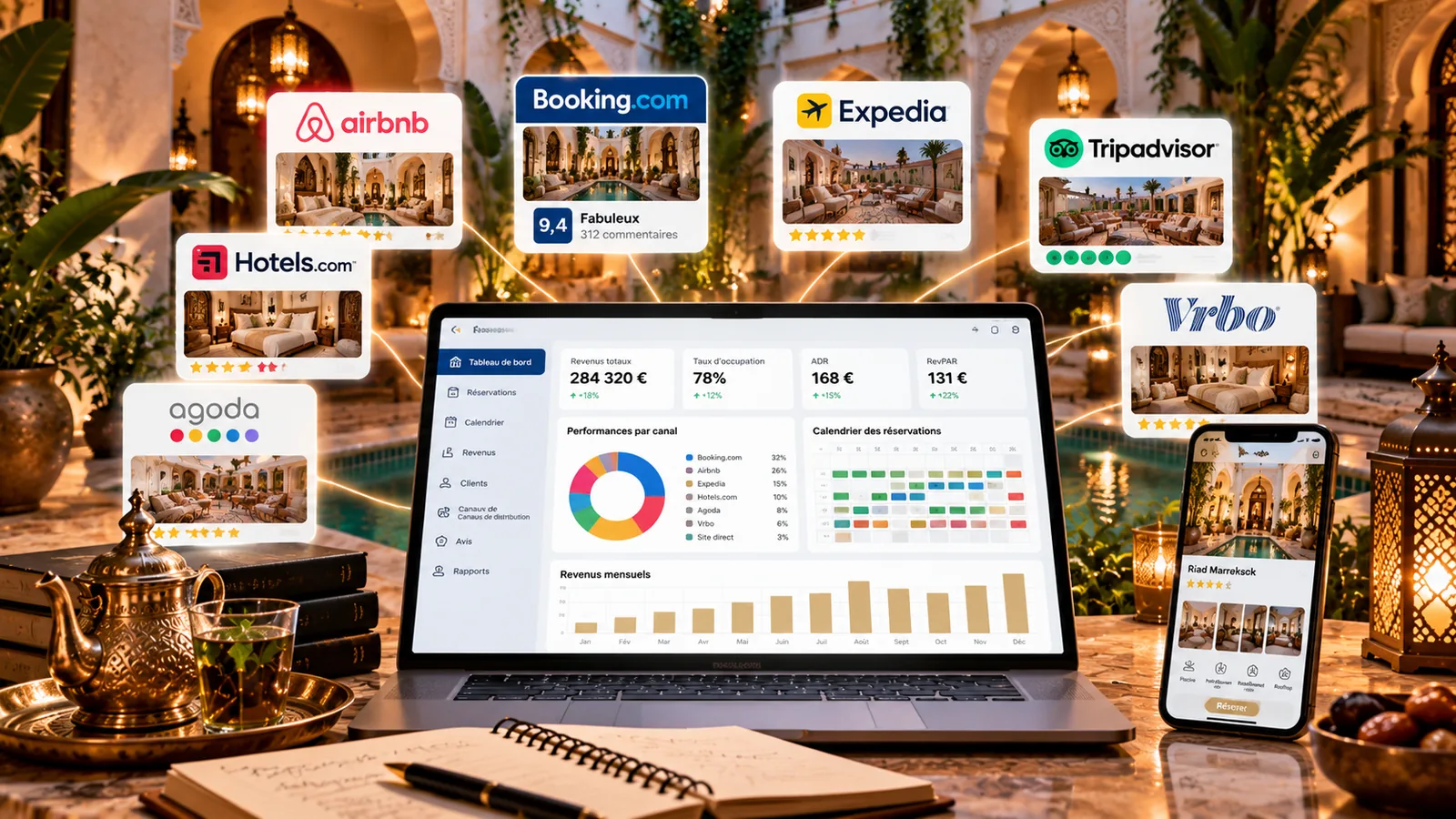
Owning a beautiful riad in Marrakech does not guarantee profitability.
A property can have a spectacular patio, an excellent location and perfectly renovated rooms yet deliver disappointing performance.
Why?
Because a riad welcoming travellers is no longer simply a property.
It is a hotel business.
You must attract travellers, manage bookings, adjust rates, welcome guests, organise staff, provide breakfasts, manage reviews, control costs, maintain the building and progressively develop direct bookings.
All of this must work 365 days a year.
This is precisely the difference between owning a riad and operating a riad professionally.
In this guide, Darnel Hospitality explains the foundations of successful riad or guesthouse management in Marrakech.
Riad management covers sales, pricing, service, staffing, maintenance and financial monitoring. To choose a manager, compare scope, responsibilities, reporting and the result after all costs. Darnel Hospitality’s method connects commercial indicators with costs and guest experience; high occupancy alone does not demonstrate profitability.
The market figures below come from the MAP release of 12 August 2026 on Maroc.ma. They cover Marrakech’s classified accommodation over the stated periods, rather than forecast your riad’s performance.
To prepare questions for your manager, compare riad operating costs and cash flow with management from France: commissions, fees, supporting expense documents and cash flow should be monitored consistently.
At a glance: what does riad management in Marrakech include?
Professional riad management generally rests on eight pillars:
1. Positioning
2. Distribution
3. Revenue management
4. Guest experience
5. Operational management
6. Team management
7. Marketing and direct bookings
8. Financial oversight
The aim is therefore more than increasing occupancy.
The aim is to optimise the property’s overall performance sustainably.
Marrakech in 2026: a dynamic but competitive tourism market
Marrakech continues to hold a central place in Moroccan tourism and confirms, year after year, its status as one of the Kingdom’s essential destinations.
By the end of May 2026, Marrakech’s classified tourism accommodation establishments had recorded 6.05 million overnight stays, an increase of 10% against the same period in 2025. The destination alone then represented approximately 33% of nationally recorded overnight stays.
This momentum also appears in occupancy. Over the first five months of 2026, average occupancy in classified establishments reached 72%, with a particularly high 78% in May.
These indicators demonstrate Marrakech’s tourism strength and ability to attract substantial visitor numbers throughout the year.
Nevertheless, overall destination performance should not be confused with that of an individual property. Investing in a riad in Marrakech does not automatically guarantee 72% or 78% occupancy.
Growing demand also brings stronger competition. Traditional hotels, riads, guesthouses, holiday rentals, boutique hotels and new hospitality concepts all seek a share of the city’s travellers.
In this environment, owning a beautiful riad and posting a few Booking or Airbnb listings is no longer enough. A property must establish genuine positioning, develop its identity, manage pricing, intelligently diversify distribution and offer an experience strong enough to generate positive reviews and encourage direct bookings.
The question is no longer simply being present in Marrakech. It is becoming desirable in a destination with an increasingly rich and professional tourism offering.
This is precisely where operational and commercial strategy can distinguish a riad merely filling rooms from a property building a genuinely profitable hospitality brand.
Managing a riad is more than providing concierge services
Concierge services and hotel management are often confused, although they represent very different levels of support.
Concierge services mainly concern daily guest-related operations. They may handle arrivals and departures, organise cleaning and linen, respond to guest requests and manage communication before, during and after stays.
Hotel management goes much further. It directs the property as a genuine hotel business, with objectives for revenue, profitability, guest satisfaction and long-term development.
The manager must notably determine room prices by period, select the most effective distribution channels, define booking conditions and identify target guests. They must also develop positioning, offers suited to each segment and the service level needed to deliver the promise made to travellers.
This requires genuine revenue management. Rates should not remain identical all year: they should evolve with seasonality, occupancy, demand, Marrakech events, booking lead time and competitor pricing.
Hotel management also seeks to develop every revenue stream. Beyond overnight stays, this can include spa, dining, transfers, activities, additional sales and all-inclusive stays or packages.
The fundamental difference lies in the purpose: concierge services mainly deliver the operations needed for stays to run smoothly, while hotel management oversees the entire business model to optimise performance sustainably.
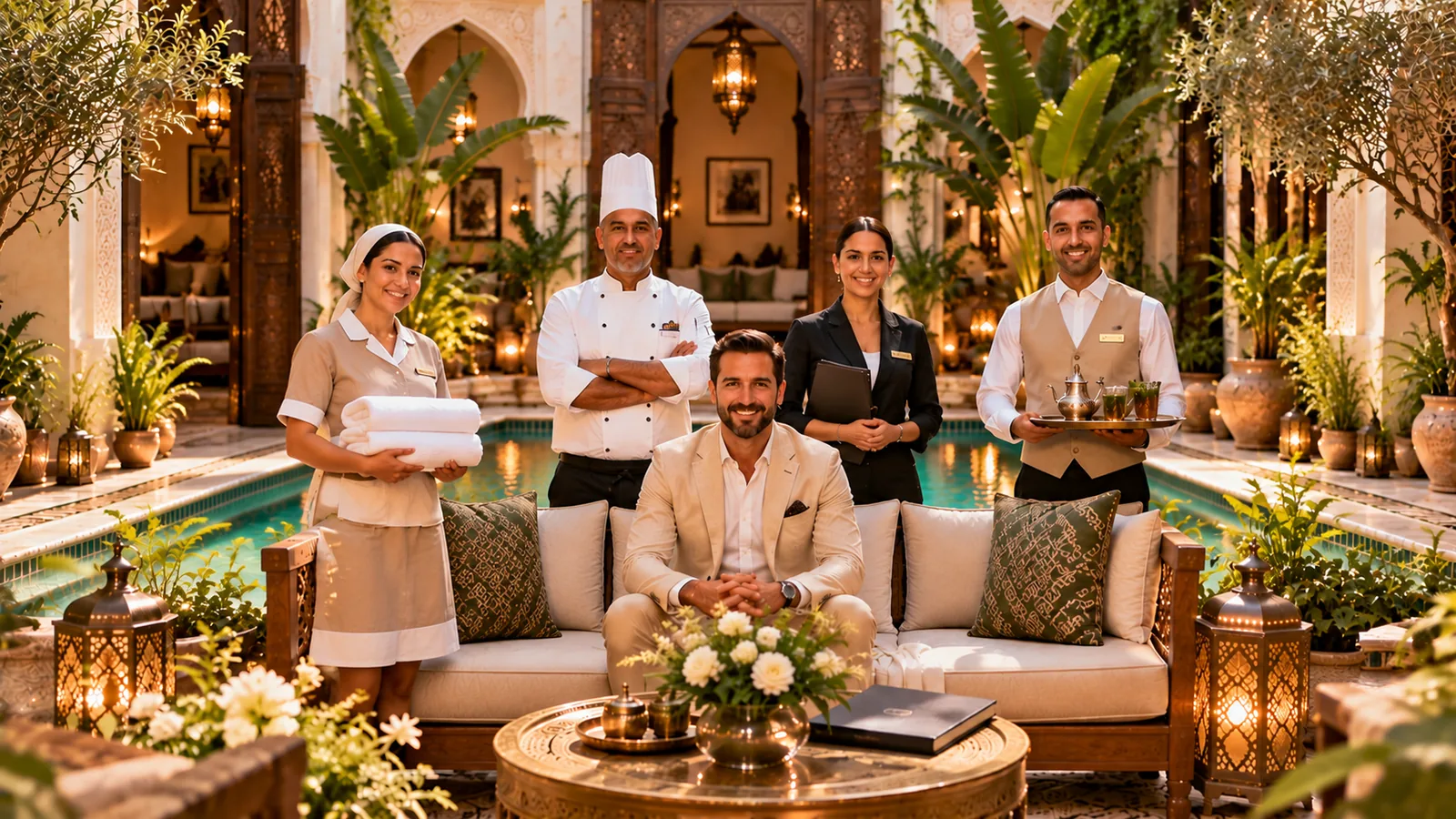
A successful guest experience generally results from dozens of processes invisible to the traveller.
Everything begins with positioning
Before considering Booking, pricing or advertising, ask an essential question: why should a traveller choose your riad over the dozens of other properties they have just viewed?
If the only answer is “because our riad is beautiful”, that is probably no longer enough. Many Marrakech properties now have remarkable architecture, attractive patios, pleasant rooftops or carefully decorated rooms. Aesthetics are an advantage, but not a positioning strategy on their own.
To differentiate itself, a riad needs an identity that travellers can recognise immediately. It might be a romantic address for couples, a family riad, a lifestyle boutique hotel, a wellness and spa experience, an ultra-premium address or a gastronomic property.
Other concepts can also work: a riad strongly focused on Moroccan design and architecture, a house available for exclusive family or group use, a cultural address showcasing Marrakech’s craftsmanship and heritage, or an intimate property with few rooms and particularly personalised service.
This choice must be more than a marketing argument. Positioning should guide the entire experience the property offers.
It naturally influences decoration and spatial planning, but also photographic art direction, price levels, services and how teams welcome guests. It determines the tone of the website and social media, the offers and packages sold and the guest segments the property seeks to attract.
A wellness riad, for example, should offer more than a hammam or massage room. The whole experience can revolve around wellbeing: treatments, Moroccan rituals, healthy breakfast, rooftop yoga, ambient scents, multi-day packages and partnerships with specialist professionals.
Conversely, a riad mainly for couples may prioritise intimate suites, romantic experiences, private dinners, personalised touches and visual communication designed specifically for them.
Successful positioning lets travellers understand within seconds whom the property is for, what they will experience and why it deserves to be chosen over another.
Pricing, distribution, communication and the riad’s entire marketing strategy can then be coherently built around that identity.
Darnel Hospitality advice
Do not try to appeal to everyone.
Clear positioning often makes you much more attractive to the guests you genuinely seek.
When an owner wants to market a riad in Marrakech, one question regularly arises: should they prioritise Booking, Airbnb or direct bookings?
The answer is simple: all three can complement one another, but need not represent the same share of bookings.
The aim is progressively to build a balanced distribution mix that generates visibility, fills the property and reduces dependence on one intermediary.
Booking: a powerful visibility channel
Booking can play a major role in riad marketing. It quickly reaches international travellers actively seeking Marrakech accommodation.
This visibility can help fill the property, particularly during lower demand or before the riad has strong recognition.
However, this distribution power has a cost. Commissions and possible promotional schemes must be included in each booking’s actual profitability. Dependence should also be monitored: the greater Booking’s revenue share, the more the property relies on a channel it does not fully control.
Airbnb: a complementary channel depending on the concept
Airbnb can also be useful, but its relevance depends strongly on the riad’s positioning and operating model.
It may particularly suit guests seeking a more residential experience, and properties offering exclusive use of the entire riad for families, groups of friends or event stays.
The aim is therefore less to be everywhere than to identify channels genuinely suited to the intended guests and business model.
Direct bookings: building a strategic asset
As the riad becomes better known, direct bookings can play an increasing role.
A traveller may discover the property on Google, Instagram, TikTok or YouTube, read a blog article, receive a previous guest’s recommendation, be referred by an ambassador or find it through advertising or a partner agency.
They can then visit the property’s website and book directly, without an OTA.
This relationship also helps the property build its own audience. With guest agreement and respect for applicable rules, the riad can develop contacts, communicate with previous travellers, encourage repeat stays and stimulate recommendations.
Over time, the website, organic search, social media, partnerships, guest database and ambassador programme become genuine commercial assets belonging to the property.
The aim: diversify rather than eliminate OTAs
A healthy distribution strategy does not seek at all costs to eliminate Booking or Airbnb. These platforms can remain powerful sources of business and play an important role in acquiring new guests.
The aim is never to depend exclusively on them.
A well-marketed riad should progressively develop complementary sources: OTAs, direct bookings, Google search, social media, travel agencies, partnerships, past guests, ambassadors and advertising.
The more diversified booking sources are, the more control the property has over sales and the less risk of excessive dependence on one channel.
Already own a riad in Marrakech?
Darnel Hospitality can conduct an initial strategic assessment with you:
Positioning · Distribution · Pricing · Experience · Revenue
REQUEST A STRATEGIC ASSESSMENT →
Revenue management: selling the right room at the right price
Revenue management means selling the right room at the right time and best possible price according to demand.
A common mistake is setting, for example, MAD 1,500 per room all year. Demand changes with season, weekdays, holidays, Marrakech events, arrival lead time, occupancy and room type.
Rates must therefore evolve.
Take a seven-room riad.
With MAD 1,200 ADR and 70% occupancy, theoretical room revenue reaches:
7 × 365 × 70% × MAD 1,200 = MAD 2,146,200.
With MAD 1,500 ADR and 65% occupancy, it reaches:
7 × 365 × 65% × MAD 1,500 = MAD 2,491,125.
The second scenario therefore has five percentage points less occupancy, but generates nearly MAD 345,000 more revenue, approximately 16% more.
This is why occupancy should never be analysed alone. Track ADR and, above all, RevPAR, measuring revenue per available room.
The aim is more than filling the riad: it is finding the best balance between price, occupancy and profitability.
For more on these calculations, read What profitability can you expect from a riad in Marrakech? Calculations, figures and examples.
Seven KPIs for managing a riad
An owner should quickly be able to establish at least:
1. Occupancy rate
The share of available rooms actually sold.
2. ADR
The average rate achieved per room sold.
3. RevPAR
Room revenue per available room.
4. Revenue
For rooms and complementary services.
5. Distribution costs
What do Booking, Airbnb and other intermediaries cost?
6. Direct-booking share
What proportion of revenue comes directly to the property?
7. Revenue per guest
What does a traveller actually spend during their stay?
Monitor these indicators regularly.
What you do not measure is difficult to optimise.
How can you increase revenue without adding rooms?
One of hotel management’s most interesting levers is increasing revenue without increasing room count.
Take a riad limited to seven rooms. Creating an eighth is difficult, but increasing the value generated by existing rooms is entirely possible.
The first lever is the average rate. With approximately 1,661 room nights sold annually, an ADR increase of just MAD 150 could theoretically generate nearly MAD 249,000 more annual room revenue.
The second is additional revenue. Depending on positioning, this may come from transfers, dining, massages, hammam, excursions, experiences, romantic packages, exclusive use or premium services.
Take a riad generating MAD 2.49 million in room revenue. If additional revenue equals 15% of that amount, it can add approximately MAD 374,000 annually.
Hotel management therefore aims not only to fill rooms but also to increase the value of every night and stay, fully developing the property’s economic potential.
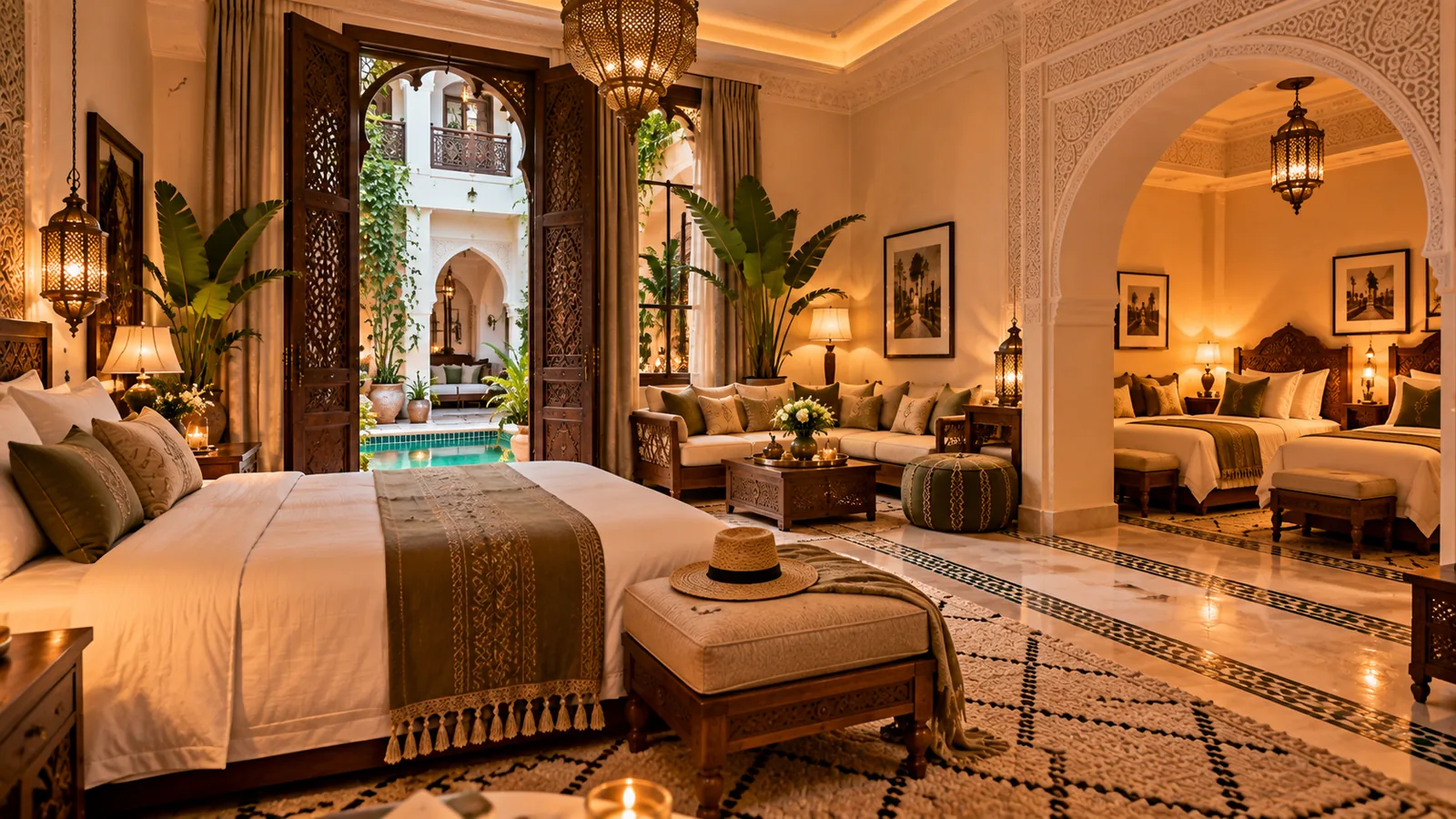
Guest experience can also drive revenue and differentiation.
Guest experience is one of the main drivers of riad performance. A traveller judges more than room quality: they assess the stay as a whole, from first contact to departure.
Even before arrival, response speed, information quality, transfer arrangements and personalised exchanges begin shaping their impression.
On arrival, welcome quality becomes essential. A welcome drink, smooth check-in and thoughtful introduction immediately create a positive experience.
During the stay, every detail matters: cleanliness, bedding comfort, breakfast quality, team availability, local recommendations and experiences in Marrakech.
The experience continues after check-out. A thank-you message, review request and loyalty strategy extend the relationship.
This attention matters because one problem can sometimes damage the overall impression of a stay. Conversely, a remarkable experience naturally encourages positive reviews.
Online reputation has genuine commercial value. Better reviews can strengthen future guests’ trust, improve platform conversion and help the property progressively justify a higher average rate.
Guest experience is therefore more than hospitality: it is fully part of the riad’s commercial strategy.
Service quality is becoming even more strategic in Morocco
Morocco’s tourism accommodation classification framework has evolved.
The decree published in late 2025 notably provides specific categories for guesthouses and riads, with the latter potentially classified Luxury, 5, 4 or 3 stars. Applications for provisional classification and operating permission must notably include information on the management model, those responsible and staffing levels.
Since May 2026, mystery visits notably concern riads and guesthouses classified from 3 stars upwards.
Assessors may examine the guest journey from booking to departure: welcome, dining, cleanliness, check-in and check-out speed and overall experience.
According to the ministry, assessment grids include 235–387 criteria, depending on property type and category.
Reference for the mystery visits and assessment grids cited: Ministry of Tourism release of 14 May 2026.
This confirms an important shift: hotel quality is no longer based solely on the building. It also rests on the actual quality of service delivered to guests.
A riad does not necessarily need a large structure to operate effectively. It does, however, need clear organisation and precisely defined responsibilities.
Depending on size and positioning, several functions must be covered: operational supervision, reception, housekeeping, breakfast or dining, maintenance, guest relations, booking management and marketing.
In a small property, one person can naturally fulfil several roles. What matters is that every responsibility belongs to an identified person.
Consider everyday situations. A guest requests a transfer at 11 pm: who arranges it? A water heater fails: who contacts the technician and follows up? A Booking reservation has an issue: who decides? A traveller posts a negative review: who responds, and how quickly?
These situations seem minor but can rapidly affect guest experience and performance.
Good organisation anticipates problems, defines who does what and establishes simple procedures for common situations.
Small problems are inevitable in hospitality. The difference is how quickly and well they are resolved.
SOPs: turning service into a system
An SOP, or Standard Operating Procedure, simply defines how a task should be carried out within the property.
For check-in, a procedure might include checking the reservation and special requests, ensuring the room is ready, confirming arrival time, arranging a transfer if needed, preparing the welcome and introducing the riad’s services.
The same approach applies to housekeeping, breakfast, maintenance, complaints, check-out and emergencies.
The aim is certainly not to turn hospitality into impersonal procedures. SOPs instead ensure consistent service, reduce oversights and help coordinate teams.
By standardising what can be standardised, staff spend less time dealing with surprises and more time on what makes the difference in hospitality: human relationships and a personalised guest experience.
Building a direct-booking system
Over the long term, the riad should progressively build its own ecosystem.
Website
A fast, visual site designed to convert.
SEO + business profile + content.
Social media
Instagram, Facebook, TikTok, Pinterest or YouTube according to positioning.
Turn past travellers and prospects into your own audience.
An especially effective channel for certain enquiries.
Partnerships
Agencies, premium concierge services, businesses, content creators and referral partners.
At Darnel Hospitality, the aim is therefore more than managing existing bookings.
It is also to progressively build future demand.
Case study: two similar riads, different performance
Imagine two seven-room riads in the same Marrakech neighbourhood, with comparable capacity and architecture.
Riad A reaches 60% occupancy with MAD 1,250 ADR. Its theoretical room revenue is:
7 × 365 × 60% × MAD 1,250 = MAD 1,916,250 annually.
Riad B reaches 68% occupancy with MAD 1,550 ADR. Room revenue is: 7 × 365 × 68% × MAD 1,550 = MAD 2,693,285 annually.
With comparable property characteristics, the difference is MAD 777,035 in annual revenue, before complementary revenue.
What explains the gap? It may come from positioning, photographs and guest reviews, but also distribution, revenue management, the experience offered and effective marketing.
Similar riads can therefore produce very different economic results.
This is precisely where hotel management creates value: developing an existing asset’s potential rather than simply filling rooms.
Darnel Hospitality: management built around performance
At Darnel Hospitality, our starting point is simple: a riad should be directed as a genuine hospitality business, not merely a holiday rental.
We work on the principal performance drivers together.
This begins with positioning: defining the concept, experience and target guests. Distribution and revenue management follow, selecting appropriate channels and adjusting rates as demand changes.
Management also includes the guest journey from booking to departure, everyday operations and the teams needed to run the riad.
Marketing develops visibility, diversifies booking sources and progressively encourages direct sales.
Finally, we develop additional revenue — spa, dining, transfers, experiences or packages — while monitoring key indicators through regular performance reporting.
The objective brings four dimensions together: guest satisfaction, revenue development, cost control and sustained enhancement of the hospitality asset.
Want to improve your riad’s performance?
Before seeking higher revenue, understand where improvement potential actually lies.
Darnel Hospitality can conduct an initial assessment, notably analysing occupancy, ADR, RevPAR, distribution, guest reviews and additional revenue.
The aim is to identify possible improvements: pricing, marketing, guest experience, direct sales, distribution or new revenue streams.
Your riad may already have the potential. The next step is to develop it fully.
REQUEST MY PERFORMANCE ASSESSMENT →
Professional management or self-management?
Both models are entirely possible. The choice mainly depends on your availability, skills and desired role as owner.
Self-management can suit owners based in Marrakech who know hospitality and want direct operational involvement. However, it requires time and skills to manage teams, guests, distribution, rates and daily operations.
Professional management becomes particularly relevant if you live abroad, own several assets or want more distance from operations. A dedicated team handles operations and marketing while reporting and key indicators retain your visibility over performance.
The choice therefore depends less on room count than on your desired role: hands-on operator or investor overseeing an asset with a manager’s support.
DARNEL PRIVATE CLUB
Riad owner, investor or future owner?
Regularly receive our analysis and resources on hospitality investment and operations in Marrakech.
We share hotel market insights, practical management and revenue-management advice, numerical case studies and selected investment opportunities.
You can also discover new Darnel Collection and Darnel Hospitality projects first.
Invest, operate, optimise: access the Darnel ecosystem’s expertise and opportunities.
JOIN THE PRIVATE CLUB →
Free access · Unsubscribe at any time.
Ten common riad management mistakes
1. Keeping the same prices all year
Demand changes.
Your rates should be able to change too.
2. Focusing solely on occupancy
Revenue also depends on ADR.
3. Depending on one platform
Diversified distribution reduces dependence.
4. Neglecting guest reviews
Your reputation is a commercial asset.
5. Not measuring KPIs
Without figures, management becomes intuitive.
6. Underinvesting in photographs
In digital hospitality, the first visit often happens on a screen.
7. Neglecting additional revenue
A guest can generate more than an overnight stay.
8. Not formalising procedures
Quality then depends on who happens to be present.
9. Not building direct bookings
You remain dependent on intermediaries.
10. Managing the property as real estate alone
This is probably the main mistake.
A tourist riad is a property asset operated by a hotel business.
Checklist: is your riad properly managed?
Ask these twelve questions.
- Do you know last month’s ADR?
- Do you know your RevPAR?
- Do you know occupancy?
- Do you know your average distribution cost?
- Do you know your direct-booking share?
- Do rates change with demand?
- Do you monitor reviews weekly?
- Do you have written procedures?
- Do you measure additional revenue?
- Do you receive monthly reporting?
- Do you have a direct-booking strategy?
- Do you know exactly what differentiates your property?
If several answers are “no”, there are probably opportunities to improve.
How do you choose a riad management company in Marrakech?
Do not choose solely on commission percentage.
Ask:
What is your distribution strategy?
How do you manage rates?
Which KPIs do you provide to the owner?
How do you manage reviews?
How do you develop direct bookings?
Who supervises the teams?
How are expenses controlled?
What is your low-season strategy?
How do you increase revenue per guest?
How do you protect my property’s experience and positioning?
The manager should explain how they create value, not only what they cost.
Could your riad perform better?
Darnel Hospitality offers a conversation about your property and its main growth opportunities.
ASSESS MY RIAD’S MANAGEMENT →
Frequently asked questions about riad management in Marrakech
How do you manage a riad in Marrakech?
Management notably includes bookings, revenue management, reception, housekeeping, teams, maintenance, distribution, guest experience, reviews and financial oversight.
What distinguishes concierge services from hotel management?
Concierge services generally focus more on stay-related operations. Hotel management also includes positioning, rates, distribution, teams, revenue and overall direction.
What does a riad management company in Marrakech cost?
Models vary according to provider and services. Darnel Hospitality notably offers remuneration levels of 30% including tax over 1 year, 25% including tax over 3 years and 20% including tax over 5 years, according to the defined contractual calculation base.
How do you increase a riad’s occupancy?
Work on product, rates, distribution, reputation, photography, search visibility and marketing together.
Is Booking essential for a riad in Marrakech?
Booking can be important, but diversified distribution and progressively developing direct bookings are preferable.
How do you calculate riad profitability?
Compare room and service revenue with operating costs, then relate the result to invested capital. Our guide “What profitability can you expect from a riad in Marrakech?” provides detailed calculations.
Which KPIs should you track?
Occupancy, ADR, RevPAR, revenue, distribution costs, direct bookings, additional revenue and main operating costs are fundamental indicators.
Can you manage a Marrakech riad from abroad?
It is possible with reliable local organisation, processes, reporting tools and operational supervision. A management company can help a remote owner delegate many of these functions.
How do you increase direct bookings?
A performing website, SEO, Google, social media, loyalty, email, WhatsApp, partnerships and brand strategy can progressively increase direct-booking share.
Why entrust a riad to a management company?
It can provide organisation, hospitality skills, revenue management, marketing, operational supervision and reporting. Its relevance nevertheless depends on the owner’s needs and value actually created.
Continue your owner journey
PROFITABILITY
What profitability can you expect from a riad in Marrakech?
Understand ADR, occupancy, RevPAR and returns through our examples.
RENOVATION
How much does it cost to renovate a riad in Marrakech?
Works, furniture, contingencies and design: build your transformation budget.
INVESTMENT
Investing in a riad in Marrakech: the complete guide
From the property search to operations, explore our reference guide.
Does your riad deserve more effective management?
Owning a riad in Marrakech represents an opportunity.
Its real value, however, develops over time.
Every booking.
Every rate.
Every review.
Every experience.
Every expense.
Every guest who returns or recommends the property.
Together, these decisions turn a beautiful riad into a performing hotel business.
Darnel Hospitality supports owners who want to structure, market and operate their property with a focus on performance and guest experience.
Own a riad or guesthouse in Marrakech?
Compare my riad’s management scope, reporting and costs →
About Darnel Hospitality
Darnel Hospitality is the Darnel ecosystem’s branch dedicated to hotel management and marketing.
Our approach brings together:
Guest experience · Revenue management · Distribution · Marketing · Operations · Performance
Darnel Collection addresses the wider cycle of creating and enhancing riad and boutique hotel projects in Marrakech.
Darnel — Invest. Transform. Operate.
The financial examples in this article are educational and do not guarantee revenue or profitability. Applicable regulatory obligations depend notably on each property’s type, classification and circumstances; they must be checked with qualified authorities and professionals.
Also read
Explore further

Tourism operations and regulations · 30 September 2026 · 11 min
How to operate a tourist riad in Marrakech: complete 2026 guide
Positioning, regulations, distribution, revenue management, guest experience and oversight: a complete approach to operating a riad in Marrakech.
Read the article →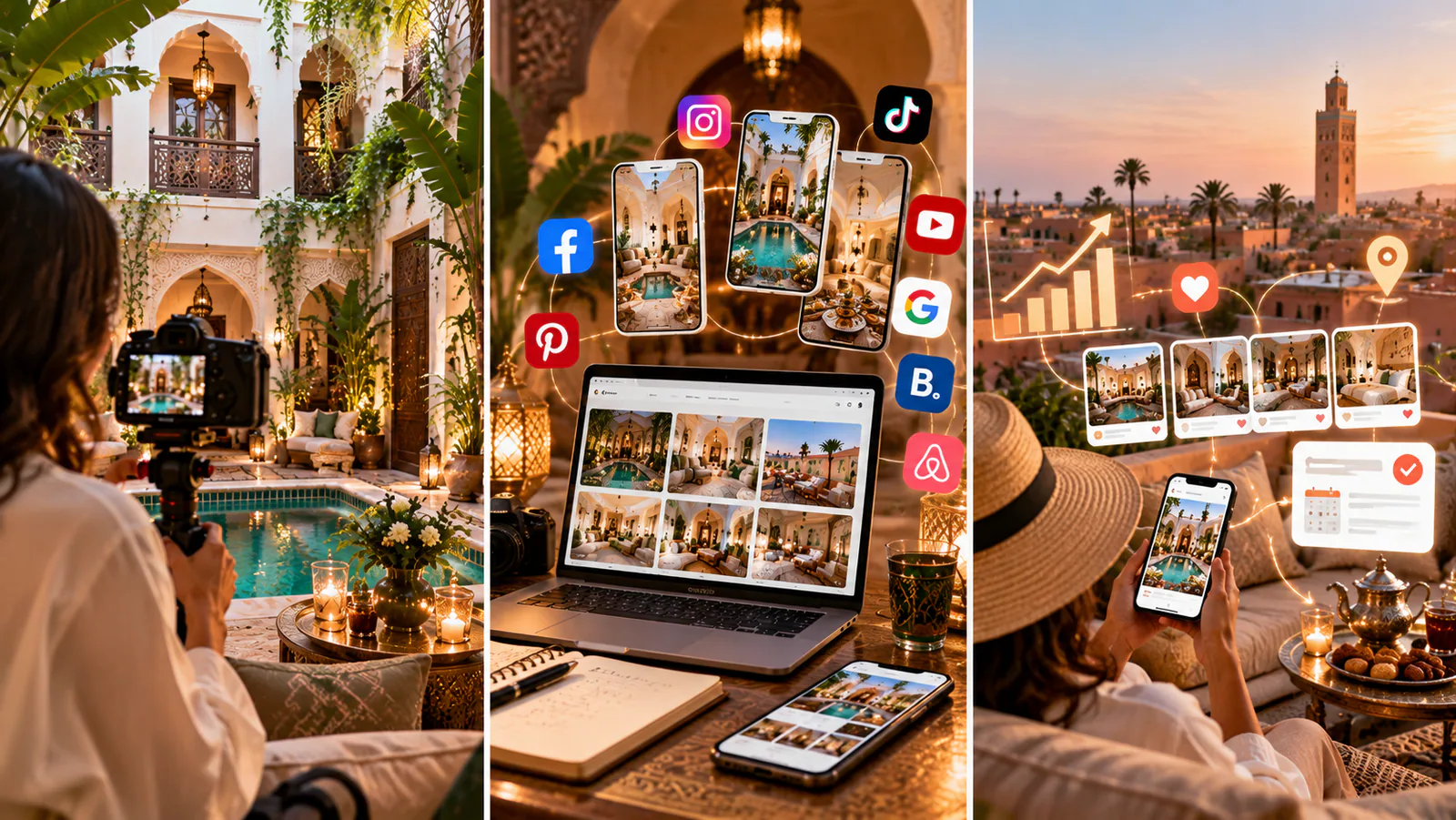
Hotel performance and marketing · 30 September 2026 · 12 min
How to build a digital strategy for a riad in Marrakech
Website, Google, Instagram, Booking, SEO, advertising and direct bookings: build a complete digital strategy for your riad.
Read the article →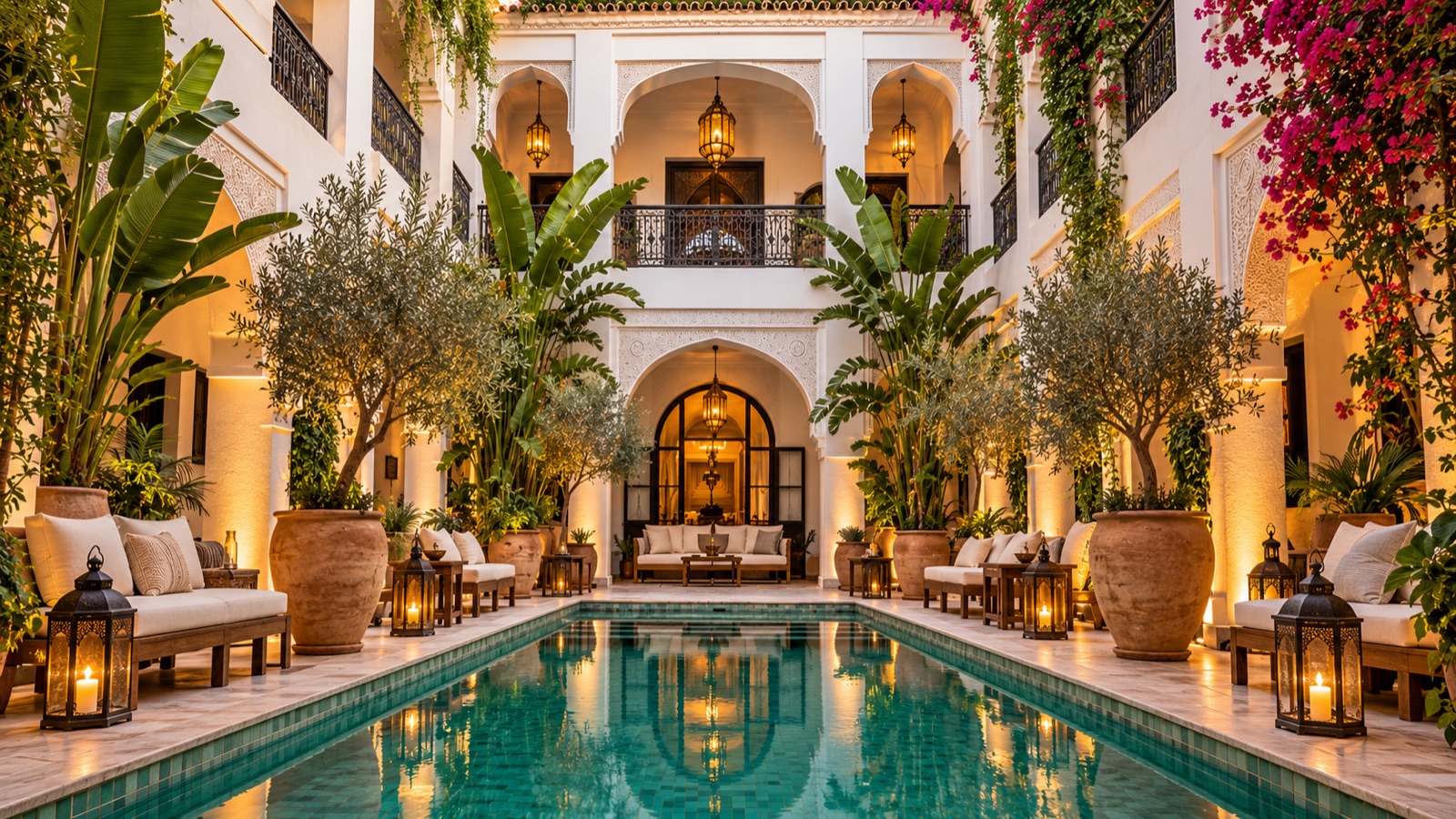
Riad profitability · 18 September 2026 · 11 min
What profitability can you expect from a riad in Marrakech? Calculations, figures and 2026 examples
ADR, occupancy, RevPAR, costs and additional revenue: three scenarios for assessing a riad’s potential profitability in Marrakech.
Read the article →