Property investment in Marrakech
Why and How to Invest in a Distinctive Riad in Marrakech
Buying a riad in Marrakech is one thing. Creating a place so distinctive that travellers seek it out by name is another.
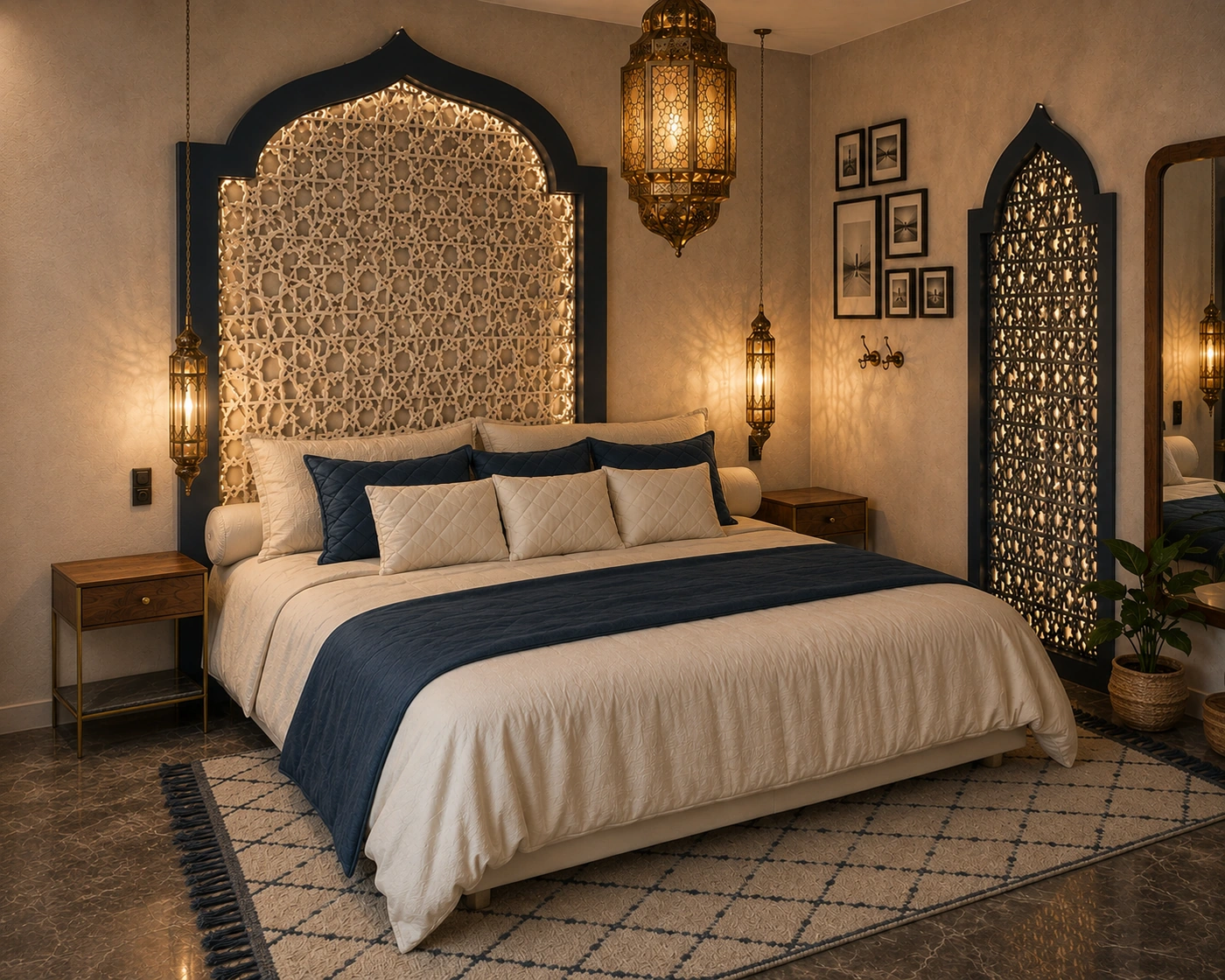
Buying a riad in Marrakech is one thing. Creating a place so distinctive that travellers seek it out by name is another.
That is precisely what we mean by a distinctive riad.
The term does not describe a specific administrative category. It expresses an investment philosophy: select a building with potential, preserve its identity, give it a strong architectural direction and build a complete hospitality experience around it.
The aim is therefore more than simply owning a few rooms in the Medina.
It is to create a property asset, a hospitality offering and a brand.
This approach makes particular sense in Marrakech. By the end of May 2026, the city’s officially classified tourist accommodation establishments had recorded 6.05 million overnight stays, up 10% on the previous year. At that point, Marrakech accounted for around 33% of overnight stays in Morocco’s classified accommodation and had an average occupancy rate of 72%.
The market is there. But in such an attractive destination, the question becomes: How do you create a riad that is more than just another place to stay?
A distinctive riad here means Darnel’s approach combining building, identity and hospitality experience; it is neither an administrative category nor a return guarantee. Assess concept feasibility, full cost and the capacity to generate a contribution after expenses. Distinctiveness needs consistent commercial and operating organisation.
The tourism indicators in the introduction come from the MAP release of 12 August 2026 on Maroc.ma. They cover Marrakech’s classified accommodation over the stated periods, rather than predict an individual project’s results.
To turn the concept into an investment file, compare the total investment budget and hotel management. Dar Léon below illustrates a design philosophy; its identity does not remove the need for a project-specific forecast.
What is a distinctive riad?
A distinctive riad is not necessarily the largest or the most luxurious.
Its defining quality is a recognisable identity.
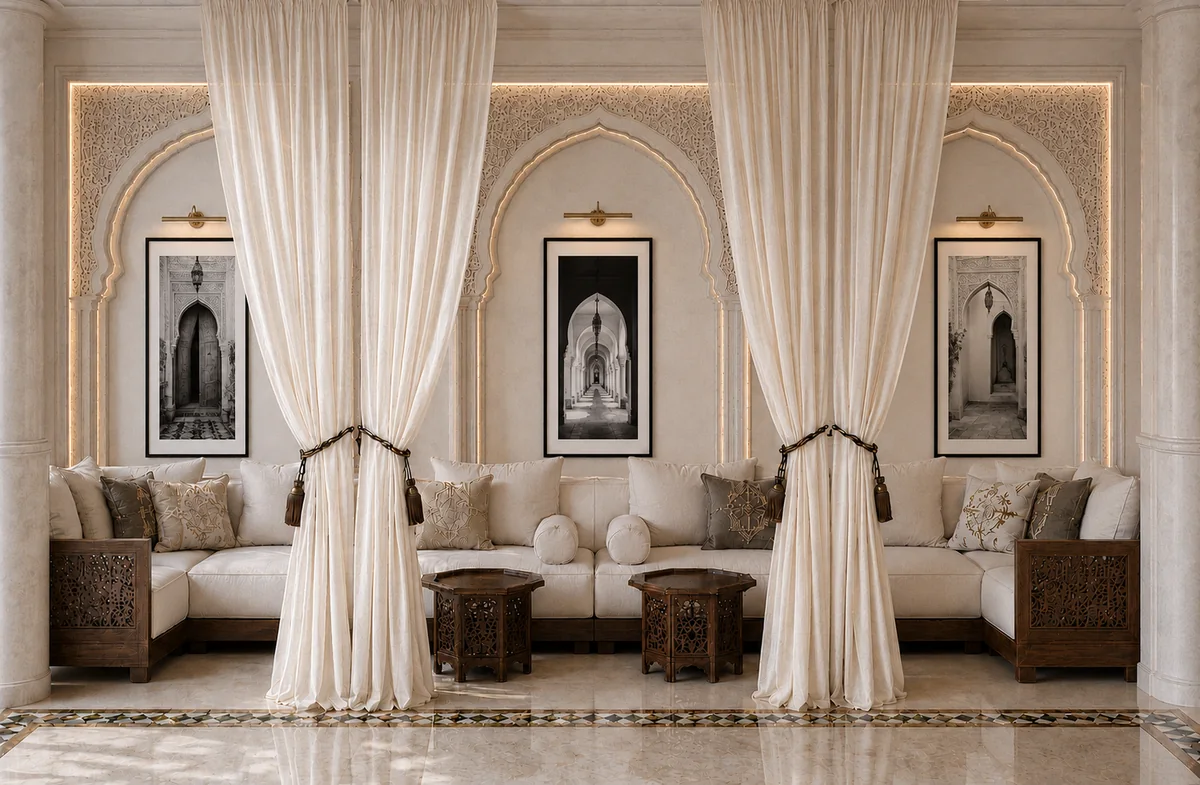
When you enter a property of this kind, its character should quickly become clear: materials, furniture, lighting, scents, music, table settings, service, food and the way guests are welcomed.
Moroccan architecture remains central, but it is not used as a generic backdrop.
It becomes the starting point for a creative vision.
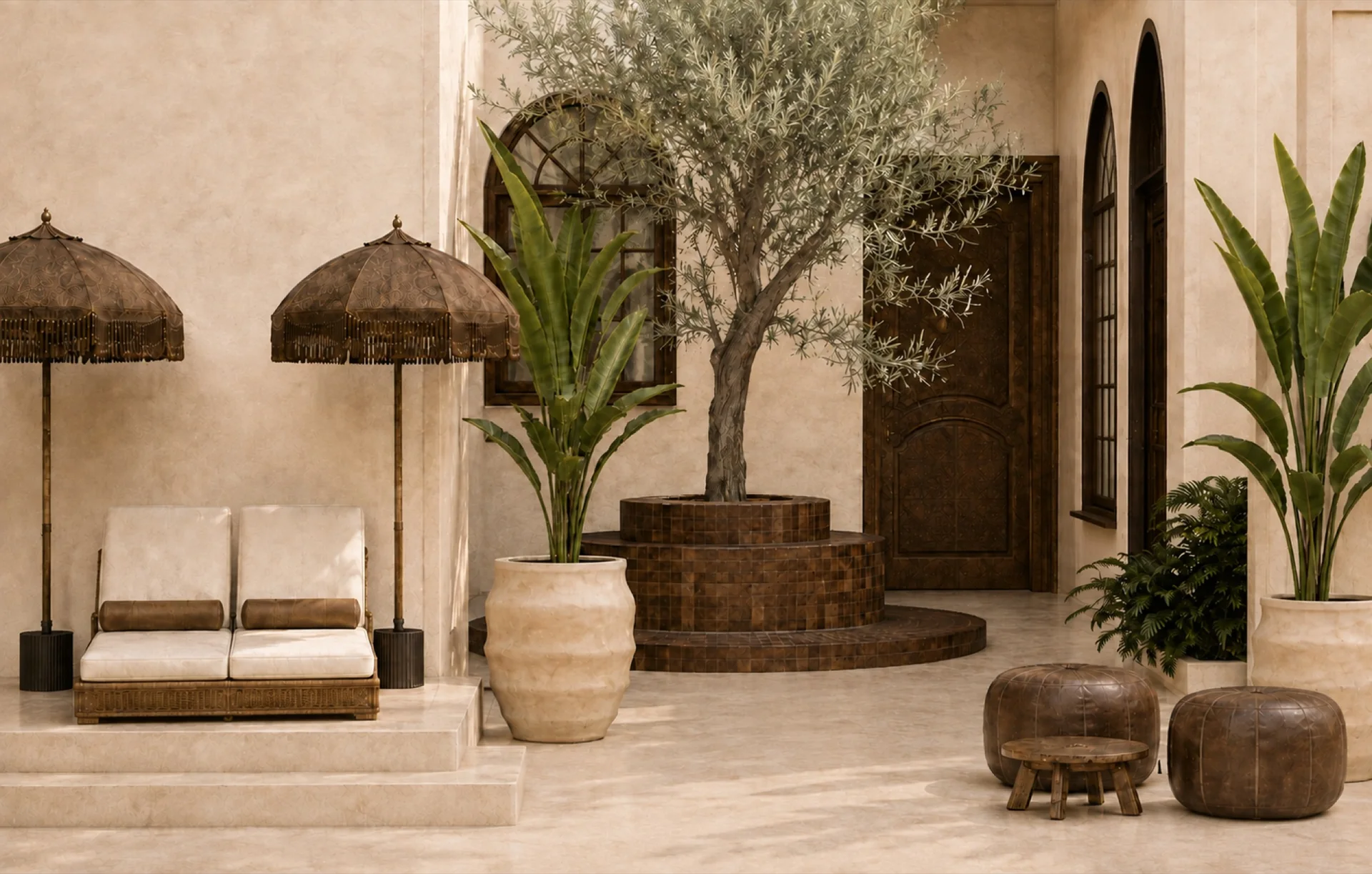
The Dar Chemaa & Spa project, the House of Light, illustrates this search for identity through light, natural materials and contemporary Moroccan architecture.
Over time, this helps move beyond a situation in which travellers compare only three criteria: location, Booking rating and price.
A distinctive riad should give them a fourth reason to book: The desire to experience that particular place.
This distinction matters to investors. The more interchangeable your property is with its competitors, the more likely price is to determine a traveller’s decision.
Conversely, a strong identity can support stronger pricing, more word of mouth and, over time, a greater share of searches for the brand itself.
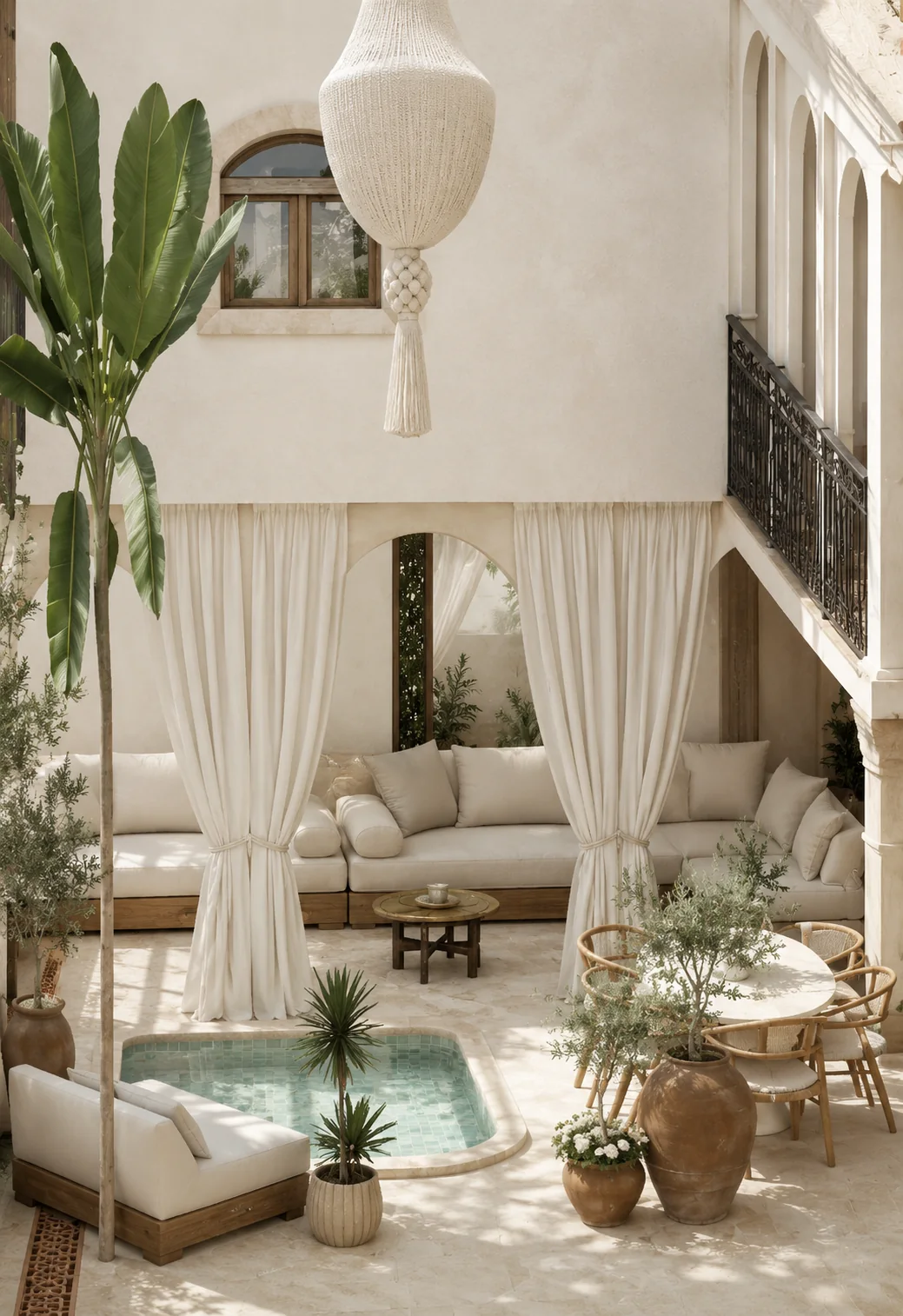
Value creation begins when architecture, design and the guest experience tell the same story.
Why is Marrakech particularly suited to this model?
A premium hospitality offering needs a sufficiently large and diverse guest base.
Marrakech has precisely this depth of demand.
Recent growth in overnight stays is one indicator. Another development also deserves attention: Morocco is shifting its hotel standards towards a greater focus on the actual quality of the guest experience.
This evolution aligns closely with the philosophy of a distinctive riad.
Architectural heritage alone is no longer enough.
The setting must be beautiful, and the experience must match it. For an investor, this means that designing the property and planning its operations must begin together.
Your first investment is choosing the right building
A common mistake is to fall in love with a riad before assessing its economic potential.
A spectacular patio can conceal a project that will be difficult to operate.
Conversely, a building that looks less appealing on a first visit may offer the space needed to create an exceptional property after reconfiguration.
Before buying, look beyond the existing decoration.
How will guests reach the riad? Can the rooms be brought up to the desired size? Could the rooftop become a genuine living space? Is there enough room for back-of-house functions? Can staff work without constantly crossing guest areas? Can dining, wellness or other services be incorporated if the concept requires them?
The property’s legal and technical position must, of course, be checked with qualified professionals.
The idea is simple: You are not only buying what the riad is today. You are buying what it could become tomorrow.
To prepare for this stage, also read our guide “What costs should you allow for when buying a riad in Marrakech?”.
Have you identified a riad in the Medina?
Before you make an offer, Darnel Collection can help you assess the asking price against the project’s architectural, hospitality and commercial potential.
ASSESS MY RIAD PROJECT →
The right purchase price is not necessarily the lowest
Consider two buildings.
The first costs MAD 4 million, but needs MAD 2 million of transformation work.
The second costs MAD 5 million, with only MAD 800,000 of work required.
The first seems much cheaper during the viewing.
Yet even before other costs:
Project A: MAD 6 million
Project B: MAD 5.8 million
The assessment must therefore always focus on the total capital needed to deliver the finished property.
Acquisition, transaction costs, architecture, construction, decoration, furniture, equipment, pre-opening expenses and cash reserves must all be included in the same business plan. This is even more important for a distinctive riad: cutting back on the very elements that define its identity can undermine the positioning you set out to create.
Equally, not every premium expense automatically creates value.
An investor must learn to distinguish what is expensive from what guests will value.
Design the riad around the rate you intend to charge
This approach changes a great deal.
Rather than starting by choosing furniture, ask yourself: Which guests do we want to welcome, and what will they be willing to pay for this experience?
Consider a six-room riad. At an ADR of MAD 1,500 and 65% occupancy, theoretical room revenue would be approximately:
MAD 2.14 million a year. At MAD 2,000, with the same occupancy rate: MAD 2.85 million.
The difference is close to MAD 712,000 a year.
Of course, more ambitious design never automatically guarantees a MAD 500 increase in ADR.
But this example shows why architecture, comfort, service, photography, reputation and positioning must be treated as economic components of the project.
For more on these calculations, read our article “What profitability can you expect from a riad in Marrakech?”.
Dar Léon & Spa: an example of this philosophy
Dar Léon & Spa by Darnel Collection, in Bab Doukkala, illustrates this approach: a four-room riad conceived as a distinctive home rather than simply accommodation. Its patio and pool, rooftop, private spa and architectural identity contribute to a coherent experience, designed from the outset to bring together heritage, hospitality and premium positioning.
DISCOVER DAR LÉON & SPA →
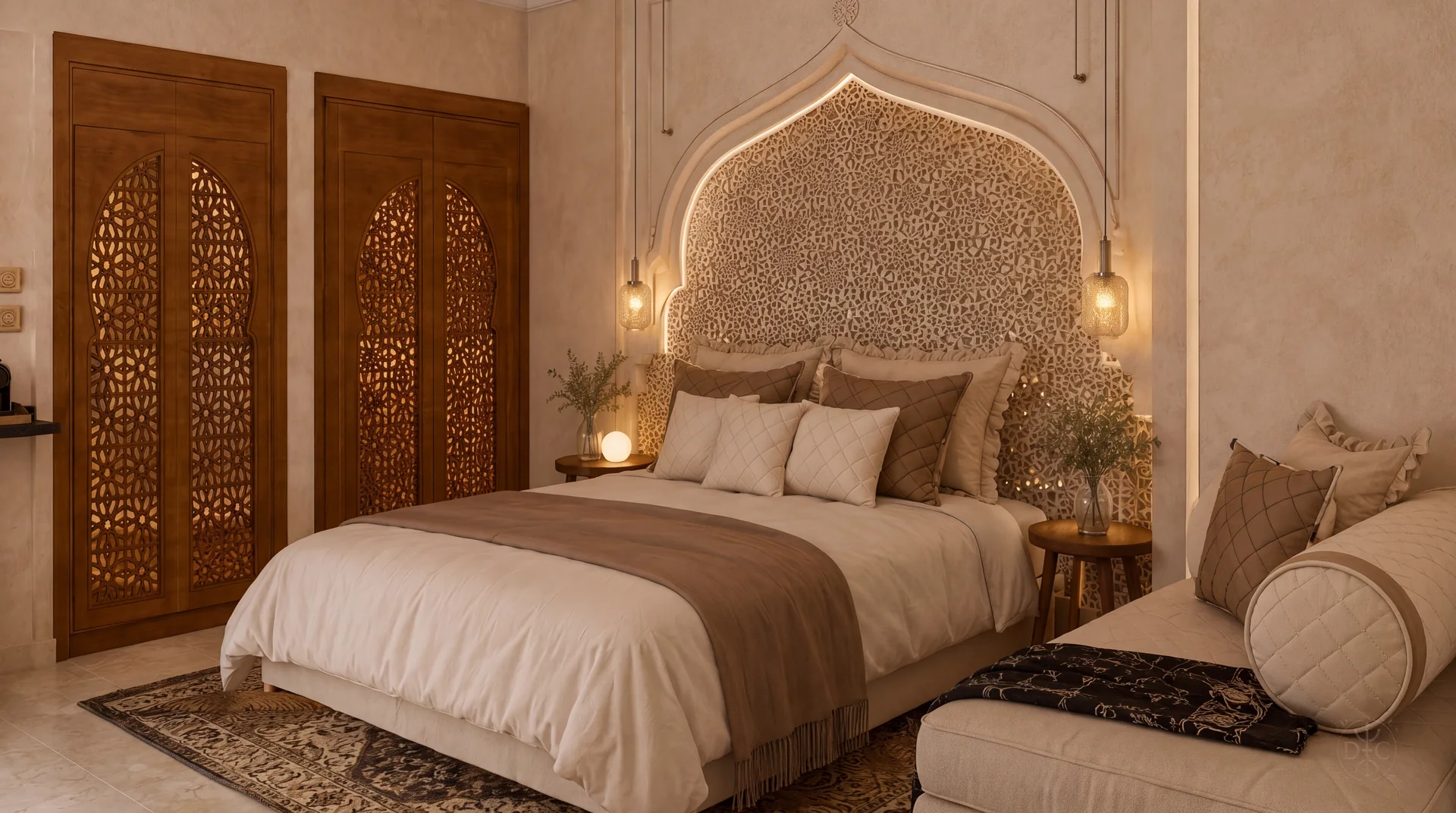
Dar Léon & Spa reflects the ambition to create homes with an identity of their own rather than reproduce a standard model.
A distinctive riad should generate more than overnight stays
Rooms are at the heart of the model, but they do not necessarily need to account for the whole business. A well-designed property can generate part of its revenue through dining, spa treatments, transfers, private experiences, activities or packaged stays.
Take a riad generating MAD 2.5 million in room revenue.
If its additional services generate the equivalent of 15% of room revenue, that represents approximately MAD 375,000 in additional revenue.
The costs of delivering those services must, of course, be deducted.
Nevertheless, this approach changes how the property is designed.
A rooftop is more than a place to put two sun loungers. It can become a space for breakfast, private dining or an experience.
A spa is more than a feature that enhances the photographs. It can become a revenue centre.
Every space should play a part in the guest experience and, where relevant, in the business model.
The brand is part of the asset
There is an important difference between: “We have booked a riad in Marrakech.”
And: “We have booked Dar Léon.”
In the second case, the name is beginning to have a place in the guest’s mind.
That is precisely what an investor should aim to build.
The name, visual identity, photographs, website, social media, reviews and quality of the experience gradually contribute to the creation of a hospitality brand.
That brand can help develop direct bookings and recommendations.
It also opens up a longer-term perspective.
Why could a first property not become the starting point for a collection of homes that share the same standards while each retaining its own identity?
This is where hospitality investment starts to extend beyond property value alone.
Performance is determined after opening
A beautifully renovated riad can be poorly operated.
This is one of the model’s main risks.
Once construction is complete, rates, online travel agencies (OTAs), direct bookings, teams, reviews, dining, additional revenue and guest satisfaction all need to be managed.
The owner must therefore decide early on whether to become the operator or entrust that responsibility to a professional.
This decision directly affects the business plan.
At Darnel, this thinking explains the complementary roles of Darnel Collection, which focuses on the creation and positioning of projects, and Darnel Hospitality, which focuses on their operations and performance.
To understand this second discipline, read our “Complete guide to managing a riad in Marrakech”.
How do you invest in a distinctive riad in Marrakech?
The process starts well before signing.
First, define your overall budget and strategy: a residence run as guest accommodation, a guesthouse or a boutique hotel, the number of rooms, target guests and market positioning.
Then look for a building that fits that strategy, rather than the other way round.
Once you have identified the property, have its legal, technical, architectural and economic aspects assessed. The concept can then be developed: identity, interior architecture, experience, services and revenue model.
Construction, brand creation and commercial preparation follow.
Several months before opening, operations should already be organised: distribution, pricing, content, recruitment, procedures and launch.
A successful opening is prepared during the design stage.
The finished hospitality offering should be planned before construction: guests, experience and pricing should guide architectural choices.
The Darnel Private Investors’ Club
Looking for opportunities in riads and boutique hotels in Marrakech?
The Darnel Collection Private Investors’ Club brings together our content for people who want to understand this market better before taking action.
You will find our market insights, case studies, new projects, investment opportunities and advice on acquisition, renovation and operations.
JOIN THE PRIVATE CLUB FREE OF CHARGE →
Free access · Unsubscribe at any time.
Mistakes that can undermine a distinctive riad project
The first is overpaying for the building because you have fallen in love with its architecture.
The second is renovating before defining the target guest and positioning.
The third is adding expensive features without checking whether they genuinely improve the experience or perceived value.
The fourth is underestimating the launch budget and cash reserves.
Finally, the most significant is probably assuming that operations begin after opening.
Marketing must start long before the first guest arrives.
Photography, the website, distribution, partnerships, content and pricing policy must all be prepared in advance.
FAQ: investing in a distinctive riad in Marrakech
FAQ — What is a distinctive riad?
In this article, the term describes a riad developed around a strong architectural and hospitality identity. It is a brand positioning, not an official legal category.
How much do you need to invest?
There is no standard budget. The capital required depends on the acquisition price, floor area, condition of the building, extent of renovation, furniture and hospitality concept.
How many rooms do you need?
There is no ideal number. A small property with an excellent ADR and a strong experience can be more attractive than a larger, poorly positioned riad.
Is a spa essential?
No. Every facility should fit the concept and target guests. A spa can, however, strengthen the experience and create an additional source of revenue when properly integrated.
Do you have to operate the riad yourself?
Not necessarily. The owner can run the property if they have the necessary skills and time, or entrust its management to a hospitality operator.
How do you calculate profitability?
You need to compare the operating result with the total capital invested, rather than only the building’s purchase price.
Continue your investment journey
Investing in a riad in Marrakech: the complete guide Understand acquisition, renovation, operations and value creation.
How much does a riad cost in Marrakech? Explore the main price ranges and differences between neighbourhoods.
What costs should you allow for when buying a riad in Marrakech? Plan for the full budget you will need before signing.
Investing in a distinctive riad means investing in three assets
This is probably the best way to sum up the strategy.
First, you invest in property: a building in one of Morocco’s leading tourist destinations.
Next, you invest in a hospitality business capable of generating revenue from rooms and services.
Finally, you invest in a brand that can build its reputation, direct clientele and value over time.
The combination of these three dimensions makes the model particularly interesting.
It also explains why a project of this kind requires more preparation than a conventional property investment.
The building creates the potential. The concept creates the distinction. Operations turn that distinction into performance.
Would you like to create your own distinctive riad in Marrakech?
Darnel Collection helps you explore projects that combine acquisition, architecture, identity, hospitality positioning and value creation.
Assess my concept, budget and future operations together →
About the author
Georges Lelièvre
Founder — Groupe Darnel
Through Darnel Collection and Darnel Hospitality, Georges Lelièvre develops an approach to investing in riads and boutique hotels in Marrakech that combines property, hospitality concept creation, marketing and operations.
Through his insights and practical experience, he shares an entrepreneurial vision of the riad: looking beyond the building as a property asset to build a genuine experience and a hospitality brand around it.
About Darnel Collection
Darnel Collection develops an approach to creating riads and boutique hotels in Marrakech in which Moroccan architecture, design and hospitality contribute to the creation of distinctive homes.
The ambition is to preserve and enhance Moroccan heritage while imagining properties that meet the contemporary expectations of premium hospitality.
Darnel Collection — Creator of distinctive riads with spas and boutique hotels.
The financial examples in this article are provided for educational purposes. They are neither a guarantee of returns nor a performance forecast. Every property or hospitality investment should undergo legal, technical, tax and financial analysis tailored to the project.
Also read
Explore further
Property investment in Marrakech · 17 September 2026 · 22 min
Investing in a riad in Marrakech in 2026: the complete guide
From purchase to operations, explore the criteria, figures, risks and levers involved in turning a riad into a performing hospitality asset.
Read the article →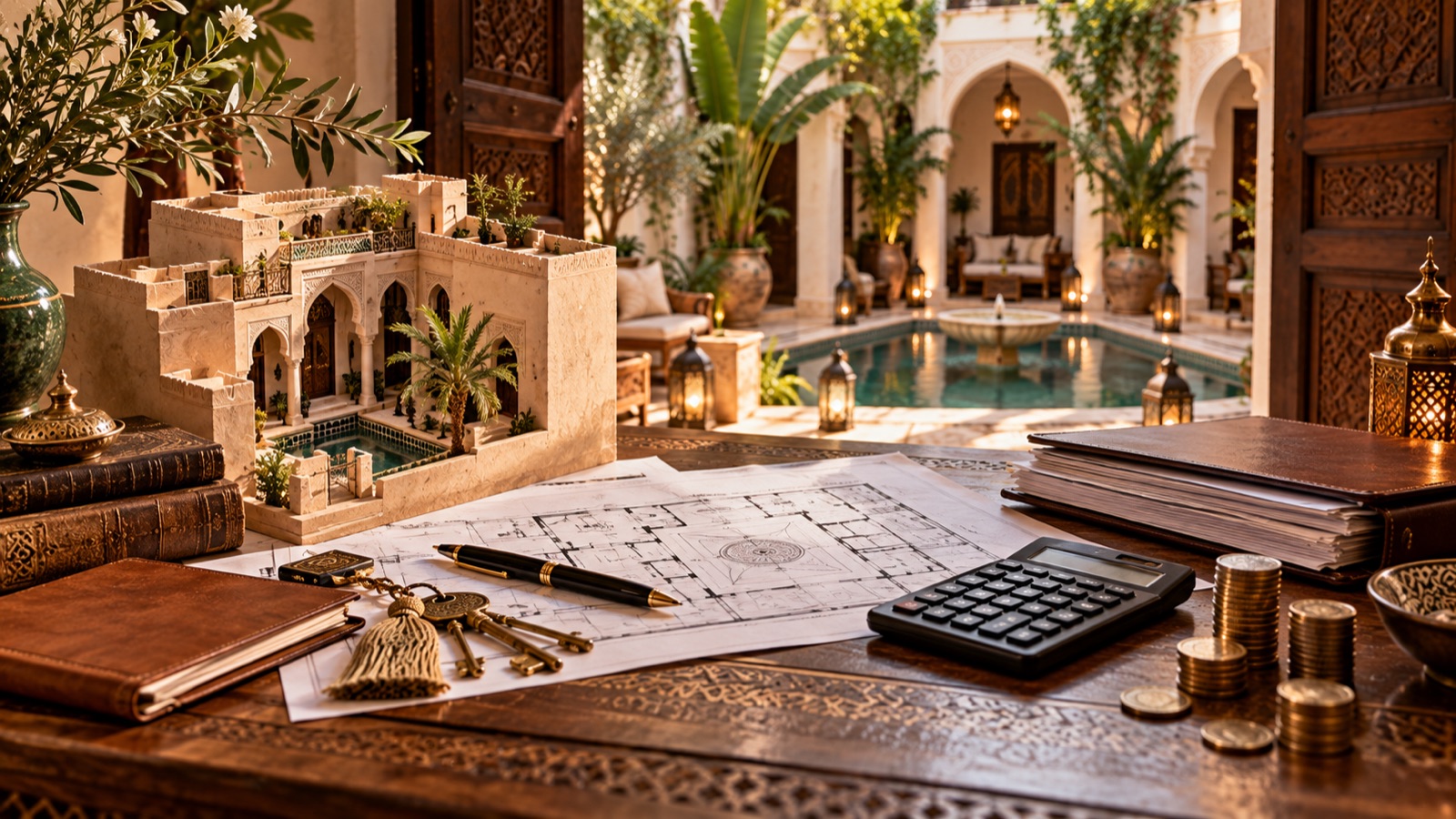
Buying a riad in Marrakech · 19 September 2026 · 12 min
What costs should you allow when buying a riad in Marrakech? Complete 2026 guide
Taxes, land registration, professional fees, agencies, assessments and financing: establish your acquisition’s real budget in Marrakech.
Read the article →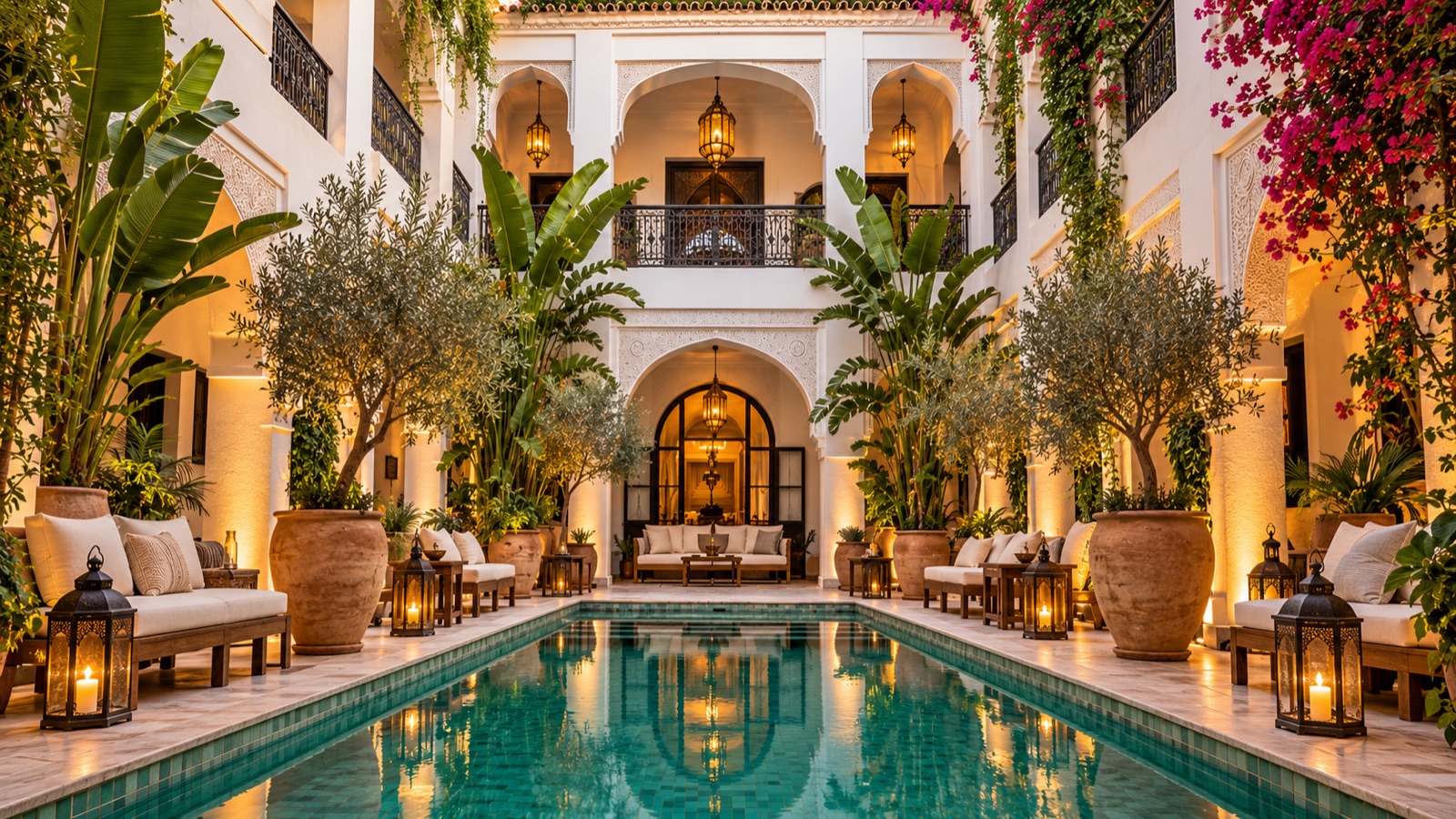
Riad profitability · 18 September 2026 · 11 min
What profitability can you expect from a riad in Marrakech? Calculations, figures and 2026 examples
ADR, occupancy, RevPAR, costs and additional revenue: three scenarios for assessing a riad’s potential profitability in Marrakech.
Read the article →