
Renovate
Renovating a Riad in Marrakech in 2027: 10 Expenses Investors Overlook
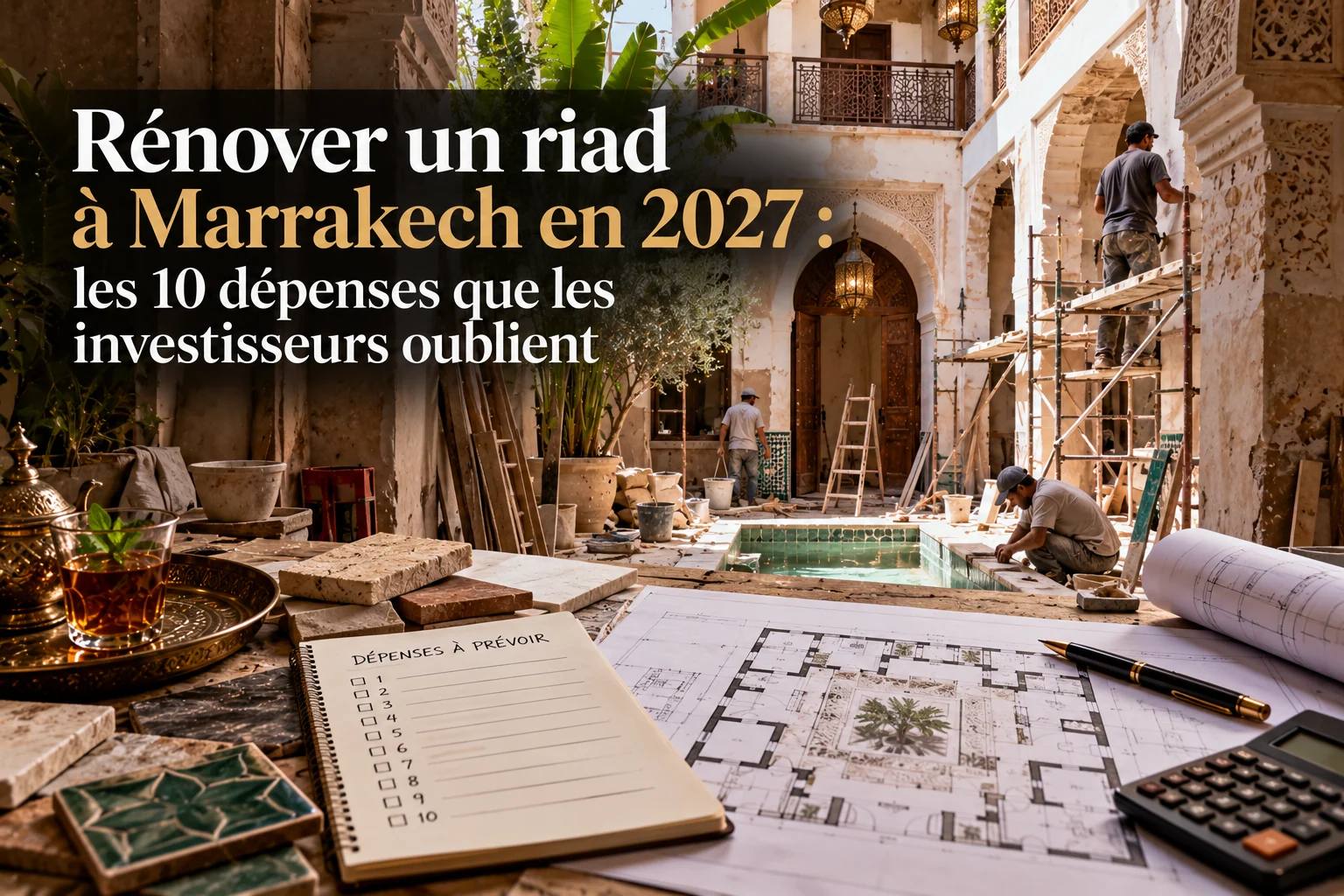
You have just viewed a riad in Marrakech’s Medina.
The courtyard has incredible charm. The proportions are promising. You can already picture five bedrooms, a plunge pool, a rooftop terrace and interiors combining zellige, tadelakt and Moroccan craftsmanship.
The seller is asking an attractive price. A contractor estimates the renovation at €150,000.
You start calculating your future returns.
But six months later, your renovation budget has risen by €60,000, the works are behind schedule and your guesthouse opening has to be postponed.
How can a seemingly profitable project become so expensive?
The answer often lies in expenses investors failed to anticipate.
In Marrakech, renovating a riad involves much more than refurbishing bathrooms or laying new finishes. You are working on an old building, sometimes with difficult access, while meeting its technical, architectural and administrative constraints.
And if you plan to operate it as tourist accommodation, you also need to create a property that can run smoothly every day.
Here are 10 overlooked expenses when renovating a riad in Marrakech, and how to factor them into your investment budget for 2027.
A riad renovation budget must cover studies, structure, logistics, formalities, utilities, waterproofing, equipment, changes, delays and pre-opening. A works quotation therefore does not automatically cover the full cost through to operations. Darnel’s method defines the hospitality programme before tendering, then separates works, contingencies and launch cash. The guide’s ranges remain assumptions requiring quotations.
To identify the administrative route, the official Rokhas gateway presentation describes digital applications for territorial authorisations. It is neither a renovation price list nor approval of your programme: ask the relevant professionals to specify procedures and costs.
Compare your quotation with renovation costs, then connect it to the total investment budget. A works contingency and cash for opening address two distinct needs.
How much does renovating a riad in Marrakech really cost?
Before examining hidden costs, remember one essential principle: a price per square metre is never enough to produce a reliable budget.
In our renovation estimates, the cost per square metre is always calculated against the riad’s ground-floor footprint, rather than the total floor area across all storeys. As an indicative budgeting assumption, a complete renovation may be estimated at MAD 8,000–15,000 per m² of ground-floor footprint, depending on the building’s condition, the complexity of the works and the standard of finish. This calculation basis covers the planned works across the riad’s different levels and must be confirmed through detailed quotations.
These figures are neither an official price schedule nor guaranteed prices for 2027.
For illustration, assuming an exchange rate of €1 = MAD 11, this equates to approximately €730–1,365 per m² of ground-floor footprint on this indicative basis.
Yet two riads of the same size may require radically different investments.
A sound, accessible building with a practical layout will be easier to convert than a house with structural defects, failing services and major access constraints.
Let us now turn to the expenses most often missing from initial calculations.
1. Technical surveys before work begins
The first mistake is starting a renovation without a precise understanding of the building’s condition.
A riad can have beautiful architecture while concealing weaknesses.
Long-standing damp, cracks, deteriorating floors, outdated services or leaks can turn a cosmetic renovation into major building work.
Before construction starts, you may need to fund measured surveys, condition assessments, structural studies or the services of an architect and engineering consultancy.
These expenses are sometimes seen as optional.
Yet they help protect the investment.
Example allowance: €3,000–8,000, depending on the complexity and the studies actually required.
This is an illustrative budget assumption that should be priced locally.
Darnel’s advice: do not just ask how much the works will cost. First ask what the building can realistically accommodate.
2. Structural surprises uncovered during construction
This is one of the main causes of cost overruns.
When old finishes are stripped back or parts of the building are opened up, previously hidden problems can emerge.
You may need to strengthen a floor, repair masonry, address water ingress or reconsider a load-bearing element.
In some cases, the work is limited.
In others, it completely changes the schedule and budget.
Imagine a project initially estimated at €140,000.
Discovering defects requiring €25,000 of additional work already represents an increase of around 18%.
And that expense does not necessarily create value that guests can see.
Darnel’s advice: set aside a contingency for technical risks, separate from decoration costs or improvements requested during construction.
3. Moving materials through the Medina’s narrow lanes
A building site in Marrakech’s Medina has very different logistics from one with direct lorry access.
Depending on the location, materials may have to travel several hundred metres using suitable transport methods.
Deliveries, handling, storage and rubble removal all need to be organised.
A riad in a narrow derb can therefore cost more to renovate than a similar building with easier access.
The cost goes beyond transport alone.
Additional handling can slow some operations and increase the hours needed.
For example, a logistics allowance of €5,000–12,000 could be used as a working assumption for a complex site, pending quotations.
Before buying, walk the route from the unloading point to the riad’s front door.
This seemingly minor detail can have very real financial consequences.
4. Professional fees, permits and administrative procedures
Some investors build their budget simply by adding up contractors’ quotations.
They overlook design and coordination fees, studies and the procedures the project requires.
Depending on the proposed works, permits or approvals may be necessary.
And if you intend to operate a guesthouse, the requirements for that activity must be examined separately.
A renovated building is not automatically a tourist establishment authorised to welcome paying guests.
The cost depends on the legal situation, the scope of works and the professionals involved.
Darnel’s advice: map out the administrative timetable before setting an opening date. Have the current requirements checked by the relevant professionals and authorities.
Thinking of buying a riad to renovate?
Before signing, have your acquisition budget, renovation plans and future operating model assessed together.
Book an advisory appointment with Darnel Collection →
5. Completely renewing the building services
A riad may appear to be in good condition because its walls have been repainted and its bathrooms modernised.
But what about the services behind them?
Electricity, plumbing, drainage, hot water, ventilation, air conditioning and internet connectivity are essential to guest comfort.
Creating five or six bedrooms with en-suite bathrooms can require a major overhaul of the installations.
A guesthouse’s hot-water consumption is very different from that of a family home.
You also need to anticipate the requirements of a professional kitchen, hammam or laundry.
Undersized systems can lead to breakdowns, negative reviews and further spending after opening.
Darnel’s advice: size the services for the property’s future capacity, rather than just the building’s current use.
6. Waterproofing the rooftop, courtyard and wet areas
A beautiful rooftop can become a major source of expense if its waterproofing fails.
Water ingress can damage ceilings, plasterwork, electrical installations and the rooms below.
The same concern applies to bathrooms, pools, hammams and plant areas.
Choosing beautiful materials is not enough.
Falls, drainage, protective layers and appropriate technical solutions must all be planned.
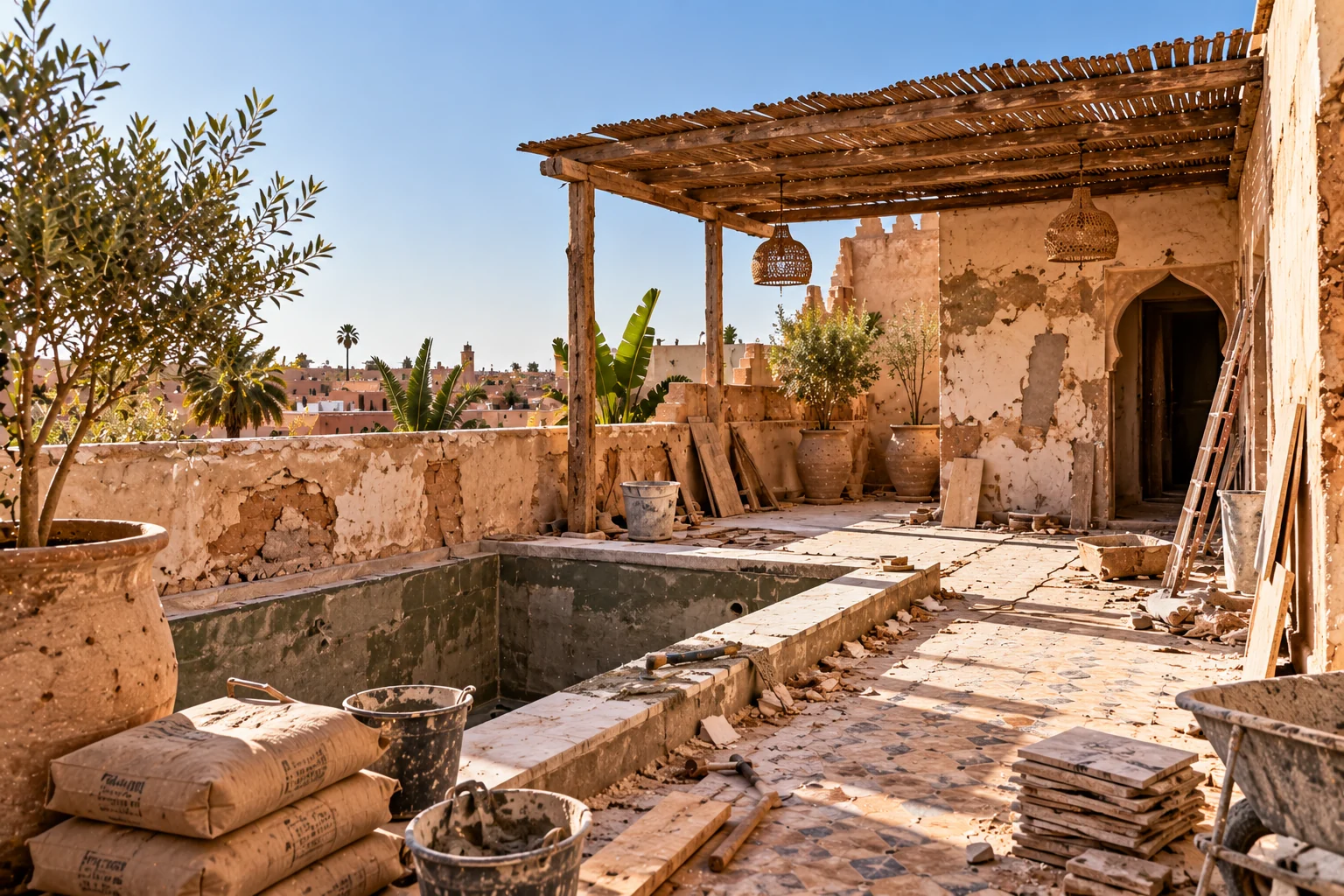
For example, refurbishing a terrace can involve far more than simply replacing the surface finish.
Darnel’s advice: have the waterproofing checked before installing expensive finishes. Repairing a leak after decoration can mean redoing several elements of the work.
7. Hotel equipment that never appears in photographs
This is one of the most frequently underestimated expenses.
When investors imagine their finished riad, they think of bedrooms, lighting and furniture.
But tourist accommodation needs a great deal of additional equipment.
Commercial-quality beds and bedding, adequate linen stocks, cleaning equipment, storage, safety equipment, laundry facilities, management software, Wi-Fi and kitchen equipment must all be budgeted for.
Some equipment will never appear on Instagram.
Yet it directly determines how well the property operates.
A six-room riad must be able to manage linen changes, arrivals and departures, breakfasts and daily housekeeping.
Darnel’s advice: draw up two separate budgets: one for building works and one for operating equipment.
This will help avoid discovering, just weeks before opening, that you need several thousand more euros to welcome your first guests.
8. Changes requested during construction
Once work begins, ideas multiply.
You decide to enlarge a bathroom, change a staircase, add a pool or replace certain materials.
Each change seems reasonable on its own.
But the accumulated changes can become very expensive.
Completed work may have to be undone, new materials ordered or contractors’ schedules reorganised.
Timelines can also lengthen.
To prevent this, the hotel concept must be defined before construction begins.
How many rooms do you actually want to sell?
Which guests do you want to attract?
What services will you offer?
The renovation should answer these questions.
Darnel’s advice: approve the plans, materials, equipment and finish standards before starting the main works. Then document every change, including its cost and effect on the schedule.
9. Construction delays and deferred revenue
A three-month delay means more than three extra months of building work.
It can also create additional coordination, financing, security and running costs.
Above all, it postpones the start of trading.
Take a six-room riad whose business plan assumes an average daily rate (ADR) of €150 and occupancy of 60%.
Its theoretical annual accommodation revenue would be:
6 × 365 × €150 × 60% = €197,100.
Three months represent approximately €49,275 of theoretical accommodation revenue, assuming activity is spread evenly throughout the year.
This amount is not lost profit. It does not account for seasonality, the gradual build-up of bookings or expenses avoided while the property is closed.
But it helps explain why the schedule has real economic value.
Darnel’s advice: plan a realistic timetable, review milestones and a cash reserve in case the opening is delayed.
Does your construction budget make financial sense?
A renovation should be assessed in terms of its cost, duration and the revenue the future property could reasonably generate.
Have Darnel Collection review my budget and timetable →
10. The commercial launch and cash reserves for the first months
Your riad is finished.
The rooms look beautiful, the rooftop is ready and the equipment works.
But your investment is not quite complete.
You now need to fund professional photography, the website, booking tools, initial content, communications and potentially advertising campaigns.
You also need to recruit, train and organise the team.
A newly opened property does not immediately have a strong reputation or a loyal customer base.
Building momentum can take time.
For example, if monthly fixed costs at launch reach €8,000, a three-month reserve already amounts to €24,000, before other launch expenses.
That is why cash reserves belong in the initial budget, rather than being sought after the works are complete.
Example: how a €150,000 renovation budget can exceed €250,000
Imagine an old riad you want to convert into a six-room guesthouse.
The initial quotation covers the main building works.
But several additional expenses have yet to be included.
On small screens, scroll the table horizontally if needed.
| Budget item | Illustration |
|---|---|
| Main building works | €150,000 |
| Studies and professional fees | €9,000 |
| Unexpected technical repairs | €20,000 |
| Logistics and rubble removal | €7,000 |
| Additional services and equipment | €15,000 |
| Furniture and hotel equipment | €28,000 |
| Pre-opening and marketing | €8,000 |
| Construction contingency | €18,000 |
| Projected total budget | €255,000 |
In this example, the initial €150,000 budget represented only 58.8% of the final total.
The apparent overrun is €105,000, or 70% of the initial quotation.
However, some of these expenses are not unexpected: they should have been included in the overall budget from the outset.
That is precisely the difference between a building quotation and a proper investment budget.
Should you buy a riad to renovate or choose a turnkey property?
A riad requiring renovation can let you create a fully customised hotel product.
You choose the number of rooms, architectural identity, services and standard of finish.
But you also take on construction risks, potential overruns and the wait before the first bookings.
A turnkey riad can reduce some uncertainties, provided you check the quality of the works and whether it can actually be operated as intended.
Neither strategy is always better.
The right choice depends on the purchase price, total conversion cost, timetable and commercial potential.
Before deciding, also read our complete guide to investing in a riad in Marrakech.
The Darnel Collection approach: design the product before starting the works
At Darnel Collection, we believe a successful renovation should meet three objectives.
Preserve and enhance the building’s architecture.
Create an experience distinctive enough to attract the intended guests.
Design a property that can operate efficiently over the long term.
This approach means planning for operations from the very first sketches.
The laundry’s location, staff circulation, room layouts and technical requirements are not minor details.
They can affect construction costs, average room rates and future operating expenses alike.
Design a riad that fits your investment
Have you identified a building or are you considering a renovation in 2027?
Present my project to Darnel Collection →
FAQ: renovating a riad in Marrakech in 2027
What budget should I allow to renovate a riad in Marrakech in 2027?
The budget depends on the size, building condition, structural works and standard of finish. Figures from 2026 provide a rough guide, but 2027 prices will need to be updated using quotations.
How much should I set aside for contingencies?
A reserve of 10–20% can serve as an initial modelling assumption, but very old or poorly documented buildings may justify a larger allowance.
Do I need an architect to renovate a riad?
That depends on the nature of the works and the applicable rules. Have the requirements for your project checked before any work begins.
Why can renovating a riad cost more than renovating a conventional house?
The building’s age, difficult access, technical interventions and handcrafted finishes can increase costs.
Can any riad be converted into a guesthouse?
No. Feasibility depends in particular on the layout, safety, legal framework and required authorisations.
Does a rooftop terrace or pool necessarily increase profitability?
No. These features can improve appeal and room rates, but their construction and maintenance costs must be justified by the business model.
How long does a riad renovation take?
There is no standard duration. Technical complexity, permits, craftsperson availability and changes during construction all affect the timetable.
Should I keep cash reserves after the works?
Yes. The commercial launch, initial expenses and potential delays must be anticipated in the overall financing plan.
Conclusion: the real risk is failing to plan properly
Renovating a riad in Marrakech can be an excellent opportunity to create value.
But the charm of a courtyard or the potential of a rooftop should never obscure the technical and financial realities.
Studies, structure, logistics, services, waterproofing, equipment, changes, delays and cash requirements can profoundly alter your investment.
In 2027, your best protection will remain a comprehensive budget, a clearly defined hotel concept and rigorous construction oversight.
Before signing a preliminary purchase agreement or starting work, take the time to test your vision against a detailed budget.
Review my overlooked costs, contingencies and renovation schedule →