
Invest
Why can a riad in Marrakech be an attractive investment in 2027?
What if your next property investment could generate several revenue streams, rather than a single monthly rent?
In two of our illustrative simulations, a four-room riad and a six-room riad, the ratio of operating result to capital invested is approximately 10.8% and 9.3% respectively, before income taxes, depreciation and financing. These results depend on the assumptions specific to each scenario and are neither a market average nor a promise of returns.
The assumptions detailed below are educational scenarios; they must be replaced by a forecast specific to each property before any investment decision.
They nevertheless illustrate a fundamental difference between traditional rental property and hospitality.
When people talk about property investment, they generally think of buying an apartment to rent out.
You buy a property, find a tenant and collect rent.
But there is another approach: investing in a property asset capable of generating several revenue streams through a genuine hospitality business.
This is precisely what makes Marrakech’s riads particularly interesting.
A well-positioned riad can earn revenue from accommodation, complementary services, packaged stays and, depending on its amenities, a spa or dining.
At Darnel Collection, we believe that this combination of property ownership and hospitality operations is a particularly interesting investment model to explore in Morocco.
But take care: a riad is not automatically profitable.
Success depends on the purchase price, project quality, commercial positioning and, above all, operations.
Here is why we continue to favour this type of investment for 2027.
A riad is more than a rental property investment
The first difference between an apartment and a riad lies in their business models.
An apartment rented on a long-term basis generally generates relatively predictable income, subject to rent payments and cost control.
A riad operated as a guesthouse works differently.
It sells room nights to several travellers, adjusts its rates to demand and can offer complementary services.
Consider two fictional investments of €500,000.
| Indicator | Rental apartment | Operated riad |
|---|---|---|
| Investment | 500 000 € | 500 000 € |
| Hypothetical annual revenue | 25 000 € | 150 000 € |
| Operating and commercial costs | 5 000 € | 105 000 € |
| Result before income taxes and financing | 20 000 € | 45 000 € |
| Operating return | 4 % | 9 % |
Educational example, not an observed market average. The riad’s costs here include operating and marketing costs.
In this example, the riad produces a higher operating result.
But it also requires more work, staff, maintenance and management.
The potential higher return also compensates for greater risk and operating complexity.
This is why investments must be compared using the same cost scope.
First source of profitability: accommodation revenue
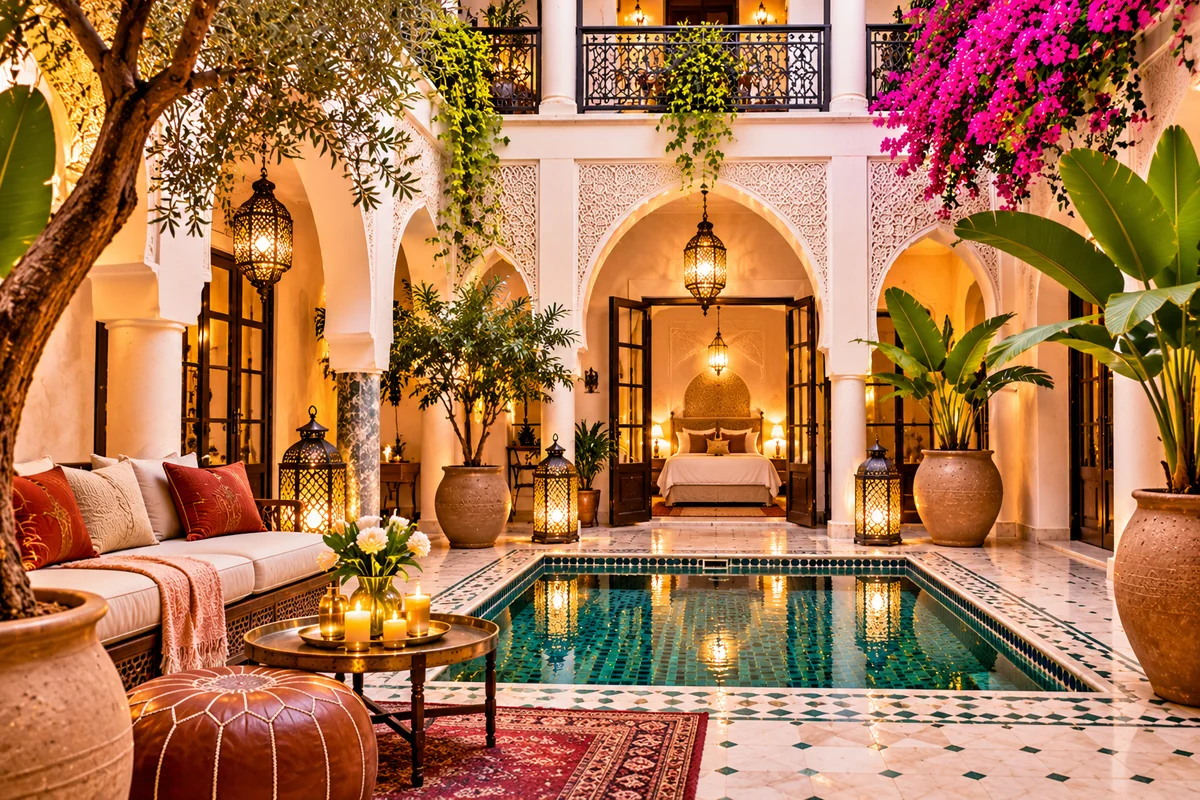
The main economic driver of a riad naturally remains accommodation.
Consider a four-room establishment.
It theoretically has:
4 rooms × 365 days = 1,460 available room nights per year.
With an average rate of €120 excluding VAT and 70% occupancy, its theoretical accommodation revenue reaches:
1,460 × €120 × 70% = €122,640 excluding VAT per year.
This amount is calculated before distribution commissions and operating costs.
Why ADR is essential
ADR, or the average rate per room sold, is a fundamental indicator.
A riad that improves its average rate can increase revenue without adding rooms.
For example, with four rooms and 70% occupancy:
| ADR | Annual room revenue |
|---|---|
| 100 € | 102 200 € |
| 120 € | 122 640 € |
| 150 € | 153 300 € |
Moving from an ADR of €100 to €150 represents an additional €51,100 in annual room revenue, with occupancy unchanged.
This is one reason Darnel Collection prioritises creating distinctive establishments.
The aim is not to offer the cheapest rooms.
It is to create an experience that can justify a higher rate.
Practical tip: track ADR, occupancy and RevPAR together. Raising prices without monitoring room nights sold can reduce revenue.
Second source of profitability: additional sales
A traveller does not spend money only on sleeping.
They may also book an airport transfer, dinner, an excursion, a gastronomic experience or a cultural activity.
These services are a significant commercial opportunity.
Case study: 250 stays per year
Imagine a riad welcoming 250 separate bookings over the year.
If each booking generates an average of €80 in complementary services:
250 × €80 = €20,000 in additional annual revenue.
With a contribution margin of 40%, this represents an €8,000 contribution, before any unallocated fixed costs.
However, this model requires organisation.
Services must be offered at the right time: before the stay, at check-in and when travellers plan their activities.
At Darnel Hospitality, we believe additional sales should be integrated into the guest journey from the establishment’s design stage.
A riad that waits for travellers to ask for services spontaneously may miss opportunities.
Practical tip: measure average complementary revenue per booking and the margin generated by each service, rather than revenue alone.
Third source of profitability: spa and wellness experiences
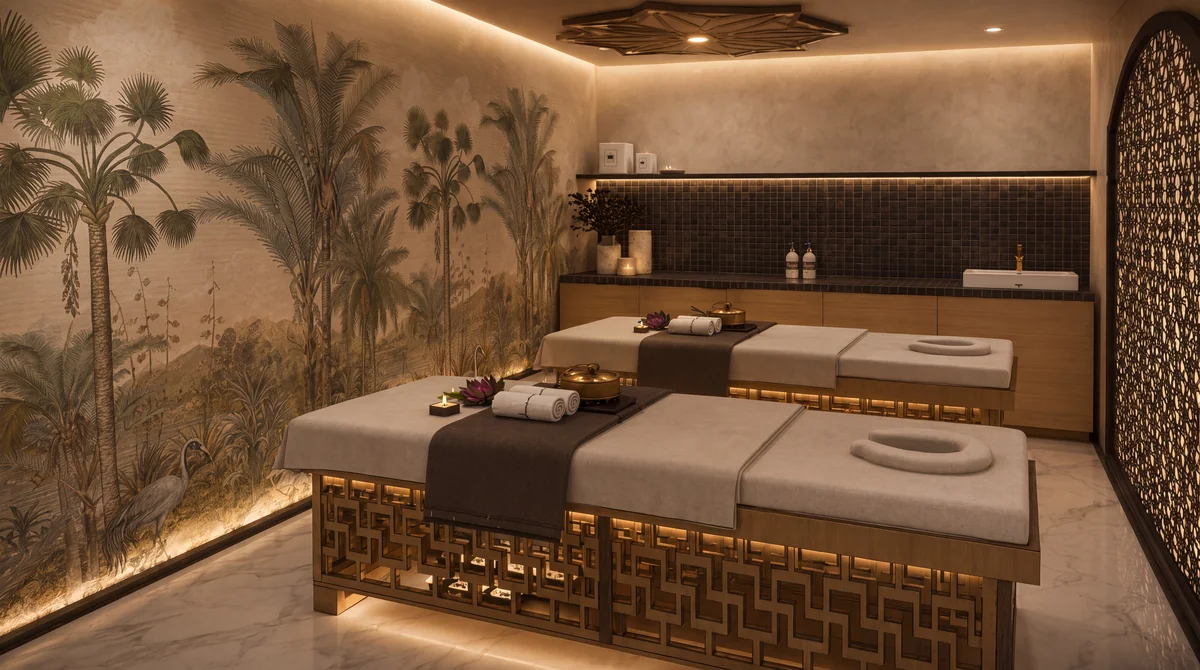
This is one reason we favour riad projects with spas.
A hammam or massage room can strengthen the establishment’s positioning and generate additional revenue.
But its value is not limited to the treatments sold.
It can also help make the rooms more attractive.
Case study: a private spa
Imagine an establishment offering five wellness treatments per week, with an average spend of €90.
Over 48 weeks of activity:
5 × €90 × 48 = €21,600 in annual revenue.
If direct costs represent 50% of revenue, the contribution reaches €10,800 before other costs.
However, the initial cost of creating the spa, maintenance, energy, products and staff must be included.
A poorly sized spa can become a cost rather than a driver of profitability.
Our strategy
At Darnel Collection, we aim to design wellness spaces suited to establishments’ actual capacity.
For a four-room riad, a private spa may be sufficient.
For a ten-suite boutique hotel, opening the spa to outside guests can be considered, subject to the necessary permits.
The aim remains the same: develop revenue without compromising the quality of the experience.
Fourth lever: creating packaged stays
Another advantage of a riad is its ability to market a complete experience.
Rather than selling only a room at €150 per night, an establishment can offer a multi-night stay including selected services.
For example:
Romantic stay in Marrakech, €590 for two people
Three nights, a transfer, dinner and a wellness experience.
This type of offer can be particularly appealing to couples or travellers wishing to organise their stay easily.
But its price must be built correctly.
The costs of included services must be deducted and accommodation must not be counted twice in revenue.
Darnel advice: a package should increase the stay’s perceived value and economic contribution, rather than simply offer a disguised discount.
To track performance properly, allocate package revenue between accommodation and included services. This prevents overstating complementary revenue.
Case study: how much can a four-room riad with a spa generate?
Consider a project representing a hypothetical total investment of €550,000.
The riad includes four rooms, a wellness area and complementary services.
Illustrative fifth-year projection — amounts excluding VAT
| Indicator | Assumption |
|---|---|
| Rooms | 4 |
| ADR excluding VAT | 150 € |
| Occupancy | 75 % |
| Room revenue | 164 250 € |
| Additional sales revenue | 25 000 € |
| Spa revenue | 20 000 € |
| Total revenue | 209 250 € |
| Total costs, including distribution and management | 150 000 € |
| Operating result | 59 250 € |
The ratio of operating result before income taxes, depreciation and financing to the hypothetical total investment of €550,000 reaches:
€59,250 ÷ €550,000 × 100 = 10.8%.
This result is calculated before income taxes, depreciation and financing.
It does not constitute a guarantee of profitability.
Why this scenario is interesting
It shows that a four-room riad can generate significant revenue when several activities are properly organised.
But it also demonstrates that profitability depends on controlling costs.
High revenue does not necessarily mean high profit.
Point to watch: this scenario assumes the €45,000 in complementary revenue comes from separate sales and that all associated costs are included in the €150,000 of costs.
Are you considering investing in a riad in Marrakech?
We can analyse your budget, room numbers, building work, potential revenue and operating model before any decision.
Book a Darnel Collection advisory appointment →
The supplied HTML v2 simulator uses assumptions distinct from the case studies: a flat operating margin of 45% of total revenue, simulated corporate tax of 20%, and the purchase price alone as denominator. It reproduces neither the €150,000 of costs in the four-room case nor the 25% margin in the six-room case. Calculations and growth assumptions are explained in the tool; they are not a validated forecast or a guarantee of returns.
Estimate your riad’s profitability
Occupancy: +5 percentage points/year up to 90 %, then +2.5 points/year up to 95 %.
Estimate based on the purchase price alone. Works, acquisition costs and financing are excluded from the return.
Your 5-year projection
Version 2 · Percentage-point progression · Updated 6 October 2026
| Year | Occupancy | Price / night | Add. sales | Annual revenue | Operating result | After corporate tax | Return |
|---|
Understanding the assumptions and calculations
The operating result is fixed at 45 % of total revenue, with operating expenses therefore estimated globally at 55 %. Corporate tax is simulated at 20 % of positive operating result, without modelling depreciation, deductions or the project’s specific tax regime. The result after corporate tax is not a cash-flow calculation after financing.
Average room price per night rises by 7.5 % a year, compounded. Occupancy rises by 5 percentage points a year up to 90 %, then by 2.5 points a year up to 95 %: 60 %, 65 %, 70 %… 90 %, 92.5 %, 95 %. Additional sales rise by 5 percentage points a year up to 30 % of room revenue, then by 2.5 points a year, without a projection cap. If an increase crosses a threshold, it stops at that threshold for that year (examples: 88 % → 90 %; 28 % → 30 %). The operating margin remains constant.
Return equals the annual result after corporate tax divided by the purchase price. No return on equity is calculated. An owner may replace the purchase price with the reference value they wish to analyse.
Fixed indicative conversion: €1 = 10.90 MAD. Displayed amounts are rounded; calculations use unrounded values.
Indicative, non-binding simulation. These assumptions guarantee neither future performance nor applicable taxation.
Help your riad work towards these results
Discuss your project and its profitability drivers with Darnel Hospitality.
Request an advisory appointmentCase study: a six-room riad with a spa
With six rooms, the establishment has greater commercial capacity. The scenario below is based on an ADR of €160, occupancy of 72% and an operating margin assumption of 25% of total revenue. The amounts use the same basis excluding VAT for this simulation. This margin must be verified through a detailed operating account.
Consider the following assumptions:
- ADR of €160.
- Annual occupancy of 72%.
- Additional sales and spa representing 25% of room revenue.
Room revenue reaches:
6 × 365 × €160 × 72% = €252,288.
Complementary revenue represents approximately €63,072.
Total revenue therefore reaches €315,360 per year.
With an operating margin of 25%, the result would be approximately €78,840.
On a hypothetical investment of €850,000, this would represent an operating-result-to-capital-invested ratio of approximately 9.3%, before income taxes, depreciation and financing.
This model may appeal to an investor seeking to develop a genuine hospitality business while keeping the establishment at a human scale.
However, it requires an appropriate organisation: staff, marketing, maintenance and margin monitoring.
Case study: a ten-suite boutique hotel
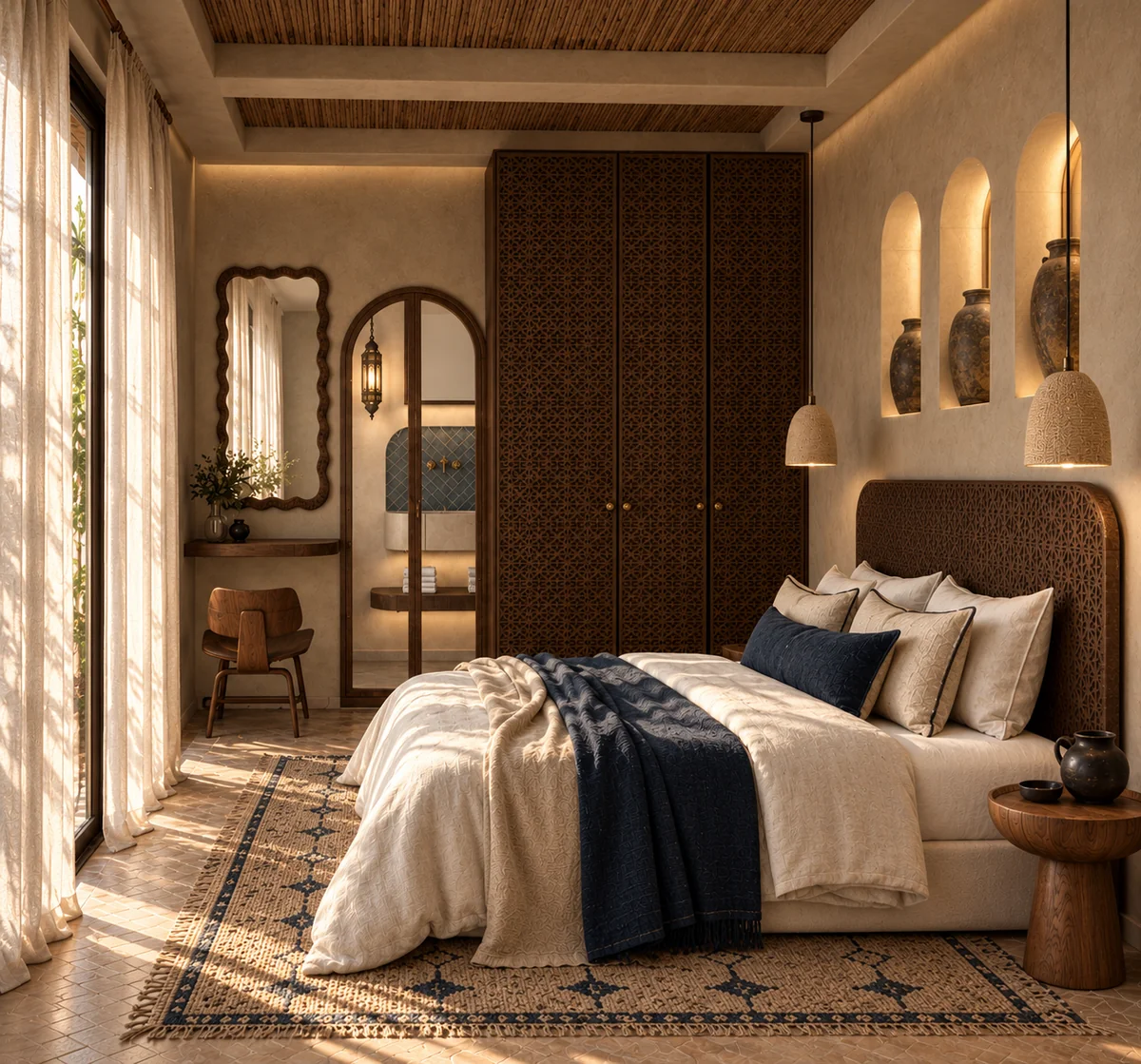
INVESTMENT CASE — KASBAH NELARIA & SPA
10 suites • Kasbah • Boutique hotel & Spa
With Kasbah Nelaria & Spa, Darnel Collection is developing a more ambitious vision of hospitality investment.
Located in the historic Kasbah neighbourhood, this project combines ten suites, contemporary Moroccan architecture and several complementary activities.
The aim is to develop an establishment capable of welcoming international travellers while offering dining and wellness services potentially accessible to outside guests.
This strategy aims to diversify revenue and reduce exclusive dependence on accommodation.
Three key figures
- 10 suites.
- Approximately 800 m² of developed floor area, to be confirmed in updated plans and technical documentation before publication.
- €2,000,000 project reference price, to be confirmed in updated commercial documentation before publication.
Discover Kasbah Nelaria & Spa →
The potential of five revenue streams
A boutique hotel can develop accommodation, additional sales, packages, spa and dining.
But this diversification also involves more staff, equipment, costs and responsibilities.
The challenge is not to multiply services indiscriminately.
It is to build complementary activities that genuinely contribute to the overall result.
Our recommendation: establish a profit-and-loss account for each activity to identify those that actually create margin.
Property value: another potential advantage of a riad
A riad has a particular characteristic: it forms part of a specific architectural and urban heritage.
In Marrakech’s Medina, available floor areas, access and construction possibilities are constrained.
A well-located, properly renovated property with appropriate permits can therefore have value as a property asset.
Value enhancement also depends on operations
For an investor, an establishment with a good reputation, loyal guests and documented results may be more attractive than a similar building without structured operations.
But the value of the property must be distinguished from that of its business operations.
An increase in value is never automatic.
It depends on the market, building condition, legal status and the future buyer’s ability to maintain performance.
Darnel advice: build profitability on operating income, and consider any eventual capital gain as additional potential rather than a certainty.
The main risk: confusing property investment with a hospitality business
This is probably the most important point in this article.
A riad is not a passive investment comparable to an apartment rented long-term.
It is a property asset associated with a commercial activity.
Travellers, teams, prices, expenses, bookings and unexpected events must all be managed.
Periods of low demand must also be anticipated.
This is why we advocate delegating to a professional operator when owners do not wish to manage establishments themselves.
At Darnel Hospitality, our role can include supporting owners with marketing, direct bookings, additional sales or the overall management of their establishments.
The aim is to professionalise operations while allowing owners to monitor their investment’s results.
Would you like to delegate the operation of your future riad?
Darnel Hospitality can help you establish a hospitality, commercial and financial organisation suited to your establishment.
Discuss my project with Darnel Hospitality →
Discover Marrakech and its riads on video
Stay, Live and Invest in Marrakech — Kasbah Episode
Stay, Live and Invest in Marrakech — Kasbah Episode
YouTube ↗The YouTube player loads only when requested.
Discover our immersion in the Kasbah neighbourhood, its alleys, establishments and the people who contribute to its appeal.
In this episode, we meet the owners of Riad Dar Augusta to discuss their experience of hospitality in Marrakech.
This video helps explain why the neighbourhood, establishment identity and experience quality play such important roles in a successful hospitality investment.
Our five tips before investing in a riad
- Buy at the right price. An excellent establishment bought too expensively can deliver a poor return.
- Study real demand. Analyse competitors, rates, seasonality and traveller profiles.
- Design a distinctive product. The spa, design, rooftop terrace and experiences must meet genuine demand.
- Prepare marketing before opening. The website, agencies, social media and videos can be set up several months before the first stay.
- Build three financial scenarios. A cautious, central and ambitious scenario help assess the risks more effectively.
To explore your project further, discover our guides:
FAQ Investing in a profitable riad in Marrakech
Is a riad more profitable than an apartment?
It can offer a higher operating return thanks to hospitality revenue, but its operation is more complex and its risks differ.
What return can you expect from a riad?
The two quantified four- and six-room scenarios illustrate operating-result-to-capital-invested ratios of approximately 10.8% and 9.3%. They are neither net returns after taxation and financing, nor a market average, nor a guarantee.
Does a spa really increase profitability?
It can help improve pricing and generate additional revenue if its costs are controlled.
Should you buy an operating riad or have one built?
Both strategies can be attractive. An operating riad may have a commercial track record, while a new project allows the experience to be designed from the outset.
Can you invest in a riad without living in Marrakech?
Yes, provided you have a professional local organisation and suitable management tools.
Conclusion: why we still believe in the potential of Marrakech’s riads
At Darnel Collection, we continue to favour riads and boutique hotels because they combine three particularly interesting dimensions.
A heritage property asset.
A hospitality business capable of generating several revenue streams.
Value-enhancement potential linked to the quality of the property and its operation.
But the true key to profitability does not lie solely in buying a riad.
It lies in the ability to create an establishment travellers choose, recommend and wish to return to.
This belief guides our work creating collection riads and our approach to operations with Darnel Hospitality.
What if we explored your future investment together?
Would you like to buy a riad, build a collection establishment or delegate the management of an existing property?
Book an appointment with Darnel Collection →
To go further
Are you also considering moving to Morocco or starting a business there?
Discover our book Réussir sa nouvelle vie au Maroc.
Georges Lelièvre — Founder, Darnel Collection
The figures presented are educational simulations, not guarantees of returns. Results depend on acquisition terms, financing, taxation and actual operating performance.