
Renovate
Renovate or demolish a riad in Marrakech: is it sometimes better to start again?
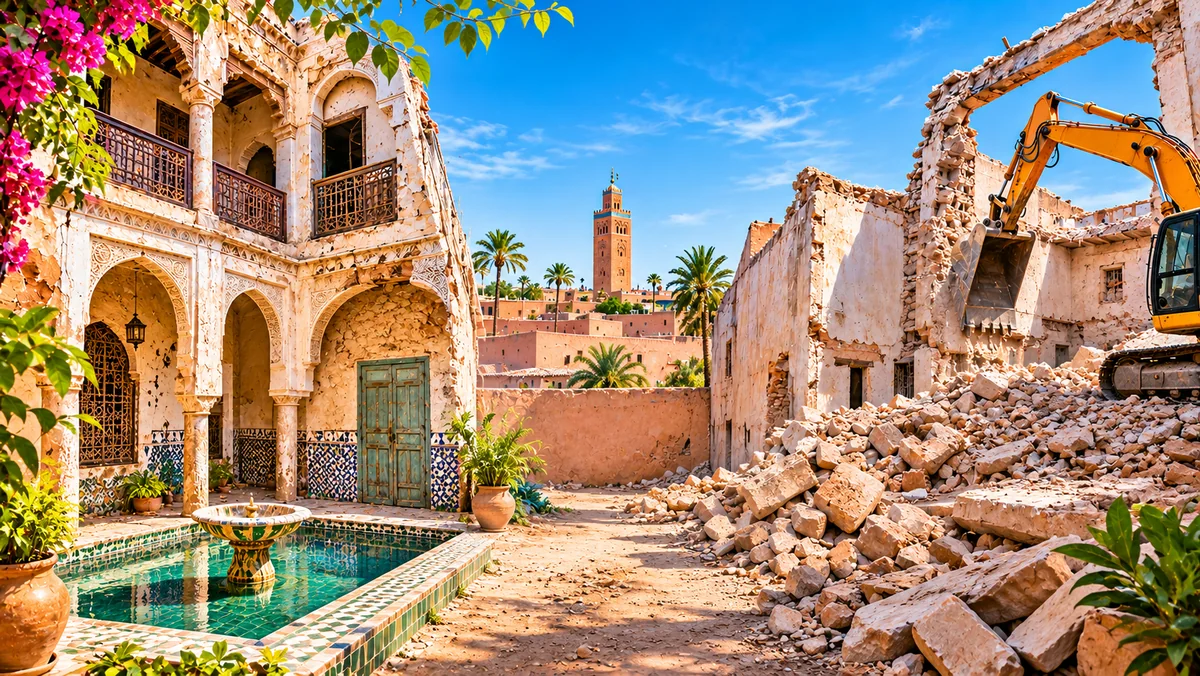
What if the best way to transform a riad in Marrakech sometimes meant rebuilding part of the building, or even starting again with an entirely redesigned structure? The question may seem surprising. In the Medina, buying an old riad naturally brings to mind restoring its walls, courtyard and traditional features. Yet behind a beautiful entrance there may be deteriorated floors, water infiltration, earlier alterations or an interior layout ill suited to tourist accommodation.
The right decision therefore involves more than comparing a renovation price with a rebuilding price. It depends on the building’s actual condition, its heritage value, regulatory possibilities, the architectural brief and the intended business model.
Consider a purely illustrative example: €240 000 for a major renovation versus €310 000 for rebuilding. The second option costs €70 000 more but could, if authorised and properly designed, allow two additional bedrooms. Is that enough to justify the difference? Not necessarily: the additional economic contribution, timelines, risks and full cost of each scenario must be compared.
At Darnel Collection, we approach this question with a simple method: understand the building before deciding what it should become. Here are the main points to examine before investing.
1. Why are some riads harder to renovate than expected?
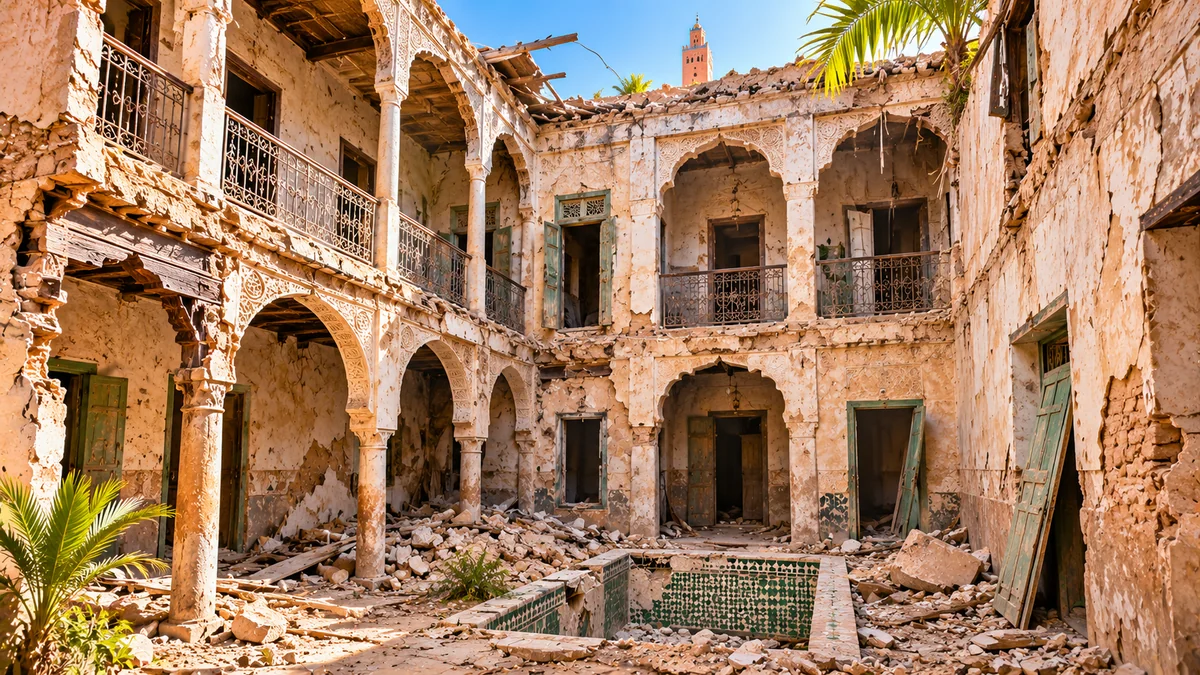
In Marrakech Medina, old buildings combine traditional techniques and materials: earth or masonry walls, timber floors, lime plaster and structures that have sometimes been altered over generations. These elements form an important part of Morocco’s architectural heritage. They do, however, require specific knowledge when work is needed on an ageing building.
Some walls show cracks, moisture marks or deformation. Floors may have been altered without a structural study. Openings, additional storeys and earlier repairs may also have changed the behaviour of the structure as a whole.
This does not mean that a rammed-earth wall is necessarily fragile or that an old building should be demolished. A properly maintained traditional wall can be durable. Only its condition, function, observed defects and compatibility with the project can determine whether it can be retained.
Before choosing major renovation or rebuilding, the building should therefore be examined by competent professionals, with investigations appropriate to its condition.
2. First question: is the structure actually sound?
A riad may appear solid during an initial visit even though some parts require substantial work. Conversely, visible cracks do not automatically mean demolition is necessary. Their cause must be investigated: an old, stabilised movement, water infiltration, overloading, poor connections, a foundation problem or another defect.
The diagnosis should cover in particular:
- load-bearing walls, floors and roof framing;
- cracks, deformation, signs of moisture and how they evolve;
- foundations and overall stability, insofar as they can be investigated;
- party walls and the apparent condition of neighbouring buildings;
- existing utility networks, drainage and site access;
- alterations made over time and any structural inconsistencies.
The trap of discovering work too late
Imagine an investor buying a riad with a renovation budget of €150 000. Once work begins, they discover that several floors need rebuilding and some walls need strengthening. The original budget can then be substantially exceeded.
Renovation itself is not necessarily the problem. The risk mainly comes from committing to an acquisition without a sufficiently precise diagnosis, a detailed works scenario and an appropriate allowance for uncertainties.
Darnel advice: never base your budget solely on a visual inspection and a price per square metre. Have competent professionals prepare a diagnosis and cost estimate before committing, wherever possible.
3. Second question: can you create the right number of bedrooms?
A riad intended to become a guesthouse should be conceived as a hospitality product, rather than simply a property layout. Bedroom numbers, floor areas, comfort, circulation, common areas and service rooms directly influence potential revenue and operating costs.
Consider a riad with a ground footprint of 120 m². Its existing layout might accommodate four comfortable bedrooms. More extensive reconfiguration could potentially make five or six possible, depending on total floor area, light and ventilation constraints, applicable rules and the intended quality of use. This possibility must be confirmed by an architectural and regulatory study: it cannot be inferred from the ground footprint alone.
Why does an additional bedroom change the figures?
Imagine an additional bedroom sold at €130 per night with 70 % annual occupancy:
€130 × 365 days × 70 % = €33 215 in theoretical gross annual room revenue.
Over five years, that would represent €166 075 at constant prices and occupancy. This amount is neither profit nor a guaranteed forecast. Distribution commissions, cleaning, linen, consumables, overheads, any additional staffing costs and the necessary investment must be deducted.
An additional bedroom is therefore not automatically profitable. It may nevertheless justify studying more extensive restructuring.
Our recommendation: before buying, have at least two layout scenarios drawn up and check their feasibility. Compare genuinely marketable, comfortable and operable bedrooms, rather than simply a theoretical maximum number of keys.
4. Renovate, restructure or rebuild: three different strategies
Renovation means retaining all or part of the existing structure and restoring it while adapting it to the brief. It can preserve authentic features, limit certain major interventions and maintain the historic character of the property. It can, however, become complex when structural defects are numerous or the existing layout does not suit the project.
Restructuring with partial retention often provides a third option. It involves preserving those old elements that can be kept, repairing or rebuilding certain deteriorated parts and rethinking the spaces needed. Depending on the building, this approach can reconcile heritage, safety, comfort and operations. It must be designed case by case: retaining a wall or floor only makes sense if doing so is technically appropriate and compatible with the project.
Rebuilding involves more extensive intervention. Where authorised, it can allow circulation, bedrooms, technical networks and service spaces to be redesigned. But it may be restricted, regulated or refused depending on the building’s heritage and planning status.
Demolishing a riad never automatically confers the right to rebuild it identically. Volumes, heights, façades, materials, protected elements and relationships with neighbouring buildings may be subject to requirements. Administrative feasibility must be checked before choosing rebuilding as the main scenario.
Are you considering buying a riad to renovate?
5. How much does renovation cost compared with rebuilding?
There is no universal price for renovating or rebuilding a riad in the Medina. The budget depends on its initial condition, site access, materials, finish quality, equipment, neighbouring constraints and the chosen brief.
To illustrate the comparison, consider a fictional riad with 250 m² of total floor area. The amounts below are educational assumptions intended to compare two scenarios. They are neither quotations, market averages nor an estimate applicable to a particular property.
BUDGET COMPARISON — ILLUSTRATIVE ASSUMPTIONS
Studies and design: major renovation €15 000; rebuilding €20 000.
Structural works and shell construction: major renovation €75 000; rebuilding €120 000.
Networks and technical equipment: major renovation €40 000; rebuilding €45 000.
Fit-out and finishes: major renovation €80 000; rebuilding €85 000.
Budgeted contingencies and uncertainties: major renovation €30 000; rebuilding €40 000.
HYPOTHETICAL TOTAL: major renovation €240 000; rebuilding €310 000.
In this example, rebuilding is €70 000 more expensive. But the comparison is only valid if both estimates cover a comparable scope, with the same equipment and equivalent finish quality.
In particular, check that the rebuilding scenario includes, where necessary, demolition, rubble removal, protection of adjoining buildings, any foundation repairs and site safety measures. These items can substantially alter the final cost. Renovation, meanwhile, may require unforeseen structural repairs, delicate interventions and successive adaptations.
Timelines, permissions, genuinely usable floor area, durability and the consequences of a delayed opening must also be included.
Practical advice: request two or three detailed estimates based on defined architectural scenarios and comparable scopes. Ask for exclusions, contingency allowances and items still requiring confirmation to be made explicit.
6. The real calculation: how much will the riad earn after the works?
For an investor, the decision should also rest on the future business model. Imagine two theoretical projects: the first retains the existing structure and creates four bedrooms; the second provides for authorised rebuilding and could create six.
Assume, solely for this exercise, an average daily room rate (ADR) of €130 and annual occupancy of 70 %.
COMPARATIVE PROJECTION — ROOMS ONLY
Number of bedrooms: renovated riad 4; rebuilt riad 6.
Assumed ADR: €130 in both scenarios.
Assumed occupancy: 70 % in both scenarios.
Gross annual room revenue: €132 860 for 4 bedrooms; €199 290 for 6 bedrooms.
Room revenue over five years: €664 300 for 4 bedrooms; €996 450 for 6 bedrooms.
The theoretical difference in room revenue is €66 430 per year, or €332 150 over five years at constant prices and occupancy. This additional revenue is not profit. Two more bedrooms entail additional costs: cleaning, linen, consumables, energy, maintenance, commissions and sometimes additional staffing or organisation.
The additional operating contribution — after variable costs and the expenses actually incurred — must therefore be compared with the full additional rebuilding cost. Permission and construction timelines, the opening date, financing, taxes and other investments must also be considered.
Illustrating the simple payback period
If the full additional rebuilding cost were €70 000 and the two additional bedrooms generated an additional annual operating contribution of €30 000, the simple payback period would be:
€70 000 ÷ €30 000 = approximately 2.3 years.
This contribution of €30 000 is an illustrative assumption, not a result automatically derived from revenue. It must be supported by an operating budget. The 2.3-year calculation is neither an IRR nor a net return: it excludes financing, taxes, opening delays, changes in prices and occupancy, and other investments in particular.
The real question is therefore: does rebuilding create enough additional value to justify its cost, timelines and risks?
This supplied simulator uses its own assumptions: flat operating expenses of 55 %, simulated corporate tax of 20 %, annual increases in ADR, occupancy and additional sales, and a fixed indicative exchange rate. Return is calculated on the purchase price alone, excluding works and acquisition costs. Its results are distinct from the article’s comparative examples; expenses cannot be edited in this version.
Estimate your riad’s profitability
Occupancy: +5 percentage points/year up to 90 %, then +2.5 points/year up to 95 %.
Estimate based on the purchase price alone. Works, acquisition costs and financing are excluded from the return.
Your 5-year projection
Version 2 · Percentage-point progression · Updated 6 October 2026
| Year | Occupancy | Price / night | Add. sales | Annual revenue | Operating result | After corporate tax | Return |
|---|
Understanding the assumptions and calculations
The operating result is fixed at 45 % of total revenue, with operating expenses therefore estimated globally at 55 %. Corporate tax is simulated at 20 % of positive operating result, without modelling depreciation, deductions or the project’s specific tax regime. The result after corporate tax is not a cash-flow calculation after financing.
Average room price per night rises by 7.5 % a year, compounded. Occupancy rises by 5 percentage points a year up to 90 %, then by 2.5 points a year up to 95 %: 60 %, 65 %, 70 %… 90 %, 92.5 %, 95 %. Additional sales rise by 5 percentage points a year up to 30 % of room revenue, then by 2.5 points a year, without a projection cap. If an increase crosses a threshold, it stops at that threshold for that year (examples: 88 % → 90 %; 28 % → 30 %). The operating margin remains constant.
Return equals the annual result after corporate tax divided by the purchase price. No return on equity is calculated. An owner may replace the purchase price with the reference value they wish to analyse.
Fixed indicative conversion: €1 = 10.90 MAD. Displayed amounts are rounded; calculations use unrounded values.
Indicative, non-binding simulation. These assumptions guarantee neither future performance nor applicable taxation.
Help your riad work towards these results
Discuss your project and its profitability drivers with Darnel Hospitality.
Request an advisory appointment7. Be mindful of permissions in Marrakech Medina
Demolishing and rebuilding an old building are not simply site decisions. Before any intervention, the rules applicable to the plot and building, and the procedures required by the competent authorities, must be checked.
Several separate questions should be considered:
- Can total or partial demolition be authorised?
- Is rebuilding possible on this plot, and under what conditions?
- What volumes, heights, building lines, façades and materials may be required?
- Are the building or any of its elements subject to specific heritage requirements?
- What constraints affect party walls, access and the stability of neighbouring buildings?
- What permissions and studies must be obtained before work begins?
Requirements may vary according to the property’s location and circumstances. Generalisations should therefore not be drawn from another site, even one in the Medina. Permission to demolish does not necessarily constitute permission to rebuild according to the intended project.
Poorly prepared demolition can also damage neighbouring buildings. Structural studies, working methods and protective measures must be planned in advance.
Our recommendation: do not sign an acquisition on the assumption that total demolition will automatically be authorised. Have competent professionals and relevant authorities confirm administrative and architectural feasibility before choosing rebuilding as the main scenario. Where possible, secure these checks in the conditions preceding the acquisition.
8. Five mistakes that can send the budget soaring
Mistake no. 1 — Underestimating the condition of walls and foundations.
An incomplete diagnosis can lead to unforeseen structural repairs. Defects should be identified and costed as far as possible before buying.
Mistake no. 2 — Starting work without a precise hospitality brief.
Bedrooms, common spaces, technical rooms, circulation and services must be defined before the architectural design is finalised.
Mistake no. 3 — Regularly changing plans during construction.
Each change can lead to costs, rework and delays. Major decisions should be made upstream wherever possible.
Mistake no. 4 — Overlooking the Medina’s logistical constraints.
Access, deliveries, storage, removal of materials and working hours must be planned in advance. Logistics can weigh heavily on costs and schedules.
Mistake no. 5 — Planning a budget without a sufficient reserve.
Contingencies should be identified and provided for according to the building’s specific risks. A flat allowance does not replace analysis of uncertainties.
These difficulties can arise in renovation, restructuring and rebuilding alike. The difference often lies in the quality of preliminary studies, site preparation and construction supervision.
9. Our on-the-ground approach at Darnel Collection
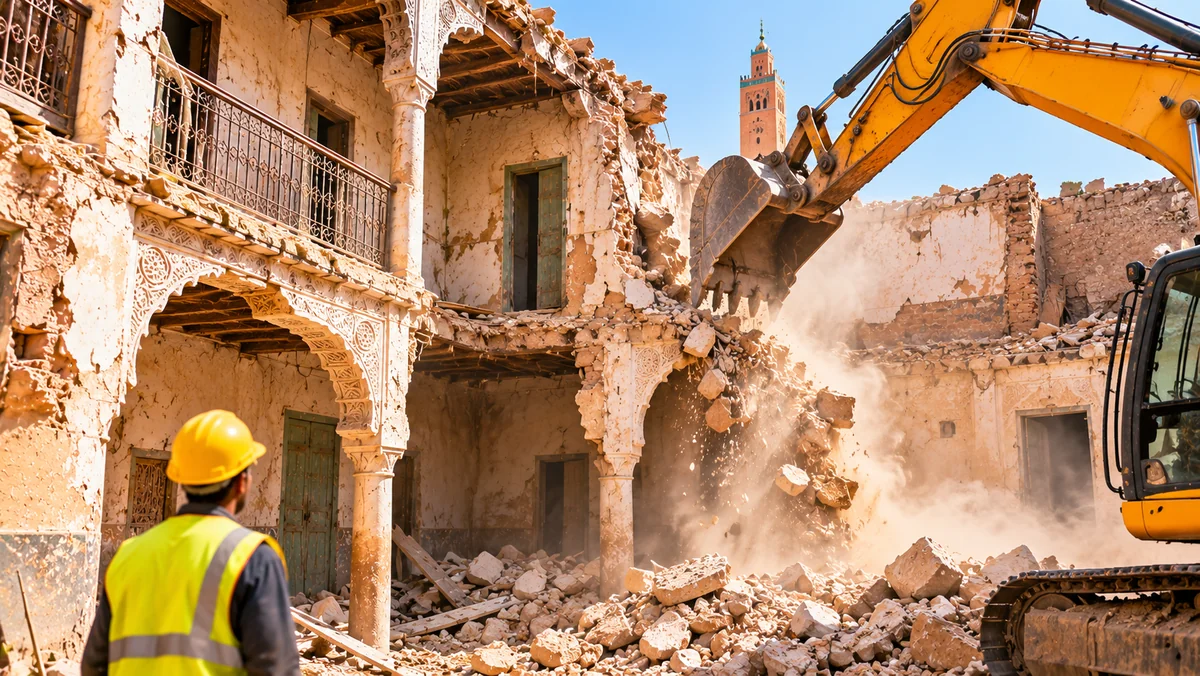
At Darnel Collection, we develop riad and boutique hotel projects with three dimensions in mind: the quality of the existing building, the feasibility of the architectural brief and the project’s economic potential.
During a visit, we first seek to understand the property’s condition and the constraints of its plot. We speak with local architects, craftspeople and contractors experienced in traditional techniques. Their practical knowledge is valuable, but never replaces structural studies, regulatory checks and the necessary permissions.
Our approach compares several scenarios: retain, restructure with partial retention, or rebuild where possible. We then compare budgets, timelines, operating capacity and risks. The most attractive scenario is not necessarily the one with the most bedrooms or the lowest initial budget.
INVESTMENT CASE — DAR LÉON
Explore Darnel Collection projects
Have you found a riad to renovate, a ruin or a building plot? We can explore the property’s potential and initial works assumptions with you, before validation by competent professionals.
Have Darnel Collection analyse my project
10. Why architectural quality must remain a priority
Rebuilding should never mean erasing a riad’s identity. Marrakech Medina has an exceptional architectural heritage. Courtyards, proportions, materials, craft skills and the play of light all contribute to the character of these houses.
Where major intervention is necessary and authorised, the project must respect its context. A quality riad is not defined solely by its bedroom count. It should offer a coherent experience in which Moroccan architecture meets contemporary comfort.
A poorly designed new building may be less attractive than an intelligently restored old riad. Conversely, retaining an unsuitable layout simply to avoid major intervention can limit the project for years to come.
The best strategy is therefore not always retention or demolition. It is choosing the solution that creates a safe, durable, desirable and economically coherent building while respecting heritage and regulatory constraints.
FAQ — Renovating or rebuilding a riad in Marrakech
Can a riad in the Medina be demolished completely?
That depends on the building’s circumstances, the plot and applicable rules. The possibility of demolition and that of rebuilding must be checked separately with the relevant authorities. Identical rebuilding should never be assumed to be permitted.
Does rebuilding always cost more than renovation?
No. Major renovation involving substantial structural repairs can become very expensive. Rebuilding, meanwhile, may entail demolition, neighbour protection and foundation costs. Detailed estimates covering comparable scopes and finish quality must be compared.
Can more bedrooms be created after rebuilding?
This may sometimes be possible, but is never automatic. Bedroom numbers must be confirmed by an architectural and regulatory study, taking account of areas, circulation, light, ventilation and quality of use.
Should rammed-earth walls be retained?
A rammed-earth wall is not necessarily deteriorated. Its condition, function and ability to be retained must be assessed by a competent professional. The decision depends on the diagnosis and project, rather than the material alone.
Which solution is the most profitable?
There is no general answer. The full cost of the works, schedule, number of bedrooms that can actually be authorised, potential income, operating expenses and risks must be compared. Additional revenue alone is insufficient to measure profitability.
Explore your investment further

Join the Darnel Collection Private Club
CONCLUSION — SHOULD YOU RENOVATE OR DEMOLISH A RIAD IN MARRAKECH?
There is no automatic answer. Renovation may be preferable when a building has a sound structure, worthwhile heritage features and a layout compatible with the project.
Restructuring with partial retention can be appropriate when some elements deserve preservation while others require repair or rebuilding.
Rebuilding can be considered when structural condition, technical constraints or the arrangement of spaces make retention difficult, and only subject to the necessary permissions.
In every case, the decision should be prepared before acquisition wherever possible. A riad that is cheaper to buy can become much more expensive if its constraints have not been identified. Conversely, an old building that seems difficult may hold worthwhile potential if its features can be restored and enhanced.
At Darnel Collection, our conviction is simple: a good investment begins with a proper analysis of the building. Before buying a riad in Marrakech, have its condition, architectural and regulatory feasibility and hospitality potential examined. This is often where the project’s success is determined.
Book my Darnel Collection strategic appointment
Georges Lelièvre — Darnel Collection
The budgets and profitability scenarios presented in this article are illustrative and constitute neither quotations nor guaranteed forecasts. Assumptions must be adapted to each property. Any demolition, rebuilding or structural renovation must undergo the applicable studies, checks and permissions, with the involvement of competent professionals.