
Architecture & Design
Pool, rooftop, hammam or spa: which amenities really increase a riad’s value in Marrakech?

A pool in the courtyard. A rooftop with a magnificent view of Marrakech. A traditional hammam. A private spa with a massage room.
These amenities appeal to travellers. They help define a collection riad’s identity and can strengthen its premium positioning.
For an investor, however, one question matters above all:
Which amenity actually increases a riad’s value and profitability in Marrakech?
A spa generating MAD 300,000 in annual revenue is not necessarily more attractive than a rooftop fitted out for MAD 200,000.
A hammam can deliver an authentic experience while occupying space that could have accommodated another bedroom.
A pool can make a property more appealing while bringing substantial maintenance costs and structural constraints.
The right decision is therefore not to add as many amenities as possible.
It is to identify those creating the most value per dirham invested and per square metre used.
At Darnel Collection, we assess amenities against five criteria: initial investment, revenue contribution, operating costs, technical constraints and impact on the property’s value.
Here is how to apply this approach to a four-, six- or ten-room riad in Marrakech. All financial examples below assume a six-room riad at 65% occupancy: they are illustrative scenarios, neither quotations nor guaranteed returns. Activity-specific revenue requires demand to be validated; it does not follow automatically from room occupancy and cannot be added together without assessing interactions.
The most profitable amenity depends on demand, dedicated costs, space occupied and capital invested. Compare its operating contribution with alternative uses of the same space. Darnel’s method separates the effect on room rates from the spa or hammam’s own sales to avoid double counting. The guide’s simple payback periods exclude tax, financing and replacements.
Article 4 of Law No. 80-14, official text, provides for standards governing tourism accommodation construction and transformation. Have the applicable requirements and building capacity assessed before including an amenity in the programme.
To build your comparison, connect renovation costs with riad operating costs and cash flow. Additional revenue is not an equal increase in contribution, and simple payback alone does not calculate project cash flow.
Three financial measures that must be kept separate
Before comparing amenities, three financial indicators need to be clarified.
Additional revenue
This is the extra revenue attributable to the amenity.
For a spa, it may come from massages and treatments sold.
For a rooftop, it may come from dining, private bookings or a higher average room rate.
Avoid counting the same revenue twice: an increase in ADR and an additional sale must represent genuinely separate revenue streams.
Operating contribution
This equals additional revenue less operating expenses attributable to the amenity.
These may include dedicated staff, consumables, energy, maintenance, commissions and marketing costs.
Operating contribution = additional revenue − attributable operating expenses.
Its scope must be clearly defined.
Net profit
Net profit also takes account of depreciation, financing costs, other relevant accounting expenses and taxes.
It does not necessarily equal available cash.
A hammam could therefore generate MAD 180,000 in revenue, contribute MAD 54,000 to operating results and produce a substantially lower net profit.
This distinction is essential to avoid overstating a hospitality investment’s performance.
Understand riad operating costs and net profit →
The pool: primarily an investment in appeal
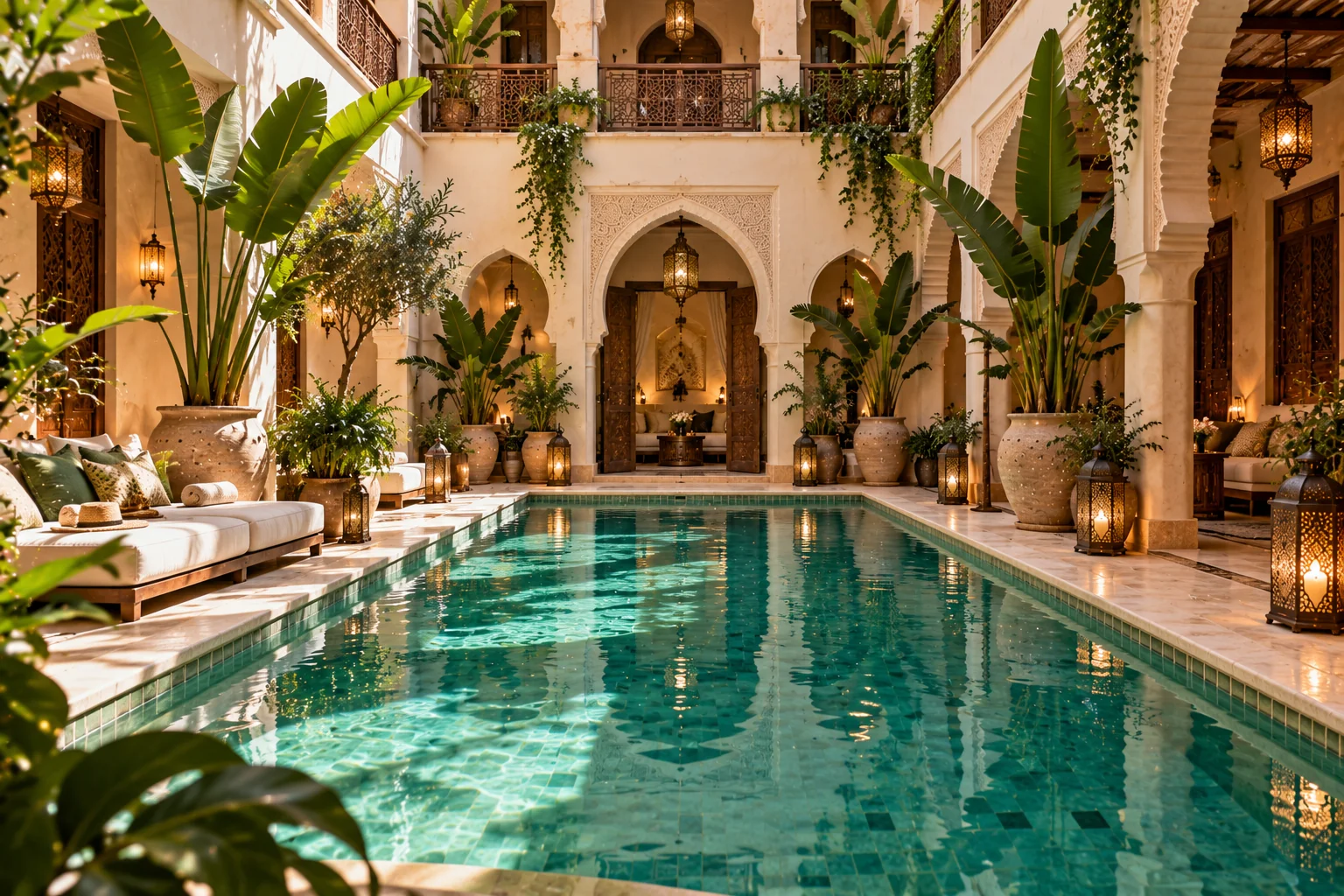
In a Marrakech riad, a pool or plunge pool can be a real differentiator.
Beyond its practical use, it transforms the courtyard’s atmosphere and strongly shapes the property’s visual identity. Unlike a spa, a pool generally generates no directly billed revenue.
Its value should therefore be assessed mainly through potential improvements in ADR, occupancy and commercial appeal.
Financial example
Take a six-room riad at 65% occupancy: 6 × 365 × 65% = 1,423.5 room nights sold annually as a theoretical average.
The plunge-pool scenario assumes an investment of MAD 140,000 and MAD 35,000 in additional annual revenue.
At constant occupancy, MAD 35,000 would represent an average rate increase of approximately MAD 24.59 per room night sold. With attributable costs of 35%, contribution would be 35,000 × 65% = MAD 22,750 annually, giving a simple payback of 140,000 ÷ 22,750 ≈ 6.2 years.
It would be incorrect to attribute this increase automatically to the pool alone.
Guest reviews, decor, market conditions and distribution channels can also affect results. Additional filtration, water, energy, treatment and maintenance costs must then be deducted.
Constraints to anticipate
In the Medina, adding a pool requires a thorough technical assessment.
Foundations, the existing structure, infiltration risks, waterproofing, drainage and safety all need to be examined.
Required permissions must be checked according to the work proposed.
Our recommendation: favour a plunge pool that fits the architecture perfectly over a large pool whose costs and constraints outweigh its expected benefits.
Assess riad renovation costs →
The rooftop: strong potential, with constraints
The rooftop is often one of a riad’s most popular spaces.
Breakfast, relaxation, dining, yoga and private experiences: it can accommodate several uses without always requiring a specialist team.
This flexibility can make its economics attractive.
Financial example
Imagine a rooftop fitted out for MAD 200,000.
It could generate MAD 100,000 in additional annual revenue from identifiable services.
If attributable operating costs represent 50% of this revenue, its annual contribution would be MAD 50,000.
The simple investment payback period would then be:
MAD 200,000 ÷ MAD 50,000 = 4.0 years.
This calculation is not a guaranteed net return.
It assumes that MAD 50,000 is available each year to recover the investment, before taxes, financing, major replacements and the cost of capital.
Frequently overlooked constraints
A rooftop is not automatically suitable for commercial use simply because it exists.
Before fitting it out, check load-bearing capacity, access, guardrails, waterproofing and any applicable restrictions.
Technical installations, pergolas, kitchens and heavy equipment may require specific studies and permissions.
Neighbours’ peace and quiet must also be considered.
Our recommendation: a rooftop is particularly attractive when it improves every guest’s experience without creating disproportionate operating costs.
Would you like to design a riad with a sound business model?
Before investing in a pool, rooftop or spa, assess your project against its hospitality potential and total budget.
Book a Darnel Collection advisory appointment →
The hammam: an authentic experience, but how profitable?
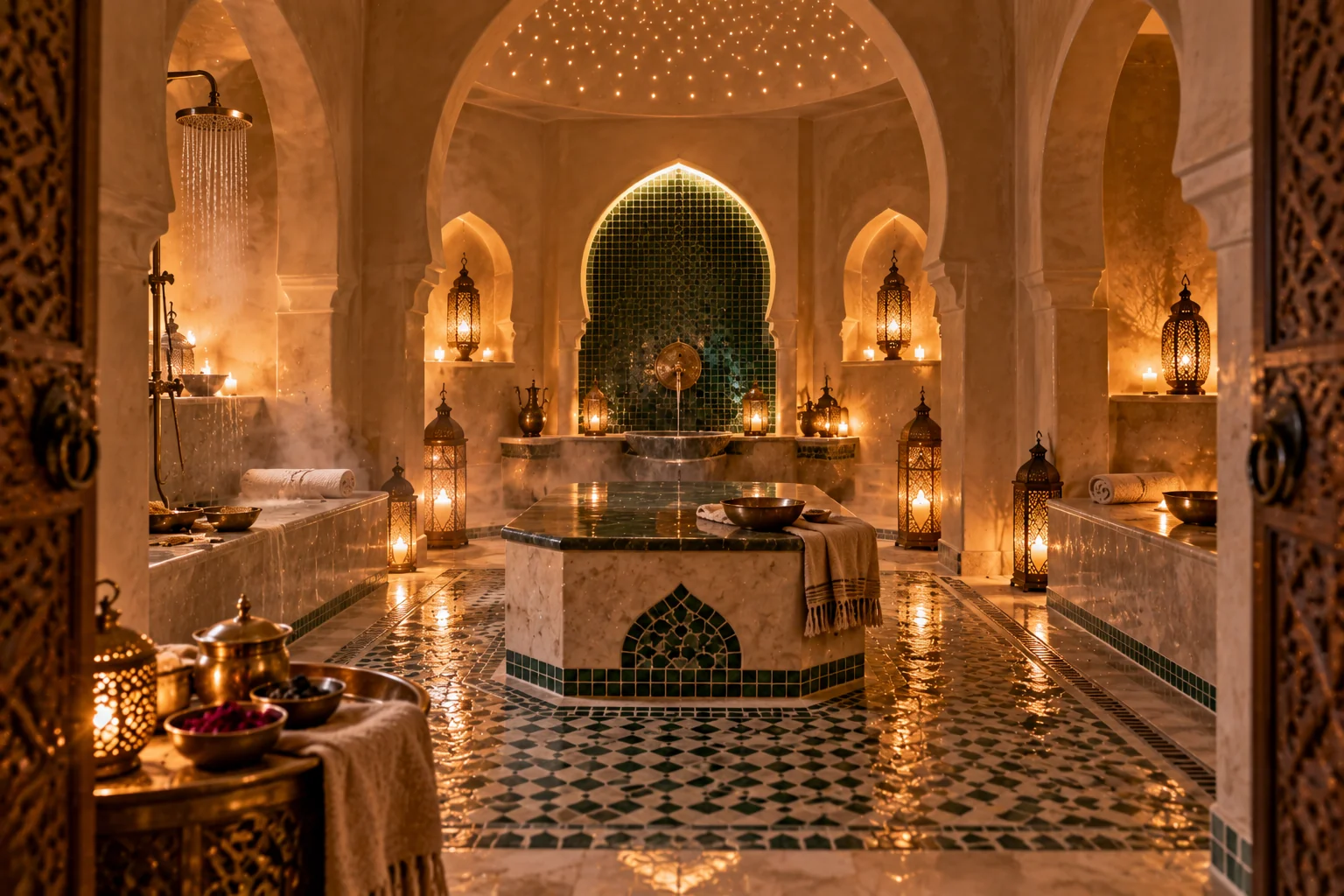
The hammam is a distinctive feature of Moroccan hospitality.
It can reinforce a riad’s identity and enrich the guest experience.
Its business model, however, deserves close attention.
Revenue simulation
Imagine a hammam selling an average of two treatments daily at MAD 360, for 250 days per year.
Its theoretical revenue would be:
2 × MAD 360 × 250 = MAD 180,000 per year.
Now assume an operating contribution margin of 30%.
This margin is an educational assumption, not an observed Marrakech market average.
Annual contribution would then be:
MAD 180,000 × 30% = MAD 54,000.
MAD 54,000 is not net profit. With an investment of MAD 160,000, simple payback would be 160,000 ÷ 54,000 ≈ 3.0 years.
For consistency, our assumption deducts current costs attributable to the hammam: directly involved staff, consumables, energy, routine maintenance and sales costs.
It excludes depreciation, financing interest, taxes and future replacement investment.
It also assumes there are no additional fixed costs outside this calculation reducing the contribution.
If a permanent team or extra fixed cost is required, it must be deducted.
The real issue: the space used
A hammam may require a dedicated room, technical equipment and ancillary spaces.
Space is especially precious in a small riad. If a hammam prevents an extra bedroom from being created, compare both options’ results.
We return to this crucial trade-off below.
The spa: a revenue centre requiring substantial investment
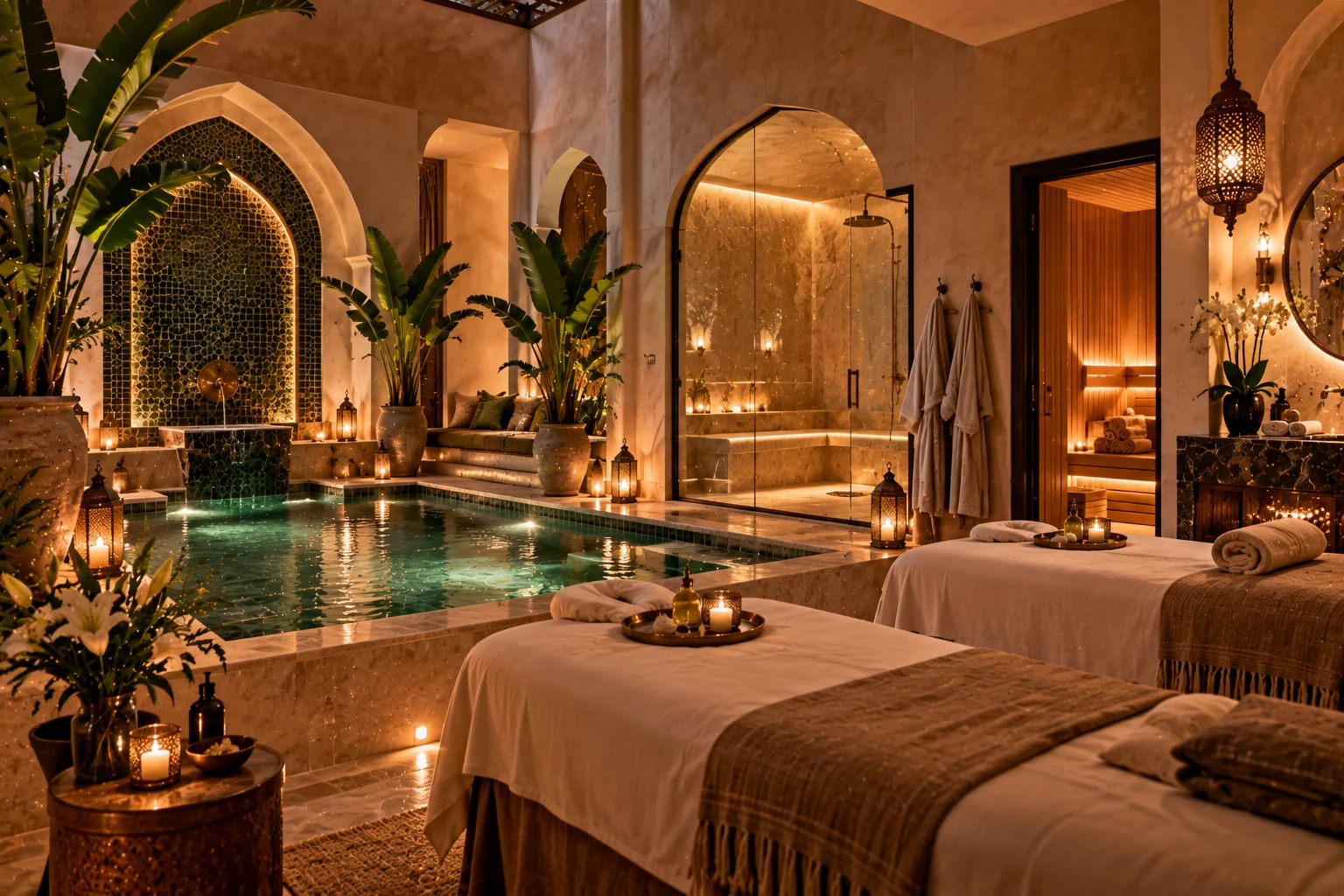
A spa can transform a riad’s positioning and strengthen its value proposition.
Massages, treatments, rituals and couples’ experiences can increase guest spending during a stay.
In a ten-room boutique hotel, a spa may even become a separate commercial activity.
But avoid confusing a spa’s revenue with its profitability.
Financial simulation
Imagine a spa generating MAD 1,000 in daily revenue for 300 days.
Annual revenue would be MAD 300,000.
At an assumed operating contribution margin of 35%, it would generate:
MAD 300,000 × 35% = MAD 105,000 per year.
MAD 105,000 is not net profit.
In our scenario, the 65% cost ratio includes ongoing expenses attributable to the activity: staff remuneration, products, energy, laundry, routine maintenance and marketing.
The calculation excludes depreciation, financing costs, taxes and replacement investment.
It assumes other spa-specific fixed costs are included in the 65%. Otherwise, the actual contribution will be lower.
Analyse a six-room riad with a spa →
Initial investment is decisive
Imagine the spa requires MAD 450,000 in initial investment.
With an annual contribution of MAD 105,000, its simple payback period would be approximately 4.3 years.
This assumes that the projected activity level is reached and maintained.
It does not include the cost of capital, taxes, equipment replacements or potential ramp-up years.
A MAD 450,000 spa may therefore be less attractive than a MAD 200,000 rooftop if demand is insufficient.
Can you welcome outside customers?
This is an important business-plan question.
Welcoming customers who are not staying at the property must not be assumed to be automatically permitted.
The ability to sell services to outside customers must be checked against the property’s status, applicable permissions, reception arrangements and safety obligations.
Our recommendation: never size a spa on the assumption of outside customers before verifying regulatory and commercial feasibility.
Comparison: which amenity offers the best investment payback?
Here are four illustrative scenarios for a six-room riad at 65% occupancy.
Installation amounts are neither actual quotations nor verified average Moroccan market prices. They illustrate a decision-making method only.
On small screens, scroll the table horizontally if needed.
| Amenity | Investment | Additional revenue/year | Costs | Contribution/year | Simple payback |
|---|---|---|---|---|---|
| Plunge pool | MAD 140,000 | MAD 35,000 | 35% | MAD 22,750 | 6.2 years |
| Rooftop | MAD 200,000 | MAD 100,000 | 50% | MAD 50,000 | 4.0 years |
| Hammam | MAD 160,000 | MAD 180,000 | 70% | MAD 54,000 | 3.0 years |
| Spa | MAD 450,000 | MAD 300,000 | 65% | MAD 105,000 | 4.3 years |
How should you read this table?
The hammam appears to have the shortest payback period.
But this result depends entirely on the assumption of two daily treatments at MAD 360 over 250 days.
If actual demand is lower, the investment takes longer to recover.
For the plunge pool, MAD 35,000 in additional revenue assumes a commercial improvement attributable to that amenity, which is harder to demonstrate than a massage sale.
The periods calculated are simple paybacks before taxes, financing, cost of capital, replacements and residual value.
They must not be presented as internal rates of return or bank-loan repayment periods.
The best investment is therefore not the one with the highest revenue, but the one with the best contribution adjusted for risk, space used and capital committed.
Opportunity cost: a hammam or an extra bedroom?
This is probably one of an investor’s most important trade-offs.
Return to our six-room riad at 65% occupancy.
You have additional space that could accommodate either a hammam or a seventh bedroom, subject to technical and regulatory feasibility. The bedroom scenario below is an additional trade-off assumption, separate from the four validated amenities.
Option A: create a hammam
Using our previous assumptions:
Initial investment: MAD 160,000.
Annual revenue: MAD 180,000.
Operating contribution: MAD 54,000.
Simple payback: 3.0 years.
Option B: create a bedroom
Imagine an additional bedroom sold at MAD 1,500 per night with 65% occupancy.
Its theoretical annual revenue would be:
MAD 1,500 × 365 × 65% = MAD 355,875.
With an assumed marginal contribution of 55% after additional operating costs, it could generate approximately MAD 195,731 in annual contribution.
Assume an investment of MAD 450,000 to create and equip the room.
Simple payback would be approximately 2.3 years, before taxes, financing and replacements.
Comparison
On small screens, scroll the table horizontally if needed.
| Indicator | Hammam | Additional bedroom |
|---|---|---|
| Initial investment | MAD 160,000 | MAD 450,000 |
| Theoretical annual revenue | MAD 180,000 | MAD 355,875 |
| Annual contribution | MAD 54,000 | MAD 195,731 |
| Simple payback | 3.0 years | 2.3 years |
In this scenario, the bedroom generates a higher annual contribution but requires more initial investment.
It may also increase guest capacity and the riad’s commercial value.
The hammam, meanwhile, may strengthen wellness positioning and help sell existing rooms at a higher rate.
These indirect effects must be considered without double counting them.
Creating a bedroom is not always possible: ventilation, daylight, circulation, safety, classification and permissions can constrain the programme.
Darnel advice: before allocating space to an amenity, calculate what the same space could earn through another use.
Does your project make intelligent use of every square metre?
In a small riad, a poor architectural trade-off can permanently reduce operating potential.
Have my riad’s layout assessed →
Regulatory constraints: feasible does not necessarily mean authorised
In Marrakech’s Medina, an amenity’s feasibility must be assessed before it is incorporated definitively into the business plan.
For a pool or plunge pool
Check structural constraints, foundations, utilities, waterproofing, drainage and safety requirements.
Administrative procedures may be needed depending on the proposed work.
For a rooftop
Load-bearing capacity is fundamental, especially if a pool, hot tub or heavy equipment is planned.
Guardrails, access, noise, technical installations and architectural changes must be studied.
For a hammam
Ventilation, waterproofing, moisture extraction, heat production and safety must be suited to the building.
For a spa
Beyond technical constraints, check the conditions applying to the services offered, staff and any outside customers.
Regulations depend on the building’s situation, the work proposed and the activity carried out.
Before forecasting future revenue, have the programme’s feasibility confirmed by qualified professionals and the relevant authorities.
An unauthorised or technically unfeasible service must never be treated as secured revenue in your forecast.
Which amenities suit each riad size?
A four-room riad
In a small property, limited space and fixed costs require disciplined decisions.
Bedroom and bathroom quality must remain the priority.
A compact plunge pool, rooftop or private wellness area may make sense.
A full spa is not necessarily justified.
A six- or seven-room riad
This capacity allows a more varied offering to be considered.
A pool and rooftop can support commercial positioning.
Massages by appointment can help test demand before investing in a permanent spa.
A ten-room boutique hotel
A larger property may have sufficient commercial potential to organise a spa or dining activity.
It must also absorb greater costs.
Build a budget for each activity rather than relying on one overall projection.
Resale value: why an expensive amenity is not always a good investment
An amenity can improve revenue without increasing a riad’s property value proportionately.
A future buyer will examine installation quality, condition, compliance, maintenance costs and demonstrated operating contribution.
An underused spa may be seen as a cost burden.
A well-designed rooftop may strengthen appeal.
A pool with waterproofing problems may instead cause a discount or negotiations.
It would therefore be misleading to claim that a MAD 200,000 amenity automatically adds MAD 200,000 to the property’s value.
To assess value creation, analyse comparable transactions and, for an operating property, the quality of its results.
Conclusion: invest in the right amenities, not the most spectacular
Pools, rooftops, hammams and spas can all contribute to a riad’s value in Marrakech.
Profitability depends on development costs, actual use, operating expenses and their role in the hospitality concept.
A rooftop can be an excellent investment when its fit-out costs remain controlled.
A pool can strengthen appeal and premium positioning.
A hammam can provide an authentic experience and additional revenue.
A spa can become a revenue centre if activity justifies the capital committed.
None of these amenities should be chosen solely for its appearance.
The right question is: how much can this amenity contribute after costs, compared with alternative uses of my capital and space?
At Darnel Collection, we take a comprehensive approach: design the guest experience, anticipate technical constraints and build a coherent business model before work begins.
Compare my amenities by contribution, costs and feasibility →
FAQ: preparing and managing your investment
Which documents should you request before budgeting for an amenity?
Request a building assessment, technical programme, itemised quotations and an estimate of recurring costs. Have the procedures applying to the project confirmed before including revenue in the forecast.
How can you test demand before creating a permanent spa?
Where the applicable framework permits, start with treatments by appointment. Track enquiries, conversion rates, average spend and contribution after actual costs, then size the investment accordingly.
Which indicators should you track after opening?
Track attributable revenue, dedicated costs, operating contribution, usage and downtime each month. Compare them with the initial scenario and isolate room-rate effects to avoid double counting.
Should you set aside a replacement reserve?
Yes. Plan an equipment replacement schedule and an appropriate cash reserve. The simple paybacks shown here exclude replacements and therefore cannot establish the complete cash budget.