Invest
Can a 6-room riad & SPA in Marrakech generate €200,000 in annual profit before corporate income tax?
€200,000 in annual profit before corporate income tax.
For a riad with just six rooms, this figure may seem ambitious. Some investors will consider it unrealistic. Others will see a particularly attractive opportunity in Marrakech's hospitality market.
The reality lies somewhere in between.
Yes, a six-room riad with a spa can theoretically achieve €200,000 in annual profit before corporate income tax. But certainly not with just any average rate, occupancy level or organisation.
Achieving this requires creating a truly premium hospitality product, capable of generating substantial revenue per room and developing several profit centres.
Above all, revenue, earnings before depreciation, amortisation, interest and taxes, profit before corporate income tax and net profit after tax must be distinguished.
Let's look at the figures.
Exceeding €200,000 before corporate income tax is mathematically possible in the guide’s exceptional scenario, rather than demonstrated for a typical riad. Its operating result before depreciation, interest and tax must still be reconciled with depreciation and financing. Darnel recommends checking volumes, prices and spa contribution separately, then testing a cautious scenario before retaining that objective.
For opening, consult the official provisional classification and operating authorisation procedure. Requirements depend on the establishment’s type and category; having a spa does not itself validate the programme or future receipts.
To prepare your analysis, compare riad operating costs and cash flow and profitable amenities. Kasbah Nelaria illustrates a hospitality concept: the general simulations are not its observed performance.
1. Six rooms: revenue potential limited by capacity
Let's start with the maths.
A six-room riad has:
6 × 365 = 2,190 available room nights per year.
At 70% occupancy, it would sell approximately 1,533 room nights.
At 80%, approximately 1,752.
The number of rooms therefore imposes a physical limit.
There are three ways to increase revenue: improve occupancy, raise the average nightly rate and develop ancillary revenue.
But the first two have their limits.
A property cannot sustainably exceed 100% occupancy, and its average rate must remain consistent with product quality and actual demand.
That is why the spa, dining and experiences can play an important role in the business model.
2. Three revenue scenarios for a six-room riad
Let's compare three market positions.
On small screens, scroll the table horizontally if needed.
| Assumption | Conservative | Premium | Very high-end |
|---|---|---|---|
| Rooms | 6 | 6 | 6 |
| Average ADR | €160 | €230 | €300 |
| Occupancy | 60% | 70% | 78% |
| Room revenue | €210,240 | €352,590 | €512,460 |
| Spa, dining and experience revenue | €40,000 | €100,000 | €180,000 |
| Total revenue | €250,240 | €452,590 | €692,460 |
These figures are theoretical simulations, rather than average performance observed in the market.
The conservative scenario corresponds to a properly marketed property with a relatively limited service offering.
The premium scenario assumes a well-positioned brand, a consistent guest experience and a spa capable of generating regular sales.
The third, particularly ambitious scenario assumes a luxury strategy, excellent distribution and guests willing to pay high rates. The €180,000 in ancillary revenue will need to be supported by a separate budget for the spa, dining and experiences, with an explicit assumption regarding external customers.
The difference between these three properties therefore goes beyond decoration.
It lies in their ability to sell an experience.
3. Can profit before corporate income tax really reach €200,000?
This is where the reasoning becomes interesting.
A property generating €450,000 in revenue does not necessarily earn €200,000.
It must fund its teams, dining, consumables, commissions, maintenance, marketing, insurance and other expenses.
Let's take three assumptions for operating earnings before depreciation, amortisation, interest and taxes.
On small screens, scroll the table horizontally if needed.
| Scenario | Annual revenue | Hypothetical operating margin | Operating earnings |
|---|---|---|---|
| Conservative | €250,240 | 25% | €62,560 |
| Premium | €452,590 | 35% | €158,407 |
| Very high-end | €692,460 | 42% | €290,833 |
In the very high-end scenario, earnings before depreciation, amortisation, interest and taxes would be approximately €290,833. Assuming, for illustration, €30,000 in annual depreciation and amortisation and no financial interest, accounting profit before corporate income tax would be approximately €260,833. It would therefore exceed €200,000 before corporate income tax. Any tax would be calculated separately under the applicable tax rules. This scenario remains exceptional and depends on actually achieving the stated revenues and margins.
Conclusion: exceeding €200,000 in profit before corporate income tax is mathematically conceivable in this exceptional scenario, subject to confirming depreciation and amortisation, financing costs and the commercial reality of projected revenues.
4. The spa: a genuine profit centre or an additional expense?
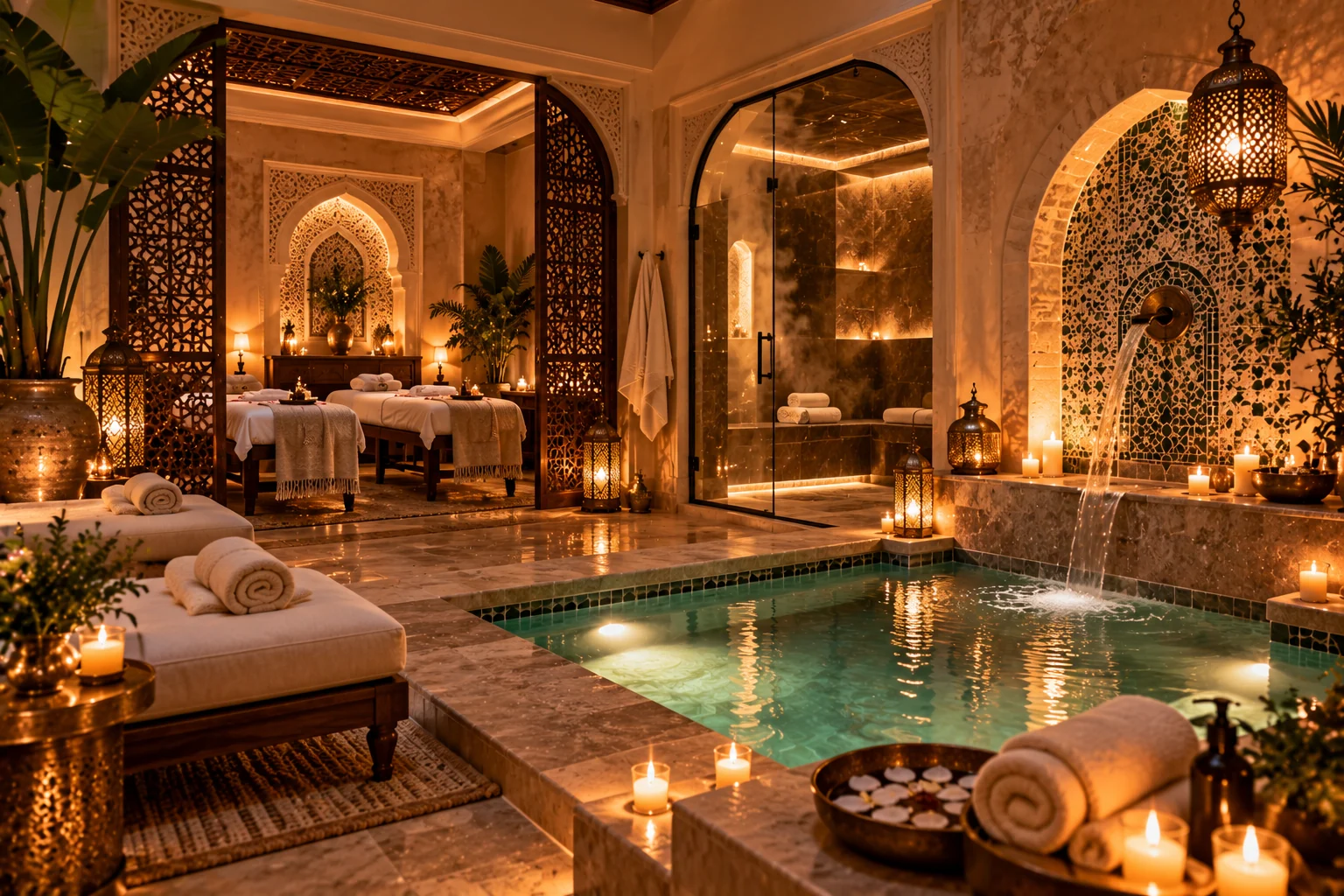
A spa can transform a riad's economics.
But having a hammam must not be confused with running a profitable wellness business.
Assume a space with a hammam, a massage room and several treatments that can be booked privately.
With average revenue of €250 per day over 300 days, the spa would generate €75,000 annually.
At €400 per day, it would reach €120,000.
But achieving these figures requires selling treatments regularly, organising the teams and developing a customer base that is not necessarily limited to overnight guests.
The spa can also generate additional expenses: therapists, energy, products, maintenance, linen and equipment.
Its value must therefore be measured by its contribution to earnings.
A spa generating €100,000 in revenue with a 20% margin contributes €20,000 in operating earnings.
A spa generating €75,000 with a 40% margin contributes €30,000.
The highest revenue is not always the most attractive.
5. The average nightly rate: the most powerful lever
For a six-room riad, each €10 increase in the average rate represents, at 75% occupancy:
6 × 365 × 75% × €10 = €16,425 in additional revenue per year.
A €50 increase could therefore represent approximately €82,125 in additional annual revenue, with occupancy unchanged.
But this increase must be justified.
An ADR of €300 cannot simply be declared.
It is built through architecture, room quality, bedding, privacy, dining, photographs, guest reviews and service.
The commercial strategy must also attract the right segments: premium couples, international travellers, exclusive stays and guests seeking personalised experiences.
What ADR should you target for your riad?
Do you already own a riad or are you considering buying one?
Book an analysis of your hospitality positioning with Darnel Collection →
We can assess your concept, facilities and target guests against average rate and occupancy assumptions.
6. Expenses: where true profitability is determined
Profitability does not depend on revenue alone.
A premium six-room riad may require a reception team, housekeepers, breakfast arrangements, spa staff and commercial oversight.
Platform commissions can also weigh heavily.
Imagine a property generating €400,000 in room revenue, 75% of which comes from platforms charging an average commission of 18%.
The annual expense would be: €400,000 × 75% × 18% = €54,000.
Direct bookings can therefore improve margins, provided direct marketing costs remain below the commissions saved.
That is why a high-end property must develop its own website, customer database, partnerships and loyalty strategy.
The objective is not simply to fill rooms.
It is to maximise the earnings generated by each booking.
7. Invested capital completely changes how €200,000 should be viewed
Now assume that two riads each generate €200,000 in annual profit before corporate income tax.
The first required a total investment of €700,000.
The second cost €1,500,000.
Their simple returns on capital would respectively be:
28.6% for the first.
13.3% for the second.
These ratios compare accounting profit before corporate income tax with invested capital: they are neither an IRR, a net after-tax return nor a cash return. Available cash flow also depends on replacement capital expenditure, working capital requirements, debt repayments and the investor's taxation.
They nevertheless show why even a high profit before corporate income tax is never enough to assess an investment.
It must always be compared with the capital actually committed and the risks taken.
Is your investment coherent?
Are you considering a six-room riad with a spa, but want to know how much to invest without undermining profitability?
Have my project's budget and potential analysed →
8. The Darnel Collection case: Kasbah Nelaria & Spa
The Kasbah Nelaria & Spa project, located in Marrakech's Kasbah, illustrates an approach based on diversifying hospitality revenue.
With ten rooms, a dining offering, a spa open to external customers and a premium identity, the project aims to build up its business progressively.
Its business model relies on accommodation, as well as the ability to sell experiences and additional services.
The project provides for ten rooms. Its financial targets must be assessed using detailed forecasts and cannot be equated with operating results already achieved.
Any targets in the business plan are neither historical results nor guaranteed performance.
The lesson for a six-room riad is simple: a spa is not enough. You need to create a consistent, marketable experience with sound financial control.
Conclusion: €200,000 before corporate income tax is possible, but certainly not automatic
A six-room riad with a spa can theoretically achieve €200,000 in annual profit before corporate income tax.
But this generally requires high-end positioning, a high average rate, solid occupancy, significant ancillary revenue and particularly rigorous operations.
The real question is therefore not: “Can a six-room riad generate €200,000?”
It is: “What product, team, budget and commercial strategy must come together to make this objective credible?”
At Darnel Collection, we believe a business plan should start with conservative assumptions, then demonstrate how to achieve the most ambitious objectives progressively.
Let's build your profitability scenario
Do you have a six-room riad project, an identified property or an investment budget?
Test my room, spa and pre-tax result assumptions →
We can compare your revenue scenarios, expenses, invested capital and the conditions needed to target a profitable operation.
The figures in this article are educational simulations. They are neither observed performance, certified forecasts nor a guarantee of results before or after tax.