
Invest
Riad in Marrakech or Airbnb in France: which investment is more profitable in 2027?

Financial comparison, profitability study and investment strategies for 2027.
What if investing €500,000 in a riad in Marrakech could earn you more than investing the same amount in an Airbnb apartment in France?
In our simulation, the riad generates an annual simplified operating surplus of €46,400, compared with €18,705 for the French apartment.
These amounts represent 9.28% and 3.74% of the capital committed respectively, before final taxation, financing and certain property-related expenditure. These ratios are operating surpluses divided by committed capital, not net returns after tax.
Why such a difference?
For a long time, rental investment in France was a preferred way of building wealth.
Buying an apartment, furnishing it and letting it on Airbnb could generate additional income.
But investors now have to contend with high prices in some cities, substantial costs, increased competition and sometimes restrictive local regulations.
Meanwhile, Marrakech attracts investors seeking to develop a tourism business around a riad or guesthouse.
The fundamental difference: an Airbnb apartment is generally a rental investment, whereas a riad with several rooms can become a true hospitality business.
This difference can significantly change the revenue potential.
But beware: a riad is not automatically more profitable. It may require more staff, capital, expertise and management.
Let us compare two €500,000 investments, their revenues, costs and risks, then explore the levers that can improve a riad’s performance.
Airbnb in France and a riad in Marrakech: two different business models
Before comparing figures, you need to understand what you are buying.
In France, an investor purchasing an apartment to let on Airbnb generally operates furnished accommodation intended for short stays.
Their income comes mainly from rental.
They may charge for additional services, but the model remains essentially property-based.
In Marrakech, a riad operated as a guesthouse can offer several rooms to different travellers, with complementary services and experiences.
It can develop several revenue sources: room nights, dining, transfers, excursions, spa, hammam or themed stays.
Not all these activities are automatically permitted or profitable. Their feasibility depends on the property and its organisation.
But this diversification represents a major economic difference.
An apartment depends mainly on its nightly rate and occupancy.
A riad can also increase the revenue generated by each traveller.
Let us compare two €500,000 investments
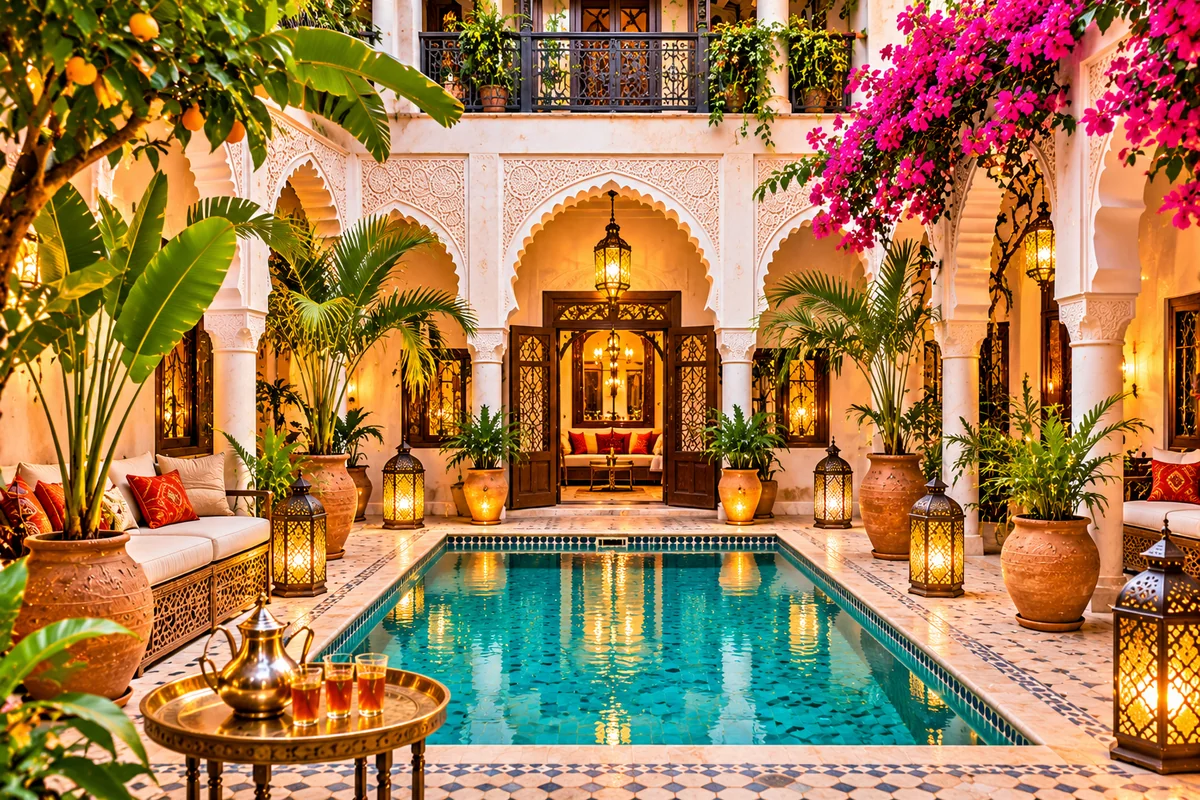
Let us take two hypothetical scenarios.
The first concerns an upscale apartment in France, operated as a holiday rental where local regulations allow it.
The second concerns a four-room riad in Marrakech, legally operated as a guesthouse.
In both cases, we assume a total capital commitment of €500,000, including acquisition, fees and any fitting-out work. This is an educational comparison at equal capital, not two strictly equivalent assets: a single dwelling in France is compared with four rooms sold separately in Marrakech.
This is an educational assumption, not two properties currently for sale.
| Indicator | Airbnb France | Riad Marrakech |
|---|---|---|
| Total investment | €500,000 | €500,000 |
| Units available for sale | 1 dwelling | 4 rooms |
| Average nightly rate | €180 | €120 |
| Occupancy rate | 65% | 75% |
| Room nights sold per year | ≈ 237 | 1,095 |
| Gross accommodation revenue | €42,705 | €131,400 |
With the same committed capital, the riad in this example generates more than three times the apartment’s accommodation revenue.
Why?
Because it has four rooms that can be sold independently.
But this higher revenue does not mean the owner retains three times as much profit.
The riad requires more operating expenditure.
We therefore need to take the comparison further.
How much remains after all costs?
This is the calculation every investor should make before buying.
High revenue can conceal poor profitability when costs are not properly controlled.
Let us take some simplified annual assumptions.
| Item | Airbnb France | Riad Marrakech |
|---|---|---|
| Gross accommodation revenue | €42,705 | €131,400 |
| Gross additional revenue | €0 | €15,000 |
| Total gross revenue | €42,705 | €146,400 |
| Distribution and marketing | €5,500 | €18,000 |
| Staff and service provision | €8,000 | €36,000 |
| Energy, consumables and maintenance | €6,500 | €15,000 |
| Insurance, operating taxes and miscellaneous | €4,000 | €7,000 |
| Direct costs of additional sales | €0 | €6,000 |
| Professional management | €0 | €18,000 |
| Simplified operating surplus | €18,705 | €46,400 |
In this simulation, the riad retains an annual surplus approximately 2.5 times that of the apartment.
But these figures must be interpreted correctly.
The Airbnb owner is assumed to handle certain functions personally, while the riad incurs management fees.
The owner’s full tax position, depreciation, borrowing interest and certain property-related expenditure are not modelled.
The riad’s costs are educational assumptions, not a Darnel Hospitality operating quotation.
We are therefore comparing simplified operating surpluses, not guaranteed net profits.
The difference in operating surplus relative to capital: 3.74% versus 9.28% in our scenario
Let us divide the operating surpluses by the capital invested.
For the French Airbnb:
€18,705 ÷ €500,000 = 3.74% per year.
For the Moroccan riad:
€46,400 ÷ €500,000 = 9.28% per year.
The riad shows an operating-surplus-to-capital ratio approximately 2.5 times higher.
But this ratio must not be confused with net profitability after tax, financing and equipment replacement.
It does not account for resale, exchange-rate risk or changes in property value.
What if the riad reached only 60% occupancy?
At €120 per room, gross accommodation revenue would fall from €131,400 to €105,120, a reduction of €26,280.
With costs unchanged, the simplified surplus would fall to €20,120. This estimate deliberately holds costs at the same level; in practice, some variable costs might decrease with activity.
This deliberately cautious calculation does not account for possible savings on certain variable costs.
It nevertheless shows how sensitive the result is to occupancy.
Our comparison illustrates the potential of the multi-room hospitality model, not a systematic superiority of Morocco over France.
Do you have €300,000, €500,000 or more to invest?
Darnel Collection supports you in analysing riad and boutique-hotel projects in Marrakech.
Book a Darnel Collection strategic appointment →
First advantage of a riad: multiplying revenue units
A riad’s first strength lies in its commercial capacity.
An apartment let on Airbnb generally constitutes a single booking unit.
When occupied, you cannot let it to another guest simultaneously.
A four-room riad can accommodate four independent bookings, depending on its operating model.
A seven-room riad can market seven units.
A boutique hotel with ten suites can market ten.
This capacity allows certain fixed costs to be spread across more room nights.
Take a six-room riad sold at €120 per night, with 70% occupancy.
Its theoretical gross accommodation revenue reaches:
6 × 365 × €120 × 70% = €183,960 per year.
At 80% occupancy, it reaches €210,240.
The difference represents €26,280 in additional gross revenue, before costs.
This capacity explains why the number of rooms is essential when purchasing.
But increasing capacity must never compromise comfort, authorisations or the guest experience.
Second advantage: developing five revenue sources
A conventional Airbnb relies mainly on room nights.
A riad can operate differently.
At Darnel Collection, we study five complementary activities:
- Room nights.
- Additional sales and experiences.
- Packages and themed stays.
- Spa or wellness services.
- Dining, where permitted and economically relevant.
Take a riad generating €180,000 in accommodation revenue.
If it develops €30,000 in additional sales, its total gross revenue reaches €210,000.
But the additional profit depends on the cost of the services.
A service sold for €100 with €60 in direct costs contributes €40, before other costs.
This is why we recommend measuring the margin for each activity.
The objective is not simply to sell more, but to genuinely improve operating results.
Third advantage: creating a distinctive experience
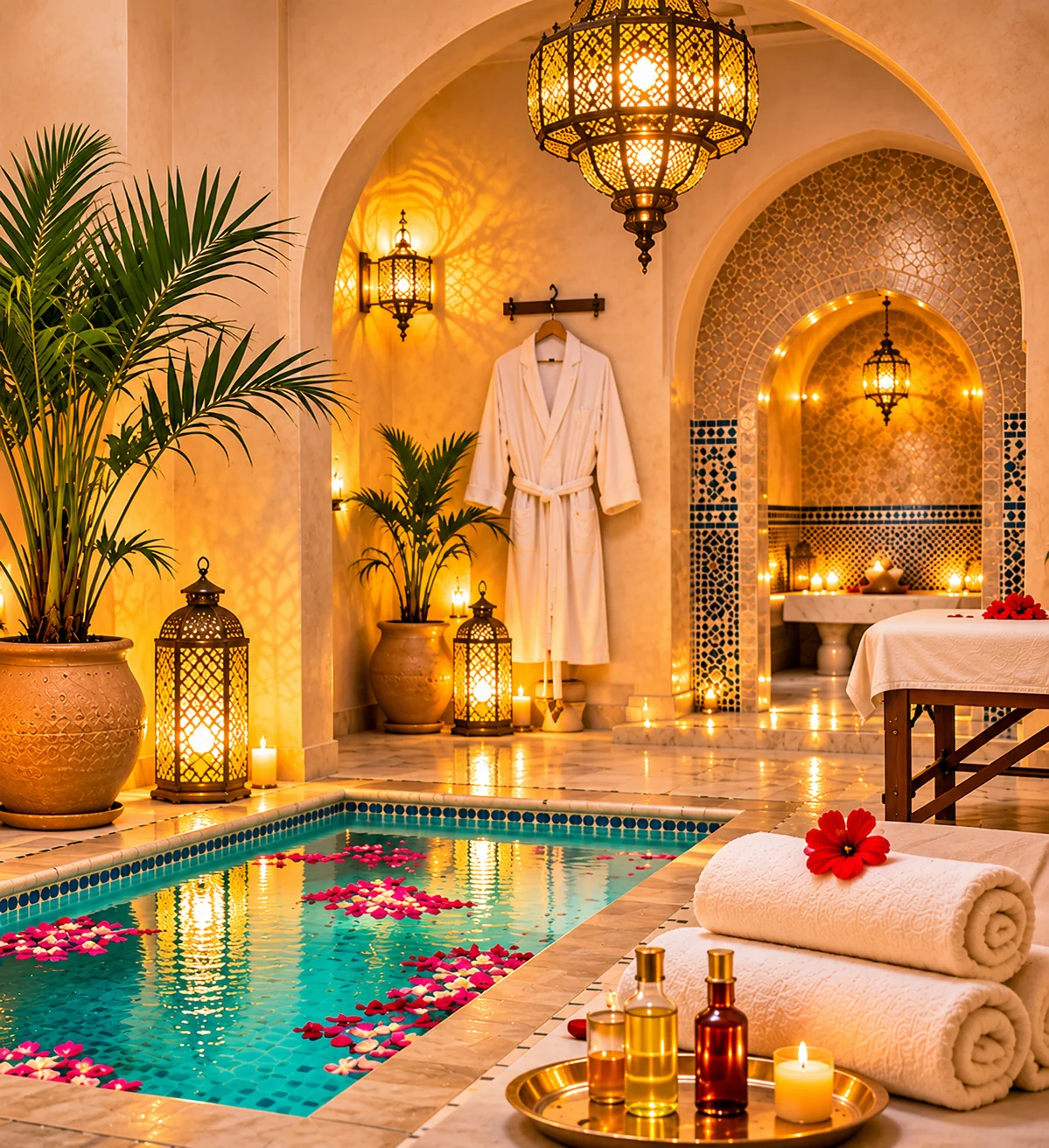
On Airbnb, an apartment may be compared mainly by location, photographs, price and amenities.
A riad has other opportunities for differentiation.
Moroccan architecture, the patio, traditional materials, personalised hospitality and living spaces can create a memorable experience.
A rooftop, a small spa or a dining service can strengthen this identity.
But their profitability must be studied.
An €80,000 spa does not become profitable simply because it looks attractive in photographs.
You need to measure the bookings generated, service margins, maintenance costs and initial investment.
Similarly, a rooftop can improve commercial positioning without directly generating billable revenue.
Differentiation must be considered a commercial investment, not simply a decoration expense.
Fourth advantage: managing prices as a hospitality business
The average nightly rate is not fixed.
It changes with the season, demand, events, competition and the property’s characteristics.
This is the principle of revenue management.
A riad can optimise its ADR, occupancy and RevPAR.
Take a six-room property.
At an average rate of €100 and 70% occupancy, its theoretical gross accommodation revenue reaches €153,300.
At €120 and 75% occupancy, it reaches €197,100.
The difference is €43,800 per year.
However, this increase assumes that the market accepts both the new price and the new occupancy level simultaneously.
An Airbnb apartment can also benefit from dynamic pricing.
The difference lies less in this technique than in the opportunities to optimise a multi-room property with complementary services.
Fifth advantage: developing a hospitality brand
A riad can gradually become a sought-after brand.
Its identity, team, story and reputation can attract travellers who specifically want to stay at that property.
This awareness can support direct bookings.
Reducing dependence on platforms can sometimes retain more revenue after distribution costs.
Take a riad generating €200,000 in accommodation revenue.
If 80% comes from platforms with a hypothetical average commission of 18%, commissions reach €28,800.
With the OTA share reduced to 50%, they fall to €18,000.
Theoretical gross savings amount to €10,800 per year, before direct acquisition expenditure.
This is precisely one of Darnel Hospitality’s areas of work.
Our objective is to help properties become known by name through content, visibility and marketing.
To explore this strategy further, discover our article on direct bookings for riads in Marrakech.
Why can a riad also be much riskier?
It would be misleading to present a riad as an investment without constraints.
Unlike an apartment, a guesthouse is an operational business.
It requires a team, daily organisation, commercial monitoring and guest management.
Staff costs can represent a significant share of the budget.
The building may require specialist work, particularly in the Medina.
Tourism authorisations, compliance and tax obligations must be considered.
For a foreign investor, exchange-rate fluctuations can influence profitability expressed in euros.
The property’s liquidity may also differ from that of an apartment in a large French city.
A riad may offer greater potential operating results, but also greater operational risks.
Choosing a competent operator and the quality of the business plan are therefore decisive.
Would you like to invest in Marrakech without managing your riad every day?
Darnel Collection supports project design and development, while Darnel Hospitality offers marketing and hospitality management solutions.
Discuss my project with the Darnel Group →
Case study: Dar Chemaa, a six-room riad
To illustrate the potential of a six-room property, let us look at the Dar Chemaa forecast.
This project presents a growth strategy over five operating years.
| Indicator | Year 1 | Year 3 | Year 5 |
|---|---|---|---|
| Rooms | 6 | 6 | 6 |
| ADR | €100 | €110 | €120 |
| Occupancy | 75% | 85% | 90% |
| Model’s economic total | €179,946 | €260,754 | €329,396 |
| Forecast surplus after the stated costs and Darnel fees | €72,165 | €119,555 | €154,920 |
These figures come from the forecast supplied for Dar Chemaa.
They illustrate an ambitious scenario, not achieved performance.
The model’s economic total (revenue and complementary margins, according to the forecast) combines revenue with certain margins from complementary activities.
The result therefore cannot be equated with net profit after tax, depreciation and financing costs without checking the accounting scope.
The fifth-year occupancy rate of 90% is particularly demanding.
This case nevertheless illustrates the value of combining accommodation, marketing and complementary services.
How can you properly compare the two investments over five years?
A serious comparison must not be limited to a single year.
You need to prepare a projection including revenue, costs, investments and cash requirements.
Using the annual surpluses from our initial simulation, without growth or inflation:
| Indicator | Airbnb France | Riad Marrakech |
|---|---|---|
| Initial capital | €500,000 | €500,000 |
| Simplified annual surplus | €18,705 | €46,400 |
| Total over 5 years | €93,525 | €232,000 |
| Cumulative ratio / capital | 18.7% | 46.4% |
This projection assumes constant performance over five years.
It excludes final taxation, financing, replacement investments, exchange-rate fluctuations and resale value.
It is therefore not a projection of total net return.
It shows how an annual difference in operating results can accumulate.
To genuinely compare two projects, you need to calculate their after-tax cash flows, exit value and, ideally, internal rate of return.
Simulate your investment
This simulator uses assumptions distinct from the article’s tables and the Dar Chemaa forecast: a 45% operating margin, simulated corporate tax of 20%, and the purchase price alone as the denominator. It does not calculate detailed costs or a total net return. Its assumptions are available within the tool and guarantee no results.
Estimate your riad’s profitability
Occupancy: +5 percentage points/year up to 90 %, then +2.5 points/year up to 95 %.
Estimate based on the purchase price alone. Works, acquisition costs and financing are excluded from the return.
Your 5-year projection
Version 2 · Percentage-point progression · Updated 6 October 2026
| Year | Occupancy | Price / night | Add. sales | Annual revenue | Operating result | After corporate tax | Return |
|---|
Understanding the assumptions and calculations
The operating result is fixed at 45 % of total revenue, with operating expenses therefore estimated globally at 55 %. Corporate tax is simulated at 20 % of positive operating result, without modelling depreciation, deductions or the project’s specific tax regime. The result after corporate tax is not a cash-flow calculation after financing.
Average room price per night rises by 7.5 % a year, compounded. Occupancy rises by 5 percentage points a year up to 90 %, then by 2.5 points a year up to 95 %: 60 %, 65 %, 70 %… 90 %, 92.5 %, 95 %. Additional sales rise by 5 percentage points a year up to 30 % of room revenue, then by 2.5 points a year, without a projection cap. If an increase crosses a threshold, it stops at that threshold for that year (examples: 88 % → 90 %; 28 % → 30 %). The operating margin remains constant.
Return equals the annual result after corporate tax divided by the purchase price. No return on equity is calculated. An owner may replace the purchase price with the reference value they wish to analyse.
Fixed indicative conversion: €1 = 10.90 MAD. Displayed amounts are rounded; calculations use unrounded values.
Indicative, non-binding simulation. These assumptions guarantee neither future performance nor applicable taxation.
Help your riad work towards these results
Discuss your project and its profitability drivers with Darnel Hospitality.
Request an advisory appointmentCompare different assumptions for average rate, occupancy and costs before making your decision.
When does a French Airbnb remain preferable?
Investing in an apartment in France may be better suited to some profiles.
An investor seeking relatively simple management, geographical proximity or property exposure in a familiar market may prefer this solution.
A well-bought apartment in a city where holiday letting is permitted and demand is strong can perform well.
It may also be converted to medium- or long-term letting, subject to applicable rules.
Conversely, a riad generally requires greater operational involvement, even when management is delegated.
Potential profitability must therefore not be the only criterion.
Time commitment, risks, liquidity and wealth objectives must all be considered.
Our vision: investing in a property asset that generates a business
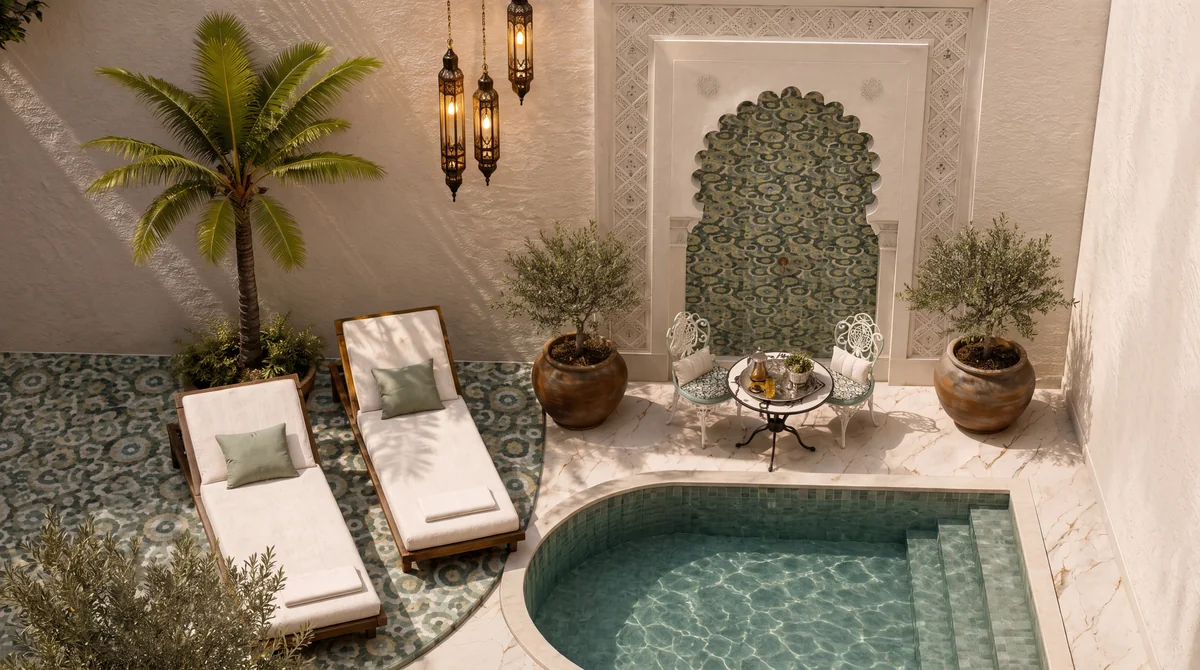
INVESTMENT CASE — DAR LÉON & SPA
4 rooms • Bab Doukkala • Riad & Spa
Dar Léon & Spa illustrates our vision: designing a property whose architecture, comfort and guest experience are planned for coherent hospitality operations.
With approximately 200 m² of developed floor area, the project shows the importance of optimising spaces and services from the design stage.
Discover Darnel Collection projects →
At Darnel Collection, we do not consider a riad solely as a property.
We design it as an asset intended to accommodate a hospitality business.
This changes how a building is selected.
You need to analyse the possible room count, the quality of the spaces, technical constraints, amenities and target guests.
You must also think about marketing before work even begins.
A perfectly designed but poorly marketed riad can produce disappointing results.
Conversely, a distinctive, well-operated property with a structured commercial strategy can make better use of its accommodation capacity.
It is this combination of property, hospitality and management that interests us.
FAQ: investing in a riad in Marrakech or an Airbnb in France
Is a riad always more profitable than an Airbnb in France?
No. Our simulation illustrates greater potential, but the result depends on the purchase price, operations, costs and risks.
What budget should you allow for investing in a riad?
The budget depends on the neighbourhood, floor area, condition, work required and level of service sought. The €500,000 used here is a comparison assumption.
Can you manage a riad from France?
Yes, with a local organisation and professional management, but the owner must maintain financial and strategic oversight.
What is the difference between revenue and profitability?
Revenue measures sales. Profitability takes costs and invested capital into account, within the chosen calculation scope.
Explore your project further
Also discover:
Join the Darnel Collection Private Club →
Are you also considering moving to Morocco or starting a business there? Discover our book Réussir sa nouvelle vie au Maroc : le guide pratique pour s'installer, investir et prospérer.
Conclusion: is a riad in Marrakech really more profitable than an Airbnb in France?
A riad can be more profitable than an Airbnb in France, but this is neither systematic nor guaranteed.
In our €500,000 investment simulation, the four-room riad generates an annual operating surplus of €46,400, compared with €18,705 for the French apartment.
The difference comes mainly from the number of units sold and complementary revenue.
But this performance requires sufficient demand, effective marketing, cost control and professional operations.
A poorly bought, designed or managed riad can become less profitable than a well-chosen French apartment.
Before investing, you need to compare projects at equal capital, calculate their actual cash flows and analyse their risks.
The right question is not simply: “Where can I buy more cheaply?”
It is rather: “Which asset can I develop to create the most value sustainably, with a level of risk I am prepared to accept?”
At Darnel Collection, we support investors wishing to explore this opportunity in Marrakech.
Book my Darnel Collection strategic appointment →
Georges Lelièvre — Darnel Collection
The comparison figures are illustrative assumptions, not market averages or promises of returns. The Dar Chemaa forecast is a non-guaranteed financial scenario.