
Investing
Investing in a riad with a spa in Marrakech: how much additional revenue can you expect?
Can a hammam, massage room or private wellness area really improve the profitability of a riad in Marrakech? Under certain conditions, yes. A spa can generate ancillary sales, enrich the guest experience and support a more upscale positioning.
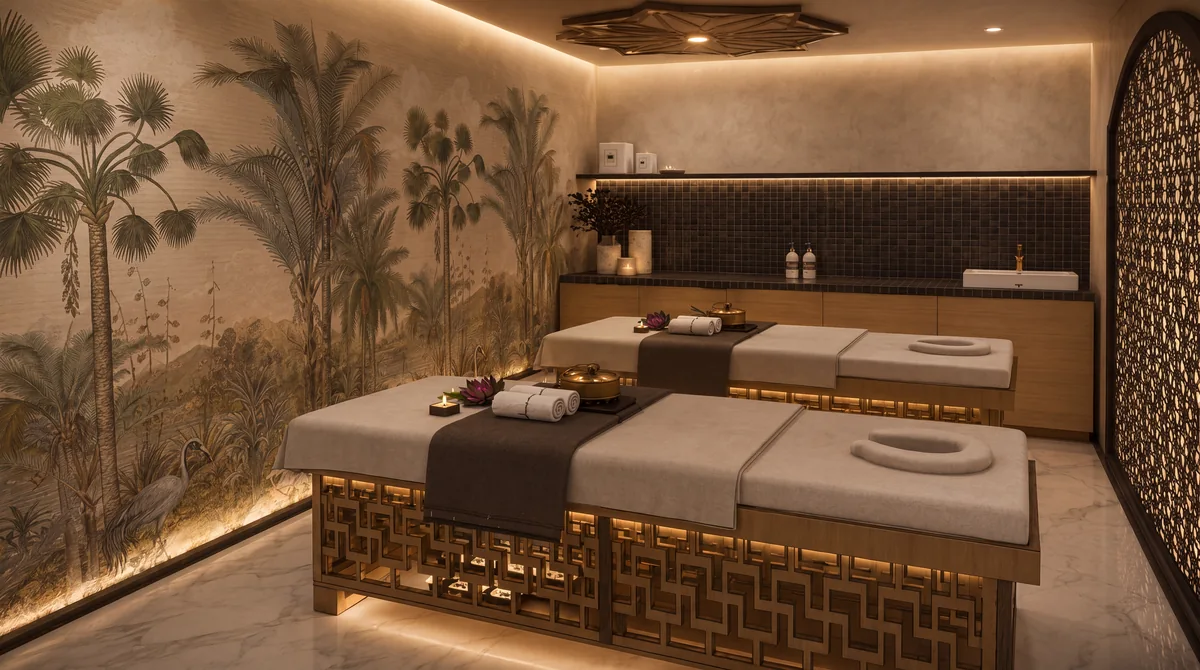
Can a hammam, massage room or private wellness area really improve the profitability of a riad in Marrakech? Under certain conditions, yes. A spa can generate ancillary sales, enrich the guest experience and support a more upscale positioning.
But installing a hammam is not enough to automatically increase room rates or generate a profit. Demand, service standards, staffing costs, technical constraints and marketing determine the outcome.
At Darnel Collection, we consider these questions from the design stage of our riad & spa projects. Our aim is to create properties where every space contributes to the guest experience and can be assessed economically.
The following simulations help explain what a spa can contribute, what it costs and when investing in one may make sense. All amounts below are illustrative assumptions, excluding tax, rather than observed performance or guarantees of profitability.
WHY CAN A SPA IMPROVE A RIAD’S BUSINESS MODEL?
A wellness area can influence three distinct drivers.
1. Support higher room rates
A riad offering a coherent experience — architecture, decoration, welcome, comfort, hammam and treatments — can target guests willing to pay more. A spa can contribute to this differentiation, but it never explains the room rate on its own. Location, overall quality, reputation, season and competition remain decisive.
2. Develop ancillary sales
A guest may book a private hammam, massage or couples’ ritual in addition to accommodation. These services increase revenue per stay without requiring additional rooms. However, they incur direct costs: staff, linen, products, consumables, water and energy.
3. Sell complete experiences
A romantic getaway can combine two nights, dinner, a hammam and a massage. Packages make services easier to understand and offer before arrival. Accommodation and services must nevertheless be accounted for separately to avoid counting the same revenue twice.
Darnel advice: plan the spa at the architectural design stage. Floor area, ventilation, drainage, hot water production, privacy, circulation, capacity and staffing arrangements must be studied before building work begins.
CASE STUDY 1 — INCREASING ADR FROM €100 TO €150 OVER FIVE YEARS
Consider a four-room riad operating all year. The simulation below assumes commercial growth in ADR — the average daily rate of a room sold — from €100 excluding tax to €150 excluding tax over five years, alongside an increase in occupancy.
Year 1: ADR €100; occupancy 55%; room revenue €80,300 excluding tax.
Year 2: ADR €110; occupancy 58%; room revenue €93,148 excluding tax.
Year 3: ADR €120; occupancy 60%; room revenue €105,120 excluding tax.
Year 4: ADR €135; occupancy 63%; room revenue €124,173 excluding tax.
Year 5: ADR €150; occupancy 65%; room revenue €142,350 excluding tax.
Theoretical room revenue increases by approximately 77% between the first and fifth years. This change results from two combined assumptions: higher average rates and higher occupancy. It therefore cannot be attributed to the spa alone.
To isolate the mathematical effect of price, compare two ADRs at a constant occupancy of 65%:
- At €100 excluding tax: 4 × 365 × 65% × €100 = €94,900 excluding tax per year.
- At €150 excluding tax: 4 × 365 × 65% × €150 = €142,350 excluding tax per year.
- Theoretical difference: €47,450 excluding tax per year.
This difference illustrates the impact of a €50 increase in ADR. It does not represent additional revenue that a spa would automatically produce. Measuring its actual effect on room rates would require comparing similar properties, with and without spas, over a sufficiently long period.
Darnel advice: treat €150 as a positioning target to test against a competitive study, rather than a guaranteed consequence of having a hammam.
CASE STUDY 2 — HOW MUCH REVENUE CAN A PRIVATE SPA GENERATE?
Imagine a riad offering private hammams and massages, mainly to its own resident guests.
Assumptions:
- Average price per service: €65 excluding tax.
- Ten services sold per week.
- Fifty operating weeks per year.
Revenue calculation: €65 × 10 × 50 = €32,500 excluding tax per year.
This amount is revenue, not profit. To estimate the activity’s economic contribution, assume direct costs equal to 45% of revenue.
Spa revenue: €32,500.
Estimated direct costs at 45%: €14,625.
Contribution margin before fixed costs: €17,875.
This contribution margin must still cover any specific fixed costs, equipment maintenance, depreciation, financing and taxes. The 45% rate is a simulation assumption: it must be replaced with the costs actually observed at the property.
With twenty services per week, at the same price and proportional costs, revenue would reach €65,000 excluding tax and the contribution margin €35,750. This growth nevertheless requires sufficient demand, available time slots and staffing resources.
WHAT IS A SPA’S BREAK-EVEN POINT?
Assume a hypothetical initial investment of €40,000 for fit-out and equipment. Also assume €5,000 in additional annual fixed costs and a unit contribution of 55% of the selling price, or €35.75 per service.
To cover only the €5,000 in annual fixed costs:
€5,000 ÷ €35.75 = approximately 140 services per year, or 2.8 services per week over fifty weeks.
To also recover the €40,000 investment over three years, approximately €13,333 must be generated each year towards the economic recovery of the investment, plus the €5,000 in fixed costs. The target annual contribution is therefore approximately €18,333.
€18,333 ÷ €35.75 = approximately 513 services per year, or 10.3 services per week over fifty weeks.
With ten services per week, the annual contribution after fixed costs would be:
€17,875 − €5,000 = €12,875.
The simple payback period would then be:
€40,000 ÷ €12,875 = approximately 3.1 years.
This period is an approximation. It does not account for the time value of money, financing costs, taxes, equipment replacement or a possible gradual ramp-up. Above all, it shows that the volume of services sold is decisive.
CASE STUDY 3 — INCREASING AVERAGE SPEND WITH PACKAGES
Consider a romantic two-night stay.
Example package contents:
- Two nights: €300 excluding tax.
- Private hammam: €60 excluding tax.
- Couples’ massage: €120 excluding tax.
- Dinner: €80 excluding tax.
- Total value of services sold separately: €560 excluding tax.
- Package price: €520 excluding tax.
The guest saves €40 compared with buying separately. For the property, a package can make it easier to sell several services at booking and improve the organisation of the stay.
One hundred packages sold at €520 represent €52,000 excluding tax in total sales. But if the €300 accommodation component per package is already counted in room revenue, the additional revenue attributable to the other services is at most €22,000 excluding tax, before deducting their costs.
This €22,000 is not necessarily entirely new revenue: some guests might have purchased a massage or dinner separately. The right measure is therefore the actual additional margin created by the package, allowing for sales that would have occurred without it.
CASE STUDY 4 — BUSINESS MODEL OF A FOUR-ROOM RIAD WITH A SPA
Let us combine the activities in a fifth-year simulation.
Assumptions:
- Four rooms.
- ADR of €150 excluding tax.
- Annual occupancy of 65%.
- Spa mainly reserved for resident guests.
- Other services accounted for excluding room nights and treatments already included.
Annual revenue:
- Accommodation: €142,350 excluding tax.
- Spa and wellness: €32,500 excluding tax.
- Other services and experiences: €20,000 excluding tax.
- Total: €194,850 excluding tax.
To make the cost assumption clearer, here is an indicative breakdown of the €125,000 operating cost envelope used in this simulation:
- Staff and social security contributions: €48,000.
- Distribution commissions and selling costs: €18,000.
- Direct costs of spa services: €14,625.
- Purchases and direct costs of other services: €8,000.
- Water, electricity and energy: €10,000.
- Maintenance and upkeep: €5,000.
- Marketing and communications: €6,000.
- Insurance, administration and other costs: €7,000.
- Allowance for miscellaneous routine expenditure: €8,375.
- Total operating costs: €125,000.
This breakdown is an educational construct intended to show the composition of the envelope. It is not a standard budget for the Marrakech market. Amounts must be recalculated according to the building, staffing, service level, actual commissions, management contract and services actually sold. Any management fees must be explicitly included and must not be counted twice if already included in another line.
The theoretical operating surplus in this simulation is:
€194,850 − €125,000 = €69,850.
Relative to a hypothetical total investment of €550,000, this represents:
€69,850 ÷ €550,000 = 12.7%.
This is a ratio between a simulated operating surplus and a hypothetical initial investment. It is neither a net property yield nor a return after taxes, interest, depreciation and equipment replacement. It must not be presented as guaranteed performance.
WHAT WOULD THE RESULT BE WITHOUT A SPA?
To measure the additional profitability actually delivered by the spa, two scenarios based on consistent assumptions must be compared.
Without-spa scenario: room and other service revenue, corresponding costs, and initial investment excluding a wellness area.
With-spa scenario: the same foundations, plus spa revenue, direct costs, specific fixed costs and initial investment. Any increase in ADR or occupancy should only be included if justified by the positioning and market study.
The difference between the two results, rather than spa revenue in isolation, measures the economic contribution of the spa project.
Darnel advice: before starting work, calculate the number of treatments you need to sell each week to cover fixed costs and achieve your desired payback period.
SIMULATE YOUR RIAD & SPA PROJECT
Explore the existing Dar Léon simulator. Its adjustable parameters are independent of the illustrative assumptions in this article.
Receive the Marrakech Riad Investor Kit and join the Private Club.
WHY DARNEL COLLECTION DEVELOPS RIADS & SPAS
Our approach is based on five complementary objectives.
1. Target coherent room rates
We aim to design properties whose overall experience can support a higher average rate. The spa contributes to this value proposition alongside architecture, decoration and service quality.
2. Develop ancillary sales
Wellness services can increase revenue per guest without increasing the number of rooms.
3. Attract guests seeking an experience
A couple choosing a stay with a private hammam is not necessarily seeking the same product as a traveller focused solely on the lowest price. Differentiation can help defend a premium positioning.
4. Sell packaged offers
Romantic getaways, birthdays and wellness stays can be offered before arrival. Advance sales help teams prepare and organise available slots.
5. Prepare for boutique hotel development
Riads with four to seven rooms allow services, procedures, sales methods and training to be tested. These lessons can then be adapted to larger properties.
Our ambition is not simply to add a hammam to every riad, but to develop a distinctive and economically coherent hospitality model.
CASE STUDY 5 — DAR LÉON & SPA IN BAB DOUKKALA
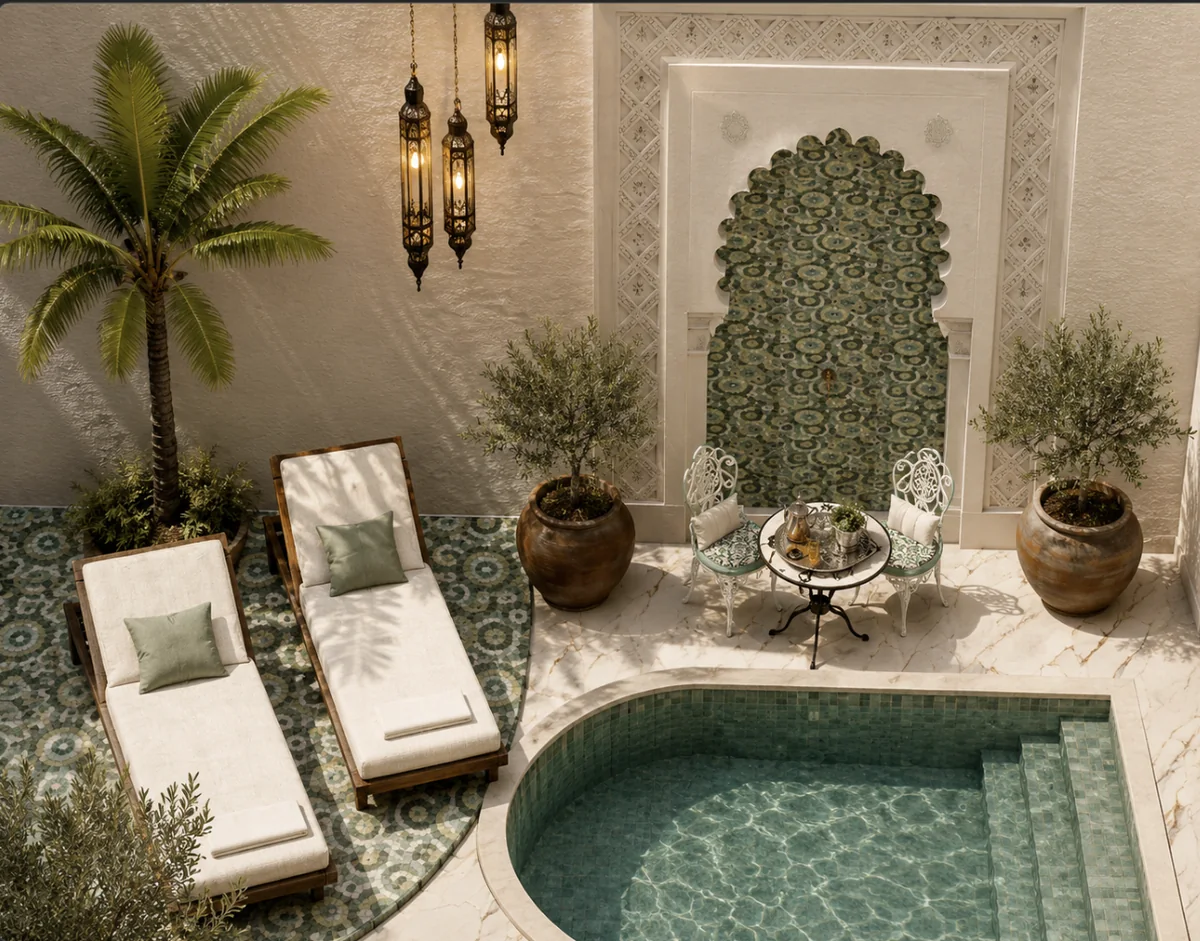
INVESTMENT CASE — DAR LÉON & SPA
Four rooms • Bab Doukkala • Riad with a private wellness area
Dar Léon & Spa is a project developed by Darnel Collection in Marrakech’s Bab Doukkala neighbourhood. It provides for four rooms, a patio with a plunge pool, a rooftop and a private wellness area.
This project illustrates our approach: integrating wellness services from the design stage to offer an intimate and distinctive experience. The aim is to enhance the value of room nights, treatments and packaged stays, without presuming future commercial results.
Project reference points:
- Four rooms.
- Approximately 200 m² of developed floor area.
- Announced asking price: €550,000 excluding fees.
CASE STUDY 6 — A SEVEN-ROOM RIAD WITH A HAMMAM
Imagine a seven-room riad equipped with a hammam and a massage room.
At an ADR of €140 excluding tax and 65% occupancy:
7 × 365 × 65% × €140 = €232,505 excluding tax in annual accommodation revenue.
Add:
- €45,000 excluding tax in spa services.
- €30,000 excluding tax in other ancillary sales and experiences, excluding accommodation and treatments already accounted for.
Total revenue reaches €307,505 excluding tax.
If complete operating costs amount to €205,000 in this assumption, the theoretical operating surplus is €102,505.
This result depends entirely on the chosen assumptions. Costs must include the direct costs of treatments and ancillary sales as well as other routine expenditure. It does not demonstrate that the spa alone generates this surplus.
Darnel advice: for a seven-room riad, track accommodation, spa and other ancillary sales revenue and margins separately.
OPENING THE SPA TO OUTSIDE GUESTS AFTER THREE YEARS: AN OPPORTUNITY?
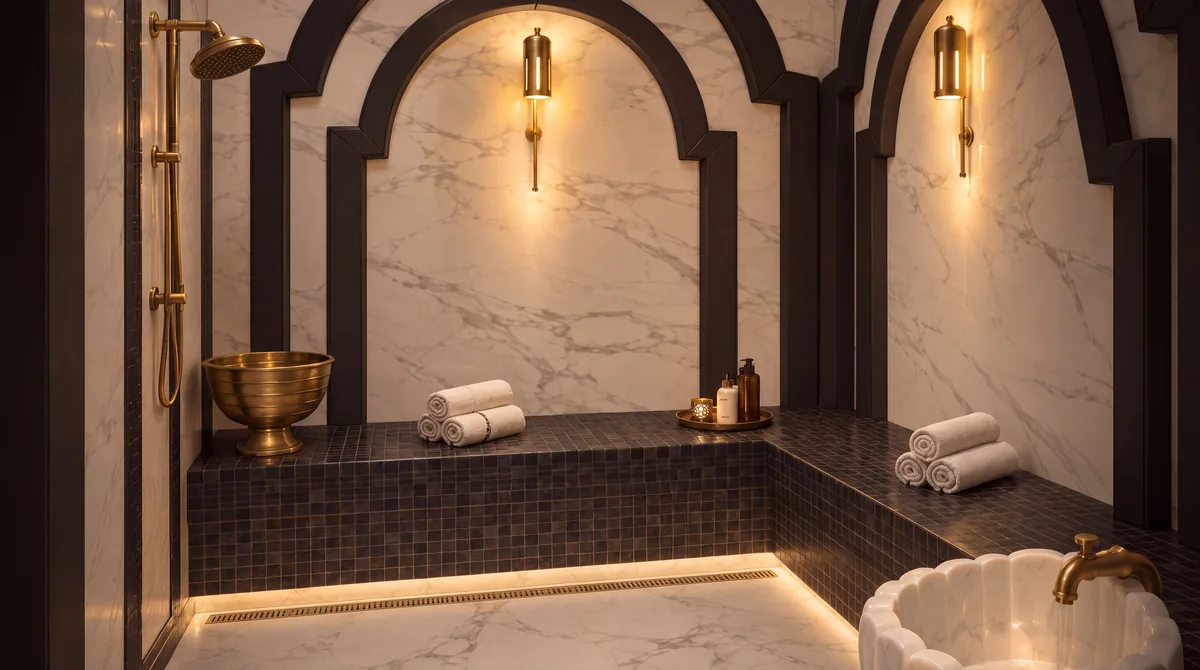
A gradual strategy may make sense.
Years 1 to 3: priority to resident guests
The aim is to build the property’s reputation, train teams, master treatment quality and measure demand. The spa mainly serves guests staying at the riad.
From year 4: consider opening to outside guests
Once operations have stabilised, welcoming outside guests can be considered. This depends in particular on applicable authorisations, access, facility capacity, staffing, safety and profitability. It must never be taken for granted in advance.
Outside guest revenue simulation:
Eight additional services per week × €70 excluding tax × fifty weeks = €28,000 excluding tax in annual revenue.
With 45% direct costs, the theoretical contribution margin would be €15,400, before any additional fixed costs.
Darnel advice: a well-marketed private spa is better than a space open to the public whose attendance fails to cover the additional expenditure and constraints.
HOW CAN YOU MARKET A RIAD WITH A SPA EFFECTIVELY?
A hammam does not generate bookings simply by existing. Sales must be organised before, during and after the stay.
Before arrival
Offer romantic packages, massages and private services as soon as a booking is confirmed. Present prices, durations and booking arrangements clearly.
During the stay
Train the team to present offers naturally, taking account of availability and guests’ preferences.
After the stay
Encourage guest reviews and recommendations. Measure which services were appreciated and which need improvement.
Across acquisition channels
Showcase the wellness area on the website, booking platforms, social media and sales materials. Professional photographs and short videos help show the experience on offer in concrete terms.
FOUR INDICATORS TO TRACK
- Treatment purchase rate: the proportion of stays generating at least one spa service.
- Average spa spend: spa revenue divided by the number of sales.
- Contribution margin per treatment: the price excluding tax minus the associated direct costs.
- Spa revenue per occupied room: spa revenue divided by the number of room nights sold.
At Darnel Hospitality, these indicators can be integrated into the property’s operating monitoring and marketing strategy.
DO YOU ALREADY OPERATE A RIAD IN MARRAKECH?
Request a performance audit from Darnel Hospitality.
FAQ — INVESTING IN A RIAD WITH A SPA IN MARRAKECH
Does a spa automatically increase room rates?
No. It can support a premium positioning, but pricing depends on the overall experience, location, reputation and competitive market.
How much revenue can a private spa generate?
In our simulation, ten services per week at €65 excluding tax for fifty weeks generate €32,500 excluding tax in annual revenue. After assuming 45% direct costs, the contribution margin is €17,875, before fixed costs, depreciation, financing and taxes.
How much does it cost to create a spa in a riad?
The cost depends on building work, technical installations, floor area and equipment. Our example uses €40,000 for illustration; this amount is neither a market price nor a quotation.
How do you calculate a spa’s return on investment?
Compare the initial investment with the additional contribution actually generated, after direct costs and specific fixed costs. Financing, taxation and equipment replacement must also be considered.
Why offer wellness packages?
Packages make it easier to buy several services and can increase the value of a stay. Their benefit must be measured using the actual additional margin, avoiding counting room nights or services already sold twice.
Should the spa open to outside guests immediately?
Not necessarily. An initial phase reserved for resident guests allows demand and service quality to be tested. Opening to outside guests must then be assessed against authorisations, access, capacity and profitability.
What is the main risk?
Investing in expensive equipment without sufficient demand, suitable staff or a commercial strategy to sell the services.
EXPLORE YOUR INVESTMENT FURTHER
To prepare for your move and investment, also discover the book Réussir sa nouvelle vie au Maroc.
CONCLUSION — A SPA CAN BECOME A PROFITABILITY DRIVER IF IT IS OPERATED WELL
Investing in a riad with a spa in Marrakech can offer several advantages: distinctive positioning, ancillary sales, packaged offers and a more complete guest experience.
But a profitable spa is more than a well-designed spa. It is a space whose attendance, selling prices and margins justify operating costs and the initial investment.
At Darnel Collection, we view the riad & spa model as a strategic step in developing premium hospitality and preparing future boutique hotels. Our aim is to design properties where every space delivers measurable value.
Would you like to invest in a riad with a spa in Marrakech?
Let us study your budget, positioning and profitability prospects with Darnel Collection.
Book an advisory appointment with Darnel Collection.
Georges Lelièvre — Darnel Collection
DISCLAIMER
The figures in this article are indicative simulations based on explicit assumptions. They are neither historical performance, a market study nor a guarantee of revenue or profitability. Every project requires an operating budget and regulatory checks tailored to the property concerned.