
Darnel Collection · Journal ·
Riad or boutique hotel in Marrakech: which investment withstands a tourism downturn best?
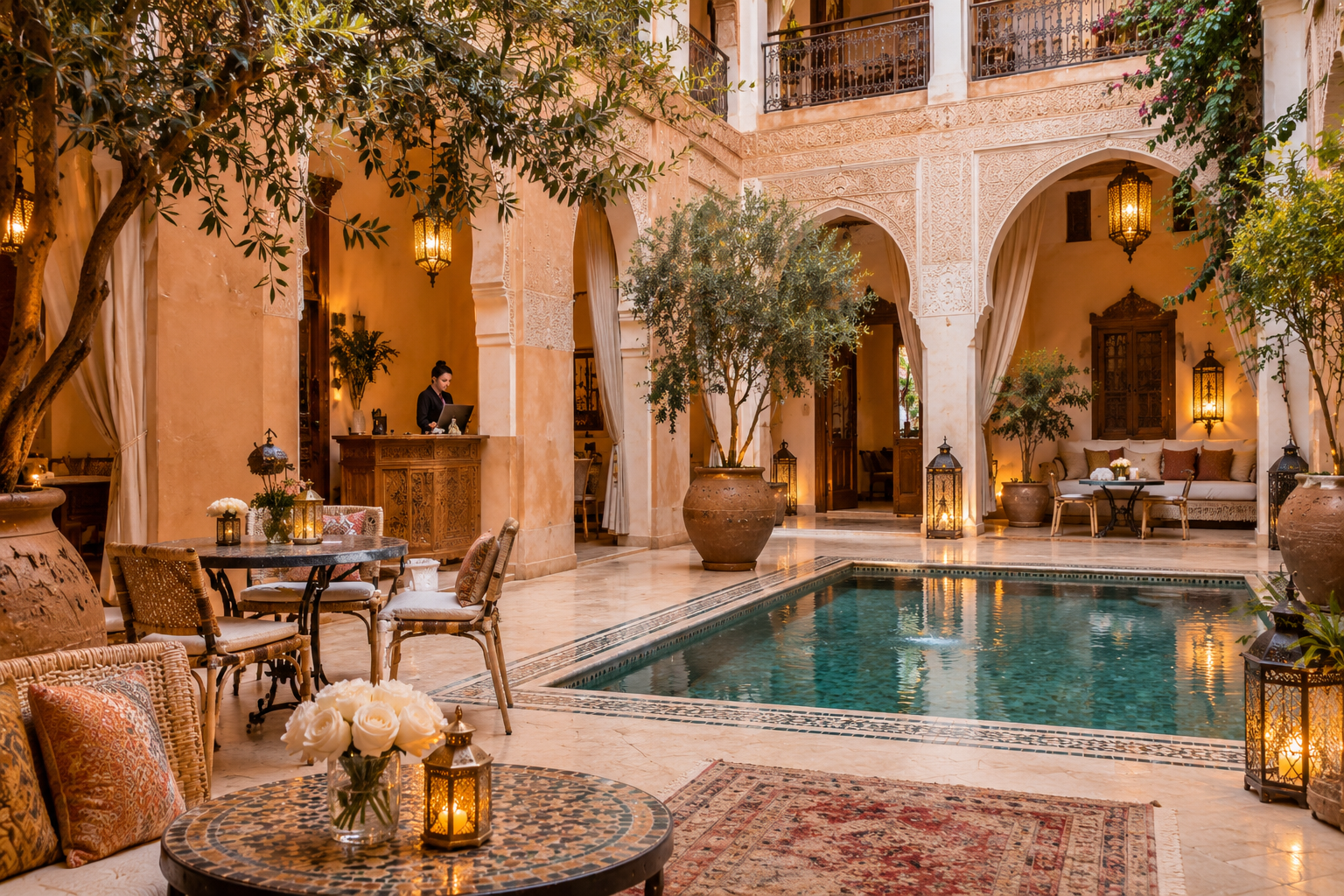
A profitability comparison between a six-room riad and a ten-room boutique hotel in Marrakech, with financial simulations and crisis scenarios.
When bookings fall, some properties start losing money. Others continue to make a profit. Why?
Investing in a riad in Marrakech remains an interesting opportunity. However, the tourist accommodation market is becoming increasingly competitive.
An attractive courtyard, a few comfortable rooms and a presence on Booking.com are no longer necessarily enough to guarantee profitable operation throughout the year.
Travellers compare properties, prices and the experiences on offer.
Against this backdrop, one question deserves consideration: is a ten-room boutique hotel better equipped than a traditional six-room riad to weather a tourism downturn?
There is no automatic answer.
A well-run six-room riad can offer excellent profitability and controlled fixed costs. Conversely, a poorly marketed boutique hotel can become particularly vulnerable in difficult periods.
At Darnel Collection, we believe the difference rests above all on commercial strategy and financial structure.
A well-designed boutique hotel may enjoy several advantages: a strong identity, more rooms, several customer segments, additional revenue and greater marketing capacity.
But these advantages must compensate for higher fixed costs and a larger initial investment.
Let us compare two fictional properties in Marrakech, using figures.
Contents
Why a tourism downturn makes riads vulnerable
Six-room riad or ten-room boutique hotel
Financial comparison in a normal year
Simulating a tourism downturn
Five marketing levers for a boutique hotel
The importance of additional revenue
Direct bookings during a crisis
Financial resilience simulator
Kasbah Nelaria & Spa
Risks and fixed costs
How to prepare your property
Discover Marrakech on video
Why can a tourism downturn make a riad vulnerable?
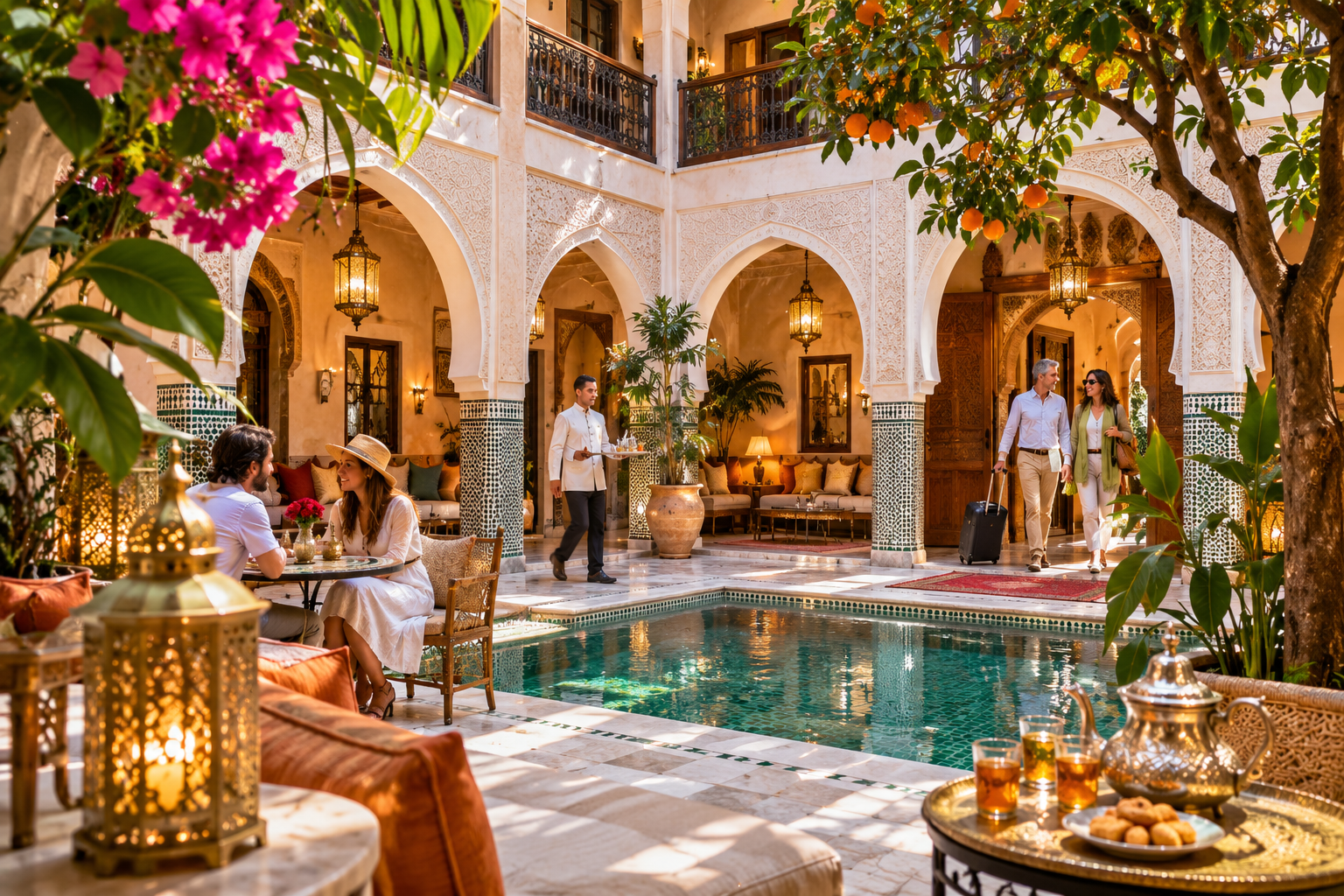
A six-room riad has limited commercial capacity.
With six rooms, it can sell a maximum of 2,190 room nights per year.
When demand slows, every unsold room directly affects results.
Consider an example.
A riad sells its rooms at €140 excluding tax per night, with 70% occupancy.
Its annual room revenue reaches:
6 × 365 × €140 × 70% = €214,620 excluding tax.
If occupancy falls to 50% and its ADR declines to €125, room revenue falls to €136,875.
That represents a fall of approximately 36.2% in room revenue.
This is a decrease of 20 percentage points in occupancy, accompanied by a lower average rate.
Yet costs do not necessarily fall in the same proportions.
Wages, maintenance contracts, insurance and certain operating expenses continue.
This is one of the main dangers of hotel operation: revenue can fall much faster than fixed costs.
Six-room riad or ten-room boutique hotel: two business models
A six-room riad can offer an intimate experience, personalised service and attractive profitability with a relatively controlled investment.
A ten-room boutique hotel generally requires more capital, staff and organisational resources.
But it can also develop a broader commercial offering.
| Criterion | Six-room riad | Ten-room boutique hotel |
|---|---|---|
| Maximum annual capacity | 2,190 room nights | 3,650 room nights |
| Positioning | Intimate | Premium and experiential |
| Potential customers | Couples, families, friends | Couples, groups, golf, wellness, businesses |
| Additional revenue | Depending on facilities | Potentially diversified |
| Marketing | Often a constrained budget | Potentially greater investment capacity |
| Fixed costs | Generally lower | Generally higher |
| Initial investment | More accessible | Higher |
This table describes two possible positions, not universal characteristics.
A six-room riad can certainly have a spa, a strong brand and excellent marketing.
The real difference lies not just in the number of rooms, but in the business model built around the property.
Financial comparison: a normal tourism year
Let us compare two fictional projects.
The first is a six-room riad.
The second is a ten-room boutique hotel with a spa, food services and additional services.
Operating assumptions
| Annual indicator | Six-room riad | Ten-room boutique hotel |
|---|---|---|
| ADR excluding tax | €140 | €190 |
| Occupancy | 70% | 70% |
| Room revenue excluding tax | €214,620 | €485,450 |
| Additional revenue excluding tax | €42,924 | €169,908 |
| Total revenue excluding tax | €257,544 | €655,358 |
| Fixed costs | €125,000 | €310,000 |
| Variable costs | €64,386 | €183,500 |
| Operating result | €68,158 | €161,858 |
Educational simulation. Additional revenue: 20% of room revenue for the riad and 35% for the boutique hotel. Variable costs: 25% and 28% of total revenue respectively. Costs assume operation, marketing and management, without double counting. Results before depreciation, taxes and financing.
First observation: more revenue, but also more capital
The boutique hotel generates approximately 2.5 times more revenue.
It also has a higher operating result.
But it requires much more capital.
If the riad represents an investment of €800,000 and the boutique hotel €2,300,000, their indicative operating returns are 8.5% and 7% respectively.
These ratios are not net distributable returns.
The boutique hotel is therefore not automatically more profitable in relation to the capital invested.
Its potential benefit becomes clearer when we analyse its resilience in difficult periods.
What happens if tourism slows in Marrakech?
Imagine a slowdown in tourism demand.
Both properties suffer fewer bookings and must adjust their rates.
However, in our simulation, the boutique hotel has a more diversified commercial strategy.
It attracts individual travellers, groups, wellness stays and local spa customers in particular.
Simulated crisis scenario
| Indicator | Six-room riad | Ten-room boutique hotel |
|---|---|---|
| ADR excluding tax | €125 | €180 |
| Occupancy | 50% | 55% |
| Room revenue excluding tax | €136,875 | €361,350 |
| Additional revenue excluding tax | €20,531 | €108,405 |
| Total revenue excluding tax | €157,406 | €469,755 |
| Fixed costs | €125,000 | €310,000 |
| Variable costs | €39,352 | €131,531 |
| Operating result | –€6,945 | €28,224 |
Stress-test assumptions, not crisis forecasts. Occupancy, ADR and ancillary revenue change differently to illustrate the possible effect of better diversification. Fixed costs remain constant and variable costs fall in proportion to revenue.
Crisis scenario results: what the simulation shows
In this simulation, the six-room riad makes an operating loss.
The boutique hotel retains a positive result of approximately €28,000.
Why?
Because it has more rooms, ancillary revenue and assumed better-diversified demand.
But be careful: simply owning ten rooms does not guarantee this result.
If the boutique hotel loses as many customers, sells fewer services or bears excessive fixed costs, it too can make a loss.
The quality of its commercial model makes the difference.
Five marketing levers for a boutique hotel
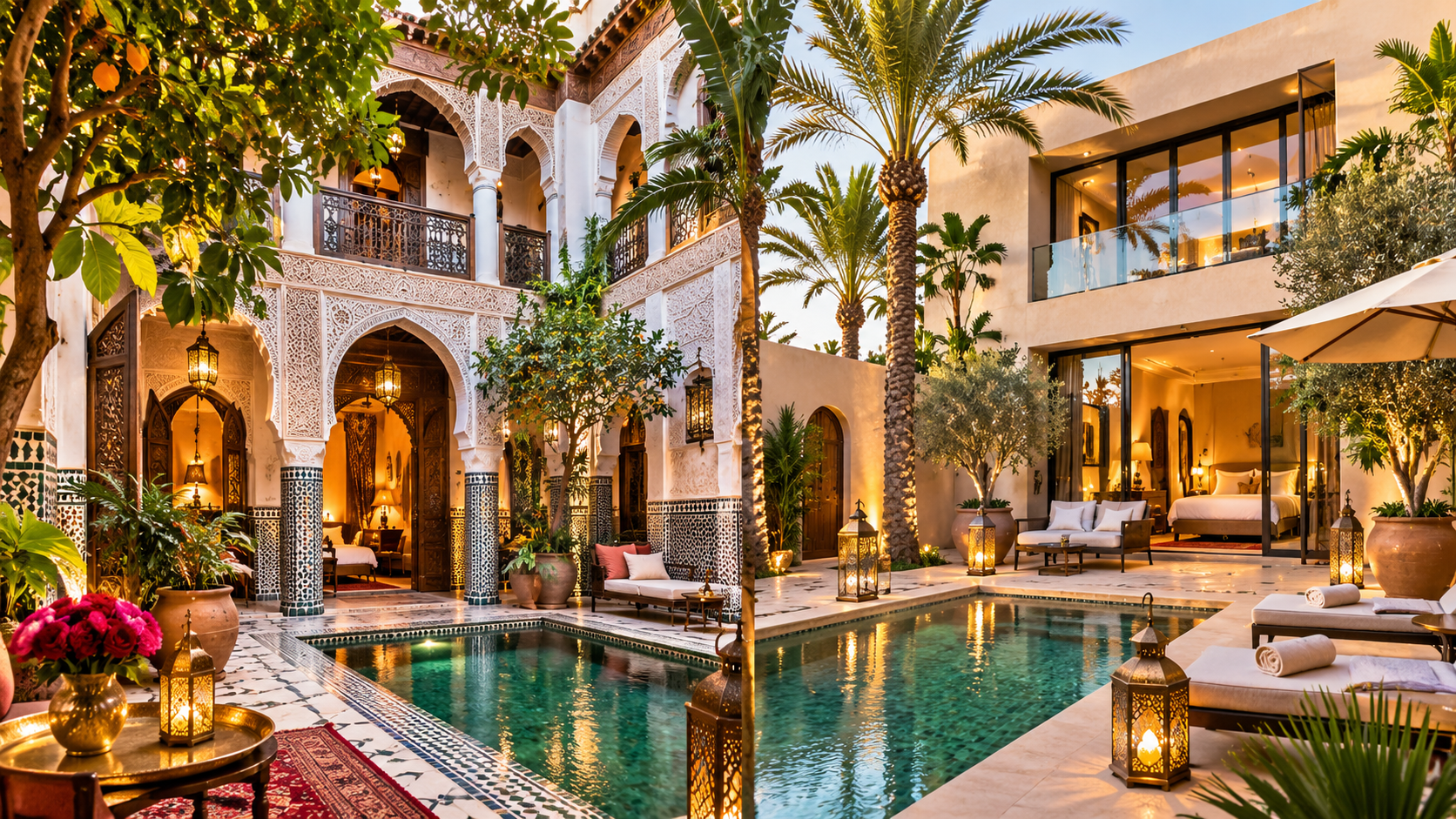
1. A stronger hotel brand
A boutique hotel can develop a recognisable visual identity, an architectural world and a real promise of experience.
This differentiation can reduce competition based solely on price.
2. Several customer segments to approach
A ten-room property can simultaneously target couples, groups of friends, golfers, wellness enthusiasts and small private events.
When one segment slows, the others can partially compensate.
3. Greater marketing capacity
With more potential revenue, a boutique hotel may have a larger budget for Google Ads, YouTube, social media, agencies and direct-booking campaigns.
But that budget must be managed according to its return on investment.
4. B2B partnerships
Travel agencies, golf-stay organisers, businesses and wellness specialists can help fill rooms.
A ten-room property offers useful capacity for certain small groups.
5. Better marketing of experiences
Romantic stays, spa packages, gastronomic breaks and private experiences allow properties to sell more than a simple overnight stay.
The real marketing advantage of a boutique hotel is its ability to sell a complete experience rather than an isolated room.
Why additional revenue can change the equation
Consider a ten-room boutique hotel with a spa and restaurant.
During a slowdown, demand for accommodation may fall.
But certain services can continue attracting local customers or visitors staying elsewhere.
Example of complementary activities
| Activity | Hypothetical annual revenue |
|---|---|
| Spa and massages | €55,000 |
| Food services | €45,000 |
| Transfers and excursions | €25,000 |
| Packages and events | €44,908 |
| Total | €169,908 |
This table corresponds to the earlier normal-year scenario.
Revenue is not profit: staff, consumables, commissions and other costs must be deducted.
In difficult times, all these activities can also slow down.
However, having them means not relying exclusively on overnight stays.
Beware of double counting: the value of services included in packages must be allocated correctly between accommodation and ancillary services.
Darnel advice: before building a spa or restaurant, check its commercial potential, capacity and contribution margin.
Direct bookings: a strategic advantage in a crisis
When a property relies heavily on Booking.com or Airbnb, it faces strong price competition.
Direct bookings can help improve control over the customer relationship and distribution costs.
A boutique hotel with a strong brand can develop its own website, a customer database, loyalty campaigns and exclusive offers.
Numerical example
On €300,000 of room bookings, moving 20% of revenue from a channel charging 18% commission to a direct channel costing 6% in acquisition and processing would represent:
€300,000 × 20% × (18% – 6%) = €7,200 in theoretical annual savings.
The theoretical saving of €7,200 assumes that 20% of room revenue actually shifts from the commissioned channel to the direct channel, with no loss of volume. The actual result must deduct the costs of acquisition, payment, loyalty and direct-channel management.
Direct bookings are therefore not free.
But they can improve commercial control and reduce dependence on platforms.
Do you operate a riad or plan a boutique hotel?
Darnel Hospitality can support you with distribution strategy, direct bookings and revenue development.
Request a commercial performance review →
Interactive simulator: would your property withstand a crisis?
DARNEL COLLECTION SIMULATOR — PROFITABILITY AND CRISIS SCENARIO
Interactive comparison of two fictional establishments. Educational scenarios and seasonality, excluding tax, depreciation and financing. Figures are rounded only for display.
Before investing, test your project at different occupancy levels.
We recommend simulating a normal year, a moderate downturn and a severe crisis.
Always include fixed costs, variable costs and additional revenue.
Do not rely solely on average annual occupancy: examine the weakest months too.
Three essential questions
Can your property remain at break-even with 50% occupancy?
What cash reserve would fund six difficult months?
Do you have several channels capable of generating bookings?
Darnel advice: build a monthly cash-flow forecast. A positive annual operating result does not guarantee the absence of payment difficulties during the low season.
Have my project's financial resilience analysed →
9. Kasbah Nelaria & Spa: our vision of tomorrow's boutique hotel
[PROJECT IMAGE]
INVESTMENT CASE — KASBAH NELARIA & SPA
10 suites • Kasbah • Boutique hotel & Spa
With Kasbah Nelaria & Spa, Darnel Collection is developing a boutique hotel in Marrakech's historic Kasbah district.
Our ambition is to create a premium property offering a complete experience: accommodation, wellness, food services and personalised services.
The architectural design, facilities and spaces are conceived to support differentiated commercial positioning.
The objective is also to develop several customer segments and distribution channels.
This approach illustrates our conviction: a hotel asset must be designed to remain attractive, even when demand becomes more difficult.
However, diversification does not eliminate commercial risk. It must be supported by cost control and regular monitoring of results.
Three key figures
10 suites.
Approximately 800 m² of developed floor area.
€2,300,000 as the project's reference price.
Discover Kasbah Nelaria & Spa and request the project presentation →
The limits of the boutique hotel: watch fixed costs
We must also discuss the risks.
A ten-room boutique hotel may require a larger team, expensive technical installations and higher maintenance spending.
An insufficiently frequented spa or restaurant can become a source of losses.
The initial investment may also be considerably higher.
The right indicator: the operating break-even point
In our scenario, the six-room riad bears €125,000 in fixed costs and variable costs equal to 25% of total revenue.
The revenue needed to cover these costs is therefore approximately €166,667.
For the boutique hotel, with €310,000 in fixed costs and variable costs equal to 28% of total revenue, the threshold reaches approximately €430,556.
The formula is simple:
Break-even revenue = fixed costs ÷ (1 – variable-cost rate).
The boutique hotel must therefore generate much more revenue to cover its structure.
A larger size only provides better resilience if demand, additional revenue and management compensate for the extra costs.
How can you prepare your property for a tourism downturn?
At Darnel Collection and Darnel Hospitality, we recommend five priorities.
First: diversify customer segments. Do not depend exclusively on one country or platform.
Second: develop additional sales. Spa, food services, experiences and packaged stays must each be profitable.
Third: invest in the brand. A strong identity can support loyalty and direct bookings.
Fourth: control costs. Revenue growth is not enough if spending rises faster.
Fifth: build a cash reserve. A hotel property must be able to withstand several difficult months.
Support from a professional operator can help structure these different levers.
Discover Marrakech and our projects on video
Stay, Live and Invest in Marrakech — Kasbah Episode
Official Darnel Collection video
YouTube ↗Discover the Kasbah district, its riads and its tourism environment.
We meet, in particular, the owners of Riad Dar Augusta to discuss the hospitality experience in Marrakech.
Additional supplied visuals
FAQ: Riad or boutique hotel in Marrakech
Is a boutique hotel more profitable than a riad?
Not necessarily. It can generate more revenue, but often requires higher investment and costs.
Does a boutique hotel withstand a tourism crisis better?
It can be more resilient when it has diversified customers, several revenue sources and a controlled cost structure.
How many rooms do you need to open a boutique hotel?
There is no universal number that alone defines a boutique hotel. Concept, service and positioning are essential.
Can a six-room riad remain profitable during a crisis?
Yes, particularly if it controls costs, has loyal customers and retains enough bookings.
Does a spa improve profitability?
It can contribute to revenue and attractiveness, but its value must be confirmed by an economic study.
Can boutique-hotel management be delegated?
Yes. A professional operator can support day-to-day management, marketing and financial monitoring under the agreed contract.
Conclusion: real resilience comes from commercial strength
So, should you invest in a six-room riad or a ten-room boutique hotel in Marrakech?
A well-managed riad can offer an excellent relationship between initial investment and operating result.
But a well-positioned boutique hotel can benefit from greater commercial strength.
Several customer segments, a strong brand, additional services and a structured distribution strategy may help it navigate certain downturns better.
At Darnel Collection, we believe in creating distinctive properties capable of developing several revenue sources and building genuine hotel value.
This vision guides our Collection Riads and boutique hotel projects in Marrakech.
Would you like to invest in a riad or boutique hotel?
We can help you compare the two models, examine your budget, design your property and build operating projections.
Book an advisory appointment with Darnel Collection →
Take your project further
Profitability of a four-room riad in Marrakech
Discover our market studies and investment guides
Discover Darnel Collection projects
Join the Darnel Collection Private Club
Are you also planning to start a business in Morocco? Discover our book Réussir sa nouvelle vie au Maroc.
Georges Lelièvre — Founder of Darnel Collection
The simulations are educational scenarios, not guaranteed forecasts. Results depend on market conditions, positioning and actual operation.