Darnel Collection · Journal · 2026-11-19
Investing in a riad in Marrakech with others: co-ownership, company or partnership in 2027?
How can you invest €200,000 in an €800,000 riad project? A legal comparison, profitability study and advice on securing a joint investment.
What if you could invest in an €800,000 riad in Marrakech using just €200,000 of personal capital?
Buying a riad with others can be an excellent strategy for accessing more ambitious property and hospitality projects.
Rather than investing alone in a small four-room property, several investors can pool their capital to acquire a six- to eight-room riad with a spa, or even develop a boutique hotel.
But one essential question arises: how should this joint investment be organised legally and financially?
Should you buy through undivided co-ownership? Create a Moroccan company? Or enter a partnership with a hospitality operator?
Please note: these three solutions do not address exactly the same need. Co-ownership and a company organise ownership of the property, whereas a management contract organises its operation.
At Darnel Collection, we believe the structure should be chosen before signing the preliminary sale agreement.
A successful investment does not depend solely on profitability. It also depends on the partners' ability to make decisions, finance unexpected costs and arrange their exit.
Here are the main solutions to consider when investing in a riad with others in Marrakech in 2027.
Contents
Why invest in a riad with others?
Buying through undivided co-ownership
Creating a Moroccan company
Investing with a hospitality partner
Comparing the three solutions
Case study: four investors
Five-year profitability projection
Joint-investment simulator
Seven clauses between partners
Foreign investors: securing contributions
Organising operations
Kasbah Nelaria & Spa
Marrakech on video
Five-step action plan
Why invest in a riad with others?

Joint investment offers three advantages.
Accessing larger properties
With four investors contributing €200,000 each, the available capital reaches €800,000.
This budget can make it possible to consider a riad with more rooms, a spa and more generous communal spaces.
Sharing financial risks
Renovation spending, unexpected costs and potential cash requirements can be shared between investors, according to the agreed commitments.
Remember, however: sharing risks does not make them disappear.
Bringing complementary skills together
One partner may have property experience, another may understand finance and a third may know the tourism sector.
But this complementarity is only truly effective if responsibilities are clearly defined.
Darnel tip: check from the outset that all investors share the same investment horizon and expectations regarding distributions.
First solution: buying a riad through undivided co-ownership in Morocco
Undivided co-ownership means several people acquire the same property.
Each investor holds a share in the property, for example 25%, 30% or 50%.
Take a riad bought for €400,000 by two people.
If each finances half the price, they can each hold 50% of the undivided rights, subject to the arrangements recorded in the deed.
Advantages
Co-ownership can seem relatively simple to organise for a property acquisition between people who know each other well.
It avoids automatically having to create a company to own the property.
Disadvantages
Difficulties arise when deciding on major works, financing renovation or selling the building.
The co-ownership regime and the conditions for partition or exit must be checked against applicable Moroccan legislation and the property's land-title situation. A private agreement cannot override mandatory rules. Have the practical consequences confirmed by a Moroccan legal professional before buying.
For a riad intended for hospitality operations, this prospect must be taken seriously.
Our advice
If you choose co-ownership, have a Moroccan professional draw up a suitable agreement.
It should cover property management, spending, decisions, exit arrangements and disagreements, within the limits laid down by law.
Co-ownership can suit some wealth-building projects, but is not necessarily the most suitable solution for a structured hospitality business.
Second solution: creating a company to invest in a riad
A company is another possibility. The choice between an SARL, undivided co-ownership and other structures must be validated in light of the investors' circumstances, the nature of the property and the proposed business by a lawyer or notary and an accountant in Morocco.
In Morocco, the SARL is a legal form commonly used for commercial activities.
It can bring together several partners, whose liability is in principle limited to their contributions. There are exceptions to this limitation, particularly where personal guarantees have been given.
Example with four investors
Four people want to develop a riad with a spa.
Each contributes €200,000.
The company therefore has €800,000 in initial financing, subject to the chosen allocation between share capital and any shareholder current accounts.
| Investor | Contribution | Illustrative holding |
|---|---|---|
| Partner A | €200,000 | 25% |
| Partner B | €200,000 | 25% |
| Partner C | €200,000 | 25% |
| Partner D | €200,000 | 25% |
| Total | €800,000 | 100% |
This allocation assumes contributions of the same nature and identical valuation of the rights.
Why this arrangement can be worthwhile
A company can formalise governance, accounting, investment decisions and share-transfer arrangements.
It also helps distinguish investing partners from those responsible for operations.
But it entails administrative, accounting and tax obligations.
Should there be one company or two?
For some projects, it may be worth examining a structure that owns the building and a separate operating company.
This separation can clarify property and commercial risks.
However, it creates additional costs and requires suitable agreements, particularly concerning occupation of the premises.
Darnel tip: have legal and tax structures compared before buying. A more complex structure is not necessarily more advantageous for a small riad.
Third solution: investing with a hospitality partner in Marrakech
A third approach is to bring investors together around a property project, then entrust operations to a professional.
However, two situations must be distinguished.
Equity partnership
The hospitality operator becomes a partner in the property-owning or operating company.
They then participate in the project under the agreed rights and obligations.
Management contract
The investors remain owners and entrust all or part of operations to a professional manager.
In this second case, the manager is not necessarily a partner.
This is an essential distinction.
Delegating management of your riad does not necessarily mean giving up part of your equity.
At Darnel Hospitality, we support owners with operations, marketing, revenue management and revenue development.
This arrangement may particularly appeal to investors living in France, Belgium or Switzerland.
Comparison: co-ownership, company or delegated management?
| Criterion | Undivided co-ownership | Company | Delegated management |
|---|---|---|---|
| Property ownership | Direct, shared | Held by the company | Retained by the owner |
| Governance | Between co-owners | Articles and corporate decisions | Management contract |
| Investor entry | Transfer of undivided rights | Transactions involving shares or capital | No direct effect on ownership |
| Exit | Can be contentious | Can be organised contractually | Contract ends under its terms |
| Day-to-day management | Must be organised | Must be organised | Assigned to the operator under the contract |
| Complexity | Variable | Accounting and legal | Contractual and operational |
These solutions are complementary, rather than three competing legal statuses.
A company can perfectly well own the riad and sign a management contract with Darnel Hospitality.
For a hospitality project involving several investors, this combination is often worth examining.
Case study: four people investing in a six-room riad
Take a fictional six-room riad project with a spa in Marrakech's Medina.
Total budget
| Item | Amount |
|---|---|
| Acquisition | €480,000 |
| Provisional acquisition costs | €38,400 |
| Works and spa | €190,000 |
| Furniture and equipment | €40,000 |
| Studies, launch and contingencies | €31,600 |
| Initial cash reserve | €20,000 |
| Total investment | €800,000 |
Acquisition costs are provisioned here at 8% as an assumption, not as a fixed statutory rate.
Each partner contributes €200,000.
The project is financed without borrowing in this example, making comparison simpler.
But what profitability can be expected?
Five-year riad profitability projection
For this six-room riad, assume a gradual ramp-up.
| Year | ADR excluding tax | Occupancy | Total revenue excluding tax | Operating result |
|---|---|---|---|---|
| 2027 | €110 | 60% | €173,448 | €26,017 |
| 2028 | €120 | 65% | €204,984 | €40,997 |
| 2029 | €130 | 68% | €232,315 | €53,432 |
| 2030 | €140 | 70% | €257,544 | €64,386 |
| 2031 | €150 | 72% | €283,824 | €79,471 |
Educational assumptions: 365 days, six rooms, ancillary revenue equal to 20% of room revenue. Assumed operating margins of 15%, 20%, 23%, 25% and 28%. Costs are assumed to include operating expenses, marketing and management. Results before depreciation, tax and financing.
How much could each investor receive?
In the fifth year, the operating result reaches approximately €79,471.
For four equal partners, this theoretically represents approximately €19,868 of operating result attributable to each partner in year five, or around 9.9% of their initial contribution. This amount is neither a dividend nor personal net income: it is calculated before tax and depends on the distribution decision and the company's cash requirements.
But remember: this is not a net dividend.
Actual distributions depend on taxes, cash resources, future investments, reserves and corporate decisions.
A company can make a profit without distributing all its earnings.
Darnel tip: define a reserves and distribution policy from the project's inception that is compatible with the property's cash requirements.
Profitability simulator: how much can you invest together?
Standalone indicative simulator: standard model separate from this article’s case studies. Operating margin 45%, simulated corporate tax 20%, fixed exchange rate €1 = MAD 10.90, 5-year projection. Individual costs, partners and 10-year appreciation are not modelled.
Estimate your riad’s profitability
Occupancy: +5 percentage points/year up to 90 %, then +2.5 points/year up to 95 %.
Estimate based on the purchase price alone. Works, acquisition costs and financing are excluded from the return.
Your 5-year projection
Version 2 · Percentage-point progression · Updated 6 October 2026
| Year | Occupancy | Price / night | Add. sales | Annual revenue | Operating result | After corporate tax | Return |
|---|
Understanding the assumptions and calculations
The operating result is fixed at 45 % of total revenue, with operating expenses therefore estimated globally at 55 %. Corporate tax is simulated at 20 % of positive operating result, without modelling depreciation, deductions or the project’s specific tax regime. The result after corporate tax is not a cash-flow calculation after financing.
Average room price per night rises by 7.5 % a year, compounded. Occupancy rises by 5 percentage points a year up to 90 %, then by 2.5 points a year up to 95 %: 60 %, 65 %, 70 %… 90 %, 92.5 %, 95 %. Additional sales rise by 5 percentage points a year up to 30 % of room revenue, then by 2.5 points a year, without a projection cap. If an increase crosses a threshold, it stops at that threshold for that year (examples: 88 % → 90 %; 28 % → 30 %). The operating margin remains constant.
Return equals the annual result after corporate tax divided by the purchase price. No return on equity is calculated. An owner may replace the purchase price with the reference value they wish to analyse.
Fixed indicative conversion: €1 = 10.90 MAD. Displayed amounts are rounded; calculations use unrounded values.
Indicative, non-binding simulation. These assumptions guarantee neither future performance nor applicable taxation.
Help your riad work towards these results
Discuss your project and its profitability drivers with Darnel Hospitality.
Request an advisory appointmentTo analyse your project, start by entering the riad's total cost, number of rooms, ADR, occupancy, ancillary revenue and expenses.
Then add the number of investors to determine each person's contribution.
Three scenarios to compare
For a joint investment, I recommend running three simulations:
Conservative: lower occupancy, higher costs and slow ramp-up.
Central: performance consistent with the chosen positioning.
Ambitious: gradual improvement in ADR and ancillary revenue.
Also test a 15% overrun in the works budget and an opening delayed by six months.
The project must withstand reasonably foreseeable difficulties without forcing partners to keep financing new deficits.
Want to invest with friends or partners?
Darnel Collection can support you in studying the property, total budget, design and operating projections.
Request a feasibility study for my joint project →
The seven essential clauses between partners

Before signing, investors must anticipate difficult situations.
Here are seven matters to address in the articles and, where relevant, a shareholders' agreement.
- Contributions. Who finances what, when and in what form?
- Decisions. Who can commission works or sign a major contract?
- Additional spending. What happens if construction exceeds the budget?
- Pay for active partners. Should a partner working in the property be paid separately?
- Profit distribution. What share should be kept for reserves and future investments?
- Exit. How should shares be valued when an investor wants to leave?
- Disputes. What procedure applies when an important decision blocks the project?
The 50/50 partnership trap
Two investors each holding 50% can disagree on a strategic decision.
Without a suitable mechanism, this can paralyse the business.
It is therefore useful to anticipate how deadlocks will be resolved before they arise.
Foreign investors: how do you secure contributions in Morocco?
Many riad projects are led by investors living abroad.
Financial transfers, bank documentation and foreign-exchange rules must therefore be anticipated.
Non-residents' contributions and foreign investments must be organised in accordance with current Moroccan foreign-exchange regulations. Financing arrangements, bank documentation and transfer conditions may vary according to the transaction and the investor's circumstances.
Where regulatory conditions are met and the investment has been financed and documented in accordance with applicable rules, certain income and disposal proceeds may qualify for transfer arrangements. Eligibility must be confirmed case by case with the bank and the Office des Changes.
Our advice
Keep documentation of contributions and have the financing route validated before transfers.
Each partner's personal taxation may also vary depending on their country of residence.
A French investor and a Swiss investor should therefore not assume their tax situations will be identical.
For applicable rules, consult Office des Changes publications and have your structure validated by a qualified professional.
Why operations must be planned when the project is established
This is one of the most common mistakes in joint hospitality investment.
Partners spend months discussing the acquisition price, works and equity allocation.
But they spend much less time on marketing.
Who will set rates?
Who will develop direct bookings?
Who will recruit the manager?
Who will control spending?
Who will produce the monthly reporting?
A riad can be perfectly renovated and still encounter commercial difficulties.
At Darnel Hospitality, we recommend defining operational responsibilities before opening.
This prevents each partner from intervening directly with staff or taking contradictory decisions.
To explore this further, discover the Darnel Collection Journal dedicated to riad investment and operations.
Kasbah Nelaria & Spa: an example of a structured hospitality project
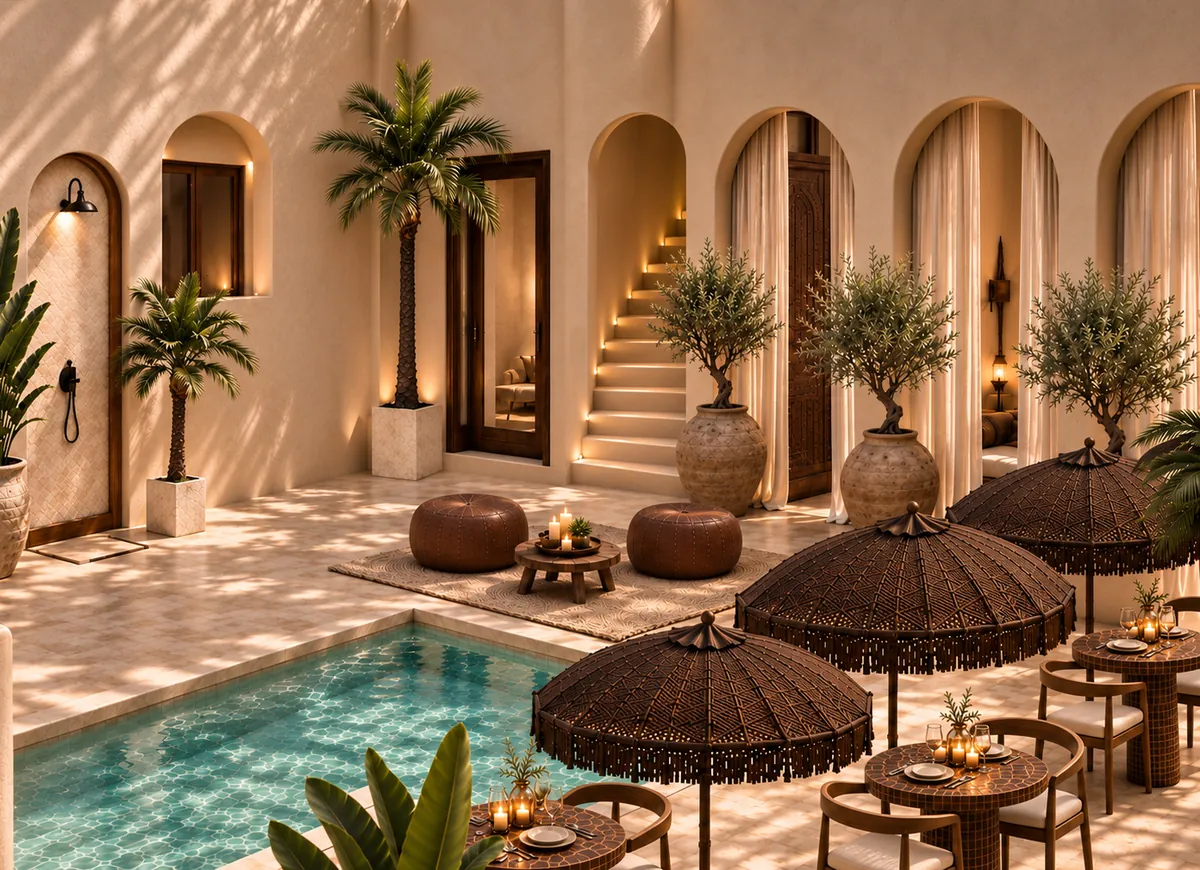
INVESTMENT CASE — KASBAH NELARIA & SPA
10 suites • Kasbah • Boutique hotel & Spa
Kasbah Nelaria & Spa illustrates the type of project developed by Darnel Collection in Marrakech's Medina.
Located in the historic Kasbah district, this ten-suite boutique hotel is designed to combine premium accommodation, a spa and complementary activities.
Its positioning relies on distinctive architecture, a structured guest experience and several revenue sources.
A property of this size requires rigorous financial, technical and commercial preparation.
It provides a reference for understanding the value of clearly organising responsibilities between investors, project leaders and operators.
Three key figures
10 suites.
Around 800 m² of developed floor area.
€2,300,000 reference price.
Discover Kasbah Nelaria & Spa →
This example is neither a public joint-investment offering nor a proposal to acquire an equity stake.
Discover Marrakech and its hospitality potential on video
Stay, Live and Invest in Marrakech — Kasbah Episode
YouTube — Darnel Collection
The external player only loads after your click.
YouTube ↗In this episode, we discover the Kasbah district, its riads and its tourism environment.
We also speak with the owners of Riad Dar Augusta about their hospitality experience in Marrakech.
Our five-step action plan for investing together
Step 1: Define the project. Budget, number of rooms, district, service level and investment horizon.
Step 2: Select partners. Check financial capacity, expectations and compatibility of objectives.
Step 3: Choose the legal structure. Have qualified professionals compare co-ownership, companies and operational arrangements.
Step 4: Build the business plan. Allow for acquisition, works, cash reserves, revenue, expenses and risk scenarios.
Step 5: Organise operations. Define responsibilities, reporting, commercial strategy and control arrangements.
Study my joint-investment project with Darnel Collection →
FAQ: Buying a riad with others in Marrakech
Can you buy a riad in Marrakech with friends?
Yes, subject to applicable legal rules. It is essential to formalise everyone's rights and obligations.
What is the best structure for investing together?
There is no universal answer. For a structured hospitality business, a company can offer a useful governance framework, to be compared with other solutions.
How much must each person invest?
That depends on the total budget and number of investors. An €800,000 project financed equally by four partners requires €200,000 each, excluding additional financing.
Can you resell your shares?
Yes, depending on the chosen structure and applicable legal and contractual rules. Transfer arrangements must be anticipated.
Must you live in Marrakech to invest?
No. Operations can be entrusted to a local team and a professional operator.
Can management be entrusted to Darnel Hospitality?
Yes, depending on the agreed scope: commercial strategy, revenue management, marketing or overall hotel management.
Conclusion: invest together, but with clear rules
Buying a riad with others can provide access to a more ambitious property and share the project's financing.
But success depends on three things.
A coherent property investment.
A solid legal and financial organisation.
Professional hospitality operations.
At Darnel Collection, we support investors in designing and developing riad and boutique-hotel projects.
With Darnel Hospitality, we can also contribute to their marketing and operation.
Want to invest in a riad in Marrakech with others?
Tell us about your project, budget and proposed number of investors.
We can examine property opportunities and economic assumptions in coordination with your legal and tax advisers.
Book an appointment with Darnel Collection →
Explore your project further
Profitability of a four-room riad in Marrakech
Discover investment articles and studies
Discover our riad and boutique-hotel projects
Join the Darnel Collection Private Club
Considering moving to Morocco or starting a business there? Discover our book Réussir sa nouvelle vie au Maroc.
Georges Lelièvre — Founder, Darnel Collection
This article is informational and does not constitute legal or tax advice or an investment offering. Financial projections are illustrative and guarantee no return.